Kurt Englmeier (2023). The language dimension of mental models in digital learning environments. In: Training, Education, and Learning Sciences. AHFE Open Access, vol. 109, pp. 67–74. https://doi.org/10.54941/ahfe1003152
Mental models support learners to develop conceptual and operational representations of learning environments. They help learners to structure their knowledge and to translate learning goals for their knowledge acquisition into cognitive learning processes. It is essential for digital environments supporting self-paced learning not only to provide a clear picture of the knowledge the learner can acquire but also to help the learners in developing a clear image of their state of knowledge acquisition and to keep up a high level of learning motivation.
A digital course shall support learners in developing sustainable knowledge. Only this kind of knowledge supports the learners’ need for esteem and self- actualization as defined by Abraham Maslow (1943; 1962). This need may have many facets addressing many areas in the life of learners, including advances in their professional life. The acquisition of sustainable (and actio- nable) knowledge, however, is a goal of outstanding importance in training and education, in general. And, of course, this holds for digital courses, too. Completing a course does not compellingly and automatically lead to sustai- nable acquisition of knowledge, even when completed successfully. If newly acquired knowledge falls to oblivion too soon, the course failed to achieve its mission. The course shall encourage learners to adopt knowledge provi- ded by the course and not just to complete the course successfully. The goal shall be the learner’s adoption of knowledge. However, the level of know- ledge adoption depends on the learner’s motivation. It is key to succeed in both, educational matters and professional formation. Sustainable learning and motivation are deeply intertwined (Woolfolk, 2020). Motivation helps learners to strengthen their focus on the mission of their learning, to assume the cognitive load of dedicating themselves to the learning material and lear- ning environment, to pursue their learning goals, and to project their acquired knowledge onto their further personal and professional development.
This paper reflects the concept of mental models in the context of digital learning courses and explains why it is so important to support the learners in developing a mental model that corresponds to both the structure of the knowledge to be acquired and their own stage of knowledge acquisition. The paper also presents the outcome of the research project eduplex that investi- gates new designs in the development of interactive platforms for self-paced learning that addresses acquisition of theoretical knowledge in academic set- tings as well as vocational education. The over-arching goal in the interaction design is to support learners
in the development of individual learning strategies along their individual skeleton of the knowledge adopted from the digital learning material and
in their cognition of the actual stage of their learning acquisition.
The design follows the metaphor “well-thumbed book” which emerged from the appearance of printed learning materials after learners have succes- sfully completed a course. Usually, “well-thumbed” learning material is full of things like personal annotations, highlighted terms, markers in different colors and shapes. These traits of personal use of the learning material ske- tches the individual skeleton of the acquired knowledge and manifests the mental model evolved over the learning process.
MENTAL MODELS–ROLES AND PURPOSE Mental models play an important role in the design of human-computer inte- raction and usability engineering (Norman, 1988; Nielsen, 1993; Norman, 1983; Norman and Draper, 1986). They have a particular importance in the design of assistive environments fostering self-paced learning where it is essential that learners develop conceptions of the interaction with their com- puter system. These conceptions enable them to understand and learn the physical system they are interacting with and to anticipate its future beh- avior, that is, to understand what can be expected from the system. The mental model for assistive systems has to address contextual and situati- onal awareness. However, there is no such thing like a universal mental model. Application designers envisage their mental models for their design that is expected to suit the learners’ model in all kinds of learning situations. Furthermore, the learners’ models evolve over time based on the learning experience they have with the system and the state of their knowledge acqui- sition. An exact matching of the models on both sides is an illusion. The designers’ model is more a skeleton that supports learners in developing their own mental model. If learners cannot develop their own autonomous model the learning process can be severely compromised.
Mental models have two essential facets. As conceptual models they explain the learners how they should conceive the system (Liddle, 1996). They outline the objects available on the system, the relationships between objects, and events and outcomes the learners can expect from the systems. This facet addresses, first of all, the interaction with the system. In a learning environment, the objects are not only interaction elements but also key conce- pts related to the material to be learned. Conceptual models, thus, clarify how
The Language Dimension of Mental Models in Digital Learning Environments 69
ideas and concepts of the content being studied are interconnected. They shall improve the learners’ ability to retain and recall the structure and key conce- pts of the course material. The conceptual model raises the awareness of what the users can expect from the interaction with the system.
The cognitive aspect of models conveys how to interact with the system in order to achieve specific goals. Cognitive models support the users in develo- ping task-oriented representations of interactions with the system (Denning and Dargan, 1996). They enable users to breakdown their goals into tasks and to plan and perform interactions in accordance with these tasks (Caroll, 2001). Therefore, they tend to cope with the processes the users have in mind when performing their tasks such as problem solving, creating an artefact, or completing a digital course. In the learning context, the cognitive aspect of mental models addresses the learning strategies as well as the awareness of the learning progress. Strategies and awareness do not only change along the learner journey, they also vary among learners. This means, the design of the learning environment has to deal with a huge variety of mental models that, furthermore, change over time.
METAPHOR FOR A LEARNING ENVIRONMENT The mission of a digital learning platform is the support of motivational lear- ning. That, in turn, requires the adoption of the design principles of assistive systems with a high emphasis of user acceptance. The system’s usability must be inclined towards the learners’ individual behaviors.
Mental models correspond to imaginational representations of systems which are rooted in analogies to existing systems or objects the users are alre- ady familiar with. If the metaphor establishes a sound correspondence with the new system at hand, the user is more easily in the position to learn and understand the new system. The metaphor leading the interaction design sup- ports a mental model that provides a clear vision on how the course content is structured and how course elements (or quiz questions) are linked to one another. It also supports the learners in understanding to what extent they have grasped the knowledge areas of a course and where their knowledge gaps are.
However, it is important to note that the course structure gets an individual trait as learners progress along their learning journey. Learners have to keep modifying their mental models to reach workable results.
Graphical elements are useful for a supportive interaction design in digital learning environments. Gamification provides further design inspirations for interaction elements supporting the learners in the formation of their mental models. These elements make the interaction a bit more attractive, which, in turn, fosters the motivation of the learners. In our prototypical learning envi- ronment, we use these elements to indicate success or failure in the quizzes, to outline the course structure, and the actual state of the individual learning progress. We use graphical elements to clarify the content structure of the course and the navigation possibilities.
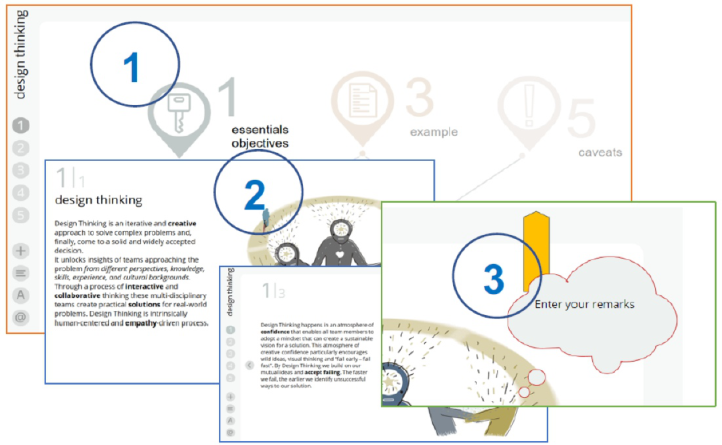
Figure 1 shows a couple of interaction elements and layout principles that help learners in mentally structuring the course content. The entire course is
70 Englmeier
Figure 1: Overview of the main interaction elements: main navigation on chapter level (1) learning nuggets (2) and panel with optional marker and/or bubble (sticky note) for remarks (3).
divided and about a handful of numbered chapters. Each chapter contains about a handful of learning nuggets. In order to comply with the metaphor “well-thumbed” learning material, we provide the learners with the possibi- lity to add color markers. Furthermore, they may put digital sticky notes on texts or queries.
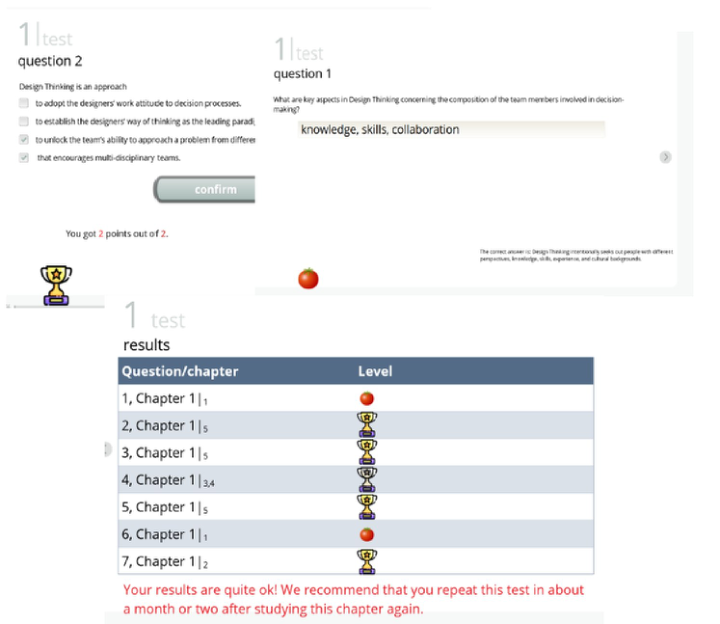
Each learning nugget is linked with a learn control (see Figure 2), a set of one or two quiz questions addressing the content to study in the nugget. The initial navigation structure follows the instructional paths as outlined by the tutor or the person responsible for the course content. It usually reflects the best strategy the learner should adopt to in order to build up the first content and knowledge structure. The course layout, the learners encounter at the beginning, grounds on the combination of mental models the platform desi- gner and tutor developed for this particular course. As soon as the learners successfully completed chapter by chapter with learning nuggets and quizzes, they start to freely navigate learning nuggets and quizzes along their indivi- dual mental model they developed step by step. The suggestions given by the system help them to adapt their models accordingly.
HOW TO SUPPORT LEARNERS’ MISSION AND LEARNING STRATEGIES The learners’ mission is acquiring the knowledge provided by the course as sustainably and as efficiently as possible. Efficient acquisition does not only mean fast learning, but also bypassing content the learner is already familiar with. In principle, the learners should have the possibility to navigate freely through the course content as long as the guidance allows it.
The Language Dimension of Mental Models in Digital Learning Environments 71
Figure 2: Each learning nugget is linked to a learn control. The results page shows the learners how they scored on the learn controls and what the system recommends for their further learning strategy.
As we have already seen, the designer and responsible tutor of the course decide on the guidance, that is, on the productive way to study and navigate best the course content. However, this guidance shall allow for short cuts for those learners, who are already familiar with some parts of the course and can demonstrate their respective knowledge by successfully passing a test that addresses exactly these parts of the course. In the system shown here, the learners may take the learn control before studying the learning nugget in order to check if they have sufficient knowledge to bypass this nugget.
Sustainable knowledge acquisition seems to be contradictory to efficient acquisition. In the first place, it requires thorough and probably repeated study of the learning material. It also has to take into account that we as humans tend to forget what we have learned or overestimate our abilities to retain our recently acquired knowledge. The digital course, thus, must insist in frequent knowledge tests. The frequency of the tests depends on the test scores obtained and the time elapsed since the test.
Offering tests is part of the digital course system’s recommendation system. It records the learner’s navigations, the visited course sections, test results, and the individual information provided by the learners, such as markers
72 Englmeier
and notes (see Figure 1). Markers indicate sections that seem important to the learners in the sense that they want to come back to this section. Notes like “will check this again after completing chapter 5” or “will check it again tomorrow” indicate such an importance, too.
As we have seen so far, the mental model determines how the course is presented to the learners. This presentation addresses first of all the layout of the course structure (including the pictograms that indicate the learning nuggets or chapters of the course, the quizzes, and the recommendation page). In principle, the design of the interaction with the learning platform roots in the mental model as devised by the designer of the learning platform and the tutor as author of the course. While most parts of the interaction do not change across courses, navigation is different from course to course and from learner to learner. Each individual learning strategy determines the learners’ self-paced journey through the digital course. This dynamic part of mental model covers, thus, also recommendations for this strategy.
The tutor defines the initial state of the dynamic part of the model. In this stage the recommendation lists the learning nuggets the learner should study, usually in a subsequent order, because the content of the nuggets build on each other. Each subset of learning nuggets is completed by a quiz. Based on the learners’ performance the course system may recommend to proceed to the next chapter, to study again a chapter or learning nugget, or retake a particular test.
The recommendation is a rule-based system that operates on the following data:
Grad achieved in a learn control (failed, passed, or excellently passed)
Time spent on all learn controls (on nugget or chapter level)
Time spent on learning nuggets or chapters
Time spent between starting/resuming the course and pausing/ completing the course
Time elapsed since studying learning nuggets/chapters When time spans are recorded, the viewing time does not necessarily corre- spond with the studying time. They usually include short breaks. Therefore, obvious outliers are pruned or reduced to the adequately average value.
Most learning platforms support this kind of learner performance evalua- tion. The system presented here has additional elements (markers and notes) that contain information useful for recommendations. The learners’ key que- stion during the self-paced learning are: What to do next? Where to go next? The recommendations given by the system emerge from analyzing the lear- ners’ performance, but they also take into considerations the markers and individual notes of the users.
THE SPECIAL ROLE OF NATURAL LANGUAGE The learners’ interaction possibilities emerge from the mental model that determines the learners’ strategies. The system design presented here fol- lows the paradigm of participatory design (Chin et al., 1997; Robertson and Simonsen, 2021). The main goal of the mental model is to reflect the learners’
The Language Dimension of Mental Models in Digital Learning Environments 73
strategies including the changes of these strategies along the learning journey. The learners, thus, implicitly co-design the underlying mental model. They provide additional and personal information along their learning experience that adapts the model. Their experiences, in the end, have implications on the learning model as depicted by the tutors and the interaction model developed by the designers.
With color markers the learners just indicate that a learning nugget is of particular interest and they want to come back to this section later in the course. The challenge in the interaction design is the correct interpretation of the notes and remarks. The learners’ notes may contain all kinds of state- ments. We assume that the statements refer to actions within their learning strategy. They express a certain importance for a particular learning nugget, indicate an action (including timing) the learner plans for the future (“study this again in two weeks”), or simply are personal key words that may serve as additional index. The language model connected with the mental model must support a proper interpretation of these statements and the correct tran- sformation into recommendations and further on into executable actions of the learning system. The statement (“study this again in two weeks”) must trigger the system to put a reminder on the recommendation page.
However, the language model and its operationalization for knowledge representation play a key role in the implementation of our metaphor. We apply well-established approaches for automatic text classification and sum- marization, including in particular Named Entity Recognition (NER). First, the identification of prominent terms is applied to the course material (on chapter or learning nugget level). It leads to a concise and verbal knowledge representation from the course perspective.
The language model first interprets the learners’ statements. It classifies them and “translate” all those into actions of the learning system (reminders, for instance) that address system functionality. By annotating learning nug- gets and quizzes with suitable keywords and by linking these keywords, we may produce a semantic network that represents the content of the course in a structured way. This network supports the dynamic adaptation of navigation paths according to the learners’ notes and remarks.
CONCLUSION
Natural language processing (NLP) has a prominent role when it comes to design of recommendation features for learning environments. NLP supports automatic classification and summarization techniques on the texts and the proper linking of textually rich elements like learning nuggets and quizzes.
The better the learning platform “understands” goals and behavior of its learners, the better it can guide them along their learning journey, and the more effectively learners acquire their desired knowledge. Guidance usually includes the observation of the learners, the evaluation of their behavior, the analysis and evaluation of their input, providing helpful and useful feedback.
Digital learning platforms increasingly focus on self-paced or self-directed learning, which gives the learners the freedom to learn whenever they
74 Englmeier
want and at whatever learning pace that suits their personal learning pre- ferences and attitudes. This trend fosters a shift away from predefined and rigidly wired sessions towards flexibly arranged learning nuggets and test. By focusing on natural language interaction, we endow learners with more participation that, in turn leads to a higher learning motivation and engagement.
Even though we haven’t conducted yet a comprehensive evaluation of our platform for self-paced learning, from the feedback of our first users we can assume that our approach and, in particular, the natural language interaction will be appreciated.
ACKNOWLEDGMENT
Research as outlined here is part of the eduplex project under the research framework INVITE of the Federal Institute for Vocational Education and Training (BIBB) funded by the German Federal Ministry of Education and Research.
REFERENCES
Caroll, J. (2001). Making Use: Scenario-Based Design of HCI. MIT Press, Cambridge, USA. Chin, George, Rosson, Mary B., Carroll, John M. (1997) “Participatory analysis:
shared development of requirements from scenarios”, Proceedings of the ACM SIGCHI Conference on Human factors in computing systems. Denning, P. and Dargan, P. (1996) “Action-Centered Design”, in: Bringing Design to Software, Winograd, T. et al. (eds.), pp. 105–120. Liddle, D. (1996). “Design of the Conceptual Model”, in: Bringing Design to
Software, Winograd, T. et al. (eds.), pp. 17–31. Maslow, Abraham H. (1943). A theory of human motivation. Psychological Review, Vol. 50 No. 4. Maslow, A. H. (1962). Toward a psychology of being. Princeton: D. Van Nostrand
Company. Nielsen, J. (1993). Usability engineering (2nd ed.). Boston: AP Professional. Norman, D. A. (1983). “Some observations on mental models”, in: Gentler, D. and Stevens, A. (eds.), Mental Models, pp. 15–34. Norman, D. A., Draper, S. W. (1986). User Centered System Design - New Perspecti-
ves on Human-Computer Interaction. Hillsdale: Erlbaum Associates. Norman, D. A. (1988). The design of everyday things. New York: Basic Books. Robertson, Toni; Simonsen, Jesper (2012). Challenges and Opportunities in Contemporary Participatory Design, Design Issues, Vol. 28 No. 3. Woolfolk, A. (2020). Educational Psychology (14th ed.). New York: Pearson.
LISTED IN THE AHFE DIGITAL BOOKSTORE CATALOGUE
Explore the complete digital volume
Training, Education, and Learning Sciences
Read this individual research paper free through the original publisher, or explore the full digital proceedings book.
ISBN 978-1-958651-85-8
Explore this ISBN in the AHFE Bookstore ↗Listed in the July 2026 bookstore catalogue; search by ISBN to confirm current availability · Digital book purchase optional