Haosong Dong, Peiyao Cheng, Haian Xue (2023). What role an agent could play at home? Exploring the social roles of smart home system based on a content analysis. In: Usability and User Experience. AHFE Open Access, vol. 110, pp. 77–85. https://doi.org/10.54941/ahfe1003179
Smart home systems not only serve users to fulfill pragmatic goals, but also ‘live with’ users. Despite the conceptual possibilities, it still remains unclear whether and what social roles current smart home systems are intended by the companies. In this paper, we report a retrospective study on 15 selected smart home systems (SHSs) on current market. We used content analysis to identify themes and categories of function, personality and social role of these SHSs, and also explore the connections among them. Four representative social roles were identified: instrument, lobby boy, assistant and family member. Four related personalities were found: competent, helpful, trustworthy, and caring. Results of this study revealed an overview of current social roles that smart home system plays as well as the personalities they exhibit.
Internet of Things (IoT) technology drives the popularity of smart home systems (SHSs) which enable the functions of alert, monitor, and control domestic products to deliver better experience for users (Malche & Mah- eshwary, 2017). Through sensors, products and systems are connected to achieve multiple functions, including monitor situations at home (e.g., energy consumption and security monitor) and provide recommendations actively. Users may no longer consider SHSs as a device but an intelligent being in their life. In other words, SHSs are gradually being integrated into users’ daily life through playing an active social role (Schill et al., 2019).
It is not surprising that people consider systems having human characte- ristics. In fact, people mindlessly associate a computer with a person, which is referred as Computers Are Social Actors (CASA) paradigm (Nass et al., 1994). Regarding the relationships between users and smart products, prior research conceptually concludes three types: master-slave, partner and unsta- ble relationship (Novak & Hoffman, 2019). Empirical studies have also been
conducted to understand how users perceived the social roles that smart devi- ces played. Wu et al. (2019) found that in the Chinese market, users primarily expect smart speakers to be their assistant and friends. Similarly, through three-week intensive usage of voice-controlled smart devices, users consider smart speakers as servant, friend and master (Schweitzer et al., 2019).
Different social roles set different social expectations for users, which influence user experience. In manufacturers’ practice, they deliberately set different roles for SHSs. For example, Xiaomi positions smart speaker Xia- oAI as a classmate, while Google label it as an assistant. In addition to names of smart speakers, designers and developers can implicitly or explicitly faci- litate users’ association between smart products and social actors through manipulating various anthropomorphic cues, such as visual, identity and interactivity (Go & Sundar, 2019; Feine et al., 2019).
Thus far, although there are studies on social roles of smart products (Novak & Hoffman, 2019; Schweitzer et al., 2019; Wu et al., 2019), we lack an overview and nuanced understanding of what intended social roles smart home systems have been created for. In this paper, unlike a projective analy- sis which directly focuses on speculating the “what if” (Cila et al., 2017), we report a retrospective analysis that reveals and categorizes the existing, which will support the future possibility envisioning.
INTERPRETING SOCIAL ROLES IN SMART HOME SYSTEMS
Method
To understand what social roles SHSs play, we conduct content analysis based on product introduction on official webpages. In e-commerce contexts, digi- tal product presentation is the only medium for companies to introduce their products (Kim, 2019; Yoo & Kim, 2014). Companies tend to spend exten- sive efforts on introducing products in various manners to deliver acceptable comprehension. Thus, product introductions represent the companies’ posi- tioning of their products, including the intended function, personality and social role. Using product descriptions for content analysis is a valid way to learn manufacturers’ intentions (Luc et al., 2020).
Stimuli Among various smart home systems, we chose the most representative ones (Del Rio, 2021) and the ones that occupy a large market share (Huang & Lin, 2017). Finally, a total of 15 SHS hubs from12 brands were selected (see Table 1). While selecting introduction materials, textual introductions from the official websites were collected for analysis.
Procedure All the materials were collected and analysed in English through the software Atlas.ti 22. Because of the exploratory nature of the study, we processed data inductively without using any existing theoretical frameworks (Thomas, 2006). Themes and categories emerged directly from the data instead. During data processing, documents of 15 SHSs were integrated and the introduction
What Role an Agent Could Play at Home? 79
Table 1. Software, hardware and service references.
Table available in the original PDF paper.
Material source
# Item name Brand Release date
Xiaomi 2019 www.mi.com
1 Astro Amazon 2021 www.aboutamazon.com 2 Echo Show Amazon 2017 www.amazon.com 3 HomePod mini Apple 2020 www.apple.com 4 Nest Hub Max Google 2019 store.google.com 5 Xiaomi XiaoAI Touchscreen Speaker Pro 8 Huawei 2021 consumer.huawei.com 6 Xiaomi Smart Gateway Xiaomi 2022 www.mi.com 7 Huawei Whole House Smart Host
of each system was coded one by one, resulting in initial 144 codes. The saturation point was reached at the twelfth SHS. We completed the analysis of all remaining text to ensure the richness of data. The initial coding was conducted by the first author. Next, the research team reviewed, discussed, and merged initial codes together until agreements. A total of 121 final codes were obtained. These codes were distributed among three themes: functions, personalities, and social roles of SHS.
RESULTS
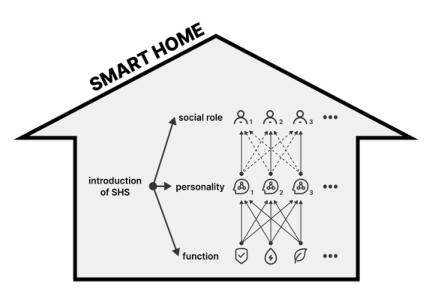
Through content analysis, three main themes were revealed: functions of SHS, personalities of SHS, and social roles of SHS. These three main the- mes are related or even overlapped. Their relationships were visualized in Figure 1.
Functions of SHS Through content analysis, 12 categories were identified as main functions of SHS, including device control, context awareness, communication, enter- tainment, and daily assistance etc. These code groups constitute different functional themes of SHS. For example, the codes “video player”, “audio player” and “gaming” were grouped into “entertainment” because they have similar properties. For another example, since the perceptions of beauty can be described from many different aspects, the codes “wall simplification”, “room-fitting”, “nice appearance” and “good looking/touching” were sum- marized into “beautify”. Consistent with previous studies (Guo et al., 2019;
Figure 1: Research process of the in-depth content analysis.
Crowley et al., 2015), we categorized the main functions of SHSs into the fol- lowing four types: energy management, entertainment system, security and housekeeping. Within each category, several specific functions are provided. Main functions, scenarios, corresponding examples and code frequencies are shown in Table 2.
Personalities of SHS In addition to main functions of SHSs, we identified four different personali- ties of SHSs. While introducing a SHS, companies typically involve characters and assigned personalities deliberately. For instance, while Amazon introdu- ces its home robot Astro, it states “during development, we realized giving Astro a personality would make regular interactions more delightful.” This
Table 2. Main functions and related information concluded in the content analysis.
Table available in the original PDF paper.
Scenario Main function Code example Freq.
30
security information protection internet safety protection 22 recognition & detection recognition: gas 46 energy management
context awareness automatic air conditioning
customization professional lighting 40
device control multiple light control 89 housekeeping communication reminder delivering 21 daily assistance cooking assistant 50 management & planning meal planning 19 beautify room-fitting 10 entertainment system
28
personalization personalized service: music suggestion entertainment audio player 43 device connection automatic multiple-device synchronizing
What Role an Agent Could Play at Home? 81
confirms our research assumption that developers have the awareness and make efforts to involve characters and personalities while developing SHSs.
Furthermore, although many SHSs share the similar functions, different descriptions and application scenario exhibit different personalities. For instance, in the function “context awareness”, a personality of competent was found in LG ThinQ: “It automatically sets the optimal washing machine cycle” and Astro tended to be helpful: “Its personality is also helpful—for example, it hangs out in places where it can be the most useful”. Personality can differ even in one specific function of a SHS. For example, in the function “information protection” of HomePod mini, “You can speak freely knowing nothing you say is sent out of your home until you activate Siri with a touch, or HomePod mini hears the magic words, ‘Hey Siri.’ “ was defined as com- petent, while “HomePod mini is designed to keep your personal information safe and be a trusted assistant in your family’s everyday life” was recognized as trustworthy.
While analysing, we coded the personalities that companies intended to create. Four different kinds of personality were identified: competent, help- ful, trustworthy, and caring. Similarly, these personalities were carefully discussed, and final identified personalities with examples are shown in Table 3.
Social Roles of SHS While introducing SHSs, companies use different social roles to position their products, either explicitly or implicitly. For instance, while Apple introducing HomePod, it explicitly states its social role “an intelligent assistant.” Differen- tly, Amazon introduces its Astro as a family member. After several discussions with one of two design experts, four representative social roles were defi- ned based on personalities, including instrument, lobby boy, assistant and family member. Final identified social roles with personas are shown in Table 4.
Table 3. Personalities summarized in content analysis and examples.
Table available in the original PDF paper.
Personality Quote example Competent
Works seamlessly with iPhone.
The connection is as stable as Mount Tai, covering everything in life. Helpful
…is there to help save you time and effort, time after time.
Help you avoid mishaps and malfunctions by sending tips and tricks based on your product use. Trustworthy
…your recordings can only be seen by you and the people you share them with, not Apple.
Being part of your home means respecting your privacy. Caring
Song list recommendation based on deep learning, always understand your mind.
Deliver serendipity while staying close to our daily lives.
Table 4. Personalities identified in content analysis with representative features.
Table available in the original PDF paper.
Persona Social role
Instrument Not a person, but a tool. It provides users with full autonomy and control. Lobby boy
Works with quick and warm responses, from daily contact with family member to prepare things automatically. Always ready to help someone instantly and intelligently. Assistant Simplify and assist daily tasks efficiently. It dramatically reduces users’ burdens of daily tasks. Family member
Expresses care and understanding, making people feel warm. In some situation, it can be a character that have a close relationship with the user.
Social Role 1: Instrument. The role of instrument does not relate to any social role. It is positioned as a pure toolkit used in daily lives. For example, it often involves the expressions in this way “Shut your garage, and lock or unlock the house through the Home app” and even “Set as many timers as you want”. By the role of instrument, manufacturers aim to highlight that users can totally control the SHS and it always obeys the user’s instructions unconditionally and has no complaints.
Social Role 2: Lobby boy. We quoted the word Lobby boy metaphorically from the film The Grand Budapest Hotel: “What is a lobby boy? A lobby boy is completely invisible, yet always in sight. A lobby boy remembers what people hate. A lobby boy anticipates the client’s needs before the needs are needed. A lobby boy is, above all, discreet to a fault.” In SHSs, lobby boy is a character who is always ready for any help upon request. It will appear when users need help and will be on call: “Just say “Hey Google”. In some cases, a clear request is not even necessary. Lobby boy is able to detect potential need and complete it prior to clear request. For instance, SHSs can play users’ favourite songs prior to request: “personalized listening suggestions will also automatically appear on your iPhone when you hold it next to HomePod mini”.
Social Role 3: Assistant. Assistant is the most commonly used character in smart home systems and smart devices, which is also been found in pre- vious studies (Wu et al., 2019; Schweitzer et al., 2019). With the role of assistant, manufacturers intend to highlight the convenience and assistances to users’ daily life. For instance, “Sends you a notification when your wash- ing is done”, and “Even when you can’t find your phone, you can ask it for help”. In addition, there are also service extensions, such as “Now you can book a table at your favourite restaurant, right from your display” The exi- stence of this social role enriches the use experience of SHSs and brings users a more diversified and easy-to-use smart home ecology.
Social Role 4: Family member. Family member is a character who shows more intimacy with users. With the role of family member, it intends to com- municate the feeling that SHSs can take care of users as a family member.
What Role an Agent Could Play at Home? 83
For example: “The house itself sympathizes with people like family and fri- ends and gives awareness”. It is usually very attentive to true family members and environment: “Dynamically predict household conditions such as air, sunlight, and water, and take care of every detail of your daily life”. In some cases, the family member will even make personal suggestions, such as “Pro- posals that are close to the people who live, just as mothers think about daily menus for their children so that they will not get bored.” It is more like a mental companion to user’s daily life.
GENERAL DISCUSSION In summary, through content analysis of introductions of SHS, this study revealed what functions, personalities and social roles that a variety of widely available SHSs are indented. Specifically, we identified 12 categories of main functions, four social roles (i.e., instrument, lobby boy, assistant, family member) and four types of personality (i.e., competent, helpful, trustworthy, caring). These results confirmed the assumption that companies intended to integrate social roles and personalities for SHSs. Despite these findings, we did not observe clear relations between functions and social roles/personali- ties. In other words, even with the same social role and personality, different SHSs exhibit few differences on its functions.
Based on current findings, there are several opportunities for future rese- arch. First, as companies intended to express certain personalities and set different social roles, whether users perceive the similar way as intended are still unknown. User perceived personality and social role of a SHS is argua- bly primarily determined by the interactive experience that the user has with the SHS. Therefore, we foresee exploring the relationship between SHS design properties, human-SHS interaction styles, resulting experiential qualities, and user perceived SHS personalities and social roles a promising future research direction. In addition, users’ relationship with SHS are not formed at first sight. It requires a long time of using. Thus, to explore and envision how users experience SHS over time can be interesting. Particularly, with AI or machine leaning increasingly used as design materials, SHSs are not simply preprogra- med to perform repetitive tasks for the users. They learn about the user, then adapt and develop new behaviour patterns accordingly (Glikson & Woolley, 2020). Thus, there is a two-way collaborative learning process between the user and the SHS, which will lead to even more dynamic SHS experience over time, compared to the experience that user has with conventional interactive systems.
ACKNOWLEDGMENT
This work was supported by National Natural Science Foundation of China (Grant no. 72002057); Humanities and Social Science projects of the Mini- stry of Education in China (Grant no. 20YJC760009); Shenzhen Basic Research Program (Grant no. JCYJ20190806142401703).
REFERENCES
Anderson, W. (2014). The Grand Budapest Hotel. Fox Searchlight Pictures. Cila, N., Smit, I., Giaccardi, E., & Kröse, B. (2017, May). Products as agents: Metaphors for designing the products of the IoT age. In Proceedings of the 2017 CHI Conference on Human Factors in Computing Systems (pp. 448–459). Crowley, J. L., & Coutaz, J. (2015). An ecological view of smart home technologies.
In Ambient Intelligence: 12th European Conference, AmI 2015, Athens, Gre- ece, November 11-13, 2015, Proceedings 12 (pp. 1–16). Springer International Publishing. Del Rio, D. D. F., Sovacool, B. K., & Griffiths, S. (2021). Culture, energy and climate sustainability, and smart home technologies: A mixed methods comparison of four countries. Energy and Climate Change, 2, 100035. Feine, J., Gnewuch, U., Morana, S., & Maedche, A. (2019). A taxonomy of
social cues for conversational agents. International Journal of Human-Computer Studies, 132, 138–161. Glikson, E., & Woolley, A. W. (2020). Human trust in artificial intelligence: Review of empirical research. Academy of Management Annals, 14(2), 627–660. Go, E., & Sundar, S. S. (2019). Humanizing chatbots: The effects of visual, iden-
tity and conversational cues on humanness perceptions. Computers in Human Behavior, 97, 304–316. Guo, X., Shen, Z., Zhang, Y., & Wu, T. (2019). Review on the application of artificial intelligence in smart homes. Smart Cities, 2(3), 402–420. Huang, K. C., & Lin, Y. C. (2017). The Battlefield of IoT: Competitive and
Cooperative Relationship Among Smart Home Vendors. Kim, M. (2019). Digital product presentation, information processing, need for cognition and behavioral intent in digital commerce. Journal of Retailing and Consumer Services, 50, 362–370. Luc, M. H., Tsang, S. W., Thrul, J., Kennedy, R. D., & Moran, M. B. (2020). Content
analysis of online product descriptions from cannabis retailers in six US states. International Journal of Drug Policy, 75, 102593. Malche, T., & Maheshwary, P. (2017, February). Internet of Things (IoT) for building smart home system. In 2017 International Conference on I-SMAC (IoT in Social, Mobile, Analytics and Cloud)(I-SMAC) (pp. 65-70). IEEE. Nass, C., Steuer, J., & Tauber, E. R. (1994, April). Computers are social actors. In
Proceedings of the SIGCHI conference on Human factors in computing systems (pp. 72–78). Novak, T. P., & Hoffman, D. L. (2019). Relationship journeys in the internet of things: a new framework for understanding interactions between consumers and smart objects. Journal of the Academy of Marketing Science, 47(2), 216–237. Schill, M., Godefroit-Winkel, D., Diallo, M. F., & Barbarossa, C. (2019). Consumers’
intentions to purchase smart home objects: Do environmental issues matter?. Ecological Economics, 161, 176–185. Schweitzer, F., Belk, R., Jordan, W., & Ortner, M. (2019). Servant, friend or master?
The relationships users build with voice-controlled smart devices. Journal of Marketing Management, 35(7-8), 693–715. Thomas, D. R. (2006). A general inductive approach for analyzing qualitative evaluation data. American journal of evaluation, 27(2), 237–246.
What Role an Agent Could Play at Home? 85
Wu, S., He, S., Peng, Y., Li, W., Zhou, M., & Guan, D. (2019, June). An empirical study on expectation of relationship between human and smart devices—with smart speaker as an example. In 2019 IEEE Fourth International Conference on Data Science in Cyberspace (DSC) (pp. 555-560). IEEE. Yoo, J., & Kim, M. (2014). The effects of online product presentation on consumer
responses: A mental imagery perspective. Journal of Business Research, 67(11), 2464–2472.
LISTED IN THE AHFE DIGITAL BOOKSTORE CATALOGUE
Explore the complete digital volume
Usability and User Experience
Read this individual research paper free through the original publisher, or explore the full digital proceedings book.
ISBN 978-1-958651-86-5
Explore this ISBN in the AHFE Bookstore ↗Listed in the July 2026 bookstore catalogue; search by ISBN to confirm current availability · Digital book purchase optional