Oliver Christ, Michelle Deuber, Anina Gächter, Jordin Guedel, Andreas Papageorgiou (2023). Immersive Virtual Reality During Work Out With Movable Sports Equipment: The Effect on Oculomotor, Disorientation, and Nausea Before and After Training. In: Human Interaction & Emerging Technologies (IHIET 2023): Artificial Intelligence & Future Applications. AHFE Open Access, vol. 111, pp. 349–355. https://doi.org/10.54941/ahfe1004041
Publisher statistics will load when you open Metrics.
AHFE OPEN ACCESS OPEN ACCESS CONFERENCE PROCEEDINGS PAPER
Immersive Virtual Reality During Work Out With Movable Sports Equipment: The Effect on Oculomotor, Disorientation, and Nausea Before and After Training
The combination of immersive virtual reality and sport has garnered significant attention in the academic world and the industry domains. There is a decent amount of literature that shows positive effects but also critical voices when it comes to learning and wellbeing in a virtual world during work out. In our study we postulate the hypothesis that subjects with a higher degree of predisposition in simulation sickness will show higher values in all three subscales of the simulation sickness questionnaire (SSQ) while doing exercise with sports gear with moveable parts in a fully immersive VR application than subjects with lower degrees of predisposition in motion sickness. However, our data did not support the hypothesis. Surprisingly, we even found a disproportionate significant improvement in the oculomotor subscale of the SSQ. These results are being discussed and further studies are being suggested.
The combination of immersive virtual reality and sport has garnered signif- icant attention in both the academic and industry domains in recent years. Immersive virtual reality (iVR) is a technology that enables users to experi- ence a computer-generated environment that simulates a real-world scenario in a way that feels realistic and interactive. When applied to sport, iVR can create a virtual environment that effects the experience of playing a sport or being present in a stadium. Several studies have investigated the effect of iVR in sports training. A study conducted by Fortes et al. (2021) evaluated the effectiveness of iVR technology in enhancing the performance of soccer players. The researchers found that athletes who underwent iVR training showed significant improvement in various skills, including inhibitory con- trol, decision-making, and visual search behaviour. In contrast, a study by Chen et al. (2019) showed the effect of iVR training on the learning and efficiency in learning of Taichi. The study showed that iVR training led to a
significant improvement when performed in a cave system but dropped when using a head mounted display (HMD). The researchers attributed this lack of improvement with HMD due to the “clumsy” sensory feedback provided by HMD technology in contrast to the cave where no additional feedback is presented. A study by Godse et al. (2020) investigated the effects of IVR on golf putting. The study found that participants who underwent manip- ulated VR training (bigger size of hole and ball) demonstrated significant improvements in their putting accuracy and consistency compared to those who received traditional training without size manipulation methods. Both, Chen et al. (2019) and Godse et al. (2020) demonstrated the importance of feedback while training in iVR. Another study by Touloudi et al. (2022) explored the effect of iVR during using an exercise training system for office workers during working hours. Participants were requested to complete two sequential 15-min dual task cycling (home trainer) sessions corresponding to two experimental conditions. In the first condition a combination of real world and virtual world system was applied. In the second condition only the real-world cycling task was done. After completion of the two conditions, participants responded to a series of scales regarding each of the experimen- tal conditions and to a semi-structured interview. The researchers found that participants noted a significant preference for the iVR exercise, condition 1, compared to condition 2 (bike only). Their acceptance, interest/enjoyment, usability and intention for future use were higher in the first condition. This suggests that iVR training can create a more engaging and positive training to real world training scenarios. We found no studies that show the influ- ence of iVR during training with sports equipment with moving parts to train balance except with clinically relevant population (e. g. Rebelo et al. 2021). iVR may cause motion sickness because the sensory information is often contradictory to the expected information due to body motion simu- lation sickness may occur (Travaglini et al. 2021). In a study from Park & Lee (2020) participants showed higher values in the simulator sickness ques- tionnaire/SSQ (Kennedy et al. 1993) and less static balance playing in a full immersive virtual reality game. Based on the evidence found in the litera- ture, we postulate the following hypothesis for our study: subjects with a higher degree of predisposition in simulation sickness will show higher val- ues in all three subscales of the SSQ while doing exercise with sports gear with moveable parts in a fully immersive VR application than subjects with lower degrees of predisposition in motion sickness.
METHODS
The sampling of our study was generated by means of pre-selection (Flick, 2017). The target group consists of students from all semesters in applied psychology at FHNW Olten. The sampling was done in two steps: The first step lies in the pre-selection, in which the target group had to provide infor- mation about their experiences with motion sickness (MSSQ Golding, 2006). N = 44 students participated in the survey (age 18–43 years). After adjust- ing for exclusion criteria (epilepsy or other medical conditions), the students were first sorted according to their MSSQ score and divided into two groups
Immersive Virtual Reality During Work Out With Movable Sports Equipment 351
using the even-out method: 5 subjects who had a high benchmark score (>20) and 5 subjects who had a low score (<11). After the preselection, we explored whether the use of VR goggles (Oculus Quest) with simultaneous use of the SensoPro Luna can cause discomfort. With 10 subjects an experiment was carried out on the SensoPro Luna with VR goggles. Before and after, the sen- sitivity measurement was done by SSQ test (Kennedy et al., 1993) and a short interview was done in the end of the study.
At the beginning, the participants were greeted upon arrival and informed about the content and procedure of the experiment by means of an instruction text. Due to the current situation with COVID-19, a Corona safety concept for the execution of the experiment was prepared on the part of the manage- ment, which meets the requirements of the federal government. During the procedure the participants were video recorded using GoPro Hero 2. Simi- larly, the conversation during the brief interview was recorded using audio recording app on a cell phone. For this procedure the TNs were required to sign a consent form and informed consent before the experiment began.
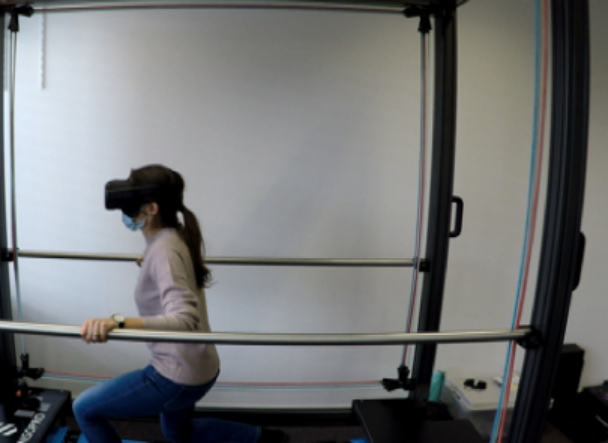
Figure 1: Experimental setup.
After the participants had signed the consent forms, completed the instruc- tion on the Sensopro Luna device and adjusted the VR goggles to suit them, they completed the T1 questionnaire.
The questionnaire was created using the Questback online service. The questionnaire was structured as follows: Welcome, Personal Data, SSQ items (T1).
After filling out SSQT1, participants started the introduction of the train- ing in the virtual world. They had to follow a star dusk tunnel with their head. To follow the hight of the tunnel (there was no change to left or right) they had to move with squats or lunches. They received feedback of their correct
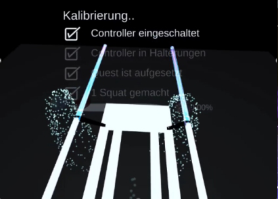
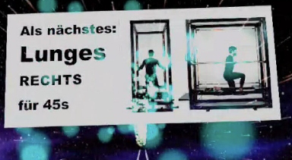
Figure 2: (a) Calibration of VR-Setup from VR googles perspective. Controllers were fixed to the SensoPro Luna System. This enabled a virtual model of the physical sport gear, for safety and exercise. (b) Welcome Screen of the virtual training from VR google perspective.Figure 3: The procedure of the training tasks was to keep the movement (e.g. lunches or squats) in a star dusk tunnel and to keep track with the head in the star dusk tunnel during the movement execution.
movement due to change in music and decrease of points which were dis- played in the virtual world. The training was in the following order: 45 sec. of squats. 20 sec. brake and breath, 45 sec. lunges, 20 sec. break and breath, this was repeated one more time. After the training participants filled out the post-test questionnaire (T2). The structure of the T2 questionnaire included the following items: welcome, was the training completed in full and SSQ val- ues. Finally, the TNs were asked about content aspects of the virtual world and the training. How would you describe your experience training on the Sensopro Luna using VR? Could you imagine doing this training in public, e.g. in a gym? Why / why not? The study was reviewed and approved by the
Immersive Virtual Reality During Work Out With Movable Sports Equipment 353
Research Ethics Review Board of the School of Applied Psychology FHNW under the number EAL210112.
RESULTS
Quantitative Data was aggregated per group and per subscale before (T1) and after the (T2) the training using SPSS 21. One outlier had to be removed. Nonparametric statistics were applied (Wilcoxon Test). The mean values of the subscale nausea and oculomotor at time T1 exceed the guideline value of 15 mentioned by Kennedy et al. (1993). The mean values of the subscale nausea for both groups as well as oculomotor for the group not sensitive at time T2 are also >15. However, no significant negative influence on the body sensation of the TN was found. Without one outlier, there is a signif- icant difference for both groups together and for the non-sensitive group. The symptoms of the non-sensitive group improved numerically somewhat more than those of the sensitive group. If the items for oculomotor are consid- ered separately, there is an improvement the symptoms of general discomfort, tiredness and eyestrain.
Table 1. Means (M), standard deviation (SD) in both groups (N = 9), sensitive group (SG, N = 5), not sensitive group (NSG, N = 4) in the subscale nausea, oculomotor, disorientation.
Qualitative Data showed a mixed but basically positive picture. Regard- ing the question: “How would you describe your experience training on the Sensopro Luna using VR?” The participants found the training rather phys- ically demanding. They mentioned high demands on coordination, balance and orientation. Since none of the participants had had comparable experi- ence before, the additional challenge was to get used to the Sensopro Luna in combination with VR and to find their way in the virtual world. The fact that the participants could hold on to the rails during the training was appre- ciated. Three participants said that the experience was new to them. Over 50% of the participants mentioned they had fun. The participants liked the use of music because it set the speed and made the training more effective. Answering the question: “Could you imagine doing this training in public, e.g. in a gym?” 20% of the participants would do the training in public like in a gym. There are reservations due to feelings of shame and that the envi- ronment cannot be perceived, but the environment can perceive the people.
If the Sensopro Luna were placed in a separate room, this would increase acceptance and motivation. Participants who have spoken out against using the device in public argue with the lack of control over the correct execution of the training, since they cannot see themselves, as well as with feelings of shame.
CONCLUSION
In this study we wanted to evaluate the hypothesis if subjects with a higher degree of predisposition in simulation sickness will show higher values in all three subscales of the SSQ while doing exercise with sports gear with moveable parts in a fully immersive VR application than subjects with lower degrees of predisposition in motion sickness. Regarding our results we found descriptive differences in the nausea scale with 5.7 (sensible) from T1 to T2 and 4.7 (non-sensible) from T1 to T2. Also, in disorientation we found descriptive difference in sensible participants (5.5 from T1 to T2) but no dif- ference in non-sensible participants. Both results were not significant. This could be due to small sample size and could change with more statistical power. Since most studies are made up to 20–30 per condition, we would suggest up to 60 participants in next studies. Our resources did not allow for this large sample size in this pilot study.
The strong improvement of the scores in the oculomotor subscale is surprising because, as mentioned in Park & Lee (2020) the occurrence of oculomotor symptoms such as eyestrain, concentration difficulties and headaches is greater in simulators or when using VR technologies (see also Bijveld et al., 2008) and it is empirically rather unlikely that the symptoms even improve during training with VR. One possible explanation could there- for be grounded in the acceptance and usability of our training. Touloudi et al. (2022) explored the effect of iVR during using an exercise training system for office workers during working hours. In the first condition a combination of real world and virtual world system was applied. The researchers found that participants noted a significant preference for the iVR exercise com- pared to bike only condition. Their acceptance, interest/enjoyment, usability and intention for future use were higher in the first condition. This suggests that iVR training can create a more engaging and positive training to real world training scenarios. When we look to our qualitative data, we saw that the participant saw a high demand on coordination, balance and orienta- tion. Additionally, no one did this kind of training before. No one had any problems doing this kind of training in a quite environment or stopped the training. Only the question about doing it in a gym or other public spaces made them feel uncomfortable. In future studies, the usability factors should also be measured beside the fact that the replication of the study is necessary to see, whether the positive effect of the training on eye strain and oculomo- tor focus maintains. If yes, it could be the same success which is described by Fortes et al. (2021). They evaluated the effectiveness of iVR technology in enhancing the performance of soccer players and found that athletes showed significant improvement e. g. in visual search behaviour. This could also give new impulses for office pausing in the area of health-related work design.
Immersive Virtual Reality During Work Out With Movable Sports Equipment 355
ACKNOWLEDGMENT
The authors would like to thank the Swiss government for funding the study under the grant 42715.1 INNO-SBM. We would like to thank the company SensoPro AG, in particular Jan Urfer, for letting us use the SensoPro Luna during the planning and survey phases.
REFERENCES
Bijveld, M. M., Bronstein, A. M., Golding, J. F. & Gresty, M. A. (2008). Nauseogenicity of off-vertical-axis rotation versus equivalent visual motion. Aviat Space Environ Med., 79(7), 661–5. Chen, X., Chen, Z., Li, Y., He, T., Hou, J., Liu, S., & He, Y. (2019). ImmerTai: Immer-
sive Motion Learning in VR Environments. Journal of Visual Communication and Image Representation, 58, 416–427. https://doi.org/10.1016/j.jvcir.2018.11.039 Flick, U. (2017). Qualitative Sozialforschung. Eine Einführung (8. völlig überarbeitete Neuauflage). Reinbeck bei Hamburg: Rowohlt. Fortes, L. S., Almeida, S. S., Praça, G. M., Nascimento-Júnior, J. R. A., Lima-
Junior, D., Barbosa, B. T., & Ferreira, M. E. C. (2021). Virtual reality promotes greater improvements than video-stimulation screen on perceptual-cognitive skills in young soccer athletes. Human Movement Science, 79, 102856. https://doi.org/ 10.1016/j.humov.2021.102856 Godse, A., Khadka, R., & Banic, A. (2019). Evaluation of Visual Perception Manipulation in Virtual Reality Training Environments to Improve Golf Perfor- mance. 2019 IEEE Conference on Virtual Reality and 3D User Interfaces (VR), 1807–1812. https://doi.org/10.1109/VR.2019.8798026 Golding, J. F. (2006). Predicting individual differences in motion sickness suscepti-
bility by questionnaire. Personality and Individual Differences, 41(2), 237–248. DOI: 10.1016/j.paid.2006.01.012 Kennedy, R. S., Lane, N. E., Berbaum, K. S., & Lilienthal, M. G. (1993). Simulator Sickness Questionnaire: An Enhanced Method for Quantifying Simulator Sickness. The International Journal of Aviation Psychology, 3(3), 203–220. https: //doi.org/10.1207/s15327108ijap0303_3 Lima Rebêlo, F., de Souza Silva, L. F., Doná, F., Sales Barreto, A., & de Souza Siqueira
Quintans, J. (2021). Immersive virtual reality is effective in the rehabilitation of older adults with balance disorders: A randomized clinical trial. Experimental Gerontology, 149, 111308. https://doi.org/10.1016/j.exger.2021.111308 Park, S., & Lee, G. (2020). Full-immersion virtual reality: Adverse effects related to static balance. Neuroscience Letters, 733, 134974. https://doi.org/10.1016/j.neul et.2020.134974 Touloudi, E., Hassandra, M., Galanis, E., Goudas, M., & Theodorakis, Y. (2022).
Applicability of an Immersive Virtual Reality Exercise Training System for Office Workers during Working Hours. Sports, 10(7), Article 7. https://doi.org/10.3390/ sports10070104 Travaglini, A., Papageorgiou, A., Brand, E., & Christ, O. (2022). Influence of Input Devices on VR Sickness: Effect of Subtle Stimulation of the Sense of Balance on the Sensory Discrepancy. In T. Ahram & R. Taiar (Hrsg.), Human Interaction, Emerging Technologies and Future Systems V (S. 774–780). Springer International Publishing. https://doi.org/10.1007/978-3-030-85540-6_98
Read this individual research paper free through the original publisher, or explore the full digital proceedings book.
ISBN 978-1-958651-87-2
Explore this ISBN in the AHFE Bookstore ↗Listed in the July 2026 bookstore catalogue; search by ISBN to confirm current availability · Digital book purchase optional