Vítor Fernando Plácido Da Conceição, Rafaela Marques, Pedro Água, Joakim Dahlman (2023). Ecological Collaborative Support System for maritime navigation teams. In: Human Systems Engineering and Design (IHSED 2023): Future Trends and Applications. AHFE Open Access, vol. 112, pp. 144–155. https://doi.org/10.54941/ahfe1004124
Maritime navigation is a demanding and complex domain that involves risks for people, the environment, and economic activity. The tasks associated with its execution require advanced training, expertise, experience, and a collaborative Navigation Team. Furthermore, naval operations demand higher readiness, accuracy, and resilience due to additional constraints. The response to these challenges has been integrating further automation and information systems. However, the effectiveness of innovative trends had been questioned by recent naval accidents like those involving the US and Norwegian naval ships.In bridge crews, collaboration is progressively more dependent on technological means since they are the information sources, and team members need to share and exchange different information formats besides audio. Furthermore, the increasing number of control functions and information systems required to strengthen the bridge situational awareness came with an additional cost to human operators. Therefore, navigation teams need further assistance in this challenging context to achieve a consistent and coherent situational awareness regarding the integrated systems in use, comprising technological and human agents' activities. The proposed solution under development is a Collaborative Decision Support System (C-DSS) fitted to the vessels' bridge systems requirements to reduce the cognitive workload, enhance collaboration between team members and information systems, and strengthen team situational awareness and sensemaking.Several studies addressed the need to provide enhanced interfaces with higher levels of abstraction representation, adjusted to the changed role of human operators, easily adaptable; improved collaboration between humans and automated agents, and superior information integration from internal and external environments. The most critical property of interfaces is to simplify the "discovery of the meaningfulness" of the problem space. World's representation should include the relevant and critical elements tailored to the task, augmenting the interaction experience, increasing the decision-making skill, and assisting the discovery of significant phenomena. The used methodology was an anthropocentric approach to innovation - design thinking. The process was performed with five phases: empathy, definition, idealization, prototyping and tests. Interface design prototypes were made with Mockups, covering the following several team roles. Usability tests, questionnaires and interviews were applied to validate and assess the C-DSS. Five focus group tests were made iteratively, with fifteen SMEs, twice with navigators, and once with SMEs from the other role, three in each iterative evaluation test, with a 1.5-hour duration. Following a snowball selection principle, participants were recruited from the Portuguese navy with the organization's guidance to ensure that all participants had an extensive seagoing experience.At the current stage of the C-DSS development, the results indicate significant potential for interface strategies. Results show that end-users would like to have the C-DSS, considering it innovative, friendly, easy to learn and with the information they need. The usability test allowed us to correct and improve numerous user interface design issues. The main difficulties maintained in terms of usability were related to recording data. The envisaged C-DSS is fitted to the vessels' bridge systems requirements embracing several prerequisites like being portable and customizable, enabling goals and priorities' management, logging performance and behavioural data, sharing different information formats, supporting information synchronization, providing situational awareness information about the system and operators.This study contributes to the understanding of the collaborative decision-making process in navigation teams through two objectives: first, systematising the main difficulties and challenges and, second, presenting a desirable solution, possible from a technological and financially viable point of view. The developed prototype has four distinct graphic interfaces, that complement each other and are oriented to the context of the user's role, based on the continuous contribution of target users, that is, elements belonging to navigation teams. The contributions allowed an improved understanding of the problem, idealise the solution, and improve the C-DSS, from design to insertion and adaptation of new functions.In the validation process of the prototype, it was found that the experts would like to use the C-DSS, stating that they would have greater autonomy and, even so, would be able to make an exceptional contribution to the team. Finally, the design thinking approach provided a basis for continuous feedback from end-users, becoming a twofold benefit by triggering new ideas of possible solutions to be deployed onboard.
Maritime navigation is a demanding and complex domain that involves risks for people, the environment, and economic activity. The tasks associated with its execution require advanced training, expertise, experience, and a col- laborative Navigation Team. Furthermore, naval operations demand higher readiness, accuracy, and resilience due to additional constraints. The response to these challenges has been integrating further automation and information systems. However, the effectiveness of innovative trends had been questioned by recent naval accidents like those involving the US (US Department of the Navy and US Fleet Forces Command, 2017) and Norwegian naval ships (AIBN and DAIBN, 2019).
In bridge crews, collaboration is progressively more dependent on techno- logical means since they are the information sources, and team members need to share and exchange different information formats besides audio. Further- more, the increasing number of control functions and information systems required to strengthen the bridge situational awareness came with an addi- tional cost to human operators. Therefore, navigation teams need further assistance in this challenging context to achieve a consistent and coherent situational awareness regarding the integrated systems in use, comprising
Ecological Collaborative Support System for Maritime Navigation Teams 145
technological and human agents’ activities (Christoffersen and Woods, 2002; Lützhöft and Dekker, 2002). The proposed solution under development is a Collaborative Decision Support System (C-DSS) fitted to the vessels’ bridge systems requirements to reduce the cognitive workload, enhance collabora- tion between team members and information systems, and strengthen team situational awareness and sensemaking (Klein et al., 2004).
As the only controls are the ship’s propulsion and steering systems, the bridge team need to appraise the vessels’ navigation capability, includ- ing the navigation functions’ performance and the interaction with envi- ronmental factors. The navigation functions are embedded in three nav- igation processes: forming goals, defining strategies and sailing (moving) (Conceição et al., 2018, p. 203). These processes require different cog- nitive skills, decision-making schemes and distributed cognition arrange- ments (Hutchins, 1995). The preparation and execution of a navigation plan have a relevant role in supporting the construction of shared men- tal maps (Klein et al., 2005). As found in other domains (Bearman et al., 2010), shared models also help to communicate intentions and needs with external actors, like other vessels, maritime authorities and services (van Westrenen and Praetorius, 2014).
The entire Bridge system has a combination and interaction of four artic- ulated areas of concern: technical systems, human-computer interaction, human operator and operating procedures (Aarsæther and Moan, 2010). The workstations found in the bridges are linked to multiple systems and sensors. Team members interact within this environment of computerised tasks. In merchant ships, “Noise, proximity and layout provide a challenging interactional frame for situated action and navigational decision making” (Bailey, Housley and Belcher, 2006) while naval vessels, the much larger teams and operational constraints provide additional difficulties. Further- more, machines’ interfaces are often poorly adapted to the user’s task and ever-changing context, imposing a substantial cognitive effort due to the required adaptations (Schager, 2008) and, consequently, deficient situational awareness (Endsley, 1995).
As human beings are not infallible, it is fundamental to consider organi- sational and technological issues (Hollnagel, 2009; Dekker, 2014). Unfortu- nately, the human-computer interaction is a significant weakness to solve, as oftentimes, the bridge is an aggregation of components that are developed as independent units, and also because it is complicated to constitute a sensitive bridge, both to environmental context and internal situation (Hadnett, 2008; Schager, 2008; Costa, 2018; Man et al., 2018). Moreover, mind biases and cognitive limitations emerge when judging under uncertainty (Água, Frias and Simões-Marques, 2021), which calls for new solutions to balance those effects. Finally, the provided working domain must not constrain human expertise, benefiting from intuition (Klein, 2003) and flexecution processes (Klein, 2007).
The representation domain that each team member has, is driven by the interface being used, generating a diversity of interpretations (Hutchins, 1995). This variation that emerges from the complex distributed system
creates problems to resolve the situation (Bearman et al., 2010). Socially dis- tributed cognition requires a coordination mechanism to avoid misalignment of priorities and goals that are dynamically adjusted. Marquet (2018) identi- fied the need for more resilient bridge crews where each team member keenly drives his actions based on the dynamic management of intentions. Collabo- ration becomes a valuable practice among individuals and between man and machine (Christoffersen and Woods, 2002).
Several studies addressed the need to provide enhanced interfaces with higher levels of abstraction representation, adjusted to the changed role of human operators, easily adaptable; improved collaboration between humans and automated agents, and superior information integration from internal and external environments. For example, Holder & Pecota (2011) suggest that a Head-Up Display could improve situation awareness in demanding situations where information changes rapidly, suggesting the potential to blend perceptual information into context and new standard information requirements. The OpenBridge project addresses user interfaces and sub- optimal workflows for navigators’ inconstancies, resulting from digitally integrated multivendor ship’s bridges components, providing a repertoire of modern, intuitive and standardized tools (OpenBridge Design System, 2021). The European project CASCADe suggests new design methodologies that better integrate the human element through an adaptable bridge as a coop- erative system (Javaux et al., 2015). The result included a set of adaptive and shareable displays between elements and the integration of exceptional information, generally only available to the pilot, like sharing between the Portable Pilot Unit (PPU) and the ship’s electronic charts. Other studies found advantages in sharing information with the PPU, as it improved early warning and faster navigational errors corrections (Rønningen and Øvergård, 2017). While working on a portable application to enhance information coordina- tion and user experience to support river pilots for passing under bridges, Man et al. (2018, p. 222) concluded that users called for “a holistic sys- tem approach for interface design and system integration”. In the naval domain, Hareide et al. (2017) designed a high-speed craft route monitor win- dow to address navigators’ workload, system awareness and human-system interaction.
A critical interfaces’ requirement is simplifying the “discovery of the mean- ingfulness” of the problem space (Bennett and Flach, 2011, p. 26). Norman (1993, p. 52) proposes that the world’s representation should include the relevant elements tailored to the task, augmenting the interaction experi- ence, improving decision-making, and assisting the discovery of significant phenomena. In ecological interfaces, perceptions and actions should be har- monized, by implying the understanding of interventions consequences and intention realization (Bennett and Flach, 2011, p. 32). Ecological interface design should adopt a triadic perspective on cognition and display design, focusing on the working domain above the interpretation processes, with emphasis on “the pragmatic consequences of decisions, actions and the stan- dards of comparison are based on the normative logic of dynamical systems” (Bennett and Flach, 2011, p. 453).
Ecological Collaborative Support System for Maritime Navigation Teams 147
METHODS
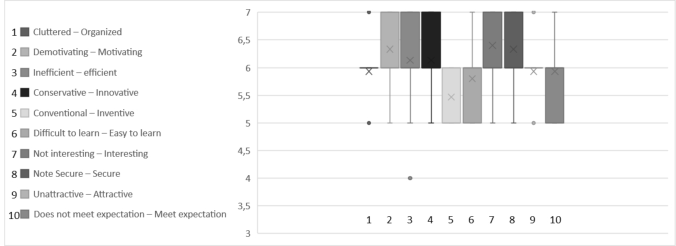
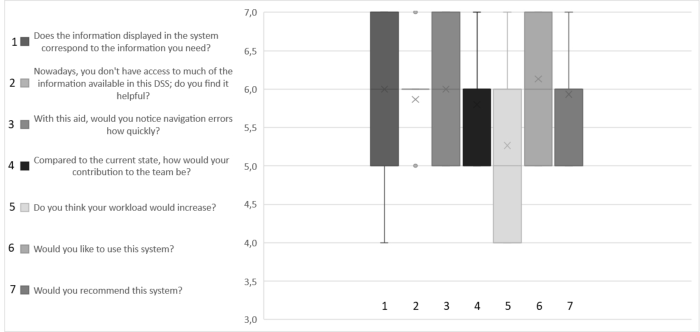
Design Thinking was used as it is a method for developing products and services creatively and innovatively, involving the human being from the perception up to the solution (Dam, 2021). The process was performed with five commonly agreed-upon phases (Institute of Design at Stanford, 2010): Empathy, Definition, Idealisation, Prototyping and Test. Interface design prototypes were made with Balsamiq Mockups, version 4.1.2, cover- ing the following roles: navigator, radar operator, chart operator and lookout. Usability tests, questionnaires and interviews were applied to verify and assess the C-DSS. Five focus group tests were made, with fifteen SMEs, twice with navigators, and once with SME from the other role, three in each iter- ative evaluation test. Following a snowball selection principle, participants were recruited from the Portuguese navy with an extensive seagoing expe- rience. The questionnaire comprises two parts (see Figures 1 and 2): (1) general questions of UI and UX and, (2), specific contents applied to the work domain.
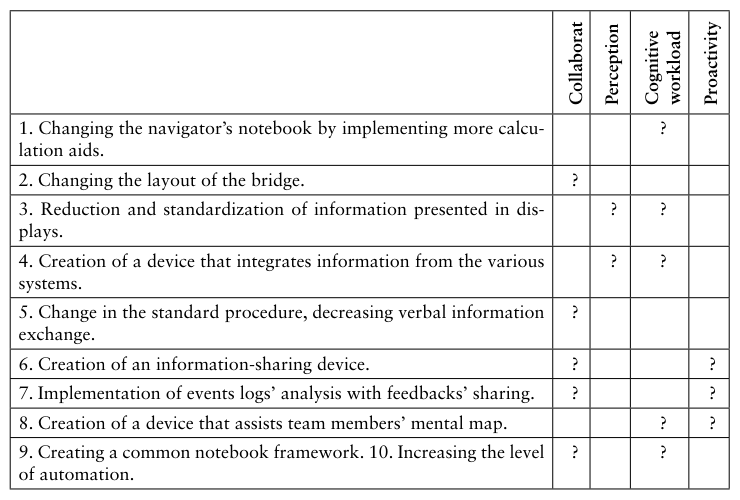
Figure 1: Box plot results of the UX questionnaires, part A.Figure 2: Box plot results of the UX questionnaires, part B.Table 1. Menu of ideas.
RESULTS
The usability test corrected and improved numerous user interface design issues. As a possible solution, it was considered the possibility of C-DSS including Speech-to-Text software. Additionally, the focus groups proved to be crucial at the level of utility and desires of individuals, allowing the adaptation and improvement of features already considered and the inser- tion of new ones. Overall, user feedback was quite positive, as reflected in the results, where users found C-DSS to be easy to learn, enjoyable and inno- vative. Although they considered that the workload would not increase, they showed some concern.
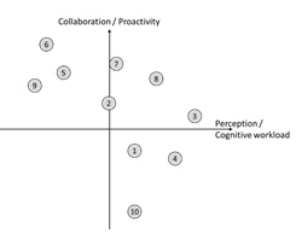
ANALYSIS OF THE DESIGN SOLUTIONS The solution space is composed of all the resources and plausible alternatives to satisfy the identified problems. However, given the situation’s complex- ity and the exhaustive list of isolated responses, we used the Menu of Ideas method shown in Table 1 to synthesise the generated ideas and allow its anal- ysis and comparison. From this, two solution sets emerged: one focused on collaboration and proactivity activities and a second directed to perception and cognition. Finally, the incompatibility of ideas led to the elaboration of a positioning matrix (see Figure 3) to find the optimal approach. The analysis was grounded on literature review and preceding studies about navigation teamwork within the Portuguese Navy (Conceição et al., 2018; Conceição, Canas and Dahlman, 2019; Cavaleiro, Gomes and Lopes, 2020).
We observed that proposal (8) assumes the most significant prominence since it helps the cognitive processes of the individuals and, while it encour- ages autonomy and proactiveness. On the other hand, option (3) does not
Ecological Collaborative Support System for Maritime Navigation Teams 149
significantly promote teamwork. Conversely, option (6) promises enhanced coordination and cooperation. However, the likelihood of adding more expendable information implies a decrease in perception. In the end, the best solution could be based on an individual wearable device strengthening a shared mental map, allowing information exchange between individuals and automated agents.
Figure 3: Positioning matrix.
Requirements were prioritized with the MoSCoW classification (M- Must have, S-Should have, C-Could have, W-Will not have), and a 3-level scale was used for the development stage: preliminary (identified during the anal- ysis); adapted (change based on UX feedback) and new (suggested by users during tests). Non-Functional requirements, associated with quality and tech- nical condition, encompassed: usability, interaction, reliability, performance (number of users, data refresh rate), security, technical integration, laws, and norms.
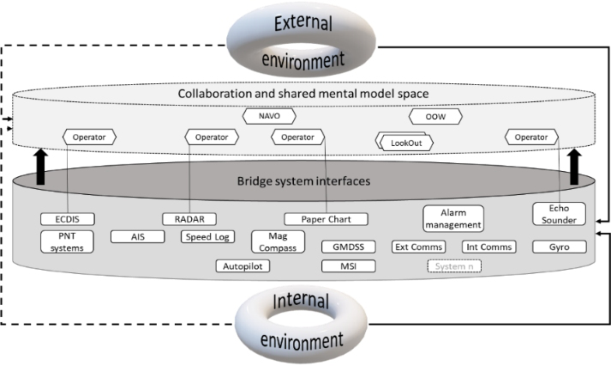
Without changing existing physical arrangements and organizational structure, the C-DSS incorporates the flexible adaptations to address working arrangements and uncertainty, facilitating the variability of the joint activity. Thus, the C-DSS takes the world perception model developed by the oper- ating bridge technological systems and merges it with the team members’ perception, as they are invited to share in their perception of both direct observations and interface representation (Figure 4). This space holds the possibility to manage, adjust and redefine goals and strategies collaboratively. In the case of navigators, they usually use notebooks, with schematic plans, predefined measurements, predicted situations, procedures for teamwork coordination, goals, and strategies to control the navigation execution.
Because of the performance and personal data confidentiality, the applica- tion has login procedures. Although distinct, the four interfaces hold common elements like distance and time to wheel over point or other goals, heading, course, speed over the ground and speed through water, meteorological infor- mation, and a banner for essential information. The interfaces are coherent in design and functionality, incorporating a list of icons, i.e., functionalities rel- evant to their role and a situation-sensitive window, which appears without user control. Twelve individual windows have been elaborated, according to the needs of the type of user.
The navigator, ECDIS operator and chart operator, may visualize repre- sentations of the entire route plan. On the contrary, the radar operator can
only view parts of the route plan due to the radar display constraints. Addi- tionally, the radar operator has two conflicting tasks: (1) monitor the vessel position and (2) the closest navigational hazards, requiring the selection of a 1, 5 or 3 NM display scale. On the other hand, he must appraise the for- ward situation to anticipate dangerous situations early, requiring the use of a 6 NM or larger scale display. Switching scales affect attention and the time required to perceive the situations (Conceição et al., 2018). Alternatively, the bridge may have two radar displays, with different scales, requiring divided attention for a single operator or additional coordination in the case of two radar operators. Finally, it also constraints the radar operator to collabora- tively manage the goals out of the monitoring window, pushing him out of the teamwork.
Figure 4: Representation of the application work domain.
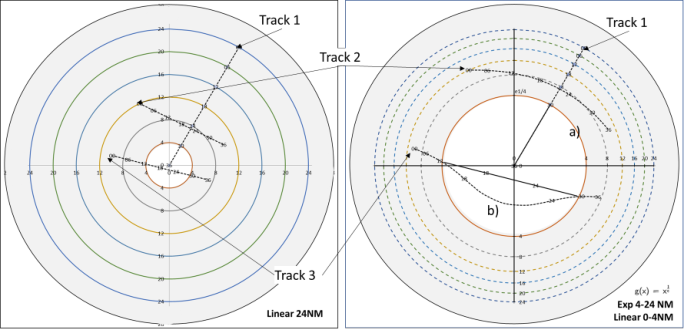
Hence, we proposed a combined multiscale display (Figure 5), comprising a linear scale in the centre, to perceive the closest situations, and an outer exponential scale for monitoring of distant situations. A critical case is the early detection of collisions, which is detected by a track pointing to the centre (track 1, Figure 5). Despite the human ability with logarithmic scale repre- sentations, mental computation of distances is challenging. Hence, the inner scale is linear, facilitating the perceived distance as shown (Figure 5), with the two types of tracks 3 in case b), once the track gets into the linear scale, it no longer appears curved.
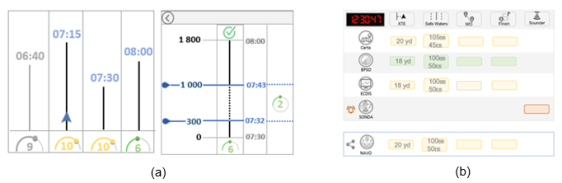
A speed simulator window allows the user to judge speed or ETA changes that impact over the route plan, (Figure 6(a)). Furthermore, within each length, it is possible to add new goals and appraise the best time or speed for any part of the route leg, such as replanning for launching a small boat. This process can be performed collaboratively since all may visualize the same window and interact with it.
Another tool that supports team coordination and awareness is shown in Figure 7(b), allowing the user to view the information shared by other team members and identify the time interval in which the information was updated from a colour code.
Ecological Collaborative Support System for Maritime Navigation Teams 151
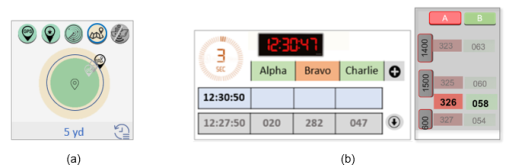
Figure 5: Combined multiscale display. Left: standard radar display with linear scale; Right: Multiscale display combining linear (0 to 4 NM) and exponential scales (4 to 24 NM).Figure 6: (a) Speed simulator. (b) Sharing information.Figure 7: (a) Position accuracy display. (b) Visual fix coordination and bearing display.
Figure 7(a) presents a window where the user can evaluate the position obtained by the various means, with accuracy and latency indicators and view the system status. The bearing display window (see Figure 7(b), on the right) compares the planned control bearings with those taken by the look- out at any specific time (brightest colour). Based on time synchronization, it places the planning elements and observations into context, connecting the initial representation of the situation (route plan) with the system’s current representation (computation of the observation and physical modelling) and the operator perception. The window presented in Figure 7(b), on the left, presents the landmarks to be used for the next fix, assigning them, and trans- mitting the exact update time to support the coordination and increase their
accuracy. In the example shown, the chart operator requested the starboard lookout, azimuth to the Alpha and Charlie landmark (in this order), and the Port lookout, azimuth to the Bravo marker, at 12:30:50.
DISCUSSION
At the current stage of the C-DSS development, the results indicate significant potential for the interfaces strategies, suggesting that end-users would like to have the C-DSS, considering it innovative, friendly, easy to learn and with the information they need. The main difficulties in terms of usability were related to recording data. As a possible solution, it was considered the possibility of C-DSS including Speech-to-Text software.
The navigation plan is consistent with the ones placed in the navigation system and the schemas held by each team member’s notebooks. The struggle consists in simultaneously managing both technological and human agents’ combined performance and contributions. Additionally, the increased uncer- tainty in naval operations entails continuous replanning during execution, which requires adjustments of intentions and goals. Therefore, the navigator’s notebook usually has several aids and mnemonics to support the flexecution process (Klein, 2007). On the other hand, each team member carries in their notebook a different representation of the navigation plan that guides the construction of their mental model. Thus, the shared mental model is refer- enced to the abstract representation of the navigation plan with contextual information. The route plan sets a common ground structure to facilitate coordination and clarify communication.
There is a close relation between goals and priorities. Actions and decisions are perceived regarding their impact on the goals and fitness of the selected priorities. Bennett and Flach (2011, p. 69) also pointed to the relevance of combining the analysis of the situation with the operator’s intuitions. The entire team’s navigation control is supported by the route plan. The positive impact on safety due to the digital exchange of route plans between vessels and VTS has also been demonstrated (IMO, 2021).
The C-DSS tries to provide consistent and harmonized representations of the joint activity, translating the physical world knowledge into meaning- ful representations fitted to each user’s tasks and context. Furthermore, the inclusion of feedback processes promotes interactions between team mem- bers and the technological agents, increasing the situational awareness over the system state.
As the app is designed to log all the voice communications, inputs and queries in the interface of each team member, this synchronized data is used in real-time to appraise teamwork and deliver superior situational aware- ness. It also provides data for further analysis of the adopted strategies and identification of competence and training need gaps, supporting the develop- ment of customized training. Consequently, this attention on everyday work variability (Work-As-Done) sets the transitional ground towards the safety II perspective and ultimately for resilient performance (Hollnagel, Wears and Braithwaite, 2015; Hollnagel, 2018).
Ecological Collaborative Support System for Maritime Navigation Teams 153
CONCLUSION
This study contributes to the understanding of the collaborative decision- making process in navigation teams by: (1) systematising the main difficulties and challenges and, (2) presenting a desirable and viable solution. The devel- oped prototype has four distinct complementary graphic interfaces, and oriented to the context of the user’s role, based on the continuous contribu- tion of target users, belonging to navigation teams. The contributions allowed improved understanding of the problem, idealise the solution, and improve the C-DSS, from design to insertion and adaptation of new functions.
In the validation process of the prototype, it was found that the experts would like to use the C-DSS, as they would have greater autonomy and, would be able to make an exceptional contribution. Finally, the design thinking approach provided a basis for continuous feedback from end-users, becoming a twofold benefit by triggering new ideas of possible solutions.
ACKNOWLEDGMENT
We acknowledge the Portuguese Navy and the Naval Research Centre (CINAV) for supporting this study together with all the participants involved.
REFERENCES
Aarsæther, K. G. and Moan, T. (2010) ‘Adding the Human Element to Ship Manoeuvring Simulations’, Journal of Navigation, 63(04), pp. 695–716. Água, P. B., Frias, A. and Simões-Marques, M. (2021) Mental Traps Behind Mar-
itime Disasters, Lecture Notes in Networks and Systems. Springer International Publishing. AIBN and DAIBN (2019) Report marine 2019/08 Part one report on the collision on 8 November 2018 between the frigate HNoMS Helge Ingstad and the oil tanker sola TS outside the Sture terminal in the Hjeltefjord in Hordaland county, Marine 2019/08. Bailey, N., Housley, W. and Belcher, P. (2006) ‘Navigation, interaction and bridge
team work’, Sociological Review, 54(2), pp. 342–362. Bearman, C. et al. (2010) ‘The breakdown of coordinated decision making in distributed systems’, Human Factors, 52(2), pp. 173–188. Bennett, K. B. and Flach, J. M. (2011) Display and Interface Design: Subtle Science,
Exact Art, Display and Interface Design. Boca Raton, London, New York: CRC Press. Cavaleiro, S. C., Gomes, C. and Lopes, M. P. (2020) ‘Bridge Resource Management: Training for the Minimisation of Human Error in the Military Naval Context’, The Journal of Navigation, (May), pp. 1–13. Christoffersen, K. and Woods, D. D. (2002) ‘How to Make Automated Systems Team
Players’, Advances in human performance and Cognitive Engineering Research, 2, pp. 1–13. Conceição, V. P. da et al. (2018) ‘Visualization in maritime navigation: A critical review’, in Stanton, N. A. (ed.) Advances in Human Aspects of Transporta- tion, Advances in Intelligent Systems and Computing. Los Angeles: Springer International Publishing, pp. 199–212.
Conceição, V. P. da, Canas, A. C. and Dahlman, J. (2019) ‘Analysing Human Factors for Naval navigation accidents using HFACS’, in Carlos Guedes Soares (ed.) Developments in the Collision and Grounding of Ships and Offshore Struc- tures: Proceedings of the 8th ICCGS, 21–23 Oct 2019, Lisbon, Portugal. Lisbon, Portugal: CRC Press, pp. 319–327. Costa, N. A. (2018) Human-centred design for maritime technology and organiza-
tional change. Chalmers University Of Technology. Dam, R. F. (2021) 5 Stages in the Design Thinking Process. Available at: https://www.interaction-design.org/literature/article/5-stages-in-the-design-t hinking-process (Accessed: 1 September 2021). Dekker, S. W. A. (2014) Safety Differently. Human Factors for a New Era. Second ed. Boca Raton: CRC Press. Endsley, M. R. (1995) ‘Toward a Theory of Situation Awareness in Dynamic
Systems’, Human factors, 37(1), pp. 32–64. Hadnett, E. (2008) ‘A Bridge Too Far?’, The Journal of Navigation, 61(02), pp. 283–289. Hareide, O. S. et al. (2017) ‘Developing a high-speed craft route monitor window’,
Lecture Notes in Computer Science, 10285, pp. 461–473. Holder, E. and Pecota, S. R. (2011) ‘Maritime Head-Up Display: A Preliminary Evaluation’, The Journal of Navigation, 64(4), pp. 573–594. Hollnagel, E. (2009) The ETTO Principle: Efficiency-Thoroughness Trade-Off.
Why Things That Go Right Sometimes Go Wrong. Farnham, Surrey: Ashgate Publishing Limited. Hollnagel, E. (2018) Safety-II in Practice: Developing the Resilience Potentials.
London: Routledge. Hollnagel, E., Wears, R. and Braithwaite, J. (2015) From Safety-I to Safety-II: A White Paper. The Resilient Health Care Net: Published simultaneously by the University of Southern Denmark, University of Florida, USA, and Macquarie University, Australia. Hutchins, E. (1995) Cognition in the Wild. MIT Press. IMO (2021) MSC 103/INF.12 Information about an intended proposal for a
new output to amend the revised performance standards for ECDIS (resolution MSC.232(82)) to facilitate a standardized digital exchange of vessel route plans. Institute of Design at Stanford (2010) ‘An introduction to design thinking: Process guide’. Hasso Plattner Institute of Design, p. 6. Javaux, D. et al. (2015) ‘Model-based Adaptive Bridge Design in the Mar-
itime Domain. The CASCADe Project’, Procedia Manufacturing, 3(AHFE), pp. 4557–4564. doi: 10.1016/j.promfg.2015.07.472. Klein, G. A. (2003) The Power of Intuition: How to Use Your Gut Feelings to Make Better Decisions at Work. New York: Currency/Doubleday. Klein, G. A. et al. (2004) ‘Ten Challenges for Making Automation a “Team Player”
in Joint Human-Agent Activity’, IEEE Intelligent Systems, 19(06), pp. 91–95. Klein, G. A. et al. (2005) ‘Common Ground and Coordination in Joint Activity’, in Rouse, W. B. and Boff, K. R. (eds) Organizational Simulation. Hoboken, NJ, USA: John Wiley & Sons, Inc., pp. 139–184. Klein, G. A. (2007) ‘Flexecution, part 2: Understanding and supporting flexible
execution’, IEEE Intelligent Systems, 22(6), pp. 108–112. Lützhöft, M. H. and Dekker, S. W. A. (2002) ‘On Your Watch: Automation on the Bridge’, The Journal of Navigation, 55(01), pp. 83–96. Man, Y. et al. (2018) ‘Gaps Between Users and Designers: A Usability Study
About a Tablet-Based Application Used on Ship Bridges’, in Stanton, N. A. (ed.) Advances in Human Aspects of Transportation: Proceedings of the AHFE
Ecological Collaborative Support System for Maritime Navigation Teams 155
2017, July 17-21, Los Angeles, California, USA. Cham: Springer International Publishing, pp. 213–224. Marquet, L. D. (2018) ‘Lessons from a nuclear submarine mishap’, in Hagen, J.
U. (ed.) How Could This Happen?: Managing Errors in Organizations. Cham: Palgrave Macmillan, pp. 265–272. Norman, D. A. (1993) Things That Make Us Smart: Defending Human Attributes in the Age of the Machine, Design Issues. Addison-Wesley Publishing Company. OpenBridge Design System (2021) OpenBridge Design Guideline. Available at: https:
//openbridge-ds.webflow.io/introduction/getting-started (Accessed: 1 Sep 2021). Rønningen, J. V. and Øvergård, K. I. (2017) ‘Shared pilot passage plan and navigational safety during pilotage’, WMU Journal of Maritime Affairs, 16(3), pp. 439–454. doi: 10.1007/s13437-017-0128-x. Schager, B. (2008) ‘When technology leads us astray: A broadband view of human
error’, The Journal of Navigation, 61, pp. 63–70. US Department of the Navy and US Fleet Forces Command (2017) Comprehensive Review of Recent Surface Force Incidents. van Westrenen, F. and Praetorius, G. (2014) ‘Maritime traffic management: A need
for central coordination?’, Cognition, Technology and Work, 16(1), pp. 59–70.
LISTED IN THE AHFE DIGITAL BOOKSTORE CATALOGUE
Explore the complete digital volume
Human Systems Engineering and Design (IHSED 2023): Future Trends and Applications
Read this individual research paper free through the original publisher, or explore the full digital proceedings book.
ISBN 978-1-958651-88-9
Explore this ISBN in the AHFE Bookstore ↗Listed in the July 2026 bookstore catalogue; search by ISBN to confirm current availability · Digital book purchase optional