Pedro Água (2026). Complex Problem Solving: From Ambiguity to Solution Design. In: Human Interaction and Emerging Technologies (IHIET 2026). AHFE Open Access, vol. 236, pp. 492–502. https://doi.org/10.54941/ahfe1008124
With the fast growing spread of artificial intelligence (AI), everyone with access to it is increasingly using it. Despite the advantages of using AI in terms of efficiency, there is some downside to such dynamics. Complex problems remain complex for a reason, and such suggests a call into practical wisdom and complex problem-solving skills. Moreover technology is triggering cognitive decline for some extent, which also adds to the need to keep what makes us humans in terms of decision making in complex contexts. This paper presents an integrated framework for strategic problem solving based on problem definition, goal setting, Ishikawa diagrams, problem trees, and solution trees. The framework is designed to support decision-makers facing complex and uncertain environments – the new normal. Drawing on systems thinking, critical thinking, the Cynefin framework, root-cause analysis, and organizational change theory, the paper presents a structured methodology rooted on the Theory of Constraints for moving from symptoms to root causes and from desirable outcomes to solution design. A well known strategic management case study is used as a pedagogical example to illustrate how strategic challenges can be framed, analysed, and resolved. The paper argues that effective strategic problem-solving skills requires not only analytical rigor but also stakeholder engagement, awareness of cognitive biases, before disciplined implementation. The proposed framework is particularly relevant for higher education, management practice, public administration, and innovation-oriented organizations, where a VUCA world challenges decision makers, managers, and leaders, or educators on their daily jobs.
Today’s organizations operate in environments characterized by uncertainty, complexity, and rapid technological change. As a result, managers and leaders increasingly face problems that cannot be solved through routine procedures alone. Strategic problem solving has therefore emerged as a critical capability for organizations seeking long-term sustainability and competitiveness. Contemporary studies consistently identify critical thinking, creativity, systems thinking, and problem-solving skills among the most important competencies required in the twenty-first century workforce. Strategic problems differ from operational or tactical problems because they significantly influence long-term organizational direction.
Complex Problem Solving: From Ambiguity to Solution Design 493 They involve multiple stakeholders, competing objectives, uncertainty, and interdependencies among organizational functions. Consequently, addressing such problems requires structured methodologies capable of integrating diagnosis, analysis, solution design, and implementation. This paper discusses a comprehensive framework for strategic problem solving derived from established management and systems-thinking approaches. The framework consists of five stages: problem statement development, goal-tree construction, Ishikawa diagrams analysis, problem-tree analysis, solution-tree development, and implementation planning. The paper also assumes a complex context as understood within the Cynefin framework (Snowden & Bonne, 2007). It follows an approximated IMRaD structure. After this introductory section, some relevant background is brought in, after which some methodology considerations are presented; followed by a ‘results’ section made of several tools borrowed from pre-existing theories and approaches, such as the Theory of Constraints (Goldratt, 1990, 2012; Dettmer, 2007); which were assembled in a way that provides a robust problem solving approach. A discussion and conclusions section finishes this text.
BACKGROUND
Several acronyms have been used to describe the increasing complex context within which business, governments and any organization manages to attain their goals or at least maintain their sustainability. Regardless of other acronyms, the VUCA one (Volatile, Uncertain, Chaotic, Ambiguous) seems an adequate one. This section provides some relevant background and context for the following description of the complex problem solving approach. The complex problem solving approach here suggested, contains three main stages, respectively: (1) Problem Diagnosis, where the problem definition and structuring is addressed (aka problem elicitation); (2) Solution Design, where a strategy, containing a set of initiatives, is structured, and (3) Solution Deployment, where all the considerations are taken with the aim of deploying the designed solution (Figure 1).
Figure 1: Complex problem solving: from ambiguity to action.
Figure available in the original PDF paper.
Obviously, in reality a complex problem-solving process is not as simply linear as represented in Fig. 1. More often, there are many iterations, back and forth, in order to get it right: refining the problem diagnosis, refining the solution design and the deployment strategy as well. It shall be stressed that the best solution may fail at deployment stage, because the implementation pre-requisites were not taken care of properly – being the human related factors and stakeholders’ pre-requisites usually among the most important.
Strategic problem solving is grounded in the notion that organizational performance depends on the ability to identify and address constraints preventing desired outcomes. Rather than focusing solely on symptoms, effective problem solvers seek to understand underlying causes and systemic interactions. The Cynefin framework distinguishes among simple, complicated, complex, and chaotic contexts (Snowden & Boone, 2007). In simple (or clear) contexts, best practices can be applied because cause-and- effect relationships are evident. In complicated contexts, expert analysis is required. In complex contexts, solutions emerge through experimentation and adaptation. In chaotic situations, immediate action is necessary before analysis becomes possible. Systems thinking offers an additional perspective by emphasizing relationships among elements rather than just isolated events. Problems frequently arise from interactions among organizational structures, policies, incentives, and behaviours – a complex context. Therefore, strategic problem solving may require a holistic understanding of organizational systems rather than fragmented analysis. Critical thinking further supports effective decision making through evidence-based reasoning, evaluation of assumptions, and rigorous assessment of alternatives. Together, these perspectives provide a conceptual foundation for the framework discussed in this paper.
Using Cases - Contrary to Abstraction, Context Improves Learning Contrary to teaching and learning on abstraction, context and teaching methodologies such as the case method, role plays, among other approaches, improve learning (Kolb & Kolb, 2011; Ssemugenyi, 2023). Moreover knowledge and ideas emerge only from situations in which learners draw them out of experiences that have meaning and importance to them (Devries, 2000). Therefore, using an illustrative case, such as the popular Robin Hood strategic management case from Lampel (2021) which examines the strategic challenges facing Robin Hood and his band of Merrymen during their rebellion against the High Sheriff of Nottingham helps in bringing context for learning. What started as a personal conflict grew into a larger movement attracting many followers who shared Robin’s desire for justice and opposition to the Sheriff’s rule. The following lines summarise the case (Lampel, 2021):
“…During the first year of the rebellion, Robin Hood successfully built a disciplined organization. He remained the central decision-maker while delegating responsibilities to trusted lieutenants. Will Scarlett managed intelligence gathering; Little John maintained discipline and training; Scarlock handled finances; and Much the Miller’s son oversaw supplies. This structure
Complex Problem Solving: From Ambiguity to Solution Design 495 helped the Merrymen become an effective force against the Sheriff. However, success has created new problems. The rapid growth of the Merrymen has made the camp harder to manage. Discipline and vigilance face declining, and Robin no longer knows many of his followers personally. In addition, the forest can no longer provide enough food for the growing group, forcing them to purchase supplies from nearby villages. Financial challenges are also increasing. Travelers and wealthy merchants have begun avoiding Sherwood Forest to escape being robbed, reducing the Merrymen’s income. To address this issue, Robin proposes replacing the confiscation of goods with a fixed transit tax. His lieutenants strongly oppose the idea, believing it would damage the group’s image as defenders of the poor (‘rob to the riches and give to the poor’) and weaken support from local communities. At the same time, the Sheriff is becoming stronger, with greater resources, political support, and additional men, he is increasingly able to challenge the Merrymen. Robin realizes that the rebellion must act urgently to achieve a decisive victory before the balance of power shifts further in the Sheriff’s favour.”
The case also introduces a political opportunity: joining a conspiracy to free King Richard and oppose Prince John – the current ruler. While this could bring Robin amnesty and greater influence, it involves significant risks. The case concludes with Robin facing unresolved strategic, organizational, financial, and political decisions that will determine the future of his rebellion – an ambiguous and complex problem, demanding a solution and due action.
A strategic problem may thus be defined as a challenge that threatens an organization’s ability to achieve its long-term goal. Strategic problems often involve uncertainty, competing stakeholder interests, resource constraints, and dynamic environmental conditions. Problem definition is the most important stage of the problem-solving process because incorrectly framed problems often originate ineffective solutions. A well-constructed problem statement is part of the problem definition phase and is usually expressed as a question linking a desired outcome with an obstacle, as such question helps focus the mind – “How can we (subject) achieve the Goal given the obstacles (constraints)?” For example: “How can the organization achieve its growth objectives given increasing market competition and limited resources?”
Effective problem statements possess several characteristics. They are specific, measurable, action-oriented, realistic, and focused on outcomes rather than symptoms. Furthermore, they connect future aspirations with current realities, thereby providing direction for subsequent analysis. The gap
496 Agua between the current state and the future desired state represents the essence of the strategic problem. Understanding this gap requires identification of barriers, constraints, missing capabilities, and environmental pressures influencing organizational performance.
METHODOLOGICAL CONSIDERATIONS Sterman (2000, pp. 845–850) suggested that “all models are wrong” (however some are useful), in the sense that every model just presents a partial, and therefore incomplete, representation of a more detailed reality, and that all we get into models are the perceptions about how reality functions. As correlation and many statistical approaches are based on stochastic process, not deterministic ones, and because only determinism can ensure causality, the approach used to confirm validity is based on Aristotelian logics and fallacies (material, verbal and formal fallacies), specifically approached by means of the Categories of Legitimate Reservation (CLR), (Dettmer, 2007, 2021; Agua et al., 2026). The CLR is a set of eight reservation clauses, usually challenging an hypothetical causal relationship, as questions to test the logical robustness of a given hypothesis Table 1.
Table 1: Categories of legitimate reservation (Dettmer, 2007; 2021).
Table available in the original PDF paper.
Category Obs.
1. Clarity Are all terms and entities clearly defined?
2. Entity Existence Do the proposed entities actually exist in the described context?
3. Causality Existence Is there a logical mechanism supporting the cause–effect link?
4. Cause Insufficiency Is the cause sufficient to produce the effect?
5. Additional Cause Could other causes be responsible?
6. Cause-Effect Reversal Could the supposed effect actually be the cause?
7. Predicted Effect existence Are all inherent side effects acknowledged?
8. Tautology Is any circular logic present?
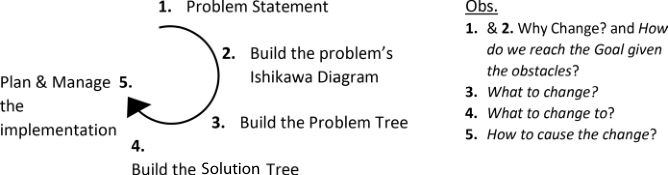
Moreover, and because a problem-solving approach for real world problems shall be pragmatic, useful and “sufficing” in its use, a practical wisdom approach is adopted (Roca, 2008; World Economic Forum, 2023). As for the complex problem-solving methodology three crucial questions are in order: (1) What is the problem statement?, (2) How de we find and map the potential problem causes, and (3) Who elects the system goal (aka objectives). The answer to the third question is obvious, as it is the system’s (or organization’s) owner who elects and defines the Goal. The answers to the other questions as well as the overall problem-solving process will be illustrated as a set of diagrams and logic trees used in the adequate sequence (see Figure 2).
Solution
Figure 2: The problem-solving process.
RESULTS – LAYING OUT THE PROBLEM SOLVING APPROACH The five steps referred to in the previous figure constitute a robust complex problem-solving methodology, and the details of the tools used for each of the four first steps are illustrated in the following sub-sections, making use of the Robin Hood case previously mentioned.
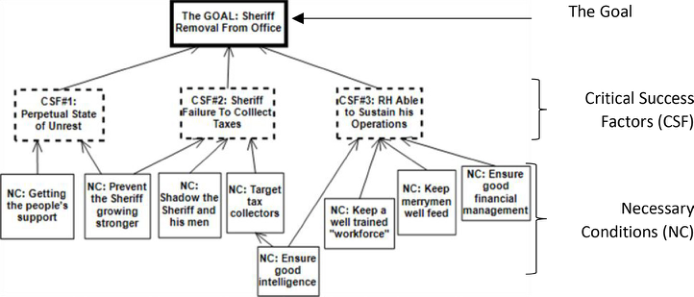
Goal Tree and Strategic Alignment The Goal Tree is associated with the question “why change?”, and it makes visible what shall be the Critical Success Factors (CSF), as well as the Necessary Conditions (NC), in order to make the Goal attainable. Obviously the question about who establish the Goal has a straight answer, as such is the responsibility and duty of the ‘system’s owner’ – the person or decision body responsible for the organization facing the problem. Figure 3 provides an illustrative example, using the Robin Hood case.
A goal tree clarifies why change is needed and the conditions required for success. Starting with a high-level objective (the Goal), it breaks it down into critical success factors and necessary conditions. Critical success factors are essential requirements, while necessary conditions include capabilities, resources, policies, and processes that enable them. By linking objectives to operational needs, goal trees improve strategic alignment, support stakeholder communication, and provide a structured foundation for further analysis and problem diagnosis.
Figure 3: A potential Robin Hood case’s goal tree.
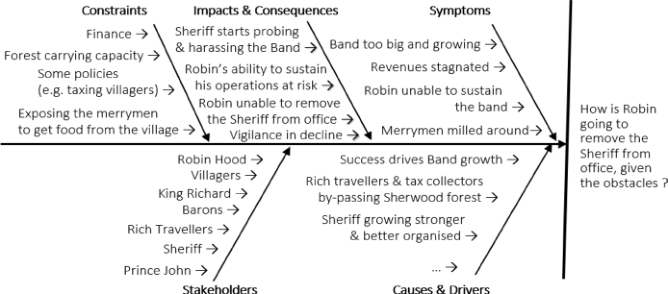
Ishikawa diagrams are widely used for root-cause exploration (Ishikawa, 1976). Within the proposed framework, the diagram serves a broader purpose by characterizing multiple dimensions of a problem. Departing from a guiding Goal Tree, the Ishikawa diagram allows one to list all the meaningful causes, grouped by relevant domains, which constitute a preliminary stage for the construction of the Problem Tree. In this case, identified causes were grouped across five main domains: (1) Symptoms, (2) Impacts & Consequences, (3) Constraints, (4) Causes & Drivers, and (5) Stakeholders. By organizing information across these domains, decision makers develop a comprehensive understanding of the problem impacts and delimitations (see Figure 4). The technique also supports collaborative analysis by encouraging diverse perspectives and structured discussion. Ishikawa analysis is particularly valuable for complex strategic problems because it prevents premature conclusions and highlights interactions among organizational, informational, human, and physical domains.
Figure 4: The Robin Hood case’s Ishikawa diagram.
These identified causes will help structure the Problem Tree, which is made up of cause-and-effect chains.
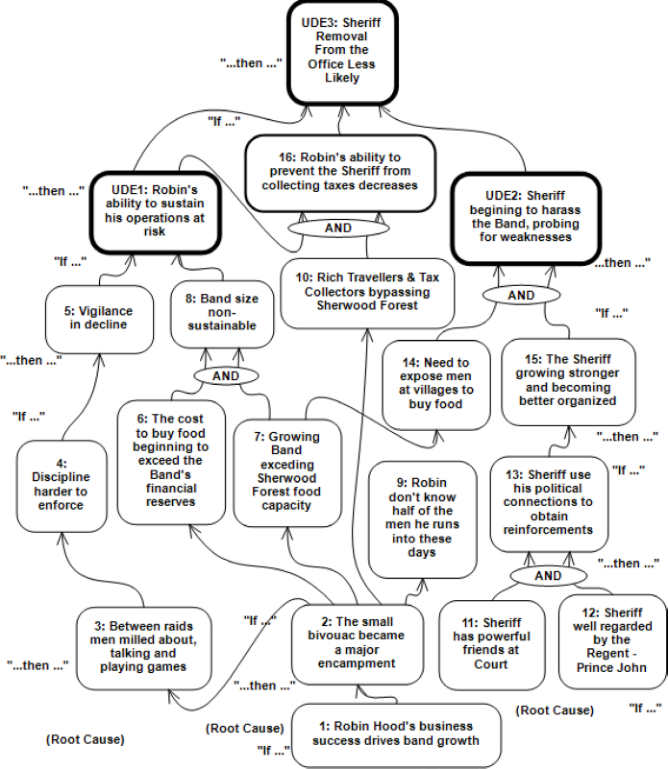
Problem Tree – The Structuring of the Problem Problem trees extend Ishikawa analysis by building explicit causal relationships among UnDesirable Effects (UDE) and underlying causes, moving beyond symptoms and identifying root causes responsible for systemic performance deficiencies – hence structuring the problem. A typical problem tree begins with undesirable effects observed at system or organizational level, which are linked to intermediate causes, and in turn are connected to deeper root causes. The resulting structure reveals how seemingly unrelated issues contribute to strategic constraints (see Figure 5).
Figure 5: The Robin Hood case’s problem tree.
The methodology incorporates the CLRs to test the validity of the causal relationships, increasing analytical rigor and reducing the risk of flawed conclusions, relying merely on correlation. Root-cause analysis provides a critical bridge between diagnosis and intervention. Without accurate identification of root causes, decision makers risk implementing solutions that address symptoms rather than underlying constraints.
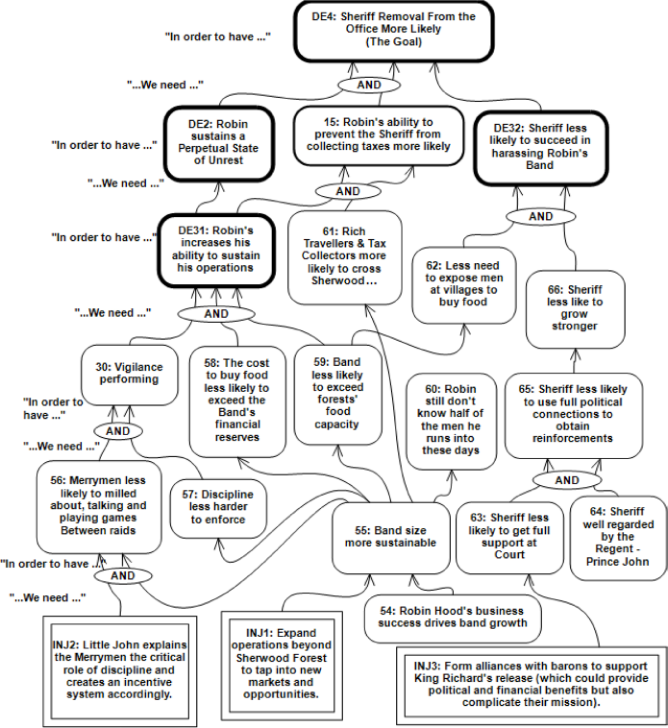
Solution Tree or Intervention Design Once root causes have been identified and the problem tree structured, a Solution Tree is developed to specify interventions (aka INJections) capable of eliminating or mitigating UDEs and generating Desired Effects (DEs) linked to corresponding corrective actions. Solution trees encourage proactive thinking by focusing attention on achievable improvements rather than merely describing problems. They also facilitate evaluation of alternative interventions according to feasibility, effectiveness, cost, and risk.
500 Agua The concept of injection is particularly important, as it refers to a targeted action designed to neutralize or mitigate root causes’ impacts. Multiple injections, which together constitute a strategy, may be required when complex problems involve several interacting constraints. Effective solution design balances ambition with practicality. Proposed interventions should address root causes directly while remaining compatible with organizational capabilities and stakeholders’s expectation (see Figure 6).
Figure 6: The Robin Hood case’s solution tree.
Deploying the Solution Many organizational initiatives fail not because solutions are inadequate but because implementation is poorly planned, managed or led. Consequently, implementation planning constitutes a distinct stage of the whole problem solving approach. Stakeholders identification and analysis is central to the successful implementation of any designed solution, as missing one stakeholder, for instance, means missing one hundred percent of such stakeholder’s requirements. Leaders and strategic problem solvers
Complex Problem Solving: From Ambiguity to Solution Design 501 must identify supporters, opponents, beneficiaries, and affected groups. The understanding of stakeholder’s interests enables the development of communication strategies and change-management plans in order to minimise resistance to change (Kotter, 1996). Implementation plans should define responsibilities, timelines, milestones, performance indicators, resource requirements, and risk mitigation measures. Continuous monitoring allows organizations to adapt interventions as conditions evolve. In this sense it may be useful to use checklists such as the DOTMLPFI one (ACT, 2021). The DOTMLPFI, with military origins, prompts one to look into the Doctrine, Organization, Training, Materiel, Leadership, Personnel, Facilities and Interoperability dimensions. By considering these dimensions, organizations reduce the likelihood of overlooking critical implementation requirements.
DISCUSSION AND CONCLUSION – FROM AMBIGUITY TO ACTION Strategic problem solving is a critical organizational capability in an increasingly complex world. This paper presented a framework combining problem statement, goal trees, Ishikawa diagrams, problem trees, and solution trees, in an integrated approach. The framework provides a systematic approach for diagnosing strategic challenges, identifying root causes, and designing interventions. The well know Robin Hood case study illustrated how the methodology can be applied to real-world strategic situations.
The framework presented in Figure 2 has significant implications for educational institutions and professional organizations. Universities and other schools should increasingly emphasize critical thinking, creativity, and problem-solving capabilities as essential graduate skills development. Incorporating structured problem-solving methodologies into curricula can enhance students’ analytical abilities and decision-making competences. In the context of practitioners and professional settings, the discussed framework supports evidence-based management and organizational learning. By combining systems thinking with practical implementation tools, organizations can address complex challenges more effectively.
The methodology is also applicable across multiple domains, such as engineering, public administration, healthcare, defence and military strategy, business and management, or innovation management. Its adaptability makes it particularly valuable in environments characterized by uncertainty and rapid change – nowadays world context. Future research directions may: (1) examine empirical applications across different sectors of activity and evaluate the effectiveness of the framework in supporting organizational transformation and strategic decision making, or (2) blend the methodology with well known frameworks for business and organizational analysis, such as the Business Policy approach with its four organisational areas (the Business, the Directing Structure, the Incentive Systems; and the Institutional Configuration (Valero y Vicente & Tomás, 2018; Andrews, 1987); or the THOR framework where the problem under analysis would be assessed against the Technology factors, Human factors, Organizational factors, or Regulatory factors.
ACKNOWLEDGMENT
The author would like to acknowledge the Portuguese Naval Academy and CINAV for their support.
REFERENCES
Agua, P.B., Silva, M., Soares, I., Frias, A., Correia, A. (2026) “The Categories of Legitimate Reservation: A Constraint-Rooted, Logic-Based Alternative to Research Validation of Causality”, INTED2026 Proceedings, Valencia, Spain. https://doi.org/10.21125/inted.2026.0729 Andrews, K. R. (1987). The Concep of Corporate Strategy, 3rd Ed. Richard D. Irwin,
Inc. ACT (2021). NATO CD&E Handbook. A Concept Developer’s Toolbox. Allied Command Transformation. Dettmer, H.W. (2007). The Logical Thinking Process. A Systems Approach to
Complex Problem Solving. ASQ Quality Press. Dettmer, H.W. (2021). Systems Thinking. And Other Dangerous Habits. VBW Publishing. Devries. (2000). Developing constructivist early childhood curriculum: Practical
principles and activities. Teachers College Press. Goldratt, E. M. (1990). What is This Thing Called Theory of Constraints and How Should It Be Implemented? North River Press. Goldratt, E. M. (2012). The Goal: 40th Anniversary Edition: A Process of Ongoing
Improvement, 3rd Ed.. North River Press. Ishikawa, K. (1976). Guide to quality control. Asian Productivity Organization. Kolb, A. & Kolb, D. (2011). “Experiential Learning Theory: A Dynamic, Holistic Approach to Management Learning, Education and Development”, in: Handbook of management learning, education and development, Armstrong, S. J. & Fukami, C. (Eds.) 10.4135/9780857021038.n3 Kotter, J. P. (1996). Leading Change. Harvard Business School Press. Lampel, J. (2021). “Case 25: Robin Hood”, in: Crafting & executing strategy: The
quest for competitive advantage: Concepts and cases. 23rd ed., Thompson, A. et al. (eds.) New York: McGraw-Hill Education, pp. C291–C292. Roca, E. (2008) Introducing Practical Wisdom in Business Schools, Journal of Business Ethics, Vol. 82,No. 3 (Oct., 2008) pp. 607–620. Snowden, D.J. and Boone, M.E. (2007) A Leader’s Framework for Decision Making,
Harvard Business Review, 85(11), pp. 68–76. Ssemugenyi, F. (2023) Teaching and learning methods compared: A pedagogical evaluation of problem-based learning (PBL) and lecture methods in developing learners’ cognitive abilities’, COGENT EDUCATION, 10(1). doi: 10.1080/2331186X.2023.2187943 Sterman, J.D. (2000). Business Dynamics. Systems Thinking and Modelling for a
Complex World. McGraw-Hill. World Economic Forum. (2023). The Future of Jobs Report. OECD. Skills for the 21st Century publications. Valero y Vicente, A. V., Tomás, J.L.L. (2018). Business Policy. An Approach on
Corporate Management. Instituto Internacional San Telmo.
SEARCH THE AHFE DIGITAL BOOKSTORE BY ISBN
Explore the complete digital volume
Human Interaction and Emerging Technologies (IHIET 2026)
Read this individual research paper free through the original publisher, or explore the full digital proceedings book.