Pedro Água, Anacleto Correia, Antonio Goncalves, Armindo Frias, Ivo Soares, Miguel Silva (2026). Jazz as an Organizing Logic. Leadership: Improvisation and Coordination in Complex Systems Operations. In: Human Systems Engineering and Design (IHSED2026): Future Trends and Applications. AHFE Open Access, vol. 237, pp. 565–575. https://doi.org/10.54941/ahfe1008196
Complex systems operations—such as emergency response, defence, and critical infrastructure management—require the simultaneous integration of stability, adaptability, and real-time decision-making under conditions of uncertainty. Traditional hierarchical models provide control but often lack responsiveness, whereas fully decentralized approaches enable innovation at the cost of coherence. This paper proposes an organizational framework based on the “jazz organization logics”, positioning jazz not as a metaphor but as an empirically grounded model of distributed coordination in complex dynamic environments. Drawing on complexity theory, systems thinking, and organizational behaviour, the approach conceptualizes jazz ensembles as high-reliability adaptive systems in which actors align around shared structures while engaging in disciplined improvisation. Four core pillars underpin the model: (1) Structured Flexibility, where minimal enabling constraints support adaptive action; (2) Distributed Leadership, where authority shifts according to situational expertise; (3) Relational Attunement, emphasizing continuous active sensing, mutual adjustment, and feedback; and (4) Rhythmic Structures, referring to enabling units that sustain operational continuity and tempo. The study integrates insights from case analyses across complex operational contexts, suggesting that teams operating with bounded autonomy show increased decision velocity and reduced coordination breakdowns compared to rigid command-and-control systems. The findings challenge the assumption that flexibility undermines control, reframing improvisation as disciplined adaptability grounded in shared norms. In environments characterized by volatility, uncertainty, complexity, and ambiguity (VUCA), the proposed framework offers a robust approach for achieving coherence without sacrificing innovation, contributing to the field of complex systems leadership and governance by articulating actionable principles for organizational design and adaptive coordination.
Most domains of human activity are facing a considerable amount of challenges across multiple spheres, and the rising complexity contexts in which organizations of any type operate is no exception. Organizations, and especially networks of organizations, are often complex systems. Typically
Received May 10, 2026 Revised June 16, 2026 Accepted July 8, 2026 Available online September 25, 2026
a complex system, more often than not operates in a complex context, characterised by many interacting parts whose relationships are nonlinear, often meaning that small changes can have large effects. Such contexts are dynamic and exhibit emergence, where outcomes arise from interactions from systems’ elements rather than being imposed. Systems evolve over time, shaped by their history and environment in irreversible ways. Although patterns may seem clear in hindsight, they are not predictable in advance because conditions keep changing. In such systems’ contexts, both the individual elements and the overall structure influence each other, making precise forecasting impossible (Snowden & Boone, 2007). The first obvious consequence of complex contexts is that the traditional industrial-age command and control thinking is not the most adequate way to manage and govern in such contexts, as the need to adapt in face of complexity is of the essence. Complex systems operations require simultaneous improvisation, adaptability and stability. The second consequence is that traditional hierarchical models provide control but often lack responsiveness, while fully decentralized approaches encourage innovation but risk fragmentation and incoherence. Hence, because in complex contexts, outcomes cannot be predicted or controlled in advance, leaders must experiment, observe emerging patterns, and adapt rather than impose fixed solutions—probe, sense, respond (Snowden & Boone, 2007).
This paper discusses an organizational framework for leading and governing complex systems by drawing on jazz as an empirically grounded model of distributed coordination. Jazz ensembles function as high-reliability, real- time adaptive organizations (systems): musicians follow shared structures— harmony, rhythm, and form—while engaging in improvisation. Leadership shifts fluidly depending on the melodic lead, yet cohesion is maintained through deep listening, shared mental models, and disciplined norms. This mirrors challenges in complex operations, where interdependent actors must make time-sensitive decisions with incomplete information. Improvisation does not imply informality or lack of discipline. Like jazz, effective improvisation relies on rigorous training, shared repertoires, and established procedures. This challenges the view that flexibility weakens control, suggesting instead that disciplined adaptability strengthens reliability. In volatile and uncertain environments, organizations must move beyond rigid hierarchies toward adaptive coordination, integrating structure and emergence to achieve coherence, resilience, and innovation in complex systems management. This paper follows and IMRaD structure (Introduction, Methods, Results and Discussion). After this introduction, some relevant background is presented in section two, after which some considerations are referred regarding the methodological approach in section three. Section fours, results, proposes ways of dealing with the problem, after which a discussion follows in section five.
BACKGROUND
Centralised command and control has been the mantra behind management and leadership for over a century in business and beyond, however, the world and the context changed, and organizations shall adapt accordingly if they want to thrive.
Jazz as an Organizing Logic. Leadership, Improvisation and Coordination 567 The Problem
Most management and leadership approaches have been adequate for simple and complicated contexts, however, in complex contexts, they lack effectiveness, as they rely in traditional command and control approaches – a sort of “orchestration”. The orchestration metaphor falls short in a VUCA world because it presumes a predetermined score, a central conductor, and obedient performers that simply do not exist in complex decentralized environments. While orchestration suggests harmony and control, a VUCA context is often better defined by unpredictable interactions, lack of a single “conductor”, and the inability to foresee how small changes will ripple through the system, or system-of-systems, giving place to emergent effects. In a truly complex context, there is no single entity with total visibility or control. Orchestration implies a top-down hierarchy, whereas VUCA contexts require decentralized, agile responses. A symphony follows a written score, but in a VUCA environment, the “rules of the game” change frequently. Planning for a set outcome often leads to rigidity rather than the necessary flexibility—crucial for adaptation ability. Moreover, orchestration focuses on alignment, but complex contexts are defined by non-linear interactions where a small action can have massive, unintended consequences. The jazz metaphor has been studied before, however as happens with many valid management theories that were discarded just for the sake of the Sorcerer’s Apprentice syndrome —a situation where the apprentice cannot flourish without the disappearance of the master (Hirsch, 2021)—and need to be recovered. This syndrome is a leading cause for the premature abandonment of valid management models, which are often discarded with arguments of poor implementation or unrealistic expectations. Likewise the jazz logic has not been paid enough attention for management, leadership and governance. Therefore, to bring attention to the relevance of the subject some of the core principles of the jazz logic are laid down below.
Searching for Guidance and the Principles Behind the Jazz Logic Jazz is an organizational system which evolved naturally, once the right conditions were available in the context where jazz born (Myers, 2013). The jazz logic is characterized by intense listening, collective responsibility, improvisation within a minimal structure, and real-time adaptation is increasingly used in complex, high-stake fields where rigid, top-down planning fails – something that implies a different leadership style (De Pree, 1992; Barrett & Peplowski, 1998; Ackerman, 2018). Key examples include: (1) Management and Strategic Execution, (2) Innovation and Product Development, or (3) Crisis Management. Barrett (2012) identified a set of core principles at play in what concerns the logic behind jazz, providing a useful framework which allows for analysis and solution design whenever an organization facing a complex context needs a different kind of approach. These core principles which characterise the jazz logic are visible at most situations presented on the fourth section of this paper, which illustrates examples from several fields of human activity where complexity and critical operations are the norm (Table 1). Rather than relying on rigid plans and routines, organizations can become more innovative and adaptive by
embracing uncertainty, experimentation, and collaboration supported by a dynamic, flexible approach to leadership that mirrors how jazz musicians perform together in unpredictable environments. This demands a need to “unlearn” routines. While routines provide comfort and efficiency, they can also limit creativity and prevent organizations from adapting to change. Leaders must therefore develop improvisational skills—learning to act without complete information, adjust quickly, and refine their actions through experience. Like jazz musicians, who rely on learned patterns but creatively adapt them in performance, leaders and managers must balance preparation with spontaneity.
Table 1: Jazz logic core principles [Adapted from Barret, 2012].
Table available in the original PDF paper.
Core Principle Core Idea
1. Mastering the art of unlearning
Let go of rigid routines. Overreliance on habits limits adaptability and innovation
2. Developing affirmative competence
Act despite uncertainty. Progress often requires stepping into ambiguity with confidence
3. Embracing errors as a source of learning
Learn through mistakes. Performing and experimenting simultaneously. Errors are valuable sources of insight, not just failures
4. Minimal structure & maximal autonomy
Balance control with freedom. Too much structure stifles creativity; too little creates chaos
5. Jamming & hanging out
Foster spontaneous collaboration. Learning by doing and talking. Innovation emerges from informal, open exchanges of ideas
6. Taking turns soloing & supporting
Share leadership roles. Effective teams require both leading and supporting Challenge the status quo. Growth comes from disrupting comfort zones and routines
7. Leadership as provocative competence
Combine structure with improvisation
8. Advancing engaged, strategic improvisation Barrett (2012) suggested the concept of “affirmative competence”, as a willingness to move forward despite ambiguity and risk. Instead of relying on traditional planning to avoid problems, effective leaders embrace them as opportunities for discovery and learning. Many tasks in organizations are not fully defined, requiring employees to rely on creativity and resourcefulness rather than strict procedures. Hence, learning from errors is a central pillar. In jazz, mistakes are not failures but opportunities to create something new, leading to adaptation. Musicians repeat or build upon a mistake, transforming it into a novel pattern. Similarly, organizations that treat errors as learning opportunities can accelerate innovation. However, many organizations discourage risk-taking by punishing mistakes, which stifles creativity reinforcing the value of trial-and-error learning.
METHODS
This paper adopts a conceptual and theoretical methodology grounded in structured critical reasoning (Paul & Elder, 2009). It combines elements of abductive reasoning, and problem-structuring approaches to examine
Jazz as an Organizing Logic. Leadership, Improvisation and Coordination 569 the documented cases. These methods sought analytical comparison and conceptual clarification rather than empirical validation. By combining a comparative analysis of cases, and alternative analysis methods, such as the Logical Thinking Process with its logical validation approach (Dettmer, 2007), it provides a robust approach, as the use of multiple methods (aka models) cover the insufficiencies or blind spots of single models (Page, 2016). Furthermore, the Five Whys technique was used to determine the root causes of the problem by asking “why” enough times.
RESULTS
This section provides evidence of jazz logic operating across several critical fields of human activity. Several examples from distinct fields of activity— business, medical, and defence—are briefly presented in the following sections, as well as a structuring tree supporting the main argument.
Examples of Jazz Logic at Play From Business Jazz logic in business refers to applying principles of improvisation, collaborative leadership, and adaptability to thrive in unpredictable environments, moving away from rigid, centralized and hierarchical industrial-age thinking business structures. Several examples are captured in Table 2, where the jazz logic are used, consciously or unconsciously.
Table 2: Examples of jazz logic in business [Adapted from: Gold & Hirshfeld, 2005; Satell, 2013; Czarnecki, 2015; Água & Conceição, 2024].
Table available in the original PDF paper.
Cases Description Corporate strategy and consulting (Jazzcode) Former IBM executive Gunnar Størmer founded Jazzcode, a consultancy that applies jazz improvisation to business. Treating business mistakes not as disasters but as “wrong notes” that offer opportunities for new creative directions.
Open innovation (Procter & Gamble)
Procter & Gamble’s Connect and Develop program. Listening to external “voices” (consumers, innovators) and collaborating across boundaries, just as jazz musicians feed off different ideas and instruments.
Adaptive service delivery
Service personnel (desk clerks, flight attendants) who embrace “variations” in service delivery when technology fails or a special request is made, enable employees to fix problems.
Executive coaching in companies like Mastercard, General Dynamics promote increasing situational awareness and improvising to achieve goals, rather than waiting for a “conductor” to dictate every action.
Leadership and creativity (Mastercard/General Dynamics) Project management Project managers adopt a “jazz mindset,” treating plans as flexible frameworks rather than rigid rules, allowing teams to react to context and market shifts while maintaining core goals.
Crisis management units
Teams handling immediate crises (firefighting, police, civil protection operations) must rely on shared knowledge and immediate communication adapting to evolving situations, much like collective improvisation in jazz.
Table 3 clarifies the parallel between jazz logic and business.
Table 3: The parallel between jazz logic and business.
Table available in the original PDF paper.
Jazz Principle Business Parallel Improvisation Rapid problem-solving and adapting to disruption.
Jam session Collaborative, cross-functional innovation sessions.
Swing Flexibility in plans, giving “flex” time for creativity.
Listening Empathic interaction with consumers and peers
Examples of Jazz Logic at Play From the Medical Field Jazz logic in the medical field refers to applying the principles of jazz— improvisation, deep listening, collaboration, and structured freedom—to clinical practice, health organizations management, and medical education. It is often used to manage uncertainty, enhance patient communication, and foster teamwork among healthcare professionals (Haidet, 2007). Table 4.
Table 4: Examples of jazz logic in the medical field [Adapted from: Haidet, 2007; Haidet et al.,2017; van Ark & Wijnen-Meijer, 2019; Pearl & Greenberg, 2020].
Table available in the original PDF paper.
Application Obs.
Patient-physician communication (Improvisational Encounter)
Deep Listening and Space - Use of jazz to teach doctors how to listen like jazz musicians, focusing on “creating space” in a conversation rather than taking it up with rapid-fire questions. This approach, inspired by Miles Davis, allows patients to tell their stories, leading to better diagnostic information.
Saying Something - Jazz logic can be applied in medical training to move clinicians beyond just memorizing symptoms to developing “their own voice” in conversations.
“Yes, and...” Technique - Nurses and clinicians have used “Yes, and...” improvisation exercises (a core concept of improvised theatre) to improve communication during patient handoffs and in high-stress, unpredictable situations.
Teamwork and interprofessional collaboration
The Jazz Ensemble Model - Interprofessional health care teams have been modelled on jazz ensembles, where different specialists work together, balancing individual expertise with collective improvisation.
Rhythmic Synchronization - Teams use this metaphor to learn how to communicate without overplaying or underplaying their roles, aiming for a shared mental model.
Medical-Surgical Unit Team Building - Applied improvisation has been used on nursing units to create a culture of psychological safety, allowing staff to share ideas or mistakes without fear.
Surgery and technical skill application
Managing the Unexpected - Surgeons have used jazz logic to “reflect in action” during unexpected surgical challenges. It bridges the gap between standardized protocols and necessary spontaneous adaptations (the improvisation) Clinical decision- making Evidence-Based Clinical Jazz - Practitioners often combine the rigid structure of evidence-based medicine (the rhythm section) with their own personal “clinical improvisation” to manage unique or uncertain cases.
Jazz as an Organizing Logic. Leadership, Improvisation and Coordination 571 Key Cases of Jazz Logic in Military Operations
Jazz logic in the military refers to a leadership style of improvisation, intuition, and high-tempo adaptation, often contrasted with the “orchestra” approach of rigid, top-down planning, where strict, long-term plans fail when facing VUCA conditions. Core Components of Jazz Logic when applied to a military operations context are: (1) Versatility, the ability to change plans rapidly; (2) Decentralized Command, or allowing lower-level leaders to exploit opportunities (the “soloist”), and (3) Improvisation, which requires adapting to the enemy’s actions. (Table 5).
Table 5: Examples of jazz logic in military operations (Based on: Sullivan, 1998; FitzGerald, 2020; Hulm, 2019).
Table available in the original PDF paper.
Cases Obs.
WWII – general Patton’s advance
While much of WWII planning was “symphonic”, as in orchestras, rapid, decisive movements like Patton’s Third Army advance across France required commanders to operate with limited information and act on initiative, a form of improvisational, high-tempo combat that fits the jazz analogy.
1991 Kurdistan & 1992 Somalia (10th Mountain Division)
Leaders in these operations, such as during the deployment to Somalia, were noted for tailoring or task-organizing based on METT-T (mission, enemy, troops, terrain and weather, and time available) rather than following a rigid, predefined plan. This improvisational, mission-driven approach is a key example of jazz logic in practice.
2003 invasion of Iraq (2nd BCT, 3rd Infantry Division)
During the push to Baghdad, the 2nd Brigade Combat Team demonstrated jazz logic. Col. David Perkins equated formal military training to practicing scales, but the fast-paced, highly collaborative manoeuvring in April 2003—where decisions were made on the fly to meet rapidly changing conditions—was described as “playing jazz”.
Ukrainian UAS (Drone) operations (2022- …)
Ukrainian drone units, have used a form of jazz logic by intentionally operating at the same time and frequency as Russian drones, creating dilemmas for the adversary. This approach is an improvisational tactic designed to render enemy jamming ineffective.
Perhaps no other field like defence and security convey a more urgent substrate to apply jazz logic nowadays, as summarised in Table 6.
Table 6: Comparing the classical/traditional approach to the jazz logic in VUCA contexts.
Table available in the original PDF paper.
Concept Classical/Traditional Approach Jazz Logic (VUCA-Ready) Strategy Fixed score or Master Plan Improvisation & Emergent Strategy
Leadership Centralized Conductor/Hierarchy Rotating, Distributed, & Adaptive Failure to be avoided/punished Source of learning Error handling
Change Seen as a disruption to be controlled Embraced as the “natural flow” of work Expertise Adhering to standard methodologies Diverse specialists co-creating in
real-time
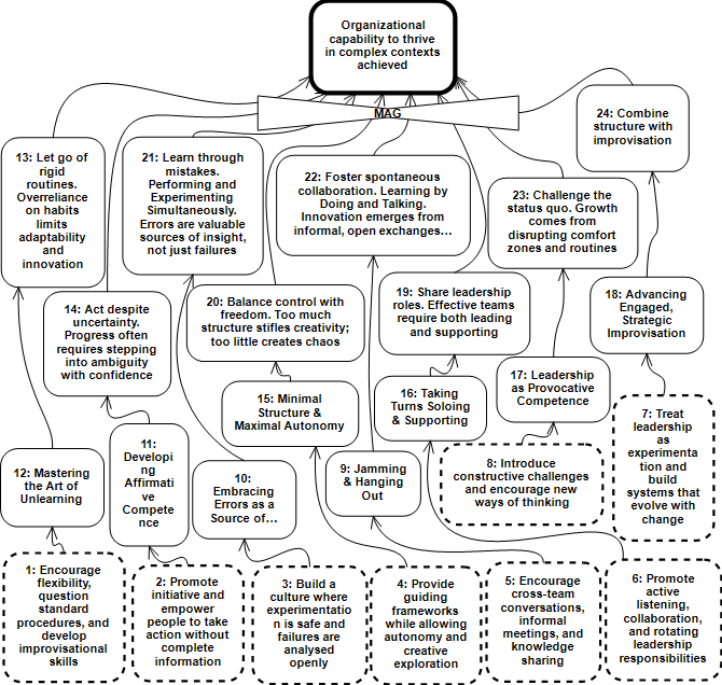
Summarising, the jazz logic is present in critical fields of human activity, from management and general business, to medical field, to defence, security and high reliability organizations. Drawing from the previous examples, and taking a logical thinking process approach one can build a logic tree structuring the jazz organizing principles in practice (Figure 1) (Dettmer, 2007). The figure shows a set of actions that organizations facing complex contexts can take into account when designing their management and governance architectures, helping lead such organizations navigate in VUCA contexts.
Figure 1: Logic tree mapping the causal structure underneath the jazz logic.
Logic trees such as this one are build though a process of logical thinking, where causality is ensured by means of the Categories of Legitimate Reservation, a Logical Thinking Process tool (Dettmer, 2007). They have the benefit of strengthening understanding by mapping the cause and effect chains from the actions at the bottom up to the effects at the top of the tree.
Jazz as an Organizing Logic. Leadership, Improvisation and Coordination 573 DISCUSSION & CONCLUSIONS
From general business to High Reliability Organizations (HRO), most current contexts are characterised by an increased complexity, which makes traditional command and control leadership and governance ineffective. The jazz logic provides some help, which allow for practical recommendations (Table 7). The jazz concepts provided by Barrett (2012) provide the basis for practical recommendations, which these organizations can implement as part of their cultures, hence driving their organizations into better futures amid the aforementioned complexity.
Table 7: Practical recommendations [Inspired on Barret, 2012].
Table available in the original PDF paper.
Jazz Concept Practical Recommendations
1. Mastering the art of unlearning
Encourage flexibility, question standard procedures, and develop improvisational skills
2. Developing affirmative competence
Promote initiative and empower people to take action without complete information
3. Embracing errors as a source of learning
Build a culture where experimentation is safe and failures are analysed openly
4. Minimal structure & maximal autonomy
Provide guiding frameworks while allowing autonomy and creative exploration
5. Jamming & hanging out Encourage cross-team conversations, informal meetings, and knowledge sharing
6. Taking turns soloing & supporting
Promote active listening, collaboration, and rotating leadership responsibilities
7. Leadership as provocative competence
Introduce constructive challenges and encourage new ways of thinking
8. Advancing engaged, strategic improvisation
Treat leadership as experimentation and build systems that evolve with change Supported by the logic tree in Figure 1, and Table 7, it is possible to conceive strategies and approaches to lead, manage and govern organizations in VUCA contexts.
The implementations of the jazz logic recommendations are not without adverse pressures, however, as it challenges the status quo—the industrial-age centralized control thinking—inherited from the early years of industrialization. The successful change of organizations which have to operate in complex contexts will depend not only on successful change management processes (Kotter, 2012), but on the will of visionary decision makers, which have the ability to understand that traditional industrial- age centralised control is not only ineffective as it does not steer their organizations to any good place. The main argument of this paper supports a shift from rigid, control-based management to a more fluid, improvisational style, where learning, collaboration, and adaptability drive innovation, and are critical traits of leadership for VUCA contexts—the new normal. Given the relevance and importance of the subject under focus in this paper, an extension to this research is already taking place, which will further elaborate
on the way to improve organizational performance for High Reliability Organizations in complex contexts, often including sociotechnical systems- of-systems for critical domains.
ACKNOWLEDGMENT
The authors would like to acknowledge the CINAV and the Portuguese Naval Academy for their support.
REFERENCES
Água, P., and Conceição, V. (2024). “Enabling Factors in Complex Operations.
Lessons from Jazz”. IHIET 2024. https://doi.org/10.54941/ahfe1005506. Ackerman, G. (2018). 4 Leadership Lessons from Jazz. Chazen Global Insights.
Columbia Business School. Barrett, F. J., and Peplowski, K. (1998). Minimal structures within a song: An analysis of “All of Me”. Organization Science, 9(5), pp. 558–560. Barrett, F. (2012). Yes To The Mess. Surprising Leadership Lessons From Jazz.
Boston, Massachusetts: Harvard Business Review Press. Czarnecki, J. R. (2015). Adopting a jazz mindset for strategic execution and leadership. PMI® Global Congress 2015—EMEA, London, England. Newtown Square, PA: Project Management Institute. FitzGerald, D. (2020). Jazz and the Orchestra: The Problem with Planning. The
Army Leader. https://thearmyleader.co.uk/problem-with-planning/ [Assessed: 4 may 2026]. De Pree, M. (1992). Leadership Jazz. New York: Dell Publishing. Dettmer, H.W. (2007). The Logical Thinking Process: A Systems Approach to
Complex Problem Solving. Milwaukee: ASQ Quality Press. Gold, M. and Hirshfeld, S. (2005). The behaviors of jazz as a catalyst for strategic renewal and growth. Journal of Business Strategy, 26 (5): 40–47. doi. org/10.1108/02756660510700528. Haidet, P. (2007). Jazz and the ‘Art’ of Medicine: Improvisation in the Medical
Encounter. Annals of Family Medicine. Vol. 5, Nr. 2 March-April. Haidet, P., et al. (2017). Using Jazz as a Metaphor to Teach Improvisational Communication Skills. Healthcare, 5(3), 41. https://doi.org/10.3390/ healthcare5030041. Hirsch, P.B. (2021). The sorcerer’s apprentice. Journal of Business Strategy, 42 (1):
77–80. doi.org/10.1108/JBS-10-2020-0231. Hulm, V. (2019). Symphony or Jazz. Mission-Planning Timelines. Military Review.
May–Jun. pp. 48–59. Kotter, J.P. (2012). Leading Change. Boston: Harvard Business Review Press. Myers, M. (2013). Why Jazz Happened. Berkeley: University of California Press. Page, S.E., (2018). Why “Many-Model Thinkers Make Better Decisions”. Harvard Business Review. 19 November. Available from: https://hbr.org/2018/11/why- many-model-thinkers-make-better-decisions [Accessed: 15 April 2026]. Paul, R. and Elder, L. (2009). The Miniature Guide to Critical Thinking: Concepts
and Tools, 6th Ed. The foundation for Critical Thinking, Foundation for Critical Thinking, Santa Barbara, California. Pearl, P. L. and Greenberg, L. (2020). How the jazz medium can inform interprofessional health care teams in improving patient care. Medical Teacher, 42(12), pp. 1337–1342. doi: 10.1080/0142159X.2020.1805102.
Jazz as an Organizing Logic. Leadership, Improvisation and Coordination 575 Satell, G. (2013). How Jazz Can Transform Business. Forbes, Oct. Snowden, D.J. and Boone, M.E. (2007). “A leader’s framework for decision
making”. Harvard Business Review, 85(11), pp. 68−76, 149. Sullivan, G.R, (1998). Leadership, Versatility and All That Jazz. Military Review, January-February 1997. van Ark, A. E. and Wijnen-Meijer, M. (2019). ‘“Doctor Jazz”: Lessons that medical
professionals can learn from jazz musicians. Medical Teacher, 41(2), pp. 201–206. doi: 10.1080/0142159X.2018.1461205.
FIND THE COMPLETE VOLUME IN THE AHFE DIGITAL BOOKSTORE
Explore the complete digital volume
Human Systems Engineering and Design (IHSED2026): Future Trends and Applications
Read this individual research paper free through the original publisher, or explore the full digital proceedings book.