Pedro Água, Armindo Frias, Anacleto Correia, Mario Simões-Marques (2023). The impact of cultural diversity on organizational and operational risk levels. In: Human Factors and Systems Interaction. AHFE Open Access, vol. 84, pp. 249–259. https://doi.org/10.54941/ahfe1003610
The blue economy develops in a multicultural environment, posing an additional risk for the organizations involved. Operations at sea where people are involved, be it in ships or offshore infrastructures, are not free from operational risks, affecting safety of on board operations for example. Moreover, international projects and operations pursued by multinational organizations (such as UN, EU or NATO), have the potential for the risk levels to increase as a result of a particular aspect of human factor – cultural diversity. Crises response and peace operations, for instance, force teaming up people not only with different cultural backgrounds among themselves, but additionally make such teams interface with local populations whose culture is usually much different from theirs. Not being aware of the cultural differences of the involved people may lead to increased misunderstandings, unnecessary controversies, increased risks and avoidable accidents. Conflicts originate from different mental models of the world, which are developed as a consequence of the growing experience – not only within a specific social context, but also national one. Therefore, when people with different backgrounds are gathered as part of a multinational effort, the potential for misaligned perceptions and conflicts arise, and consequently organizational and operational increased risk levels.Several distinct models and frameworks exist to bring understanding over intercultural management; however, there’s barely any established taxonomy or standard model which one could refer to in order to master any situation. Among the main frameworks, we have the ones from Hall, Trompenaars, Hofstede. The purpose of this paper is to bring some clarity, and if possible order, contributing to establish a general framework as a result of the integration, or blending, of the main different ones, and as such provide guidance for professionals who have to face risks in their respective fields of work as a result of the impact of different multicultural settings. Even if the writing of this paper was done with the maritime industry in mind, which is perhaps the oldest multicultural industry in the world, the attained results and practical implications will spill over the purely maritime operations and extend their application into most multinational systems’ endeavours – be it within the business, NGO or security contexts.The methods used comprise the analysis and comparison of the main culture models and associated frameworks, clarifying where such models superimpose each other and where they are complementary. Once they are understood, it will be possible to think in terms of cause and effect and design useful procedures to support the people on the fields, hence contributing to an improved human factor paradigm in what intercultural interactions concern.The expected outcome will be a clearer and tentatively universal model – a proposed taxonomy - which may help to address, manage and keep risks derived from multicultural interactions under control, so their organizational risk level doesn’t arise as a result of such endeavours.Finally, and guided by the principle of usefulness, some practical implications will be presented and discussed; and a summary of suggested actions, followed by some conclusions.
Human organizations are complex socio-technical systems, which we try to manage the best we can. Sometimes the goal is to keep the system stabilized as it fulfils its purpose, however at other times, we want to change a certain system of interest or want it to evolve in a certain direction. Among the main
approaches for evolving a system for attaining organizational goals, one finds that the introduction of diversity is one of the known measures (García, 2004; Meadows, 2008). Introducing diversity, however, is not free from problems as it also introduces different worldviews or mental models. Such differences are already a complicated issue within the same country or culture; however, it may increase its impact as such diversity brings together people from different countries and respective cultures within certain critical endeavours, as would be, for instance, a disaster response scenario, or just working together within a multinational complex project.
Crises response and peace operations, for instance, force teaming up people not only with different cultural backgrounds among themselves, but additio- nally make such teams interface with local populations whose culture may be much different from theirs. This was noted, for instance, by Simões-Marques (2017). Not being aware of the cultural differences of the involved people may lead to increased misunderstandings, unnecessary controversies, increa- sed risks and avoidable accidents. Conflicts originate from different mental models each of us have of the world, which are developed as a conseque- nce of our growing experience – not only within a specific social context, but also national one. Therefore, when people with different backgrounds are gathered as part of a multinational effort, where compromises and agre- ements have to be attained, the potential for misaligned perceptions and conflicts arise, and consequently organizational and operational risk levels (Água et al., 2022).
There has been some culture models proposed, which provide some expla- nation and at times clues on how to optimise or improve management within such socio-technical systems, in order to minimize the levels of conflict across multicultural contexts. The main culture models are reviewed in this paper and a uniformizing taxonomy is proposed.
This paper includes four sections. Besides this introduction, section two introduces some relevant background information and main culture models. Section three presents a comparative analysis, suggesting a unifying taxo- nomy, after which some discussion and conclusions are drawn.
CULTURE MODELS AND THEIR RELEVANCE The relevant background here exposed is twofold. From one side it is impor- tant to briefly introduce the main culture models, their dimensions and reference frameworks. From another point of view, and for purposes of use- fulness it is critical to understand cause and effect mechanisms in order to clarify how these models may help in organizational development and trai- ning of people towards improved multicultural interaction and minimization of risk, which is specially critical during crisis or disaster response operati- ons. Such may seem like an ambitious scope, however this text is a first step towards such direction.
Main Culture Models Several authors have been producing models or frameworks to support inte- rcultural management and some even suggest how to lead and manage within
The Impact of Cultural Diversity on Organizational and Operational Risk Levels 251
such contexts (French, 2007; Livermore, 2010). Such frameworks are useful as a basis to design training for managers and workers at large, so they will have a better grasp in interfacing with other cultures and making the best of intercultural endeavours. Among the main authors one can refer to: Hall; Trompenaars; Hofstede; Lewis; Jean Brett and Erin Meyer.
According to Hall (Hall & Hall, 1990), culture can be understood as a sort of silent language containing a wide range of evolutionary concepts, practices and problem solving strategies, which have their origins in the common expe- riences of ordinary people. From his side, Trompenaars (1997) suggests that every culture distinguishes itself from others by the specific solutions it cho- oses to certain problems which oftentimes reveal themselves as dilemmas; a definition aligned with that of Hall. Hofstede (1991), however, suggests that culture is the collective programming of the mind that distinguishes the mem- bers of one group or category of people from others. Therefore, culture may resemble a kind of “lenses” which we use in our understanding of the world and in relating with others. However interesting from the academic point of view it might be, a definition is only useful if it helps operationalize solutions to tackle real world problems. Therefore, more important than definitions is the sort of frameworks and respective dimensions that may help in develo- ping people and teams in working together as part of multinational efforts in critical operations – some of these frameworks are characterized by several dimensions as introduced below.
Hall-Dimensions Hall was the first to use the concept of cultural dimensions and focused on three main culture dimensions (Hall & Hall, 1990): (1) High and Low context; (2) the different understandings of Time and; (3) Space. Howe- ver simplistic, Hall’s model is useful as a first step in understanding culture models and culture dimensions (Table 1).
For instance, the well-known Mercedes-Chrysler Merger fiasco of early 2000’s, which ended in several billions of value destruction was paved with considerable amount of cultural friction due to the German and American cultural differences.
Hofstede-Culture-Model Hall used the dimensions of High and Low context cultures, and the diffe- rent understandings of Time and Space. Adopting some of Hall’s dimensions
Table 1. Hall culture dimensions (Hall & Hall, 1990).
Table available in the original PDF paper.
Dimensions Description High vs. Low context Relates to how direct or indirect information is passed during intercultural interchange Time Relation with the Monochronic/Polychronic and short term/long term orientation concepts Space Has some similarities with Trompenaars’ inner-directed/outer-directed concepts
Hofstede went further to propose a framework consisting of six dimensions: (1) Power distance (PDI); (2) Individualism vs. Collectivism (IDV); (3) Mascu- linity vs Femininity (MAS) ; (4) Uncertainty Avoidance (UAI); (5) Long-term vs. Short-term Orientation (LTO) and (6) Indulgence vs. Restraint (IVR). Table 2 briefly describes the Hofstede culture dimensions.
From the contrast within each dimension one can easily imagine the potential for misunderstandings rising potential conflicts.
Trompenaars-Dimensions Trompenaars culture model includes seven dimensions: (1) Universalism vs. Particularism; (2) Collectivism vs. Individualism; (3) Neutral vs. Affective;
Dimensions Description Power Distance (PDI) PDI is related to the different solutions to the basic pro- blem of human inequality. It is related to the degree to which members of a society accept that power is distributed unequally. From this concept one can start imagining how a member of a country like USA or Germany would react when interacting with members of quite diverse cultures such as India, China or some Middle East ones. Individualism vs. Col- lectivism (IDV)
IDV relates to the degree of interdependence a society maintains. It is possible to imagine that in collectivist societies there will be less initiative from its members; and less initiative means less innovation. Moreover, during critical operations as would be the case of a disa- ster response, members of collectivistic societies may be tempted to follow orders as opposed to contribute with their own initiatives, as they may be afraid to outstand the group. Masculinity vs. Femi- ninity (MAS)
The MAS dimension is related to the more or less competitive people are in a society. Uncertainty Avoidance (UAI)
Related to the choice of focus a society has towards time horizons, future or present.
This dimension is related to the extent to which people from a certain society feels at ease when dealing with uncertainty, which has consequences for risk taking or avoidance. In a straightforward statement this dimen- sion could be related to the overall level of confidence a society shows when facing uncertainty, something with strong implications for institutional development. Long-term vs. Short- term Orientation (LTO) Indulgence vs. Restraint (IVR) IVR dimension relates to the freedom of expression across a society, and may have a strong impact during critical operations as for example crisis situations, where transparency and assertiveness is of the essence.
The Impact of Cultural Diversity on Organizational and Operational Risk Levels 253
(4) Diffuse vs. Specific; (5) Achievement vs. Ascription; (6) Monochronic vs. Polychronic; and (7) Inner-direct vs. Outer-direct (refer to Table 3).
Lewis-Dimensions Lewis framework comprises three dimensions: (1) Linear-active; (2) Multi- active; and (3) Reactive. Their meaning is briefly described in Table 4.
Other models could be described, however the above four are the main ones commonly referred to. Nevertheless, other known models would com- prise, for instance, the Schwartz (1999) culture model, which concerns the
Dimensions Description Universalism vs. Particularism Universalistic people focus more on rules than on relationships, as opposed to Particularistic Collectivism vs. Individualism
As opposed to Individualistic, in Collectivistic cultures achievement is accomplished by groups. Decisions take time, because they have to be made by the organisation. “We” has priority over “I”. Neutral vs. Affective In Neutral cultures, reason dominates emotion, while in Affective cultures one finds the opposite. Diffuse vs. Specific In Diffuse cultures, relationships shall be built before discussing business, while in Specific cultures business is separated from personal life. Achievement vs. Ascription
In Achievement cultures reputation of people depends on what they achieved, rather than who they are. While in Ascription cultures such reputation depends on variables such as age, gender, etc. Monochronic vs. Polychronic
In Monochronic cultures time is of the essence and everything shall have a schedule; while in Polychronic cultures time is relative. Inner-directed vs. Outer-directed
Conversely to Outer-directed cultures, in Inner-directed cultures, people believe that their destiny is under their control.
Table 4. Lewis culture dimensions (Lewis, 2014).
Table available in the original PDF paper.
Dimensions Description Linear-active Relates to people who tend to do only one thing at a time. It has some relation to Trompenaars Monochronic concept. Multi-active This dimension related to cultures that tend to do several things at a time, are flexible and not caring too much about punctuality. Reactive Such people tend to listen without interrupting before they react. They are also keen in asking clarifying que- stions instead of open confrontation.
relationships between values, suggesting that some values are less compati- ble with others. The Schwartz model ten values are the following: (1) Power; (2) Achievement; (3) Hedonism; (4) Stimulation; (5) Self-direction; (6) Uni- versalism; (7) Benevolence; (8) Tradition; (9) Conformity; and (10) Security. Regardless of being relevant dimensions, they seem less clear when building an operational model for developing organizational capabilities in leading and managing across cultures. Brett (2014), from her side, suggests a dimen- sional framework for the specific case of negotiating in multinational context by dividing cultures into dignity, face and honour cultures. Meyer (2014) also presents some relevant information useful for intercultural endeavours; namely, she provides several examples of specific situations where different management cultures played a role, as well as a comparison from a subset of countries.
Throughout the time some criticism has appeared regarding such culture models, suggesting they are too “narrowband” in accommodating for vari- ability. Regardless, they are the best we have in order to tackle and manage multicultural endeavours, where sometimes assets and lives are at stake. Moreover, all models are inherently wrong, as they are simplifications of a much more complex and detailed reality; however, some are more useful than others (Sterman, 2000); and such models provide the basis on which to build on.
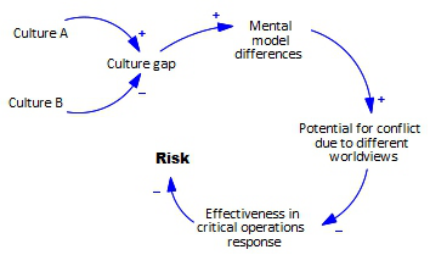
Why Shall We Care About Understanding Culture Frameworks and Dimensions? The benefits obtained by diversity across teams in terms of increasing the number of perspectives a certain team or organization may have over a certain issue, problem or task, gets sometimes complicated due to an increase in interpersonal conflicts – with the consequence of increasing organizational risk (Figure 1).
To understand Figure 1, a ‘+’ sign in an arrow head means that the effect moves in the same direction as the cause, and a ‘-’ sign means the opposite (Sterman, 2000; García, 2004; Meadows, 2008). Hence, in this case the big- ger the Culture gap, the bigger the Mental model differences and the higher the Potential for conflict due to different worldviews, which decreases the
Figure 1: Relation between culture gap and risk.
The Impact of Cultural Diversity on Organizational and Operational Risk Levels 255
Effectiveness in critical operations response, which in turn increases Risk (the ‘-’ sign reverses the direction of a variable behaviour within a cause and effect relation).
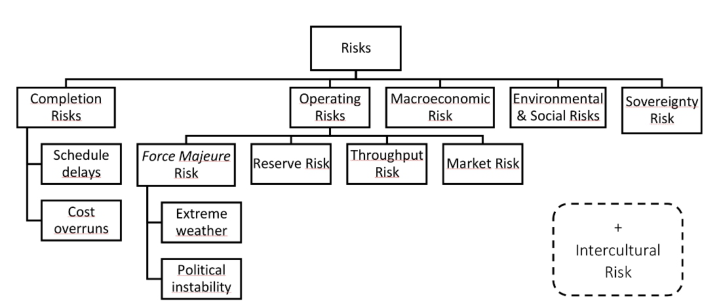
Multinational industrial, maritime, military, peacekeeping and other ope- rations may be regarded as having already associated risks by their nature (Água & Morgado, 2020). Figure 2, drawing from an international oil and gas megaproject, provides an example of what could be a risk breakdown structure for a typical multinational megaproject, to which one can add the impact of the intercultural risk, potentially aggravating the former ones. One may be tempted to devalue the intercultural risk in the perspective of so many risks already identified; however, such risks are seldom independent among themselves, and reinforce each other in different quantities, with culture having a considerable impact.
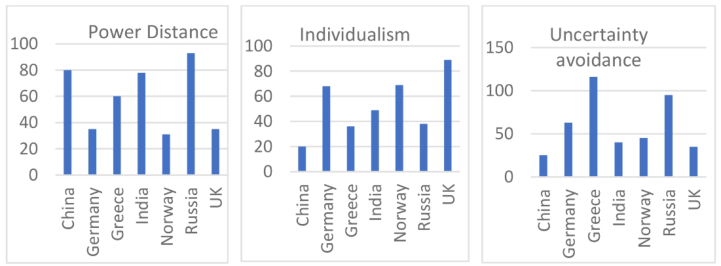
National culture impacts critical operations due to several causes. For example, Hofstede’s uncertainty avoidance dimension defines the level of courage or “bravery” typical of a culture which doesn’t fear addressing the issues assertively and challenging bosses or whoever is responsible for adequ- ate decision-making. One can imagine how certain far east cultures deal with disaster response when such cultures plan for everything by being unable to improvise; but improvisation sometimes are the best and only response. Or, one can imagine the degree of diligence in a critical operation when people from monochronic and polychronic cultures are working together – it’s not difficult to imagine the pressure building process going on within a mono- chronic type of person as he/she has to deal with some critical emergency while having to coordinate operations with fellows from polychronic cultu- res. The power distance dimension could also provide examples where time was of the essence and operators, as for instance pilots, didn’t question higher authority until it was too late and a plane crashes with the loss of lives and assets. Figure 3 puts into perspective a subset of seven quite diverse countries in what these cultural dimensions concern.
Figure 2: Example of a risk breakdown structure for a multinational megaproject (based on Esty & Bitsch, 2013).Figure 3: Example Hofstede culture dimensions for 7 countries (elaborated by the authors based on https://geerthofstede.com/).
Many other examples could be pointed out; however, the aim is to establish the relevance that cultural diversity plays in increasing organizational risks, especially critical when in the context of multinational operations, projects and businesses.
COMPARATIVE ANALYSIS TO ESTABLISH A UNIFYING TAXONOMY Decision-making in critical endeavours has more potential for disaster as compared with more stabilized contexts, as it usually affects human life, and valuable assets, within a potentially aggravated VUCA (Volatile, Uncertain, Complex, Ambiguous) context. By analysing and comparing the main culture models and associated dimensions, clarifying where such models superim- pose each other and where they are complementary, one can have a better understanding of all the culture models menace, and a stepping stone on which to build on. Consequently, it will be possible to think in terms of cause and effect, and design useful procedures to support the people on the field and organizational development, hence contributing to an improved human factors paradigm in what intercultural interactions concerns. The outcome is a clearer and tentatively unifying model – a proposed taxonomy – which may help in addressing, managing and keeping risks derived from multi- cultural interactions under control, so organizational risk levels don’t arise considerably as a result.
Table 5 proposes a comprehensive enough unifying framework. By com- prehensive enough it is meant that the main culture models were taken into consideration; however, not in an exhaustive or “maximizing” approach. A compromise was chosen between comprehensiveness and usefulness – there- fore the “satisficing” (a combination of sufficing and satisfying) concept was given more relevance than the maximizing one (Simon, 1956).
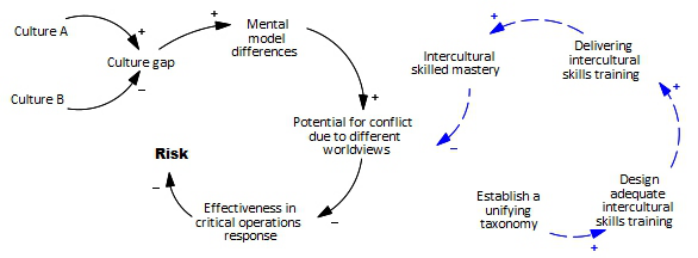
Such twelve dimensions framework, resulting from the blend of Trompe- naars and Hofstede culture models, together with insights from Hall and Lewis culture models could be the basis for specific training design aimed at preparing professionals across diverse industries and businesses to perfect their intercultural skills and therefore decrease the potential for conflicts or
The Impact of Cultural Diversity on Organizational and Operational Risk Levels 257
Table 5. A unifying taxonomy proposal (author’s elaboration).
Table available in the original PDF paper.
Dimension Obs.
1. Universalism vs. Particularism 2. Collectivism vs. Individualism Common both to Hofstede and Trompenaars frameworks 3. Neutral vs. Affective 4. Diffuse vs. Specific 5. Achievement vs. Ascription 6. Monochronic vs. Polychronic Relates to Lewis’ Linear-active dimension 7. Inner-directed vs. Outer-directed 8. Power distance 9. Masculinity vs. Femininity 10. Uncertainty avoidance 11. Long-term vs. Short-term orientation Relates to Hall’s time dimension 12. Indulgence vs. Restraint
Figure 4: By understanding culture models and dimensions it is possible to design solutions for effective team and organizational development.
friction due to different worldviews (Figure 4). Obviously the utter risk level will be a function of the balance between the contributing causes on Potential for conflict due to different worldviews.
DISCUSSION/CONCLUSION Having a baseline model with a “satisficing” number of cultural dimensions provides a first step in thinking intercultural skills development. Guided by the principle of usefulness, some practical implications can be drawn to point towards a more ambitious research line where operationalizing models for people and organizational development may rely on.
Despite the benefits of diversity, cultural diversity may in fact escalate organizational risks as a collateral effect. Such is due to misunderstandings, different concepts of power, hierarchy, time and space, among others. Not planning to address such critical concepts when in multinational operations and businesses is planning to fail. The most perfect strategy may just fail in
its implementation because people have different cultural lenses, with many examples that could be drawn from the referenced literature.
Cultural diversity is a way to drive systems towards intended goals; how- ever, with such diversity one also gets more friction and conflicts across multicultural organizations which extend into most multinational systems’ endeavours and operations – having emergencies and disaster response efforts a particular interest due to lives and assets potentially at stake. Not taking cultural differences into account can lead to misunderstandings, friction and aggravating conditions where oftentimes safety is at stake.
The main culture models were introduced and a unifying taxonomy was proposed. Besides the need for further research, among the ideas for develo- pment one can suggest is the need to develop training programmes aimed at developing the cultural intelligence of organizations, which can only be attai- ned by developing their people. After all, perhaps around 50% of business success could be credited on soft skills such as negotiation techniques, cul- tural awareness, with professional or technical knowledge playing a minor part in comparison. Nevertheless, it is not possible to end this text without stating that any culture model constitutes a stereotype, with countries having several subcultures within. Moreover, a person may have a culture of his/her own or of the organization it has been serving for many years, which makes him/her culturally distinct from his/her country of origin to a certain degree.
ACKNOWLEDGMENT
The authors would like to acknowledge the EU MEDEA Project grant agreement n
787111 and the Portuguese Navy for their support.
REFERENCES
Água, P. B., Morgado, A. V. (2020). Project Governance, An essay on the business policy approach as applied to the governance of megaprojects. The Journal of Modern Project Management, 8. Água, P. B., Frias, A., Correia, A. (2022) “Negotiating Across Cultures: Insights
for the 21st Century.” Handbook of Research on Organizational Sustainability in Turbulent Economies, edited by Rafael Ignacio Perez-Uribe, et al., IGI Global, 2022, pp. 247–265. https://doi.org/10.4018/978-1-7998-9301-1.ch014 Brett, J. M. (2014). Negotiating Globally. How to negotiate deals, resolve disputes, and make decisions across cultural boundaries. San Francisco, CA: Jossey-Bass. Esty, B. C., Bitsch, F. (2013) The Kashagan Production Sharing Agreement (PSA).
Case 213082. Harvard Business School. French, R. (2007). Cross-Cultural Management. London, UK: Chartered Institute of Personnel and Development. García, J. M. (2004) Sysware; Barcelona, Spain: Juan Martin García. Hall, E. T., Hall, M. R. (1990). Understanding Cultural Differences: Germans, French
and Americans. London: Intercultural Press. Hofstede, G. (1991) Cultures and Organizations. Intercultural cooperation and its importance for survival. Software of the mind. London, UK: Profile Books. Lewis, R. D. (2014) When Cultures Collide: Leading across cultures. London, UK:
Nicholas Brealey Pub. Livermore, D. (2010). Leading with cultural intelligence. New York. AMACOM.
The Impact of Cultural Diversity on Organizational and Operational Risk Levels 259
Meadows, D. H. (2008) Thinking in systems: a primer. White River Junction, VT: Chelsea Green Publishing. Meyer, E. (2014). The Culture Map. New York: Public Affairs. Schwartz, S. H. (1999). A theory of cultural values and some implications for work.
Applied Psychology: An International Review, Vol. 48(1): 23–47. Simões-Marques, M. J. (2017). Facing Disasters—Trends in Applications to Support Disaster Management. In: Nunes, I. (eds) Advances in Human Factors and System Interactions. Advances in Intelligent Systems and Computing, vol 497. Springer, Cham. https://doi.org/10.1007/978-3-319-41956-5_19 Simon, H. A. (1956). Rational choice and the structure of the environment. Psycho-
logical Review 63(2), 129–138. Sterman, J. D. (2000). Business Dynamics. Systems Thinking and modelling for a complex world. New York: McGraw-Hill. Trompenaars, F., Hampden-Turner, C. (1997) Riding the waves of culture: Under-
standing cultural diversity in business. London, UK: Nicholas Brealey Pub.
LISTED IN THE AHFE DIGITAL BOOKSTORE CATALOGUE
Explore the complete digital volume
Human Factors and Systems Interaction
Read this individual research paper free through the original publisher, or explore the full digital proceedings book.
ISBN 978-1-958651-60-5
Explore this ISBN in the AHFE Bookstore ↗Listed in the July 2026 bookstore catalogue; search by ISBN to confirm current availability · Digital book purchase optional