Mario Simões-Marques, Pedro Água, Armindo Frias, Anacleto Correia (2023). Metaverse and Digital Twins: contributions, opportunities and challenges to a sustainable use of the ocean. In: Human Factors and Systems Interaction. AHFE Open Access, vol. 84, pp. 227–237. https://doi.org/10.54941/ahfe1003608
1 CINAV, Escola Naval, Instituto Universitário Militar, Base Naval de Lisboa, 2810–001 Almada, Portugal ↗
2 CINAV, Escola Naval, Instituto Universitário Militar, Base Naval de Lisboa, 2810–001 Almada, Portugal; Advance/CSG, ISEG-Universidade de Lisboa, Rua Miguel Lupi n ◦ 20, 1249–078 Lisboa Portugal ↗
Human activity often negatively affects the ocean and their livelihoods, with overexploited fisheries, marine pollution, plastic litter, or acidification. The importance of sustainable use of the ocean is recognized under United Nations’ SDG 14, which focused on ocean habitats. Dealing with the challenges facing the ocean and their use requires ocean-related stakeholders to make informed decisions, often complex, due to the cross-domain nature of the issues and the still quite limited amount of knowledge and tools available for such a decision-making process. This article discusses a conceptual framework addressing the contributions and challenges that a Digital Twin Ocean, as a key element of the Metaverse, faces or presents to sustainable ocean use, in support of its stakeholders.
Despite the importance of oceans for human life, the significance of this dependence is largely underestimated or even ignored. Some figures conve- ying such importance are: (i) oceans cover approximately 72% of the earth’s surface; (ii) around 10% of world’s population live in low elevation coa- stal zone (less than 10 meters elevation), with almost 40% living within 100 km of the coast; (iii) stocks from the sea satisfy around 17% of human needs for animal proteins (with the importance of aquaculture rapidly gro- wing); (iv) over 80% of the volume of global trade is carried by sea; (v) over 95% of the intercontinental communications flows over undersea fiber cables; and (vi) the ocean is a vital regulator of climate, absorbing 30% of the carbon dioxide produced by humans. Human activity is affecting the ocean and their livelihoods, with negative impacts such as overexploited fish stocks, marine pollution, plastic litter or acidification. The importa- nce of conservation and sustainable use of the ocean is recognized under
UN’s Sustainable Development Goal 14 (SDG 14), focused on the ocean habitats1.
Dealing with the challenges facing the ocean and their use from a Blue Economy perspective requires the ocean related stakeholders to make infor- med decisions, often complex, due to cross-domain nature of the issues and the still quite limited amount of knowledge and tools available for such decision-making process. The demand for digital ocean related pro- ducts and services (e.g., hydrographic, maritime and GIS) led, for insta- nce, the International Hydrographic Organization (IHO) to develop the S-100 Universal Hydrographic Data Model which defines concepts, meta- data attributes, and other resources to use in the development of inte- roperable products. This standard goes along with other International Organizations standards (e.g., IALA’s S-200 and IOC’s S-300). Therefore, the Metaverse and Digital Twins can play a relevant role in supporting the definition of strategies, plans and actions, particularly when dealing with ocean related crises. Even though these terms recently gained incre- ased attention and became buzzwords, the concepts and interactions they underly are as old as the technologies their rely on, which naturally are growing in capability as systems and methodologies evolve, and some did not really surpassed the “death valley” that face many of the innovative technologies in the initial stages of their development before coming into production.
The term “metaverse” was first coined in 1992 by Neal Stephenson, in his science-fiction novel “Snow Crash”, referring to a computer-generated (imaginary) universe that a computer draws onto goggles and pumps into earphones, reflecting what is currently designated as virtual/mixed reality. On the other hand, according to Michael Grieves (2017), the term “digital twin” was introduced by him in 2003, reflecting the concept of a vir- tual, digital equivalent to a physical product, attributing it to John Vickers, the NASA Principal Technologist in the area of advanced materials and manufacturing.
Politicians are recognizing and promoting innovation around emergent technologies, aimed at designing tools that support their decision-making process. This is the case of European Commission in its publication “The digital twin ocean: an interactive replica of the ocean for better decision- making” where it is addressed the goal of creating a digital space that gathers knowledge which will help on designing the most effective ways to restore marine and coastal habitats, support a sustainable blue economy and adapt to a changing climate (EC-DG R&I, 2022).
The aim of this article is to contribute to the analysis of the features of a common framework which addresses the design of Digital Twins, as key elements of the Metaverse, and in particular of a Digital Twin of the Ocean (DTO). Thus, the next sessions address the role that a DTO can play in the support of decisions related with a sustainable exploitation of blue economy (e.g., shipping, aquaculture, wind farms, marine infrastructures) and propo- ses a conceptual framework for its development. The methodology applied 1https://sdgs.un.org/goals/goal14
Metaverse and Digital Twins: Contributions, Opportunities and Challenges 229
encompassed the screening of literature and sites of relevant national and international organizations, and project groups.
METAVERSE AND DIGITAL TWINS Metaverse
Metaverse has no standard definition; but, according to the Analysis and Research Team of the Council of the European Union, it can be described as an immersive and constant virtual 3D world where people interact through an avatar to enjoy entertainment, make purchases and carry out transaction with crypto-assets, or work without leaving their seat (ART, 2022). Due to the broadness of potential applications and challenges, the Metaverse as been compared with the Ocean, considering the enormous amount of oppor- tunities, but also the risks, of its exploitation2. The concept subjacent to Metaverse is not new; a common example are gaming virtual worlds, such as Second Life, and some Serious Games3 derived from this environment. Nevertheless, Metaverse is quite recent as a research topic, with a still limi- ted number of publications, particularly regarding research addressing oceans and the maritime domain.
Bale et al. (2022) offer a review focused on explaining the concept of the Metaverse, its history, the expected benefits, and the concerns regarding how it can impact and affect humans mentally, physically, and psychologically.
In Dionisio et al. (2013) are identified and discussed the current and future possibilities regarding the four features that are deemed central ele- ments of a Metaverse: 1) realism (enabling users to feel fully immersed in an alternative realm); 2) ubiquity (establishing access to the system via all existing digital devices and maintaining the user’s virtual identity throughout all transitions within the system); 3) interoperability (allowing 3D objects to be created and moved anywhere and users to have seamless uninterrupted movement throughout the system); and 4) scalability (allowing a concurrent efficient use of the system by massive numbers of users). The development of Metaverse tools relies on the evolution of emerging technologies, namely regarding computation, communications, and representation/ interaction capacities. For instance, a key topic is the cyber-physical systems (CPS) interaction involving solutions that can lay in the continuum ranging from Augmented Reality (AR) to Virtual Reality (VR), encompassing Mixed Reality (MR), a space often designated under the umbrella term Extended Reality4.
In ART (2022) are identified five Metaverse key features: 1) Persistent Immersive & Massive (continues indefinitely, feels real and has the scale of a world/universe); 2) Synchronous (living experience for all in real time); 3) Digital and Real (an experience that spans both the digital and real world); 4) Economy (individuals/businesses create, own, invest, sell and produce 2https://insights.geeiq.com/the-metaverse-as-the-ocean/ 3For instance, First Person Cultural Trainer (Zielke et al., 2009). 4For further readings on Extended Reality refer, for instance, to (Cárdenas-Robledo et al., 2022) and (Rauschnabel et al., 2022).
value recognized by others, altering the way we allocate and monetize resou- rces); and 5) Interoperable (data, content, assets and digital items can be used across different platforms).
An example of research addressing the Metaverse in Maritime Sector is (Luimula et al., 2022), which presents a study case that uses a Metaverse environment for a multi-user training of fire extinguisher usage, in a context that enables the communication between students and the instructor, and another in an harbor environment.
Digital Twin A ‘Digital Twin’ is a digital equivalent of a physical system reflecting its characteristics. Due to variety of physical systems (e.g., products, vehicles, factories, natural environments) and the inherent complexity represented by DT, the definitions found in literature vary significantly; however, they have in common the concept of a realistic digital representation and/or simulation of a physical entity. Several authors have reviewed the literature on DT from different perspectives, that are address bellow.
A significant quantity of research has been done in the context of Inter- net of Things (IoT) and Industry 4.0, an early adopter context of the DT concept. For instance, in (Negri et al., 2017) the authors discuss the role of DT within Industry 4.0 and describe the findings of MAYA project, whose central innovations concept is the combination of the virtual and physical dimensi- ons with the simulation domain within a platform that supports: a semantic meta-data model, describing exhaustively the CPS features; a simulation fra- mework, that connects different simulation methodologies and tools for a multi-disciplinary replica of the physical system; and a communication layer, that ensures the seamless connection of physical CPS to the digital world. Another thorough review of digital twin related concepts, key technologies, modeling and simulation approaches, and industrial applications (including the different lifecycle phases) is presented in (Liu et al., 2021). These authors highlight that the connotation of the DT includes concepts of: 1) Individuali- zation (i.e., one-to-one relation of the DT with the individual physical twin); 2) High-fidelity (i.e., a DT can simulate the physical twin’s behavior in the virtual space as exact as possible, which requires multi-physics modeling and continuous model updating through the whole lifecycle); 3) Real-timeliness (i.e., a DT responds to physical twin with relatively low latency, which is made possible by current development of mobile communication technology and IoT technology); and 4) Controllability (i.e., changes on DT or physical twin control the other twin). Lui et al. further note that a variety of fra- meworks, reference models of digital twin were identified on literature, but none of them become industry consensus, making difficult to conduct syste- matic research, building on the work done by other researchers, and appeals for researchers’ cooperation to form a systematic architecture of digital twin research.
From a sustainability perspective, in (Hassani et al., 2022) the auth- ors review the current trajectory of DT applications in supporting general sustainability, in the context of the 17 UN SDGs. Namely regarding the
Metaverse and Digital Twins: Contributions, Opportunities and Challenges 231
implementation of DT in the fields of agriculture, farming, and fishery, the authors refer the specific challenges faced, noting that managing living phy- sical entities can be far more complex than DT of products. In the maritime domain the authors identify a couple of references addressing DT enabled smart fishery and precision aquaculture, promoting sustainable management of the underwater environment and aquaculture production. The same review also refers research aimed at developing DT related with Earth observation, focused on understanding the changes to the planet and the accelerating cli- mate challenges, namely using tools of climate modelling and forecasting, and reveal the keys to managing interactions between human activities and climate. Further to this, the authors address the main elements composing a DT system, mentioning the five-dimensional model composed by physical entity, the corresponding virtual representation, the digital twin data, the digi- tal twin empowered services, and a bi-directional data transmission channel between the last 2 elements.
From a Human Factors perspective related with complex systems, it is relevant the research presented in (Grieves & Vickers, 2017), where the auth- ors discuss the advantages of using DT over physical prototypes in Systems Engineering (both in terms of costs and feasibility of modeling distributed systems), propose a DT implementation model, identify DT obstacles (i.e., organizational siloing, knowledge of the physical world, and the number of possible states that systems can take), and the possibilities (capturing and using in-use information and system front running) to mitigate unpredicta- ble undesired behaviors of complex systems, and also to evaluate how well virtual systems mirror their physical counterparts. The main context addres- sed by these authors is the one of sociotechnical systems, where the human element interacts with complex systems, occasionally leading to accidents and disasters, including maritime disasters as a result of human inconsiste- ncy (deliberate or accidental) in following rules, processes, and procedures; and a lack of sensemaking (i.e., the ability to make sense out of the inputs and stimuli that are being presented to the human).
From a DT conceptualization framework perspective, the review and the results presented in (Rasheed et al., 2020) are worth of note. The authors identify some challenges to such endeavor, like the identification of relevant information (roles, activities, etc.), or the abstraction from domain-specific particularities and the specification of a proper level of abstraction that can be used as a frame of reference for further DT developments. The authors also mention different DT categories, namely: 1) Virtual Twin (i.e., a vir- tual representation is created based on a physical asset), 2) Predictive Twin (i.e., physics, data, or hybrid models based on a virtual twin in order to predict behavior of a physical asset); and 3) Twin Projection (i.e., the data obtained through the predictive twin is analyzed in order to gain insights in terms of underlying operations and processes). The authors also note that the overarching challenge to develop the DT is hardly different from its phy- sical counterpart, which results in taking a variety of design and engineering solutions considering: 1) data handling (involving protection, security, and quality supported by cryptography, blockchain, and Big Data technologies); 2) real-time communications (through compression techniques or proper
communication technologies including 5G and IoT protocols); 3) real-time modeling and modeling the unknown (requiring the combination of sensing, symbolic regression, reduced order modeling, or multivariate data-driven models along cybernetic life cycles in order to continuously update an existing model); 4) interfacing physical assets technologically and organization-wise (enabled through sensor technologies, physics-based simulation, data-driven models, and human-accessible interaction mechanisms such as natural lan- guage interfaces, augmented or virtual reality features); 5) variability of system topologies (requiring edge, fog, and cloud computing approaches); and 6) maintainability (based on transparent and interoperable architecting, allowing for hybrid analysis and modeling).
From the literature it is possible to identify a number of DT references addressing specific elements of the maritime domain, for instance related to shipbuilding, wave energy conversion, offshore wind power, submarine pipelines, and aquaculture.
THE OCEAN VALUE AND THE NEED FOR A TRANSFORMATIONAL OCEAN SCIENCE Considering the Ocean value perspective, it was noted in (Simões-Marques & Pacheco, 2022) the most recent way of valuing the ocean is by identifying the services provided by marine ecosystems. These authors identified four services’ types:
Support services for marine ecosystems - include safeguarding biodiver- sity, nutrients cycle (from primary production to degradation by bacteria and biochemical conversion), maintaining the dynamics of food chains, keeping habitats intact, primary production (biomass), and maintaining the resilience of marine habitats and the water cycle;
Supply services - include maritime trade routes, fisheries and aquacul- ture, renewable energies (e.g., tides, wind, and sea turmoil), freshwater production through desalination processes, installation of pipelines and submarine cables, the availability of ingredients for the pharmaceutical and cosmetic industry, areas for military use, the disposal of hazardous materials, jewelry goods, genetic resources for the development of new medicines and the exploitation of non-renewable resources (e.g., natural gas, oil, sands, rare elements);
Regulatory services - include coastal protection through dunes, coral reefs, and mangrove forests, maintaining air quality through oxygen renewal by algae and absorption of carbon dioxide, maintaining climate characteri- stics through thermohaline circulation and heat exchange between water and the atmosphere, maintaining water quality through the decomposi- tion of nutrients from sewage and agriculture, maintaining water purity through the decomposition of pollutants through their dilution, chemical modification and deposition on the bottom of the sea;
Cultural services - include, for example, enhancement of the aesthetic part of seascapes, contributions to science and natural history education, religi- ous and spiritual enhancement of seascapes and sites, providing a source of
Metaverse and Digital Twins: Contributions, Opportunities and Challenges 233
artistic inspiration, enhancement of heritage culture associated with land- scapes, sites, and marine creatures for traditional jewelry, and recreation and tourism activities.
Considering the scientific perspective, the importance of understanding the challenges facing the ocean and such services led the United Nations (in December 2017, at the 72nd Session of the UN General Assembly) to lau- nch a long duration campaign to deliver a lasting change, proclaimed as the UN Decade of Ocean Science for Sustainable Development 2021–2030 (refer- red to as ‘the Ocean Decade’). The general objective is that ocean science5, further than diagnosing problems, has the ability to offer solutions to sustai- nable development, recognizing the need for a transformational ocean science that will empower and engage stakeholders across disciplines, geographies, generations and genders (UNESCO-IOC, 2022). The action plan presented in (UNESCO-IOC, 2022), defines as objectives: 1) identify required kno- wledge for sustainable development; 2) generate comprehensive knowledge and understanding of the ocean; and 3) increase the use of ocean knowledge. This action plan recognizes the role of data and information as key enablers of the Ocean Decade outcomes (i.e., a clean ocean; a healthy and resilient ocean; a productive ocean; a predicted ocean; a safe ocean; an accessible ocean; an inspiring and engaging ocean), and states that digitizing, acces- sing, managing and, most importantly, using ocean-related data, information and knowledge will be cornerstones of the success of the Ocean Decade. The Ocean Decade identifies ten challenges to address: 1) Understand and beat marine pollution, 2) Protect and restore ecosystems and biodiversity, 3) Sustainably feed the global population, 4) Develop a sustainable and equi- table ocean economy, 5) Unlock ocean-based solutions to climate change, 6) Increase community resilience to ocean hazards, 7) Expand the Global Ocean Observing System, 8) Create a digital representation of the ocean, 9) Skills, knowledge and technology for all, and 10) Change humanity’s relationship with the ocean. Challenge 8 ‘Create a digital representation of the ocean’ is particularly related with the theme of the Digital Twin of the Ocean (DTO).
Aligned with this vision, the European Commission envisages the deve- lopment of a DTO, i.e., ‘a digital space providing access to vast amounts of data, models, artificial intelligence and other tools, which will allow the repli- cation of the properties and behaviors of marine systems, including ocean currents and waves, marine life and human activities, and their interactions, in and near the sea’ (EC-DG R&I, 2022). Exploiting the DTO allows better understanding of the ocean, predict its response to changes, simulate alter- native scenarios, and ultimately make the best informed decisions. Potential beneficiaries include the marine and coastal policies (e.g., as a result of testing the effectiveness of planned infrastructures), researchers (e.g., through the
5Ocean science includes all research disciplines related to the study of the ocean: physical, biological, chemical, geological, hydrographic, health, and social sciences, as well as engineering, the humanities, and multidisciplinary research on the relationship between humans and the ocean. Ocean science seeks to understand complex, multi-scale social-ecological systems and services, which requires observations and multidisciplinary and collaborative research (Expert Panel on Canadian Ocean Science, 2013).
assessment of the impact of human activities and climate change), Blue Eco- nomy stakeholders (e.g., ensuring sustainability by reducing environmental pressures), and all the population (e.g., as result of the contribution to science and the empowerment of citizens).
Each of the ten challenges identified in the Ocean Decade is by itself quite complex. Take, for instance, challenge 7 ‘Global Ocean Observing System’; this is an endeavor that requires the combination of multiple enti- ties (e.g., governmental, non-governmental, academia, industry) at planetary level. One dimension of this endeavor, essential to all the others, is the high resolution bathymetric mapping of the sea bed; Seabed 2030 is a col- laborative project between the Nippon Foundation and GEBCO6, which aims to bring together all available bathymetric data to produce the defi- nitive map of the world ocean floor by 2030 and make it available to all. The Global Ocean Observing System (GOOS) of the Intergovernmen- tal Oceanographic Commission of UNESCO (IOC GOOS), is integrated by several regional GOOS; for instance, EuroGOOS is the European compo- nent of IOC GOOS, is composed by 44 members and supports five regional systems in Europe. EuroGOOS identifies priorities, enhances cooperation and promotes the benefits of operational oceanography to ensure sustained observations are made in Europe’s seas underpinning a suite of fit-for-purpose products and services for marine and maritime end-users. EuroGOOS wor- king groups, networks of observing platforms7, and regional systems, provide fora for cooperation, unlock quality marine data and deliver common strate- gies, priorities and standards. The observing systems gather data extracted from satellite imagery, and generated by a host of sensors (encompassing HF Radars, tide gauges, ferry boxes, fixed platforms, gliders, multipara- metric buoys, drifting buoys, or animal-borne instruments) used to measure water and sea bed ocean parameters (e.g., temperature, salinity, pH, waves, currents, tides).
The context set above is key to the contribution to definition of a frame- work for the specification and design of a DTO, which will be addressed in the next section.
DIGITAL TWIN OF THE OCEAN As stated in (EC-DG R&I, 2022), one key purpose of DTO is to support better decision-making. These authors state that by connecting data and models through tailor-made applications, scientists, marine experts, policymakers, entrepreneurs and user-driven applications, DTO allows the test of different specific scenarios.
This vision, unlike what happens with most DT developed to date, anticipates a multitude of ocean stakeholders with totally different 6GEBCO (General Bathymetric Chart of the Oceans) is an organization whose aim is to provide the most authoritative publicly-available bathymetry of the world’s oceans. It operates under the joint auspices of the IHO and the UNESCO’s Intergovernmental Oceanographic Commission (IOC). 7For instance, the Copernicus European Union’s Earth Observation Programme and Marine Services, the European Marine Observation and Data Network (EMODnet), and the Pan-European Infrastructure for Ocean & Marine Data Management (SeaDataNet).
Metaverse and Digital Twins: Contributions, Opportunities and Challenges 235
interests. As highlighted in (Simões-Marques et al., 2021) the list of Maritime Industry stakeholders is hard to enumerate, encompassing, at least, Crews & shoreside employees, Unions, Ship owners & opera- tors, Maritime sector associations, Ship builders & shipyards, Ports, Classification societies, Suppliers, Investors, banks & insurers, International organizations & agencies, Governments & regulators, Security & safety agencies, Costumers, Local communities, NGOs, Academia, Public and Media.
Thus, as consequence of this variety of stakeholders and interests, DTO has to be designed as a System of Systems (SoS) DT and the integration chal- lenges facing its design need to be overcome. These kind of challenges were discussed, for instance, in (Michael et al., 2022), where the authors address the issues facing the evolution from DTs of smaller systems to more com- plex SoS, including: the components and supported functionality of a DT (e.g. data, models, services, APIs, access rights, and views), or the context of a DT implementation (e.g., implementation technologies, frameworks, or black-box systems).
Identically, the type of challenges facing the development of a DTO were discussed in (Correia et al., 2023) focused on a different context, the design of intelligent decision-support systems (comparable to a DT) applied to the context of Disaster Management. The authors note the complexity of decision-support requirements, considering the need to encompass both eli- cited knowledge regarding the domain and the specific context, and raw data from historical and current operational actions, most based on infor- mation provided by large and diverse collections of sensors, combined with crowdsourced data. Moreover, in the ocean context this type of informa- tion is critical to effectively support the collaboration and cooperation of the stakeholders coming from different origins (countries, languages, and cultures), and adopting multiple perspectives towards the maritime domain, which requires effective and efficient data, information and knowledge sha- ring, achieved through the interoperability among open access distributed systems. Correia et al. (2023) argue that ontologies can provide a formal representation of the domain, where categories, relationships, and data are structured in a meaningful way, fit for decision-making purposes, and even suited to machine processing. These authors identify the need for coherent ontologies, integrated in information systems which allow the variety of their users to benefit from the available distributed data, information and knowledge.
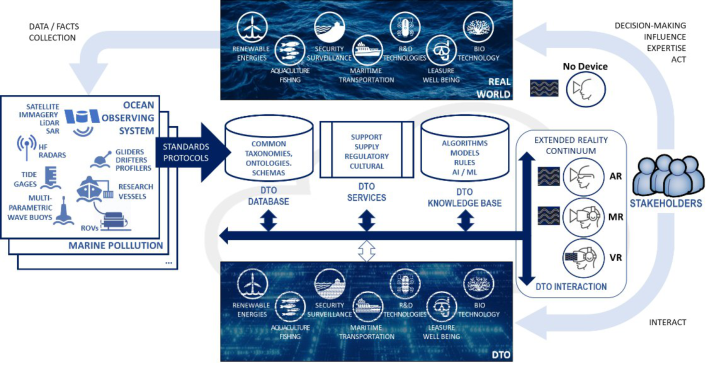
Figure 1 presents a proposal of DTO conceptual framework identifying the interaction of stakeholders both with real world and their digital twin. It illu- strates the collection of real world data and facts, for instance, using sensors. Such data is stored within cloud shared databases, using standards and proto- cols to ensure interoperability. Combining data with cloud shared knowledge, DTO offer services (e.g., virtual replication, simulations or what-if scenarios) to stakeholders, which interact with the DTO using some form of Extended Reality.
Figure 1: Proposed digital twin ocean (DTO) conceptual framework.
CONCLUSION
A sustainable use of the ocean is a global concern, considering the critical value of the services it provides to the planet and to mankind. As technology and their capabilities evolve, there is increasing room for the consolidation of a Metaverse vision, and for the exploitation of the potential benefits of a DTO in supporting the large community of stakeholders worldwide and their multiple roles and perspectives towards the ocean. However, develo- ping an effective global or even regional DTO implies the compliance with very demanding requirements and is faced with substantial challenges. These issues were addressed in the paper, which also proposes a conceptual frame- work that identifies the key components of the DTO, its relationship with the real-world ocean, and forms of interacting with ocean stakeholders.
ACKNOWLEDGMENT
The authors would like to acknowledge the EEA Grants and the Blue Growth for their financial support, via project PT-INN-0066 – M4ML.
REFERENCES
ART (2022). Metaverse - Virtual World, Real Challenges. Brussels: Council of European Union. General Secretariat. Analysis and Research Team. Bale, A. S. et al. (2022). A Comprehensive Study on Metaverse and Its Impacts
on Humans. In: A. Agostini, ed. Advances in Human-Computer Interaction: Hindawi, pp. 1–11. Cárdenas-Robledo, L. A., Hernández-Uribe, O., Reta, C. & Cantoral-Ceballos, J.
A. (2022). Extended reality applications in industry 4.0. – A systematic literature review. Telematics and Informatics, 73(101863), pp. 1–39. Correia, A., Água, P. B. & Simões-Marques, M. (2023). The Role of Ontologies and Linked Open Data in Support of Disaster Management. In: H. J. Scholl, E. Holdeman & K. Boersma, eds. Data in Support of Disaster Management: Public Administration and Information Technology 40, Springer Nature Switzerland AG, pp. 393–407.
Metaverse and Digital Twins: Contributions, Opportunities and Challenges 237
Dionisio, J., Burns III, W. & Gilbert, R. (2013). 3D Virtual Worlds and the Metaverse: Current Status and Future Possibilities. ACM Computing Surveys, 45(3), pp. 1–38. European Commission, DG Research and Innovation (2022). The digital twin ocean
: an interactive replica of the ocean for better decision-making. [Online] Available at: https://data.europa.eu/doi/10.2777/343496 [Accessed 31 01 2023]. Expert Panel on Canadian Ocean Science (2013). Ocean Science in Canada: Meeting the Challenge, Seizing the Opportunity. Ottawa: Council of Canadian Academies. Grieves, M. (2017). Digital Twin: Manufacturing Excellence through Virtual Factory
Replication. 2014. Grieves, M. & Vickers, J. (2017). Digital Twin: Mitigating Unpredictable, Undesirable Emergent Behavior in Complex Systems. In: F. J. Kahlen, S. Flumerfelt & A. Alves, eds. Transdisciplinary Perspectives on Complex Systems. New Findings and Approaches. s.l.: Springer International Publishing Switzerland, pp. 85–113. Hassani, H., Huang, X. & MacFeely, S. (2022). Enabling Digital Twins to Support
the UN SDGs. Big Data and Cognitive Computing, 6(4), pp. 1–16. Heindl, W. & Stary, C. (2022). Structured Development of Digital Twins—A Cross- Domain Analysis towards Unified Approach. In: Processes, 10, 1490. MDPI, pp. 1–26. Liu, M. et al. (2021). Review of digital twin about concepts, technologies, and
industrial applications. Journal of Manufacturing Systems, 58(B), pp. 346–361. Luimula, M. et al. (2022). The use of metaverse in maritime sector – a combination of social communication, hands on experiencing and digital twins. In: E. Markopoulos, R. S. Goonetilleke & Y. Luximon, eds. Creativity, Innovation and Entrepreneurship. AHFE (2022) International Conference Vol. 31. AHFE International, pp. 115–123. Michael, J., Pfeiffer, J., Rumpe, B. & Wortmann, A. (2022). Integration challenges for
digital twin systems-of-systems. In: Proceedings of the 10th IEEE/ACM Interna- tional Workshop on Software Engineering for Systems-of-Systems and Software Ecosystems (SESoS ‘22). New York, NY: Association for Computing Machinery, pp. 9–12. Negri, E., Fumagalli, L. & Macchi, M. (2017). A review of the roles of Digital Twin in CPS-based production systems. In: Proc. Manufacturing Vol. 11. Elsevier, pp. 939–948. Rasheed, A., San, O. & Kvamsdal, T. (2020). Digital Twin: Values, Challenges and
Enablers From a Modeling Perspective. IEEE Access, Vol. 8, p. 21980–22012. Rauschnabel, P. A. et al. (2022). What is XR? Towards a Framework for Augmented and Virtual Reality. In: Computers in Human Behavior. Vol. 133: Elsevier Ltd, pp. 1–18. Simões-Marques, M. & Pacheco, M. B. (2022). O Oceano: Uma oportunidade para
Portugal. Negócios Estrangeiros. Issue 22, July, pp. 73–89. Simões-Marques, M., Frias, A. & Água, P. (2021). Human Factors Impact in the Security and Safety of the Maritime Domain. Advances in Human Factors and System Interactions. AHFE 2021. Lecture Notes in Networks and Systems Vol. 265, pp. 28–36. UNESCO-IOC (2022). The United Nations Decade of Ocean Science for Sustaina-
ble Development (2021-2030) Implementation plan – Summary. Paris: UNESCO (IOC Ocean Decade Series, 19). Zielke, M. A. et al. (2009). Serious Games for Immersive Cultural Training: Creating a Living World. IEEE Computer Graphics and Applications, Vol. 29, pp. 49–60.
LISTED IN THE AHFE DIGITAL BOOKSTORE CATALOGUE
Explore the complete digital volume
Human Factors and Systems Interaction
Read this individual research paper free through the original publisher, or explore the full digital proceedings book.
ISBN 978-1-958651-60-5
Explore this ISBN in the AHFE Bookstore ↗Listed in the July 2026 bookstore catalogue; search by ISBN to confirm current availability · Digital book purchase optional