Orchida Dianita, Kakeru Kitayama, Kimi Ueda, Hirotake Ishii, Hiroshi Shimoda, Fumiaki Obayashi (2023). The Effect of Micro-Breaks on Intellectual Concentration Work: An Individual's Characteristics Measurement. In: Human Systems Engineering and Design (IHSED 2023): Future Trends and Applications. AHFE Open Access, vol. 112, pp. 18–26. https://doi.org/10.54941/ahfe1004109
Micro-breaks are very short time breaks such as several tens of seconds during intellectual work and they are expected to be effective to recover intellectual concentration. A controlled laboratory experiment was conducted to examine the effect of the micro-breaks focusing on individual characteristics. Thirty-one participants were recruited in this study performing cognitive comparison tasks for 25 minutes on a tablet PC under two conditions, which are micro-break intervention condition and no micro-break intervention condition. Quantitative answering times were analyzed to find the individual's performance characteristic concerning the micro-breaks intervention. Five patterns grouping of performance variations were determined utilizing the moving average and locally-weighted scatterplot smoother data. The result shows that 42% of the total participants resulted that micro-breaks condition outperformed the condition without micro-breaks during all the task periods incorporated in the first pattern group. The second pattern group does not show the eminence of micro-breaks towards 10% of total participants. In the third pattern group, the superiority of the micro-breaks appears after a certain time and not from the beginning of the task shown by 26% of participants' data. The degradation of the micro-break effectiveness is shown in a fourth pattern group for 19% of the sample group. In the last pattern group, both the superiority and deterioration of the micro-break are found in 3% of the data. The results demonstrate each individual's characteristic in responding to the micro-breaks intervention during cognitive task presented in the five patterns group. The majority of the participants benefited from the micro-breaks indicated by more stable and faster performance compared to the no micro-breaks condition.
Managing a good and stable cognitive performance is essential in a modern dynamic work environment. Office workers are expected to excel in their performance and maintain their productivity during their work schedule. Maintaining individual stable performance and intellectual concentration remains a challenge in a daily 8-hour normal work-time.
One promising approach named micro-breaks arises as a mechanism to maintain an individual’s work performance by allocating a short time to
The Effect of Micro-Breaks on Intellectual Concentration Work 19
pause work during the working period. The micro-breaks are expected to put out better general outputs concerning the work performance indicators.
Previous studies mentioned the importance of taking a break during work. Biwer et al., (2023) evaluated the effect of taking a break in dif- ferent conditions namely self-regulated break, systematic long break, and systematic short break which resulted that systematic break possessing the mood and efficiency benefits compare to self-regulated break. Not hav- ing frequent breaks resulted in increasing the symptom of fatigue both physical and psychological for the remote workers’ case studies (Cropley, et al., 2023). A study conducted by Conlin et al., (2021) found that both types of micro-breaks mentioned as a relaxation activity and an exper- tized activity were more effective to restore performance than no break condition.
Regardless of the previous studies conducted incorporated the micro- breaks, it is still unclear whether each individual owns certain characteristics in responding to the micro-break intervention amid the intellectual cog- nitive work. Hence, the purpose of this study is to investigate the effect of the micro-breaks on intellectual work by considering the individual’s characteristic measurement.
METHODS
Participants Thirty-one participants (ID:1-31) aged 18–28 years were recruited in this study (male = 20 and female = 11). They were asked to perform a cogni- tive comparison task on a tablet PC. All the participants performed the task under two different conditions with the micro-break intervention and with- out the micro-break intervention in a counterbalanced design for 25 minutes in each condition. The micro-break intervention was given for 20 seconds every 7,5 minutes under the micro-break condition. In total, there were three times the micro-breaks were given. During the 20 second micro-break period, a blank grey screen appeared on the display. The design of micro-break intervention had been adopted from previous study by Kitayama et al., (2023).
Cognitive Comparison Task The cognitive comparison task design as a task to compare two semantic words and two numerical values was adopted from Ueda et al., (2016). Two words appear on the display and the participants should decide whether the two words fall into the same category or not. Additionally, two num- bers also appear with the inequality sign between the numbers. Then they should also decide whether the inequality sign is correct or not. For exam- ple, if the answer to word comparison fall into the same group and the answer to number inequality is correct, then they should tap the box of word comparison “same category” and number comparison “correct”. The answering box are displayed in a 2x2 format, with the intersection categories
of word comparison as “same” and “not same” categories and the inequality sign as “correct” and “incorrect” boxes. The answering times are auto- matically recorded in the experiment program. Every time the participants finish answering one question, the next question immediately appears on the display.
Analysis Method Answering time data for both conditions with micro-break and without micro-break intervention were analyzed with the time-series moving aver- age method and locally-weighted scatterplot smoother analysis (Cleveland, 1979), where the statistical software Minitab was utilized (Minitab, 2023). Grouping patterns were determined based on participants’ answering time characteristics. The patterns reflected an individual performance comparison in two conditions with and without the micro-break intervention during the task. The grouping consideration was based on the smoother line analysis between the condition with and without micro-breaks from the viewpoint whether the intersection was found at one particular point or not. The intersection indicates a critical point in whether there is a shift changing when one performance outperforms another when previously the opposite conditions apply.
RESULTS AND DISCUSSION
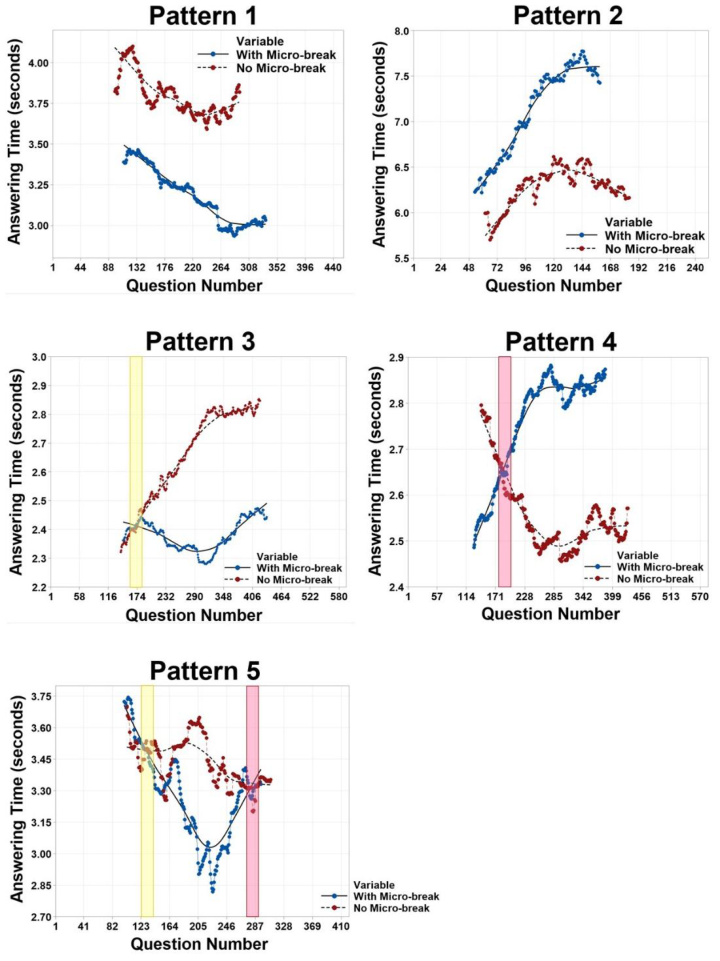
Considering whether the intersection appeared or not, distinguished pattern was divided into five patterns namely: 1) pattern 1 – no intersection found and the performance in micro-break excel the no micro-break condition in all working task period, 2) pattern 2 – no intersection found and the per- formance in no micro-break condition surpass the micro-break condition in all task period, 3) pattern 3 – intersection found and after the intersec- tion, the micro-break performance surpass the no micro-break, 4) pattern 4 – intersection found then followed by the no micro-break performance dominancy among micro-break performance, 5) pattern 5 – both the inter- section found which characterize as pattern 3 and pattern 4. Figure 1 shows the five pattern grouping characteristics in conditions with micro-break and without micro-break. The vertical axis of the graph indicates an answering time for each question answered by the participant, while the horizon- tal axis indicates the question numbers that the participants successfully answered during 25 minutes task period. The blue dots indicate the per- formance in the condition with the micro-break intervention, follows by the black smoother line between the dots. Meanwhile, the red dots indi- cate the performance in the condition without micro-break intervention and the black dash smoother line follows between them. If the blue dots trend and its smoother line located below the red dots, it can be interpreted that the performance in the condition with micro-breaks was outperformed that without micro-breaks by showing a faster answering time, and vice versa.
The Effect of Micro-Breaks on Intellectual Concentration Work 21
Figure 1: The five patterns group characteristic of answering time in condition with micro-breaks and without micro-breaks.
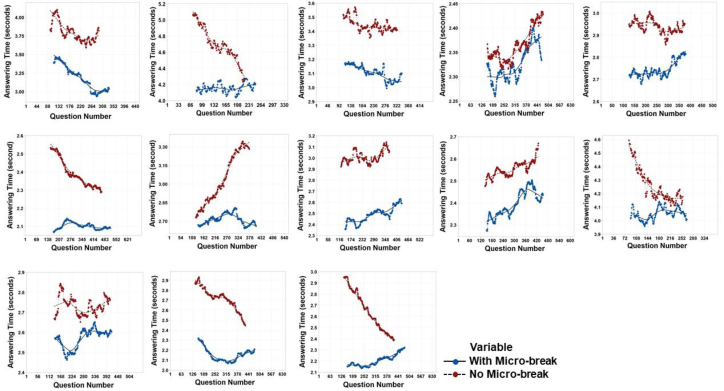
Figure 2 shows the thirteen participants’ data which follows the first pat- tern group. It shows that in a condition with micro-breaks, the performance was to transcend the condition without micro-breaks during overall the task period. In this pattern, no intersection point was found between the smoother line with and without micro-break data. Thirteen participants (42%) show the answering pattern indicated in the first group.
Figure 2: Moving averages and smoother lines of answering time of the participants in the first pattern grouping.
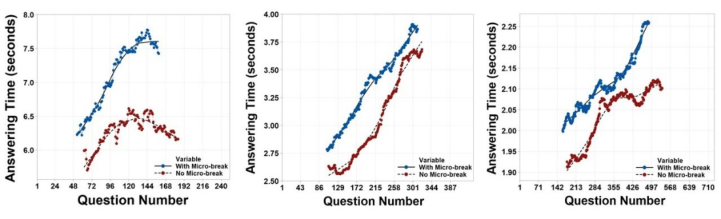
Figure 3 shows the data of the second pattern group. The performance without the micro-break outperformed those with micro-break interven- tion in all task duration in the second pattern group. Similar to the first pattern, in the second pattern, no intersection point was found during all task periods. Three participants (10%) were included in the second pattern group.
Figure 3: Moving averages and smoother lines of answering time of the participants in the second pattern grouping.
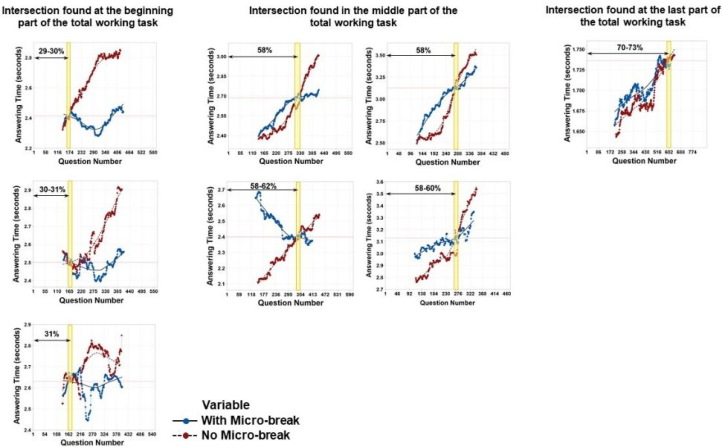
Figure 4 shows the data of the third pattern group. It detects an intersection occurs between performance in both conditions, in which after the inter- section happens, the performance under the micro-break condition excels that under the no micro-break condition. Eight participants’ data (26%) were classified into the third pattern group. In the group, the intersection occurs generally in three different task periods which are at the beginning, middle, and end of the task period. Three out of eight participants were categorized in the third pattern show the beginning intersection emergence
The Effect of Micro-Breaks on Intellectual Concentration Work 23
during the task period. The beginning intersection was found around the area of 29-31% of the total task. The middle intersection occurrence was found in four participants’ data. In the middle intersection, the intersection was found around the area of 58-62% of the total task. One participant’s data showed the intersection at the end part of the task. Intersection with the end part of the task period occurs between the range of 70-73% of the total task.
Figure 4: Moving averages and smoother lines of answering time of the participants in the third pattern grouping.
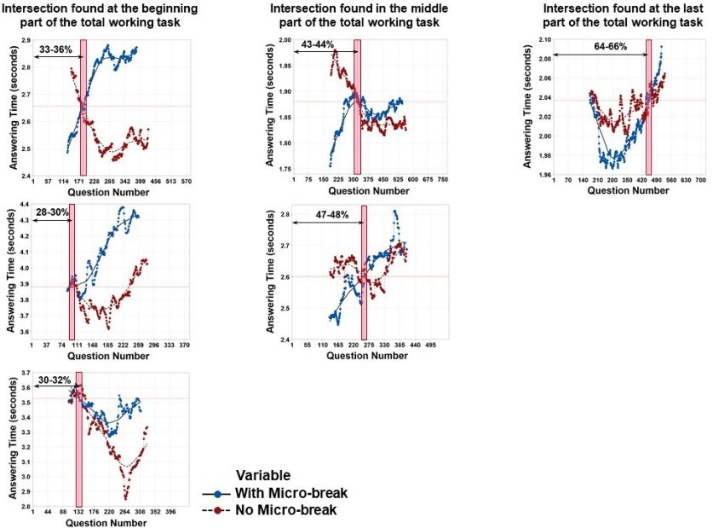
Figure 5 shows the data of the fourth pattern group. It depicts the opposite characteristics of the third pattern group. The intersection was also found in this pattern, however after the intersection occurs, the performance under the micro-break conditions decays, thus the performance in no micro-break outperformed it. Six participants’ data (19%) showed the pattern correlated with this pattern group. Similar to the previous pattern group, the intersec- tion was also found at the beginning, in the middle, and at the end of the task period. Three out of six participants correlated with the fourth pattern, which showed the intersection found at the beginning of the task period. The beginning intersection was found in the area around 28-36% of the total task period. The middle intersection of the fourth pattern was shown by two participants’ data. Around the area of 43-48% of the total task, the middle intersection was found. Lastly, the intersection found at the end part of the task period was shown by one participant. The end part inter- section specifically was found around the area of 64-66% of the total task period.
Figure 5: Moving averages and smoother lines of answering time of the participants in the fourth pattern grouping.
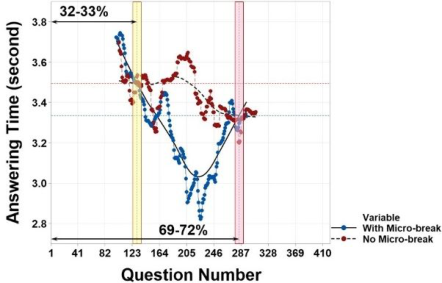
Figure 6 shows the data of the fifth pattern group. It shows both the intersection characteristics with the performance in micro-breaks and no micro-breaks outperformed each other. One participant’s data fell into the fifth pattern group. Specifically, the intersection at which the micro-breaks’ performance started to excel was found in the area of around 32-33% of the total task period. Around the area of 69-72% of the total task period, the second intersection occurred and then the performance in the micro- break condition started to decay and the performance under no micro-break condition surpassed the micro-break performance.
Figure 6: Moving averages and smoother lines of answering time of the participants in the fifth pattern grouping.
The Effect of Micro-Breaks on Intellectual Concentration Work 25
CONCLUSION
Five grouping patterns were determined based on participants’ answering time characteristics. These patterns reflected an individual performance com- parison under two conditions with and without the micro-break intervention during the task. The formation of grouping patterns indicated that the effec- tiveness of the micro-breaks was perceived by individuals with different characteristics. This could indicate that the micro-break could be utilized to achieve optimum performance in each individual. Thus, it is important to consider the individual’s characteristics of the micro-break during the work.
The majority of participants benefited from the micro-break portrayed in the first pattern group and the third pattern group specifically when the inter- section was found relatively at the beginning of the task period. Meanwhile, in the third pattern group, when the intersection was found in the middle and end part, the effective period of the micro-break was relatively short. Thus, it is unclear whether the effect lasts longer considering the experimental work task design set in only 25 minutes. Additionally, the second pattern group data indicated that the condition with micro-breaks did not excel the no micro-break condition and also in the fourth pattern group after the intersec- tion. However, in the fourth pattern group when the intersection was found at the end of the task, it can be depicted that the participant still had the effectiveness of micro-break at the beginning and middle part of the task. The fifth pattern group had a unique characteristic when both the condition with and without micro-break outperformed each other. As one participant’s data was classified in this pattern group, it showed that the effectiveness of micro-break received one-third of the total task period in the middle part of the task.
The result from this study might benefit as an additional reference in designing the optimum work design with the user’s virtue perspective specif- ically related to the intellectual work. Extended from this research, further investigation of the variations of micro-break forms, the alternative micro- break duration and the interlude during the work in corresponding to the individual’s need might enhance the findings in recovery work design.
ACKNOWLEDGMENT
This work was supported by JSPS KAKENHI Grant Number 22H03633.
REFERENCES
Biwer, F., Wiradhany, W., Oude Egbrink, M. G. A., and de Bruin, A. B. H.
(2023). Understanding effort regulation: Comparing ‘Pomodoro’ breaks and self- regulated breaks. British Journal of Educational Psychology, 1–15. https://doi.or g/10.1111/bjep.12593 Cleveland, W. S. (1979). Robust locally weighted regression and smoothing scatterplots, Journal of the American Statistical Association, 74, 829–836. Conlin, A., Hu, X., and Barber, L. K. (2021). Comparing relaxation versus mas-
Cropley, M., Weidenstedt, L., Leick, B., and Sütterlin, S. (2023). Working from home during lockdown: the association between rest breaks and well-being. Ergonomics, 66(4), 443–453. https://doi.org/10.1080/00140139.2022.2095038 Kitayama, K., Dianita, O., Ueda, K., Ishii, H., Shimoda, H., and Obayashi, F. (2023).
Micro-refresh to Restore Intellectual Concentration Decline during Office Work: An Attempt at Quantitative Effect Evaluation. Proceedings of the 2023 Intelligent Human Systems Integration. AHFE Open Access, vol 69. AHFE International, USA. http://doi.org/10.54941/ahfe1002824 Minitab. (2023). Minitab. Retrieved from Minitab: https://www.minitab.com/ Ueda, K., Tsuji, Y., Shimoda, H., Ishii, H., Obayashi, F., and Taniguchi, K. (2016).
Development of “comparison task” to measure intellectual concentration affected by room environment. Proceedings of the 2016 International Conference on Com- munication and Information Systems, 58–64. https://doi.org/10.1145/3023924. 3023939
LISTED IN THE AHFE DIGITAL BOOKSTORE CATALOGUE
Explore the complete digital volume
Human Systems Engineering and Design (IHSED 2023): Future Trends and Applications
Read this individual research paper free through the original publisher, or explore the full digital proceedings book.
ISBN 978-1-958651-88-9
Explore this ISBN in the AHFE Bookstore ↗Listed in the July 2026 bookstore catalogue; search by ISBN to confirm current availability · Digital book purchase optional