Kento Nomura, Takuto Higashimaki, Reika Abe, Kimi Ueda, Hirotake Ishii, Hiroshi Shimoda, Fumiaki Obayashi (2024). Experimental study on the effect of micro-refresh during office work in VR space to restore intellectual concentration decline. In: Intelligent Human Systems Integration (IHSI 2024): Integrating People and Intelligent Systems. AHFE Open Access, vol. 119, pp. 79–87. https://doi.org/10.54941/ahfe1004471
The authors expect that short breaks during work to promote refreshment will suppress the decline in intellectual concentration. In addition, we have been studying the effect of micro refresh (MR), which is a refreshment stimulated by very short breaks and stimuli during work. In this study, we focused on visual changes caused by VR as a method to promote MR appropriately. For example, in a VR space, it is possible to change the environment in a way that is not possible in reality, such as instantly moving from a space where work is performed to a space where nature spreads out. We believe that such a brief distraction from the content of work is an effective way to refresh oneself during work. The purpose of this study is to create a system that encourages brief refreshments during work by changing the environment using VR and to confirm the effect of the system on suppressing the decline in concentration. To evaluate the effect of suppressing the decline in concentration, we calculated and used the concentration time ratio (CTR), which is an indicator of the degree of intellectual concentration, from the response time data of the comparison questions. In addition, several questionnaires were administered to evaluate subjective changes in fatigue and other symptoms. Participants in the experiment were asked to wear a VR head-mounted display and answer the comparison questions. In this research system, the background changes to a natural landscape after a certain amount of time elapses during the work, prompting the participants to take a break. In this experiment, the background changed for 40 seconds every 7 minutes and 30 seconds. When the background changes, the cognitive task is still displayed, and the participant can continue to answer the task. 3 types of backgrounds were created for the MR prompt, and the participant can select one of the backgrounds of their choice. Twelve participants took part in this experiment, and four sets of 25-minute comparison questions were conducted for four hours each. One of the sets 3 and 4 were conducted with MR, and the other set was conducted without MR. When asked why they chose the landscapes, they focused on brightness, color, and motion (especially water currents). Regarding brightness, only one respondent chose the brightest landscape. As for color, green grass and trees tended to be preferred over blueish colors such as the sky and the sea. The CTR results were high for five participants with the MR condition and low for seven participants without the MR condition. The results of the subjective questionnaire showed that eight participants did not change between conditions in the questionnaire asking whether they refreshed during the task, and one participant's value was lower in the condition with MR. The reason for this may be that the visual stimuli were weak. The CTR results with the MR condition were not good because the participants continued to perform the task without paying attention to the background, even though they noticed changes in the background.
In recent years, research has focused on intellectual concentration in order to improve work productivity. For example, it has been found that 20 sec- onds of airflow exposure per 10 minutes improves intellectual concentration (Ito et al., 2019). The authors expect that short breaks and stimulation to promote refreshment will have the effect of preventing the decline in intel- lectual concentration. Additionally, the authors have studied the effect of short breaks of a few seconds to a few dozen seconds, which they termed micro refresh (MR), on the suppression of intellectual concentration over time (Kitayama et al., 2023).
Several stimuli can promote MR, including sound and wind. However, this study focuses on visual stimuli resulting from environmental changes while working in a VR space. This space allows us to experience moving instantly from one place to another. For instance, virtual reality can create visual experiences that are impossible in reality, such as instantly transitioning from a workspace to a natural environment. We contend that VR’s visual stimulation is effective for refreshing oneself during work.
The aim of this study is to create a system that promotes short-term refreshment by altering the VR environment and to verify its effectiveness in suppressing the decline in concentration through experiments. To eval- uate the system’s effectiveness, we used the CTR (Uchiyama et al., 2014), which was calculated based on response time data from comparison tasks (Ueda et al., 2016). Additionally, we administered and evaluated several questionnaires regarding subjective fatigue.
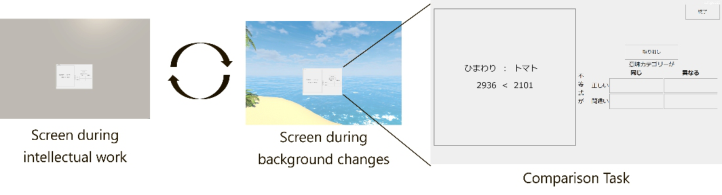
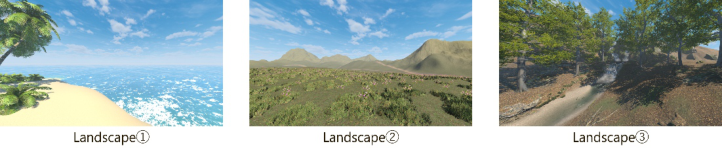
Overview of the VR System Used in the Experiment Participants in the experiment were instructed to wear a head-mounted dis- play (HMD) and complete a comparison task, as depicted in Figure 1. The background changed at regular intervals, as shown in Figure 2, with a fre- quency of every 6 minutes and 50 seconds, and a duration of 40 seconds. The backgrounds are designed to create an open landscape with movements such as waves and wind, making it easier to notice when the background changes and providing a refreshing effect. To ensure individual preferences do not affect the appropriate background images during breaks, participants were asked to select one of their favorite backgrounds after viewing three different landscapes during their work while wearing HMD. The selected image was then displayed during CTR measurement. This is expected to effectively pro- mote refreshment by reflecting subjective preferences. In addition, by asking about the selected landscapes, we will also attempt to examine the preferred images in MR.
Figure 1: Displayed screens in VR system and an example screen of comparison task.Figure 2: Three landscapes created as background for MR.
Experiment Overview The experiment was conducted between August 18 and August 31, 2023, with 12 university students from Kyoto University who were recruited
Experimental Study on the Effect of Micro-Refresh During Office Work in VR Space 81
through the Kyoto University Co-op’s part-time job recruiting system. Each session lasted approximately 4 hours and began at either 8:30 a.m. or 3:00 p.m. The task was conducted under two conditions: with and with- out background change. Each session lasted approximately 4 hours and began at either 8:30 a.m. or 3:00 p.m. The task was conducted under two conditions: with and without background change. Participants completed a questionnaire before and after the task. The study compared and analysed the performance of the task in each condition. The experiment was conducted with the participants’ consent and approved by the Ethics Review Committee of the Graduate School of Energy Sciences at Kyoto University.
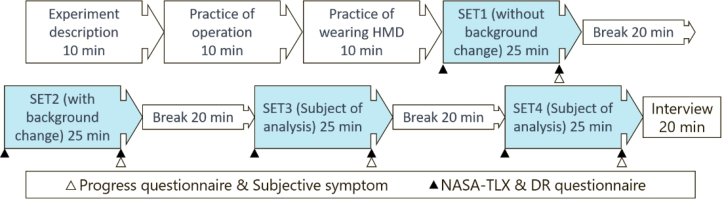
Experimental Procedures The experiment followed the procedure outlined in Figure 3. Initially, an overview of the experiment and the method of answering the comparison task were provided. Subsequently, participants practiced answering the com- parison task, followed by an explanation and practice of how to wear the HMD. The experiment employed a Meta Quest2 256GB [301-00353-02] HMD, which weighed approximately 800 grams and was suspended from the ceiling to prevent its weight from affecting the results. An iPad was used for SET1 to avoid the potential impact of prolonged HMD use on the results. The analysis focused on SET3 and SET4, with CTR measured based on the time taken to complete the comparison task. The participants counterbal- anced the order effect to determine which SET was used as the condition with a background change. Additionally, participants were informed that SET5 would be completed in advance to eliminate any terminal effects, but this was not carried out in practice. Questionnaires were administered before and after each SET, as depicted in Figure 3. The progress questionnaire was utilized to assess the participants’ subjective fatigue and concentration lev- els. The fatigue questionnaire included 15 questions to investigate three key factors in the evaluation of MR: feeling sleepness, sluggish, and blur feeling. The NASA-TLX evaluated mental burden during work, while the DR ques- tionnaire assessed the degree of detachment and recovery felt during work. Finally, the end-up questionnaire was used to gather impressions of the entire experiment. During the interview, participants were asked to explain their reasons for selecting the landscape and to discuss the burden of the HMD.
Figure 3: Experimental protocol.
RESULT
Table 1 shows the average CTR for each participant and condition. It is important to note that the evaluation of CTR is objective and not influenced by personal opinions or biases. On average, the CTR was 1.2% lower in the condition with background change.
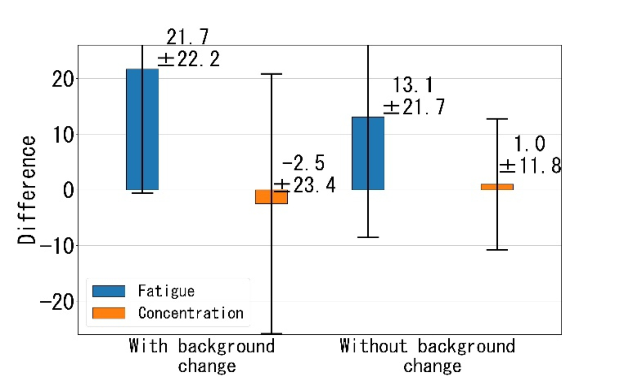
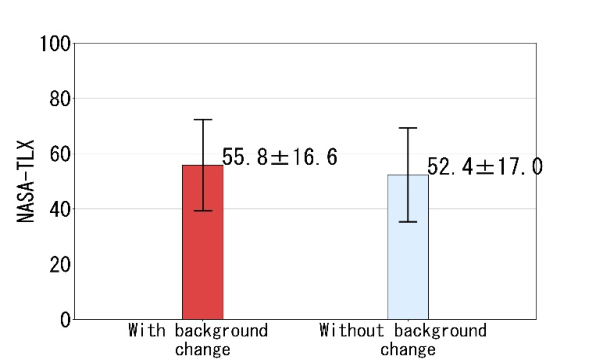
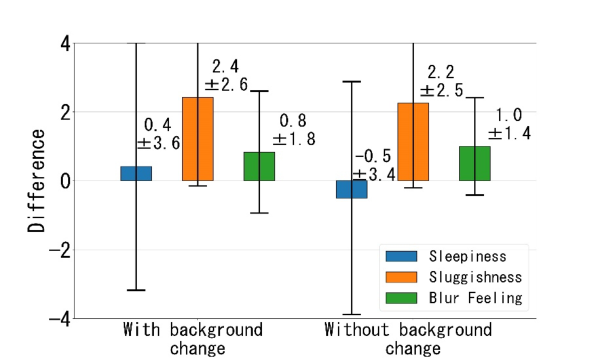
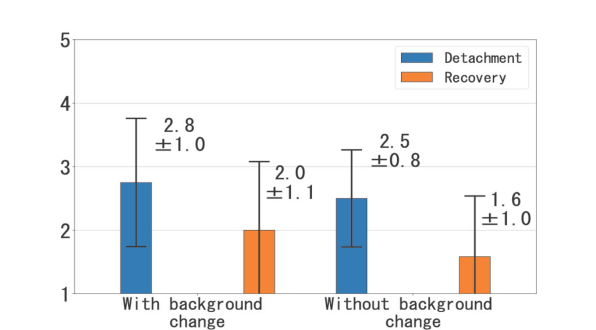
The results of the questionnaire are presented below. Figure 4 displays the mean difference between the SETs for fatigue and subjective concen- tration in each condition. Figure 5 shows the mean NASA-TLX for each condition. Figure 6 displays the mean differences between the SETs for sleepi- ness, sluggishness, and blur feeling in each condition. Figure 7 displays the average results of the Detachment and Recovery questionnaires for each con- dition. In the Detachment questionnaire, five participants had higher values in the condition with a background change, four participants had no change between conditions, and three participants had lower values in the condition with a background change. In the Recovery Questionnaire, eight partici- pants showed no change between conditions, while three participants had higher values in the with background change condition and one participant had a lower value in the same condition. Table 2 displays the results of the subjective questionnaire for each participant.
Table 1. CTR list of each participant.
Table available in the original PDF paper.
Participant ID Condition With background change(%) Without background change(%)
Upper part of Table 3 shows the items of the questionnaire conducted at the end of the experiment. The interview questions at the end of the experi- ment are shown in lower part of Table 3. Table 4 shows the answers to the questionnaire conducted at the end of the experiment and interview.
DISCUSSION
In this experiment, the CTRs of five participants (ID01,03,04,05,08,09) in the background change condition were higher than those in the no background change condition, while those of the other six participants
Experimental Study on the Effect of Micro-Refresh During Office Work in VR Space 83
Figure 4: Average of difference in fatigue and concentration in each condition.Figure 5: Average of difference in NASA-TLX score in each condition.Figure 6: Average of sleepiness, sluggishness and blur feeling in each condition.Figure 7: Average of detachment and recovery in each condition.Table 2. Subjective questionnaire for each participant.
Table available in the original PDF paper.
Fatigue Concentration Detachment Recovery ID With back- ground change Without back- ground change With back- ground change
(ID02,06,07,10,11,12) were vice versa. In the end questionnaire and inter- views, ID01 and ID08 reported that the condition with the background change helped them concentrate the most. Additionally, ID01, ID03, ID04,
Experimental Study on the Effect of Micro-Refresh During Office Work in VR Space 85
Table 3. End questionnaire question and interview question list.
Table available in the original PDF paper.
Number Question Content E-Q1 Please provide your observations on the differences in the quality of work between each set, and feel free to note how the quality of work and level of concentration changed within each set. Please include any details you remember. E-Q2 Regarding changes in the screen, please feel free to share your thoughts on aspects such as time intervals (e.g., 7 minutes and 30 seconds) or durations (e.g., 20 seconds) and how you experienced them. E-Q3 Regarding changes in the screen, such as landscapes, please freely describe how you felt. E-Q4 If you have any additional feedback about the entire experiment, please feel free to share. If you don’t have any comments, there’s no need to provide input.
I-Q1 Why did you choose that background? The reason behind it. I-Q2 Did you notice the change in the background? I-Q3 Did you pause and take a break when the background changed or feel inclined to do so? I-Q4 What impact did the change in background have on the overall performance of the task? I-Q5 What kind of environment did you think would be ideal for other breaks? I-Q6 How did you feel about the suspension of the VR goggles? Did it feel like a reduced burden? I-Q7 Did you feel that the weight of the VR goggles had an impact on the task?
ID02, ID07, ID11, and ID12 reported that the background change had a pos- itive impact on their performance. Participants ID04, 05, 08, and 09 reported losing focus on their work due to the background change. Only participants ID01 and ID04 stopped and took a break when the background changed. The subjective questionnaire results showed that participant ID01 experi- enced less subjective fatigue and higher concentration in the condition with background change. Additionally, the NASA-TLX values were lower. How- ever, in the condition with background change, ID03 reported low sleepiness, blur feeling and sluggishness, while high subjective fatigue and low subjective concentration were reported in the condition without background change. Additionally, the NASA-TLX values were higher in the former condition. The results indicate that the change in background led to refreshment and detachment, potentially resulting in reduced fatigue and improved concentra- tion. However, it should be noted that some participants subjectively reported improved performance, despite a low CTR.
The reason for this result was that the background change, as a visual stim- ulus, was weak. In the condition with a background change, the background changed three times during one SET, and they were all the same. This may have caused participants to become accustomed to the landscape, which may
Table 4. The answers of end questionnaire and interview.
Table available in the original PDF paper.
Answer
Question Number
Number of people E-Q1 3 They were able to concentrate the most in the SET with background change condition. 3 The background change refreshed them. 4 The background change interfered with their concentration. E-Q2 8 The length of the background change was longer. 1 The length of the background change was moderate. 3 They did not mention the length of the background change. E-Q3 6 The background change refreshed them. 5 The background change distracted them. E-Q4 12 (all) No answers.
I-Q1 1 Landscape 1 was the most open. 3 In landscape 2, there was a lot of greenery. 2 Landscape 2 is the least distracting 1 The landscape 1 and 3 seemed intoxicating. 3 The color tone of Landscape 3 was dark. 1 In Landscape 3, the proportion of the sky and the sea was small. 1 He prefer a forest landscape with a river running through it like landscape 3. I-Q2 12 (all) they noticed the background change. I-Q3 7 They did not take a break and did not feel like taking a break. 2 They felt like taking a break and slowed down the pace of work. 2 They did not feel like taking a break, but they were distracted by the scenery. 1 He felt like taking a break, but did not actually take a break. I-Q4 7 The background change had a positive impact on his performance. 1 Overall performance in the with background change condition was unchanged. 1 He felt relaxed when the background was changed, but he was surprised by the change and stopped working. 1 He was distracted by the background change, but his concentration returned when the background returned to the original state. I-Q5 Music and nature sounds, a countryside landscape, landscape with a little more movement, a sea without a beach, sunset landscape, open and greener landscapes, not an animation, but a still picture and a landscape with constellations floating in the night sky. I-Q6 12(all) They felt a reduction in burden. I-Q7 9 No impact. 3 Impact.
not have promoted detachment or refreshment. The results of the DR ques- tionnaire indicate that the participants were not particularly encouraged to refresh themselves. In the future, it will be necessary to create an environment that is engaging and promotes refreshment.
Another possible reason for the observed fatigue and loss of concentration could be the weight of the HMD used in the experiment, which was approxi- mately 800 grams. It is possible that the burden of wearing the HMD for long hours outweighed the benefits of the background change in reducing fatigue and loss of concentration. To address this issue, future experiments should be conducted using a 2D display or without the physical burden of the HMD.
Experimental Study on the Effect of Micro-Refresh During Office Work in VR Space 87
CONCLUSION
This study aimed to confirm the effect of suppressing the decline in concen- tration during work when background changes were performed at short time intervals in a VR space. The results suggest that the use of an HMD for back- ground changes may not be appropriate, and the content of the background change also needs to be considered. Future modifications to the experimental conditions will take these possibilities into account.
REFERENCES
Ito, K., Furuta, S., Kamihigashi, D., Ishii H., Shimoda, H., Obayashi, F., Taniguchi, K.
(2019) “An Influence of Indoor Airflow on Intellectual Concentration in Winter”, The Transactions of human Interface Society, Volume 60 No. 5, pp. 235–244. Kitayama, K., Dianita, O., Ueda, K., Ishii, H., Shimoda, H., Obayashi, F. (2023) “Micro-refresh to Restore Intellectual Concentration Decline during Office Work: An Attempt at Quantitative Effect Evaluation.” Intelligent Human Systems Inte- gration (IHSI): Integrating People and Intelligent Systems. AHFE International Conference. Vol 69. Ueda, K., Shimoda, H., Ishii, H., Obayashi, F., Taniguchi K. (2016) “Development of
a New Cognitive Task to Measure Intellectual Concentration Affected by Room Environment”, The Fifth International Conference on Human-Environment Sys- tem. Uchiyama K., Oishi K., Miyagi K., Ishii Hirotake, Shimoda H. (2014) “Process in Evaluation Index of Intellectual Productivity Based on Work Concentration.” Lecture Notes on Software Engineering. 21–25.
LISTED IN THE AHFE DIGITAL BOOKSTORE CATALOGUE
Explore the complete digital volume
Intelligent Human Systems Integration (IHSI 2024): Integrating People and Intelligent Systems
Read this individual research paper free through the original publisher, or explore the full digital proceedings book.
ISBN 978-1-958651-95-7
Explore this ISBN in the AHFE Bookstore ↗Listed in the July 2026 bookstore catalogue; search by ISBN to confirm current availability · Digital book purchase optional