Reika Abe, Takuto Higashimaki, Kento Nomura, Orchida Dianita, Kimi Ueda, Hirotake Ishii, Hiroshi Shimoda, Fumiaki Obayashi (2024). An Experimental Study on the Effect of Short-term Airflow on Concentration during Intellectual Work. In: Human Factors, Business Management and Society. AHFE Open Access, vol. 135, pp. 170–177. https://doi.org/10.54941/ahfe1004943
In today’s information society, the efficiency of intellectual work, referred to as intellectual productivity, is highly valued. There is an observed tendency for intellectual concentration to decrease over time, leading to many studies related to the benefits of short breaks during tasks. Some research defines breaks lasting no longer than 10 minutes as “micro-breaks” and suggests their positive effect on performance [1]. There is also a study on “micro-refresh,” which encourages workers to refresh during 20-second pauses given every 7 minutes and 30 seconds of task time [2].However, in these studies, workers are compelled to take breaks. There is a possibility that these breaks interrupt concentration, especially when they are in a state of high concentration. In addition, taking breaks that are too long or too short than needed can decrease work efficiency. To effectively recover concentration, individuals should take an appropriate length of breaks based on their respective needs.Therefore, in this study, we aimed to encourage self-determined refreshment during tasks to improve intellectual productivity, which few studies have tried to. As a method to induce refreshment spontaneously, we used airflow stimulation. Airflow is known to have a relaxation effect. For example, a study showed simulated natural wind decreases mental stress compared to a windless condition [3]. Thus, airflow stimulation is expected to induce a relaxed state, allowing for a refreshed state when returning to tasks. To confirm the effect of this short-time airflow on intellectual productivity, we conducted an evaluation experiment.In this experiment, a quantitative evaluation was conducted using CTR (Concentration Time Ratio), an intellectual concentration index calculated from response time data for a comparison problem developed by Ueda et al [4]. As for the design of airflow stimulation, a tabletop fan was placed behind the iPad used for the task to expose airflow towards each participant’s hands. The task duration was 45 minutes per set, with a 20-second airflow exposed every 7.5 minutes under conditions with airflow. Each participant performed tasks under both conditions, with and without airflow, in different sets, and the difference in intellectual concentration was measured using CTR. In addition, in each set, we conducted several surveys asking participants about subjective fatigue, mental workload, and so on. Participants were also asked about their impressions of airflow after the experiment.7 university students participated in this experiment, and as a result, 4 participants had a higher CTR, while 3 participants had a lower CTR under conditions with airflow. Each participant’s response time data and descriptive survey suggested a possibility that participants who were distracted by airflow showed a decrease in CTR, while those prompted to refresh showed an improvement. In addition, 6 participants answered they preferred airflow at a higher frequency, and 6 participants answered they preferred airflow with longer exposure times, suggesting that the interval and duration of airflow should be modified in further studies. Reference:[1] Patricia Albulescu et al.; PLOS ONE, 17-8 (2022).[2] Kakeru Kitayama et al.; Proceedings of the 2023 Intelligent Human Systems Integration, AHFE International, USA, 2023.[3] Kenichi Ito et al.; 2023 IEEE Conference Virtual Reality and 3D User Interfaces (VR), Shanghai, China, 2023, pp. 215-225.[4] Kimi Ueda et al.; The Fifth International Conference on Human-Environment System, 2016.
In our modern information-driven society, the performance of intellectual tasks is of great importance. Office workers frequently engage in substantial intellectual labor, but extended periods of work without rest decrease con- centration on tasks, leading to a decrease in productivity. To address this, numerous studies have investigated the effects of short breaks, characterized as “Micro-Break” in some studies. Albulescu et al. (2022) defined Micro- Break as breaks not exceeding 10 minutes and conducted a meta-analysis of 22 studies. The results indicated Micro-Break improved the performance of
An Experimental Study on the Effect of Short-Term Airflow on Concentration 171
clerical or creative tasks, and suggested more breaks may be needed for cog- nitively demanding tasks. On the other hand, some research suggested that breaks could reduce performance (Brazaitis, 2023). One reason for this is the need for effort to refocus on tasks after breaks (Quintus, 2003).
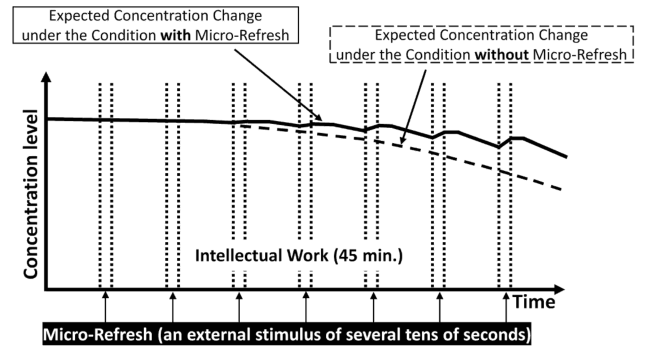
Figure 1: Concept of micro-refresh.
The degree of concentration decline can vary depending on the type of task and individual characteristics. Thus, the imposition of breaks at inappropri- ate timing is considered to distract concentration, especially when workers are highly focused on tasks. To address this issue, a way was explored to restore concentration without breaking off ongoing tasks. In this study, an external stimulus of several tens of seconds intended to prompt refreshment was introduced. By regularly being refreshed for a short time, defined as “Micro-Refresh”in this study, it is expected to prevent a decline in concentra- tion. Figure 1 illustrates the concept of Micro-Refresh. Unlike Micro-Break, Micro-Refresh is expected to return awareness on tasks or give a breather when concentration declines, without interrupting the continuity of tasks during periods of high concentration. As a stimulus for Micro-Refresh, air- flow was used in this study. Airflow is known to have a relaxation effect. For example, a study showed simulated natural wind decreases mental stress compared to a windless condition (Ito, 2023). Hence, airflow stimulation is expected to induce a relaxed state, allowing for a refreshed state when return- ing to tasks. To verify the impact of this short-time airflow on intellectual concentration, an evaluation experiment was conducted in this study.
METHODS
Overview of the Experiment In the evaluation experiment, each participant performed a 45-minutes cog- nitive task under both conditions: with and without airflow exposure. Then,
172 Abe
the differences in CTR and responses to subjective questionnaires between the conditions were compared.
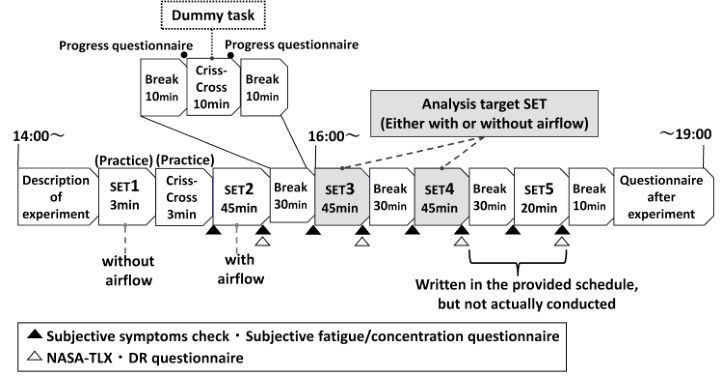
Experimental Schedule Each day from 14:00 to 19:00, 1 group consisting of up to 4 participants joined the experiment. Figure 2 shows the schedule of the experiment. As a cognitive task to measure CTR, the comparison task developed by Ueda et al. (2016) was performed in each SET. The participants were asked to determine the airflow intensity after the SET1, and they had the opportunity to change it after they experienced the airflow in the SET2. It was not allowed to change the airflow intensity after that. The conditions with airflow and without airflow were presented in different order in SET3 and SET4 to take a counterbalance of order effects. The SET3 was scheduled to start after 16:00 to eliminate the post-lunch dip effect from the analysis target SETs.
Figure 2: Schedule of the experiment.
The SET5 was used to eliminate terminal effects. Although the SET5 was included in the schedule shown to participants in advance, it was not actually conducted. As a dummy task to alleviate the monotony of the comparison task, the Criss-Cross task was performed between breaks.
Experimental Environment Airflow Design In the experiment, a 20-second airflow was exposed every 7.5 minutes during a 45-minute cognitive task, under the condition with airflow. This is based on a previous study, which incorporated a 20-second break every 7.5 minutes of task time (Kitayama, 2023).
In this study, airflow was used as a stimulus for refreshment. To provide individuals with comfortable airflow stimuli, the design of airflow needs to take into account individual differences in airflow preferences. Thus, the following elements were incorporated into the airflow design: 1) Selectable
An Experimental Study on the Effect of Short-Term Airflow on Concentration 173
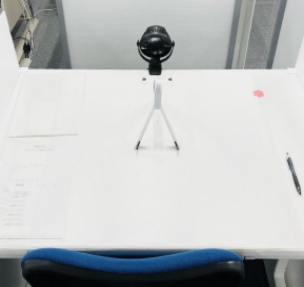
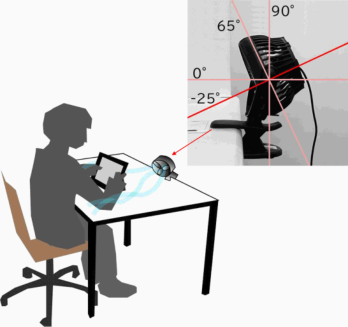
airflow intensity. 2) Airflow is exposed to a specific body area rather than the entire body. 3) Airflow avoids direct contact with the skin. To meet these purposes, the desktop fan (Product of Miyoshi Corp., Model number: USF- 19) was employed, as portrayed in Figure 3. The airflow intensity can be selected as either low or high. The desktop fan was positioned at the top cen- ter of the desk. The rotating part of the fan was oriented towards the desk at a downward angle of −25
as shown in Figure 4, allowing the airflow to pass along the desk to reach around worker ’s hands during tasks. The wind speeds felt at hands are 1.28 m/s when the intensity is low, and 1.34 m/s when the intensity is high.
Figure 3: Placed desktop fan.Figure 4: Concept of airflow.
Environmental Settings The experiment took place in an experimental room in Kyoto University. The environmental settings of the room were set to meet the ISO standard, with PMV (Predicted Mean Vote) within ± 0.5. Table 1 outlines the environmental settings of the experiment. PMV and SET* (Standard Effective Temperature) were calculated using the tool, THERble provided by Shin Nippon Air Tech- nologies. For the calculations, the median values of room temperature and
174 Abe
humidity were used, with other parameters: 24.0
C mean radiated tempera- ture, 0.10m/s air velocity, 0.70 clo amount of clothes, and 1.1 MET activity rate. Although the air velocity could change during the airflow exposure, since it was a short duration and was used as a stimulus, it was deemed an exception for the calculations.
Table 1. Environmental settings of the experiment.
Table available in the original PDF paper.
Factor Setting Room temperature 25.0 ± 0.5
C Humidity 60 ± 15% Noise level Less than 55dB Carbon dioxide concentration Less than 700ppm Desk illumination 650 ± 50lx PMV 0.17 SET* 25.4
C
Measurements CTR As an index to quantitively measure intellectual work performance, the Con- centration Time Ratio (CTR) developed by Uchiyama et al. (2014) was applied. CTR is the ratio of how long workers concentrate on the cogni- tive task to the total task time, calculated using analysis of answering time data. By not using task scores, CTR can evaluate performance without being affected by the learning effect.
Subjective Questionnaires Before and after the tasks, several subjective evaluations were administered. Measurement items are as follows.
I. Subjective symptoms check (Sasaki, 2005), asking physical fatigue symp- toms: feeling of sleepiness, dullness, and blurred vision. Each of these factors is calculated as a total of five question items, each rated on a 5-point Likert ranging from 1 (completely disagree) to 5 (completely agree). II. Subjective fatigue/concentration questionnaire, asking the subjective level of fatigue and concentration with the Magnitude Estimation Method from 0: no fatigue at all, cannot (could not) concentrate at all, to 100: cannot continue work, can (could) concentrate more than ever before. III. NASA-TLX (Hart, 1998), asking the mental work load of the task. The six items are rated from 0 to 100 using a Graphical Scale, and the NASA- TLX is calculated by summing the products, each of which is obtained by multiplying the respective rating by its corresponding weighting coef- ficient obtained through one of the questionnaires conducted after the experiment. IV. DR questionnaire, asking about the detachment of consciousness from the task, and the feeling of refreshment during the task. The airflow used in the experiment is expected to shift focus from tasks and induce a sense of
An Experimental Study on the Effect of Short-Term Airflow on Concentration 175
refreshment. To assess these effects, these were asked on a 5-point Likert scale, from 1 to 5.
Additionally, questionnaires including several open-ended questions and multiple-choice questions were conducted after the experiment. These asked participants’ impressions of the airflow and preferences regarding length and intervals of the airflow. Based on that, interviews by the experimenter with participants were also carried out to gather more specific feedback.
Participants The experiment took place from 14:00 to 19:00 on July 31 and August 2, 2023. 5 male and 2 female university students participated in the experi- ment. It was conducted with the approval of the Ethics Review Committee of the Graduate School of Energy Science, Kyoto University. To prevent differ- ences in environmental sensitivity among participants, they were instructed to participate wearing long sleeves.
RESULTS
The results of CTR for each participant are shown in Table 2. CTR improved in 4 out of 7 participants under the condition with airflow. The subjective evaluation results are shown in Table 3. In all items, the values after each SET of the comparison task were assessed.
The results of the questionnaires and interviews on the exposed airflow were as follows.
6 participants answered they preferred airflow with longer exposure length.
6 participants answered they preferred airflow at a higher frequency.
5 participants, including 4 participants whose CTR improved, had a pos- itive impression of the airflow such as, “I felt refreshed.” and “I was able to concentrate more after the airflow exposure”.
2 participants whose CTR decreased had a negative impression of the air- flow such as, ID1: “I felt like the noise from the fan distracted me.”, and ID7: “I was a bit shaken because there was a long interval until the next airflow exposure. I prefer the interval is about 5 minutes”.
DISCUSSIONS As shown in Table 2, the average CTR is 1.7% lower under the condi- tion with airflow. However, given the small sample size of 7 participants, it is essential to focus on the individual values for each participant. Under the condition with airflow, CTR increased for 4 participants, all of whom had a positive impression of the airflow. Conversely, CTR decreased for 3 participants, 2 of whom had a negative impression of the airflow. For these 2 participants, CTR decreased by more than 10%, showing rela- tively large differences between conditions compared to other participants. Thus, it can be inferred that there is a potential for the airflow to improve concentration when the airflow facilitates refreshment. However, in case of that the airflow distracts concentration, the negative impact may out- weigh the benefits of refreshment, leading to a significant decrease in concentration.
As for the results of subjective evaluations, the result of sleepiness suggests the airflow helped alleviate the feeling of drowsiness. In addition, the result of recovery suggests a sense of refreshment was felt more under the condi- tion with airflow. However, for other subjective evaluations, there were no big differences among conditions. These results indicated that the presented airflow tends to promote arousal and refreshment, but it does not appear to have a substantial impact on the improvement of fatigue or concentration.
Based on the results of the participants’ preferences for the airflow, it was implied that airflow at a higher frequency with longer exposure length might be more appropriate. Additionally, it may be necessary to take measures to reduce fan noise. Moreover, 2 male participants were sweating during the experiment, likely due to wearing long sleeves as instructed. Before the anal- ysis target SETs, there were opportunities to adjust the room temperature based on participants’ requests for it being too warm or too cold. However, the inability to change clothing from long sleeves may have increased some of the participants’ sensory temperature so much that it could not be adjusted by indoor temperature. Considering that workers can adjust their clothing in an actual office environment, participants should be allowed to adjust their clothing in the next experiment.
An Experimental Study on the Effect of Short-Term Airflow on Concentration 177
CONCLUSION
In this study, we attempted to provide workers with brief opportunities to restore concentration repeatedly during intellectual work, by introducing a 20-seconds airflow stimulus every 7.5 minutes. We named it “Micro- Refresh” and evaluated its effect on intellectual work performance. The results showed that the length and the timing of the airflow should be modified to make the airflow effective in the improvement of intellectual concentration. Based on the results, we decided to expose the airflow for 30 seconds every 4.5 minutes in the next experiment, under the condition of adjustable clothing by the analysis target SETs. In addition to this, measures to reduce fan noise, such as introducing a quieter desktop fan or incorporat- ing actual office environment noise into the experimental environment should be considered.
REFERENCES
Patricia Albulescu, Irina Macsinga, Andrei Rusu, Coralia Sulea, Alexandra Bodnaru, and Bogdan Tudor Tulbure. (2022). “Give me a break!” A systematic review and meta-analysis on the efficacy of micro-breaks for increasing well-being and performance, PLOS ONE. Marius Brazaitis and Andrius Satas. (2023). Regular short-duration breaks do not
prevent mental fatigue and decline in cognitive efficiency in healthy young men during an office-like simulated mental working day: An EEG study. International Journal of Psychophysiology, Vol. 188, pp. 33–46. Quintus R. Jett and Jennifer M. George. Work Interrupted: A Closer Look at the Role of Interruptions in Organizational Life. (2003). The Academy of Management Review, Vol. 28, No. 3, pp. 494–507. Kenichi Ito, Juro Hosoi, Yuki Ban, Takayuki Kikuchi, Kyosuke Nakagawa, Hanako
Kitagawa, Chizuru Murakami, Yosuke Imai, and Shin’ichi Warisawa. (2023). Wind comfort and emotion can be changed by the cross-modal presentation of audio-visual stimuli of indoor and outdoor environments. 2023 IEEE Conference Virtual Reality and 3D User Interfaces (VR), pp. 215–225. Shanghai, China. Kakeru Kitayama, Orchida Dianita, Kimi Ueda, Hirotake Ishii, Hiroshi Shimoda, and Fumiaki Obayashi. (2023). Micro-refresh to Restore Intellectual Concen- tration Decline during Office Work: An Attempt at Quantitative Effect Evalua- tion. Intelligent Human Systems Integration (IHSI 2023): Integrating People and Intelligent Systems, AHFE (2023) International Conference, Vol. 69. Kosuke Uchiyama, Kotaro Oishi, Kazune Miyagi, Hirotake Ishii, and Hiroshi Shi-
moda. (2014). Process in evaluation index of intellectual productivity based on work concentration. Lecture Notes on Software Engineering, Vol. 2, No. 1, pp. 21–25. Kimi Ueda, Hiroshi Shimoda, Hirotake Ishii, Fumiaki Obayashi, and Kazuhiro Taniguchi. (2016). Development of a new cognitive task to measure intellectual concentration affected by room environment. In The Fifth International Confer- ence on Human-Environment System ICHES2016 Nagoya, Vol. 5, pp. 58–64. Tsukasa Sasaki and Shun Matsumoto. (2005). Actual conditions of work, fatigue
and sleep in non-employed, home-based female information technology workers with preschool children. Industrial Health, Vol. 43, No. 1, pp. 142–150. Sandra G. Hart and Lowell E. Staveland. (1998). Development of NASA-TLX (Task Load Index): Results of Empirical and Theoretical Research. Advances in psychology, Vol. 52, pp. 139–183.
LISTED IN THE AHFE DIGITAL BOOKSTORE CATALOGUE
Explore the complete digital volume
Human Factors, Business Management and Society
Read this individual research paper free through the original publisher, or explore the full digital proceedings book.
ISBN 978-1-964867-11-3
Explore this ISBN in the AHFE Bookstore ↗Listed in the July 2026 bookstore catalogue; search by ISBN to confirm current availability · Digital book purchase optional