Vasja Plesec, Gregor Harih (2023). Can Transient Simulations Improve Lower Limb-Prosthesis Interaction Analysis?. In: Human Systems Engineering and Design (IHSED 2023): Future Trends and Applications. AHFE Open Access, vol. 112, pp. 407–415. https://doi.org/10.54941/ahfe1004153
Human gait is a highly dynamic process; however, most numerical analyses to simulate a lower limb prosthesis wearer are still performed using an implicit static method. To account for the dynamic effects, a transient numerical simulation was performed in this study, simulating a gait cycle of a lower limb-prosthesis system. Donning of the socket followed by heel strike and push-off conditions of the gait were analysed using a recently developed generic transtibial limb model representing an average transtibial amputee. The static results previously obtained were compared with the transient simulation and the results in terms of contact pressure at residual limb-liner interface and von-Mises stresses in the prosthetic socket were evaluated. The numerical results show a significant difference between the transient and static numerical simulations due to the dynamic effect incorporated in the numerical analysis, indicating a need to include these effects to obtain more realistic conditions.
The loss of a lower limb represents a distressing event that places indi- viduals in a complex psychophysical situation. Within Europe, the rate of major lower limb amputations stands at approximately 30 cases per 100,000 individuals, predominantly arising from diseases rather than injury-related accidents (Kolossváry et al., 2020). Among the various types of major lower limb amputations, transfemoral (above the knee) and transtibial (below the knee) amputations are the most prevalent, with the latter being particularly common (Lee, 2006). To restore patients’ mobility and facilitate their reinte- gration into normal social life, the fitting of a prosthesis is typically employed. However, achieving an optimal fit between the prosthesis socket and the residual limb remains a significant challenge, as a failure to do so often results in limited prosthesis usage (Krajbich et al., 2016). The prosthesis socket, in conjunction with the liner, assumes a primary role in transferring the load to pressure-tolerant areas and minimizing stress concentration, thereby enhancing the overall comfort of the prosthesis. In addition to comfort, the attainment of stability is also crucial in ensuring the provision of a secure prosthesis (Paterno et al., 2018).
Attaining an optimal trade-off between comfort and stability is often unachievable through conventional tools and manufacturing processes. Con- sequently, the concept of employing computer-assisted technologies to aid in the development and manufacturing of lower limb prostheses has been explored for several decades (Silver-Thorn, 1991). However, owing to the inherent complexity of the problem, involving intrinsic geometry, dynamic boundary conditions, and non-linear material models, the incorporation of computer-controlled processes within clinical practice remains infrequent. Numerical simulations commonly yield approximate representations of spe- cific static configurations, posing challenges for socket design in clinical settings. A predominant challenge stems from the prevalent usage of the static finite element method (FEM) by most researchers to predict the interaction between the residual limb and the prosthesis (Dickinson et al., 2017). While this method is suitable for rate-independent scenarios where inertia and damping effects do not impact the results, the dynamic nature of the resid- ual limb-prosthesis interaction necessitates the incorporation of transient numerical simulations to enhance accuracy and enable a more comprehensive representation. A notable exception is the study conducted by (Lacroix and Patiño, 2011), which incorporated dynamic simulations utilizing the explicit FEM to simulate the donning of transfemoral sockets. Their numerical find- ings revealed substantial disparities compared to static simulations reported by other authors.
In the absence of dynamic simulations that could enhance accuracy and enable a more comprehensive understanding of the interaction between the residual limb and the prosthesis, the objective of this study was to conduct a transient numerical simulation and subsequently compare the outcomes with those obtained through static analysis. To accomplish this, a generic geome- try representing the transtibial residual limb was utilized to simulate various loading conditions, including donning of the prosthesis, single-leg stance, heel strike, and push-off phases of the gait. The evaluation of results focused on contact pressure at the interface between the residual limb and the liner, as well as von-Mises stress within the prosthetic socket. The discussion section of the study provides a detailed analysis and relative comparison between the findings derived from static and transient simulations.
METHODS
The study utilized a previously developed generic transtibial model, consist- ing of a silicone liner and a composite socket, as the fundamental geometry (Plesec and Harih, 2023). The residual limb model incorporated bulk soft tissue and various bones including the femur, tibia, fibula, and patella. This model proved to be valuable for evaluating and making relative comparisons among different numerical results (Plesec et al., 2023). The widely employed silicone liner was incorporated into the model, as it helps alleviate stress concentration and enhances the comfort of the prosthesis. The socket was rec- tified following the patellar tendon bearing rectification method, which aims to redistribute pressure to the pressure-tolerant region of the patellar tendon
Can Transient Simulations Improve Lower Limb-Prosthesis Interaction Analysis? 409
while alleviating pressure on pressure-sensitive areas such as the fibular head, tibial crest, and tibia end.
All material models employed in the simulation were sourced from the existing literature, where they had been previously validated through numer- ical or experimental means. In order to reduce the complexity of the FEM model, the bones were represented as rigid cavities, given the substantial dis- parity in stiffness between the bones and soft tissues. This approximation is considered reasonable. The soft tissue and silicone liner were modelled using hyperelastic material models, specifically the Ogden first-order model for the soft tissue (Kallin et al., 2019) and the Yeoh third-order model for the silicone liner (Cagle et al., 2018). The composite socket was defined using liner-elastic model, specifying the Young’s modulus and the Poisson ratio (Bombek et al., 2021). A comprehensive overview of all the material models utilized is presented in Table 1.
In conjunction with the material model selection, the manner in which the different components are connected has a notable influence on the numeri- cal results. In this study, the bones were bonded to the soft tissue, ensuring a rigid, Connection between them. The silicone liner, on the other hand, was connected to the soft tissue surface through rough contact, which restricts tangential movement while allowing for separation in the normal direction. Additionally, a frictional contact with a coefficient of friction of 0.5 was defined between the silicone liner and the prosthetic socket. The application of forces and mass points to the model was achieved using rigid wires.
Table 1. Material models used in the simulation (Plesec and Harih, 2023).
Table available in the original PDF paper.
Component Material model Parameters Soft tissue (Kallin et al., 2019) Ogden first order MU1 = 0.012 MPa A1 = 14 D1 = 1.67 MPa-1
Silicone liner (Cagle et al., 2018) Yeoh third order C10 = 0.2014 MPa C20 = −0.00115 MPa C30 = 0.00041 MPa D1 = 3 MPa-1 Transtibial socket (Bombek et al., 2021) Liner-elastic E = 4991 MPa ν = 0.3
In order to simulate the most prevalent loading conditions experienced during the use of a transtibial prosthesis, several scenarios were considered, including the donning of the prosthesis, single-leg stance, and the heel strike and push-off conditions following the guidelines outlined in ISO 10328. To capture the dynamic effects inherent in these situations, the transient implicit FEM was employed, incorporating the mass matrix and damping matrix.
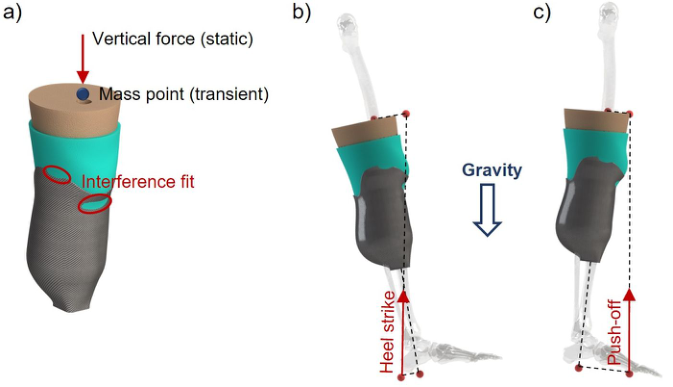
The initial step involved simulating the donning of the prosthesis, follow- ing the same protocol as in the static case. This process entailed resolving the initial overlap between the socket and the liner. Subsequently, a mass point of 85 kg was affixed to the femur bone cavity, and the gravitational force was applied to simulate the single-leg stance (see Figure 1a).
410 Plesec and Harih
The heel strike and push-off phases were defined in accordance with ISO 10328 for loading level P5, which encompasses patients with masses ranging from 80 kg to 100 kg. During these phases, the force vector acted in the opposite direction to the force of gravity (see Figure 1b and Figure 1c). The duration of the loading was set at 0.5 s, corresponding to a cyclic loading and unloading frequency of 1 Hz, as specified in the ISO 10328 cyclic test procedure. The magnitudes of the applied forces for the heel strike and push- off phases were 1024 N and 920 N, respectively, representing the loading conditions during normal gait.
Figure 1: Boundary conditions a) donning of the prosthesis and single-leg stance, b) heel strike and c) push-off condition according to the ISO 10328.
The outcomes obtained using the transient implicit method were compared to the previously obtained results for the same loading scenarios but utiliz- ing the static implicit method. The primary distinction between these two approaches lies in the fact that the static analysis solely incorporates the stiff- ness matrix K in the computation (1). This is applicable when the loading rate is slow, and the dynamic effects have no impact on the outcomes. Conversely, the transient methods encompass the incorporation of both the mass matrix M and the damping matrix C, forming a second-order differential equation that can be solved via either the implicit or explicit methods (2). In the present study, the implicit transient method was employed to effectively account for the dynamic effects.
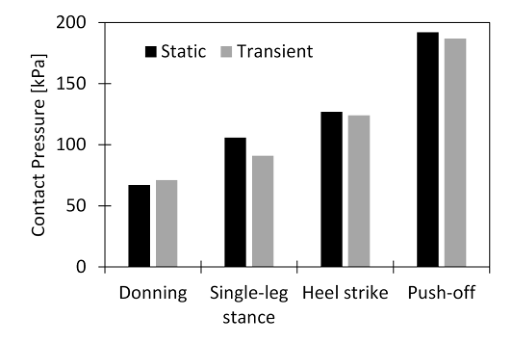
The peak contact pressure at the interface between the residual limb and the liner was determined and assessed for both static and transient simulations,
Can Transient Simulations Improve Lower Limb-Prosthesis Interaction Analysis? 411
considering various loading conditions. Figure 2 illustrates the disparities between the numerical techniques employed, highlighting the variation between the static and transient outcomes.
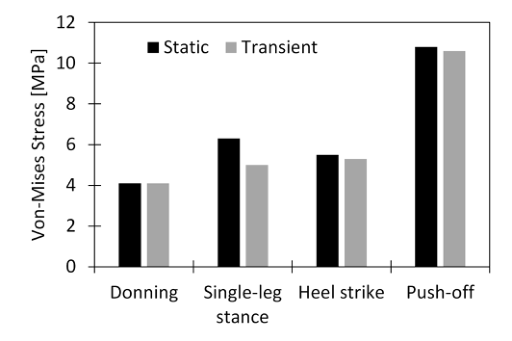
In addition to analysing the maximum contact pressure, the peak von- Mises stress within the prosthetic socket was also examined, considering both static and transient simulations. Similar to the contact pressure analysis, all loading steps were included in the investigation. Figure 3 depicts a graphical representation of the peak stress obtained through numerical simulations. The summarized numerical results are presented in Table 1.
Figure 2: Comparison of static and transient contact pressure results between residual limb and prosthetic liner for all simulated steps.Figure 3: Comparison of static and transient von-Mises stress results in the prosthetic socket for all simulated steps.
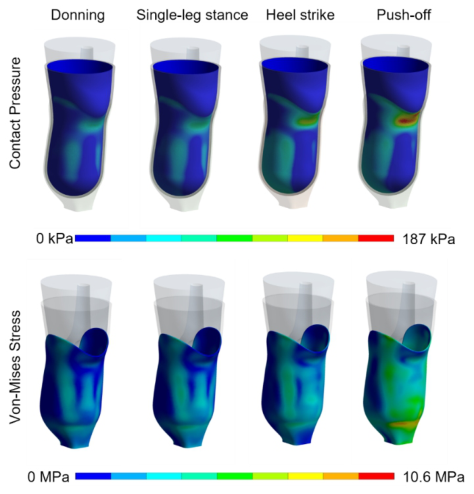
In addition to examining the maximum numerical values of contact pres- sure and von-Mises stress, the analysis of their distribution is equally signif- icant. Figure 4 presents the distribution of pressure and stress for all load steps within the transient numerical simulation. It is worth noting that the distribution in the case of the static simulation exhibits a high degree of similarity.
412 Plesec and Harih
Table 2. Summary of the numerical results.
Table available in the original PDF paper.
Donning Stance Heel strike Push-off Static Trans Static Trans Static Trans Static Trans
Figure 4: Contact pressure distribution and stress distribution of transient numerical simulation.
DISCUSSION
The primary objective of this study was to incorporate dynamic effects into a numerical simulation of a generic transtibial prosthesis and examine their impact on the obtained results. The assessment of contact pressure at the interface between the residual limb and the prosthesis served as a com- monly utilized parameter to evaluate the comfort provided by the prosthesis (Cagle et al., 2018). Both peak pressure values and pressure distribution were deemed significant factors in achieving an appropriate fit and enhanc- ing overall comfort. Additionally, the strength of the prosthesis socket was evaluated to ensure its capability to withstand the imposed loads. To enable a direct comparison between different numerical methods, identical geome- tries, material models, and boundary conditions were employed, focusing on the analysis of contact pressure and von-Mises stress. These two parameters proved useful in conducting a relative comparison between the static and transient numerical simulations.
The initial phase of the simulation involved the donning of the prosthesis, which entailed resolving the interference fit between the socket and the liner.
Can Transient Simulations Improve Lower Limb-Prosthesis Interaction Analysis? 413
This step held considerable importance, as once the prosthesis was donned, an initial stress state was established within the socket that subsequently influenced the outcomes under subsequent loading conditions. Intriguingly, the transient simulation exhibited a slightly elevated maximum contact pres- sure (71 kPa) compared to the static simulation (67 kPa). This disparity could be attributed to the boundary conditions used. The donning process was simulated by resolving the initial overlap between the socket and the liner, and the dynamic effects inherent in such an arrangement tended to induce higher stresses. To precisely simulate the donning effect, employing displace- ment instead of an interference fit would be ideal. However, adopting such an approach would significantly increase the computational time and pose convergence challenges.
Incorporating a point mass and accounting for the influence of gravity during the simulated single-leg stance yielded a notable reduction in the max- imum contact pressure (91 kPa) when compared to the static simulation (106 kPa). This decrease in contact pressure within the transient configuration can be attributed to the presence of shear stresses at the interface between the socket and the liner. These shear stresses play a role in arresting the motion of the point mass and facilitate a more uniform distribution of pressure. In con- trast, in the static case, the load steadily increases until reaching the defined value, irrespective of time.
The heel strike and push-off phases of the gait cycle represent the most demanding periods in terms of intensity. While analysing the entire gait cycle would offer a more comprehensive understanding, focusing on these crucial moments provides valuable insights into the interaction between the residual limb and the prosthesis. The disparity between the static and transient simu- lations was marginal, with a difference of 3 kPa and 5 kPa observed during heel strike and push-off, respectively. These findings suggest that static simu- lations of gait instances yield satisfactory results when compared to transient simulations. Interestingly, despite the inclusion of gravity in the transient sce- nario, the contact pressure was lower than that in the static case. This can be attributed to the dynamic effects, which facilitate a more homogeneous pressure distribution throughout the interface.
In parallel to the examination of contact pressure, the assessment of von- Mises stress within the socket highlights the distinction between static and transient simulations, particularly in the single-leg stance load scenario. Addi- tionally, the numerical findings indicate that the static simulation generally produces higher values in comparison to the transient simulation. Although the maximum values differed noticeably, the distribution of contact pressure and stress remained similar across all loading stages.
The comparative analysis between static and transient simulations, employing identical geometry, material models, and boundary conditions, revealed noteworthy distinctions in the numerical outcomes. Transient simu- lations offer the potential to investigate the complete gait cycle and consider dynamic effects, making them advantageous for accurately predicting the interaction between the residual limb and the prosthesis. Given the highly dynamic nature of this interaction, the utilization of transient methods holds
414 Plesec and Harih
promise in achieving more precise predictions. The mass and damping matri- ces play a crucial role in capturing the material properties that significantly impact the results under dynamic conditions. To enhance realism, future investigations should endeavour to simulate the donning process of the prosthesis by incorporating displacement. Moreover, a comprehensive under- standing of the biomechanical behaviour of the residual limb-prosthesis sys- tem can be achieved by employing transient numerical methods to simulate the complete gait cycle.
CONCLUSION
The obtained numerical results from the transient simulation were sub- sequently compared to previously conducted static simulations, and the resulting discrepancies were examined. The most significant disparity was observed during single-leg stance loading, where the static simulations exhib- ited notable overestimation in contrast to the transient simulation. Con- versely, the differences were comparatively minor in the case of heel strike and push-off. While the transient simulation displays potential in enhancing the accuracy of the residual limb-prosthesis interaction, further investigations are warranted to validate the findings and refine the simulation methodology to encompass the entire gait cycle.
ACKNOWLEDGMENT
The authors acknowledge the financial support from the Slovenian Research Agency (research core funding No. P2-0063).
REFERENCES
Bombek, M., Vesenjak, U., Pisek, M., Vidmar, G., Knez, S. & Medved, S.
2021. Mechanical testing of laminated composite materials for prosthetic sockets. Materials and Technology, 55, 655–661. Cagle, J. C., Reinhall, P. G., Allyn, K. J., Mclean, J., Hinrichs, P., Hafner, B. J. & Sanders, J. E. 2018. A finite element model to assess transtibial prosthetic sock- ets with elastomeric liners. Medical & Biological Engineering & Computing, 56, 1227–1240. Dickinson, A. S., Steer, J. W. & Worsley, P. R. 2017. Finite element analysis of
the amputated lower limb: A systematic review and recommendations. Medical Engineering and Physics, 43, 1–18. Kallin, S., Rashid, A., Salomonsson, K. & Hansbo, P. 2019. Comparison of mechanical conditions in a lower leg model with 5 or 6 tissue types while exposed to prosthetic sockets applying finite element analysis. arXiv preprint arXiv:1907.13340. Kolossváry, E., Björck, M. & Behrendt, C.-A. 2020. Lower Limb Major Amputation
Data as a Signal of an East/West Health Divide Across Europe. European Journal of Vascular and Endovascular Surgery, 60, 645–646. Krajbich, J. I., Pinzur, M. S., Potter, B. K. & Stevens, P. M. (eds.) 2016. Atlas of Amputations and Limb Deficiencies: Surgical, Prosthetic, and Rehabilitation Principles, Rosemont, IL: Lippincott Williams & Wilkins.
Can Transient Simulations Improve Lower Limb-Prosthesis Interaction Analysis? 415
Lacroix, D. & Patiño, J. F. R. 2011. Finite element analysis of donning procedure of a prosthetic transfemoral socket. Annals Of Biomedical Engineering, 39, 2972–2983. Lee, W. C. C. 2006. Computational and experimental analysis of the use of lower
-limb prostheses, concerning comfort, structural design and gait performance. ProQuest Dissertations Publishing. Paterno, L., Ibrahimi, M., Gruppioni, E., Menciassi, A. & Ricotti, L. 2018. Sockets for Limb Prostheses: A Review of Existing Technologies and Open Challenges. Ieee Transactions on Biomedical Engineering, 65, 1996–2010. Plesec, V. & Harih, G. 2023. Development of a Generic Numerical Transtibial Model
for Limb-Prosthesis System Evaluation. Applied Sciences, 13, 2339. Plesec, V., Humar, J., Dobnik-Dubrovski, P. & Harih, G. 2023. Numerical Analysis of a Transtibial Prosthesis Socket Using 3D-Printed Bio-Based PLA. Materials, 16, 1985. Silver-Thorn, M. B. 1991. Prediction and experimental verification of resid-
Human Systems Engineering and Design (IHSED 2023): Future Trends and Applications
Read this individual research paper free through the original publisher, or explore the full digital proceedings book.
ISBN 978-1-958651-88-9
Explore this ISBN in the AHFE Bookstore ↗Listed in the July 2026 bookstore catalogue; search by ISBN to confirm current availability · Digital book purchase optional