Tomoki Inoue, Kyoko Shibata (2024). Comparison of Race Walking and Power Walking at Varying Paces by Expressing Movement in the Frequency Domain. In: Human Factors in Design, Engineering, and Computing. AHFE Open Access, vol. 159, pp. 1372–1380. https://doi.org/10.54941/ahfe1005704
Many people use walking as a form of exercise to maintain or improve their health. Main gait types of walking are normal walking, power Walking and race walking. Although race walking has a potential to contribute significantly to healthcare due to its high exercise load, it is difficult for athletes to judge gait themselves due to the nature of the competition, in which the gait is judged visually by a judge. Therefore, this study focuses on race walking and elucidates mechanism of race walking in order to examine whether race walking can be used for healthcare. Previously, this research group has considered walking as a periodic motion and proposed a method to quantitatively represent normal walking by analyzing the frequency components of vertical acceleration that occur in body parts during walking. By applying this method to race walking, it is considered that frequency components can be used as a quantitative indicator of characteristics in race walking, and can help to evaluate and improve their own movement. On the other hand, power Walking, which is a walking movement with a stronger exercise load than normal walking, is more similar to race walking than normal walking. So, we believe that the characteristics of race walking can be further clarified by comparing the characteristics of power Walking with those of race walking. Therefore, the purpose of this report is to clarify the characteristics of walking movement in race walking based on the frequency components of vertical accelerations occurring at body parts in race walking and power Walking. In this report, pace is used as one of parameters to represent the movement, and changes in the characteristics of movement when pace is varied are focused on.
Walking is a simple health care activity that many people consciously take part in. Among walking activities, race walking (hereinafter referred to as RW) is a particularly demanding activity because of its fast pitch and large arm and hip movements compared to normal walking (Hanley et al., 2008). Therefore, RW has the potential to contribute to health care. However, due to the nature of RW in which the judges visually judge the gait, it is difficult for athletes themselves to know whether they are moving in accordance with the rules, and it is also difficult to standardize the criteria for visual
Comparison of Race-Walking and Power Walking at Varying Paces 1373
judging. To improve these problems, Suzuki et al. (2022) studied detection of movement rule violations from smartphone videos. Although such research has been conducted, a method to quantitatively represent RW has not yet been established. We believe that this is one of the factors that make it difficult to adopt RW as a means of health care.
Our research group has focused on frequency analysis as a means of quantifying movement. Frequency analysis can quantitatively express compound waves in terms of amplitude and phase for each wave. Viewing gait as a periodic motion„ our research group has proposed a method to quantitatively represent features in the frequency domain by frequency analysis of normal walking of healthy subjects, taking advantage of this property (Inoue et al., 2023). In this study, we used the frequency analysis for acceleration of each body segment, considering that the characteristics of movement are expressed in acceleration of each body segment. Other than our research group, several studies have applied the frequency analysis to gait, and Mostayed (2008) investigated a method to detect gait abnormalities in normal walking using the discrete Fourier transform. Ochoa-Diaz et al., (2020) examined symmetry of gait in people with lower limb defects by using the discrete Fourier transform for trajectory of body center of gravity. However, no study has examined the use of frequency analysis in RW to quantitatively represent the motion of each body segment. Therefore, our research group is considering the application of the frequency analysis performed on healthy natural walking as a method for quantitatively expressing RW. By using this method, we can quantitatively represent RW movement, clarify the characteristics of RW according to the rules and the characteristics of lean movements, and enable the athletes themselves to improve their own movements.
On the other hand, power walking (hereinafter referred to as PW) is a walking motion similar to RW. PW is a large swinging motion with arms bent at 90[deg], and is incorporated into health care as an exercise with a greater load than normal walking (Li et al., 2022). So, the frequency analysis proposed in this paper compares RW and PW to further elucidate the characteristics of RW.
Therefore, as a first step in application of RW to health care, this paper aims to clarify the characteristics of RW by the frequency analysis to acceleration of body segments during RW and comparing the results with those of PW. This study examines changes in movement characteristics due to changes in gait and differences in body part movement characteristics among volunteers. The variation in movement between trials within same volunteer will not be examined.
PROCEDURES This chapter describes experimental method used to measure acceleration data for the frequency analysis. The experiment was conducted after obtaining approval from the Ethics Review Committee of Kochi University of Technology and after explaining the experiment to volunteers and obtaining their consent in advance.
1374 Inoue and Shibata
The volunteers were three healthy male volunteers (age 22±1, height 1.73±0.01[m], weight 63.5±5[kg], volunteers A and B: 8 years of athletic experience, volunteer C: 3 years of athletic experience) with RW experience. Walking paths were designed to allow for 10 steps of RW and PW, respectively. Acceleration is measured using MVN Link (Martin et al., 2018), a high-precision inertial sensor motion capture system manufactured by Movella. A metronome is used for pacing.
In this experiment, we consider the body as a set of 15 rigid bodies consisting of the head, upper trunk, lower trunk, right and left upper arms, right and left forearms, right and left hands, right and left thighs, right and left lower legs, and left and right feet (Ae et al., 1992), and attach MVN Link to each body segment to measure acceleration. The gait was increased by 10 BPM from 120 BPM to 200 BPM for both movements, and 5 trials were measured for each gait. The measurement range for both movements was two steps from the fifth step to the seventh step, which is number of steps required for a steady gait in a normal walking. In this study, in order to match the period of central parts such as torso with that of left and right parts such as arms, the acceleration of the left and right parts is averaged in the time domain, and one step of the walking motion is defined as basic period. In this paper, only vertical acceleration is measured. The sampling frequency is 240 Hz, and cutoff frequency of low-pass filter is 25 Hz.
As a procedure for the frequency analysis is to transform one cycle of acceleration in walking measured in the experiment into frequency components using the discrete Fourier transform, and express the frequency components in terms of orders. Fundamental frequency of walking is considered to be a wave that occurs once in a cycle, and the fundamental frequency and its integer multiple components are focused on, with the fundamental frequency expressed as first-order component and the frequency component that is twice the fundamental frequency as quadratic component. The higher-order frequency components in the fast paces are blocked by low- pass processing. Since the first-order component is 3.33 Hz at 200 BPM, the fastest pace, and low-pass processing at 25 Hz does not remove up to seventh- order component, this paper examines the first to seventh-order components. In this report, only amplitude is analyzed.
The zeroth-order components of the frequency components are not considered in this paper because they represent constant terms, and the intermediate components between integers, such as the 0.5th-order and 1.5th-order components, represent left-right differences, respectively.
RESULTS
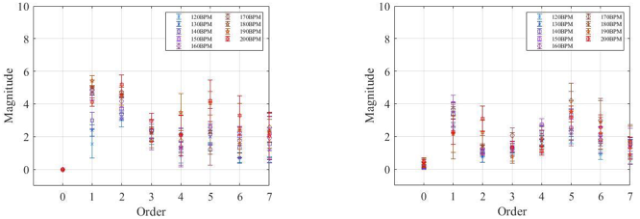
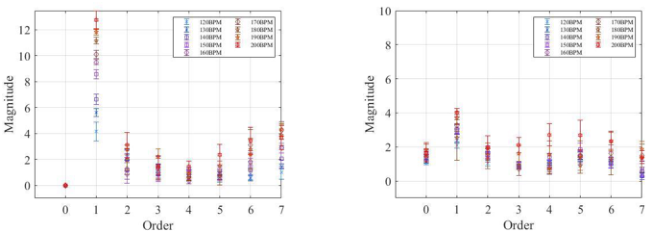
There were no significant differences among volunteers except for the foot, and the results were generally similar. Thus, only the results of Volunteer A are shown except for the foot, and only the results of all Volunteers A, B, and C are shown for the foot. The results for the arm part, consisting of upper arms, forearms, and hands, were almost same except for the amplitude of the first-order component. Thus, only the upper arm figure is shown in the arm part, and the amplitude and standard deviation of only the first-order components with characteristics of forearm and hand are shown in Table 1.
Comparison of Race-Walking and Power Walking at Varying Paces 1375
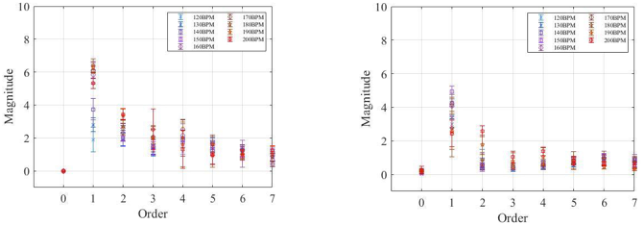
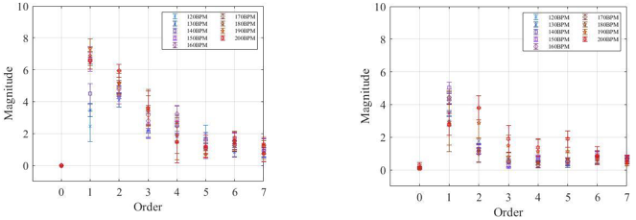
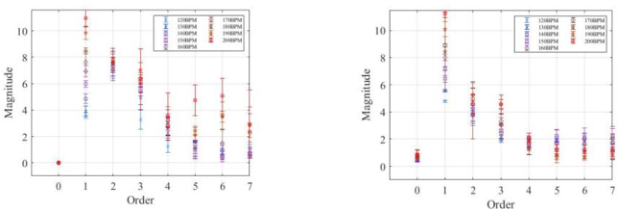
Figure 1: (RW), Amplitude of head acceleration; (PW), Amplitude of head acceleration.Figure 2: (RW), Amplitude of upper trunk acceleration; (PW), Amplitude of upper trunk acceleration.Figure 3: (RW) Amplitude of lower trunk acceleration; (PW), Amplitude of lower trunk acceleration.
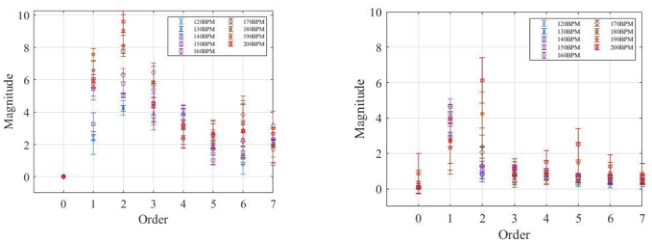
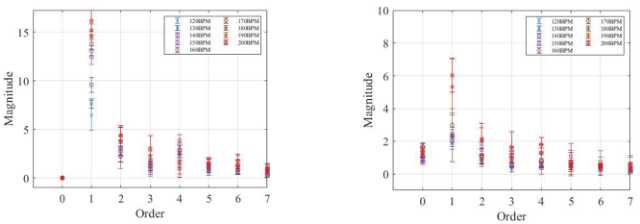
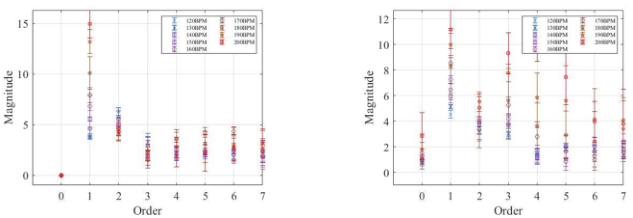
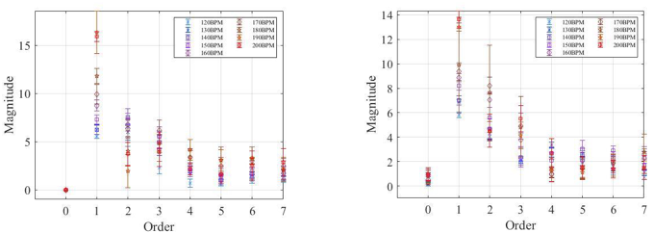
The results of the analysis of volunteer A’s race walking (RW) and power walking (PW) are shown in Figures 1 through 7, and the results of the frequency analysis of feet of volunteers B and C are shown in Figures 8 and 9. In these figures, the horizontal axis is order and the vertical axis is the amplitude. Area marked by symbols represents mean value of five trials, and error bars represent the standard deviation.
The analysis of acceleration at 15 segments showed that the characteristics of the frequency components of each site could be divided into three parts: central part consisting of the trunk and head, arm part consisting of the upper arm, forearm, and hand, and leg part consisting of the thigh, lower leg, and foot. The differences in characteristics between the PW and RW are described below. The characteristics of RW and PW are omitted due to number of pages.
1376 Inoue and Shibata
Figure 4: (RW), Amplitude of upper arm acceleration; (PW), Amplitude of upper arm acceleration.Figure 5: (RW), Amplitude of thigh acceleration; (PW), Amplitude of thigh acceleration.Figure 6: (RW), Amplitude of lower leg acceleration; (PW), Amplitude of lower leg acceleration.Figure 7: (RW, volunteer A), Amplitude of foot acceleration; (PW, volunteer A), Amplitude of foot acceleration.
Comparison of Race-Walking and Power Walking at Varying Paces 1377
Figure 8: (RW, volunteer B), Amplitude of foot acceleration; (PW, volunteer B), Amplitude of foot acceleration.Figure 9: (RW, volunteer C), Amplitude of foot acceleration; (PW, volunteer C), Amplitude of foot acceleration.Table 1. Amplitudes and standard deviations of the first components at the arm part.
In the central parts, the quadratic component is large in the lower trunk for both movements. Comparing Figure 3 (RW) and Figure 3 (PW), the quadratic component was larger in RW, and the quadratic component was dominant in all paces in RW.
Figure 4 and Table 1 show that the amplitude of the first-order component in the arm part increased at a constant rate with increasing pace in RW, while the amplitude of the first-order component in PW began to increase more rapidly around 180 BPM. In addition, the amplitude of RW was larger than that of PW for the arm part.
1378 Inoue and Shibata
In the leg part, the difference between RW and PW was particularly large. Figures 7 to 9 show that the quadratic component decreased with gait in the RW for volunteers A and B in the foot, whereas the quadratic component increased with gait in the PW. In addition, Figures 5 and 6 show that the quadratic component of PW increased with pace in volunteers A and B. Figures 5 and 6 show that relationship between the quadratic component of the lower leg and the thigh was smaller in the PW, but the thigh was larger in the RW. Finally, Figures 6 and 7 show that the amplitude of the lower leg and foot was larger in the RW.
DISCUSSION
In the leg part, where many RW-specific characteristics were observed, many characteristics were found especially in the quadratic component. In the leg part, the quadratic component is a waveform consisting of two motions: an increase/decrease in acceleration at the time of ground contact and an increase/decrease in acceleration at the time of kick-start, so it can be said that this component includes impact at the time of ground contact. Based on this, we will discuss each result. First, the decrease in the quadratic component with increasing pace in volunteers A and B for RW only is thought to be due to the decrease in shock with increasing pace. Since there is a trade-off between pace and stride length in the walking, the stride length becomes smaller as the pace increases. The change from heel-strike grounding to midfoot grounding, in which the entire sole of the foot is grounded, is thought to have resulted in a smaller angle between the ground and the foot at the time of ground contact, and thus a smaller impact on the heel. It should be noted that the midfoot grounding in RW is reported to cause hyperextension of knee joint, and therefore, a low impact does not necessarily mean a low load movement (Di Gironimo et al., 2016). The fact that the quadratic component tended to increase in the foot region only in Volunteer C is due to the fact that Volunteer C was the athlete with the shortest competition history, which suggests that there were differences in the trend due to differences in the level of proficiency in RW.
Second, in PW, the quadratic component of the lower leg was larger than that of the thigh except for paces above 190 BPM, but in RW, the quadratic component of the thigh was larger than that of the lower leg, and the reason why the quadratic component of the lower leg was larger than that of the thigh in PW may be due to the shock absorption effect of the knee joint (Tagawa et al., 2001). On the other hand, in RW, the Bent Knee rule states that the knee must not be bent until the leg is perpendicular to the ground from the time of ground contact. Therefore, the knee joint cannot be bent at the time of ground contact, and it is thought that shock absorption at the knee joint did not take place. Another reason why the quadratic component of the thigh was larger than the quadratic component of the lower leg in the RW is related to the movement of the lower trunk. The quadratic component of the lower body is large, just like that of the leg part, suggesting that because the legs cannot absorb the shock during RW, the pelvic rotation movement specific to RW mitigates the propagation of the shock. Therefore, the rotational motion
Comparison of Race-Walking and Power Walking at Varying Paces 1379
in the lower trunk was transmitted to the thighs, resulting in a larger second- order component in the thighs than in the lower legs.
Next, the amplitude was larger in the RW than in the foot and lower leg. This is thought to correspond to the RW rule of Loss Of Contact, in which one of the foot must always be on the ground, so that the area below the knee moved faster than the PW in the period from ground release to before ground contact.
Finally, in the arm part, the increase in amplitude with pace was almost proportional for the RW movements, but the increase in amplitude increased for the PW movements above around 180 BPM. This suggests that the PW movements cannot adjust to the increase in step speed after 180 BPM, but the RW movements are able to respond to the increase in gait because of the large rotational movement of the hips and the shoulder movements. In addition, the amplitude of RW was larger than that of PW in all segments of the arm part. This indicates greater acceleration in the arm part, which may assist the response to Loss Of Contact in the feet and lower legs.
CONCLUSION
In this paper, as a basic study for applying RW to healthcare, the characteristics of body part acceleration in the frequency domain during RW operation are clarified by comparing them with those of PW. The results of the frequency analysis showed that RW-specific movements appeared especially in the leg part, while the movements of other body parts had characteristics similar to those of PW, but some body parts, such as the arms, had larger movements, and some body parts, such as the lower trunk, were affected by the movements of the leg part. The above results indicate that the frequency analysis can be used to quantitatively describe the motion in RW.
The results of this study only analyzed the acceleration in the vertical direction, but acceleration in front-back direction also plays a significant role in the walking motion, and new knowledge may be obtained by analyzing the acceleration in the front-back direction, such as the fact that the decrease in impact with the increase in pace that appeared in the results of this study is converted into motion in the forward direction. Therefore, we will analyze the motion of RW in the front-back direction to further elucidate the characteristics of RW and examine whether it can be applied to health care.
REFERENCES
A. Mostayed, M. Mynuddin, G. Mazumder, S. Kim (2008), Abnormal Gait Detection Using Discrete Fourier Transform, 2008 International Conference on Multimedia and Ubiquitous Engineering. B. Hanley, A. Bissas, A. Paul Drake (2008). The biomechanics of elite race walking:
technique analysis and the effects of fatigue, New Studies in Athletics, 23, 4, 17–25. C. Ochoa-Diaz, A. Padilha L. Bó (2020), Symmetry Analysis of Amputee Gait Based on Body Center of Mass Trajectory and Discrete Fourier Transform, MDPI Sensors 2020, 20(8), 2392.
1380 Inoue and Shibata
G. Di Gironimo, T. Caporaso, D. Maria Del Giudice, A. Tarallo, A. Lanzotti (2016), Development of a new experimental protocol for analysing the Race, Procedia Engineering Volume 147 : 741–746. J. Li, Y. Yang, X. Li (2022), Effect of Power Walking on the Body Shape of College
Students Who Sit Long and Exercise Little, 2022 International Conference on Wearables, Sports and Lifestyle Management. M. Ae, H. Tang, T. Yokoi (1992): “Estimation of Inertia Properties of the Body Segments in Japanese Athletes”(in japanese), Society of Biomechanisms Japan M. Schepers, M. Giuberti, G. Bellusci, Consistent Tracking of Human (2018), DOI:
10.13140/RG.2.2.22099.07205. T. Inoue, K. Shibata (2023), Relationship between gait and walking motion in healthy walking by analysis in time and frequency domains (in japanese), Proceedings of the Society of Biomechanisms Japan, 44th, pp. 43–46. T. Suzuki, K. Takedaa, K. Fujii. (2022), Automatic detection of faults in race walking
from a smartphone camera: a comparison of an Olympic medalist and university athletes, 2022 IEEE 11th Global Conference on Consumer Electronics. Y. Tagawa, N. Shiba, K. Miyazaki, A. Inoue, T. Yamashita (2001), Effects of Knee and Ankle Movements on Foot Impact Forces in Human Walking, JSME International Journal Series C 44(4) : 1089–1096.
LISTED IN THE AHFE DIGITAL BOOKSTORE CATALOGUE
Explore the complete digital volume
Human Factors in Design, Engineering, and Computing
Read this individual research paper free through the original publisher, or explore the full digital proceedings book.
ISBN 978-1-964867-35-9
Explore this ISBN in the AHFE Bookstore ↗Listed in the July 2026 bookstore catalogue; search by ISBN to confirm current availability · Digital book purchase optional