Takashi Sakamoto, Kouki Kamada, Atsushi Maki, Toshikazu Kato (2023). The Impact of Parental Treatment and Education on Social Exclusion Sensitivity in Adult Children: A Questionnaire Survey and fNIRS Study Using the Cyberball Paradigm. In: Artificial Intelligence, Social Computing and Wearable Technologies. AHFE Open Access, vol. 113, pp. 363–372. https://doi.org/10.54941/ahfe1004209
Publisher statistics will load when you open Metrics.
AHFE OPEN ACCESS OPEN ACCESS CONFERENCE PROCEEDINGS PAPER
The Impact of Parental Treatment and Education on Social Exclusion Sensitivity in Adult Children: A Questionnaire Survey and fNIRS Study Using the Cyberball Paradigm
We investigated how attachment styles between parents and children, as well as the coping styles taught by parents to their children, affect sensitivity to social exclusion using psychological assessments based on questionnaire surveys. Additionally, we examined whether differences in sensitivity to social distress could be detected as differences in activation sites in the brain using functional near-infrared spectroscopy (fNIRS) measurements with the Cyberball Paradigm. The results suggested a potential correlation between children's own coping styles and their cognitive perception of parental guidance. However, no correlation was observed between parental guidance and children's cognition. Furthermore, in the group experiencing high levels of social distress, specific brain regions, the dorsomedial prefrontal cortex (DMPFC) and anterior prefrontal cortex (APFC), were significantly more active during the experience of social distress. Several activations in brain regions not previously reported in conventional research were also observed. These findings suggest that the way parents interact with their children and the content of parental education may have an impact on children's future sensitivity to social distress.
This study investigates the attachment styles between parents and their adult children, the transmission of coping strategies from parents to children, and the social exclusion sensitivity in grown-up children. The hypothesis exam- ined in this study is whether parental interactions and educational content provided by parents influence their children’s future sensitivity to social exclusion. Additionally, using functional near-infrared spectroscopy (fNIRS), the study aims to examine whether differences in social exclusion sensitivity can be detected through brain activation patterns.
The Cyberball Paradigm is used in our fNIRS study, to assess social exclusion sensitivity, which involves a virtual ball game experiment. The Cyberball Paradigm is an experimental method used to study social exclu- sion and acceptance. Participants engage in a virtual ball game, passing the ball with other participants (computer programs) on a computer-based game screen. Initially, participants actively participate in the game, but eventually experience social exclusion as other participants stop passing the ball. This experiment allows for evaluating psychological and behavioral responses to exclusion and disregard from others.
Generally, we often find ourselves in situations of isolation and loneli- ness due to factors such as a lack of interaction with others and a loss of support opportunities. However, there are many aspects of sensitivity to social distress that remain unexplored. It is believed that even when expe- riencing social distress, individuals may be able to endure it if they have acquired coping methods to change their cognition. Therefore, whether one has acquired coping methods to change cognition is likely to have a signifi- cant impact on sensitivity to social distress. Based on these perspectives, this study employs both subjective measures using questionnaires to investigate sensitivity to social distress and parent-child interactions and more objective brain function measurement using fNIRS.
RELATED STUDIES It is believed that “attachment style” influences sensitivity to social dis- tress. Attachment style is a concept derived from Bowlby’s attachment theory, and it has been reported to have an impact not only on behavior and emotions in interpersonal relationships but also on social adaptability (Kanemasa, 2003).
The choice of coping methods in situations where social distress can occur is believed to influence the susceptibility to social distress. Szkody et al. (2020) conducted a study targeting university students to inves- tigate the content of coping styles related to interpersonal relationships taught by parents in the past and their impact on emotional regulation when expe- riencing social distress. As a result, differences in the relationship between emotions before and after tasks were observed based on the content taught by parents. It is suggested that a connection between social distress and coping styles and highlights the important role of parental coping style instruction in children’s coping with distress.
Research on social distress is also conducted in the field of neuro- science, particularly through functional magnetic resonance imaging (fMRI) to measure brain function. Eisenberger et al. (2003) used fMRI to mea- sure brain activity when individuals experienced social distress. Their results revealed a positive correlation between subjective evaluations of social dis- tress and activity in the dorsal anterior cingulate cortex (dACC) and a negative correlation with the right ventrolateral prefrontal cortex (r-VPFC). On the other hand, there is no precedent for the use of fNIRS in this context, and it is expected that new insights can be gained through its application.
The Impact of Parental Treatment and Education on Social Exclusion Sensitivity 365
METHODS
Psychological Assessment The psychological assessment of attachment styles is evaluated using the ECR-GO by Nakao et al. (2004). In the ECR-GO, both parents and chil- dren respond while considering generalized others and society. There are two factors: “anxiety about abandonment” and “intimacy avoidance.” From the questionnaire results, the values of each factor item are averaged for each participant and treated as the participant’s scores. There are 30 items in the questionnaire, rated on a 7-point scale.
Coping styles are assessed using the Japanese version of GSOC, which our research group independently translated into Japanese based on the GSOC (Abaied, 2010). The GSOC evaluates coping styles in four cate- gories: “cognitive attention shifting,” “problem-solving,” “acceptance,” and “withdrawal.” In this report, the average values of questionnaire items cor- responding to the four styles are used as the scores for each style. There are 23 items in the questionnaire, rated on a 5-point scale. Based on GSOC, this study obtained responses for the following three evaluation items:
1. Child’s Current Coping Style: Adult children provide their own assess- ment of their current coping style. 2. Parental Intentions: Parents recall and provide answers regarding the coping instructions they gave to their child. 3. Child’s Cognition: Adult children recall and provide answers about the coping instructions they received from their parents.
The evaluation of “social distress” after the experiment on Cyberball Paradigm is done using the Japanese version of Need Threat Scale, which our research group translated into Japanese based on the original Need Threat Scale (Van Beest et al., 2006). This scale consists of four sub-scales: “belong- ingness,” “controllability,” “self-esteem,” and “meaningfulness.” The sum of scores from these four sub-scales is labeled as “Total,” and a smaller total score indicates a greater level of social distress. There are 20 items in the questionnaire, rated on a 7-point scale.
Functional Near-Infrared Spectroscopy (fNIRS) The technique of measuring changes in the concentration of oxygenated hemoglobin (Oxy-Hb) or deoxygenated hemoglobin (Deoxy-Hb) in brain blood flow as time-series data using fNIRS is known as optical topography (Maki et al., 1995). The optical topography device used in this study (ETG- 4000 Hitachi) emits two wavelengths, 695 nm and 830 nm. The sampling rate is 10 Hz, and the unit of each hemoglobin signal is [mM ·mm]. In this study, the focus is on the values of Oxy-Hb that can be measured by fNIRS (Hoshi et al., 2001). This is because Oxy-Hb is the most sensitive indicator of changes in brain blood flow.
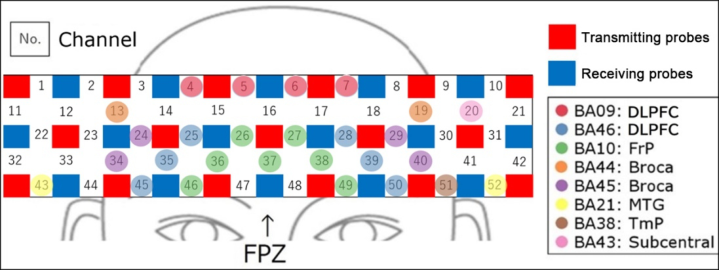
The probes of the optical topography device are attached to the frontal cor- tex of the participants using a 3x11 probe holder to cover the area (v1). The probes consist of 17 emitters and 16 detectors, placed at alternating intervals
of 30 mm, allowing for measurements at 52 channels. The consecutive num- bers from 1 to 52 represent the 52 channels (CH.) being measured (Figure 1). The Fpz, a reference point for electrode placement in the international 10–20 system for EEG, is located between CH.5 and CH.6. This attachment method allows for the determination of the regions shown in the table in the figure with an accuracy of over 80%. This accuracy is derived using the virtual registration method (Tsuzuki et al., 2007).
Figure 1: We utilized a 52-channel continuous wave system (ETG-4000, Hitachi). The probe comprises 17 transmitters and 16 receivers, and it was affixed with a 9 × 34 cm rubber shell covering the frontal and temporal areas. The channel numbers and cor- responding anatomical labels are based on previous studies (Tsuzuki et al., 2007, Tsuzuki et al., 2012; Tsuzuki & Dan, 2014; Endo et al., 2020; Shinozuka et al., 2021; Kamada et al., 2022).
Cyberball Paradigm The Cyberball Paradigm is an experimental method used to study social exclusion and acceptance (Williams, 2000). Participants engage in a vir- tual ball game, passing the ball with other participants (computer pro- grams) on a computer-based game screen. Initially, participants actively participate in the game, but eventually experience social exclusion as other participants stop passing the ball. This experiment allows for evaluating psychological and behavioral responses to exclusion and disregard from others.
Experiments using the Cyberball paradigm in prior research are typically conducted as a procedure where participants transition continuously from a “free period,” in which they participate in a ball-passing game, to an “exclu- sion period,” where participants are excluded and cannot engage in the ball game. However, if one were to compare the cerebral blood flow in each of these periods in their current state, it is believed that the exclusion period may be influenced by the preceding free period. To address this issue, it is desirable to introduce a certain time interval between each period to make them discontinuous.
On the other hand, when such time intervals are introduced, there is a concern that measurements would be interrupted at the end of each period, potentially leading to a diminished sense of participation in the ball game and a reduced sense of exclusion from other participants. To treat each period
The Impact of Parental Treatment and Education on Social Exclusion Sensitivity 367
as independent trials as much as possible, it would be effective to create a consistent situation before and after each period to standardize the conditions when each period begins. Specifically, including a task where participants pass the ball counterclockwise for a few minutes before and after each period can help. By doing so, it is believed that the situation where the exclusion period is influenced by the preceding free period can be relatively improved without compromising the participants’ sense of engagement in the ball game.
RESULTS
Participants The study involved 25 right-handed Japanese university students in their 20s (14 males, 11 females, M = 21.92±0.81) and their parents (2 males, 23 females, M = 51.56±3.54) as participants. Both parents and adult chil- dren completed separate subjective assessment questionnaires on personality traits and parental guidance in the home. Only the adult children, who were the focus of the investigation, participated in fNIRS measurements during the Cyberball task, which induces social exclusion, and also completed subjective assessment questionnaires on social exclusion.
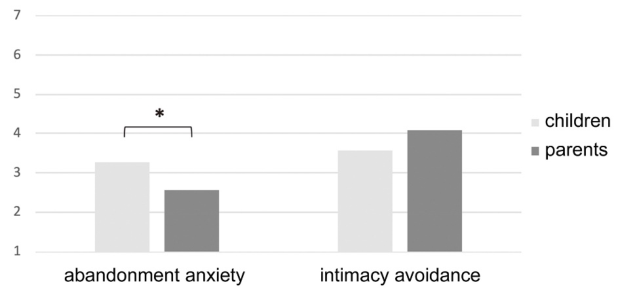
Psychological Assessment We conducted a t-test (Welch’s test) with a significance level of 5% to com- pare the average values of attachment styles in children and parents for two factors, “abandonment anxiety” and “intimacy avoidance” (Figure 2). As a result, a significant difference was found in the “abandonment anxiety” fac- tor. Additionally, we calculated the correlation coefficients between parent and child data for these two factors using Pearson’s product-moment correla- tion coefficient and performed a null correlation test with the null hypothesis being “the population correlation coefficient is 0.” The test results did not reject the null hypothesis for either factor.
Figure 2: Attachment styles in children and parents for two factors.
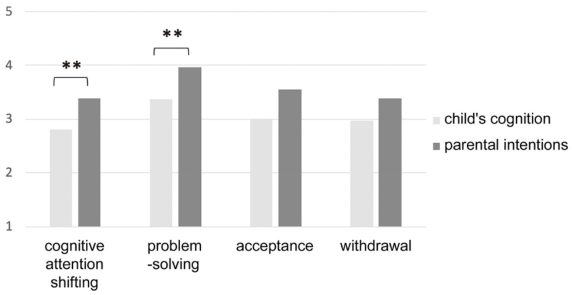
We also conducted t-tests (Welch’s test) on the evaluation items (parental intentions) answered by parents and the evaluation items (child’s cogni- tion) answered by children regarding coping style instruction from parents.
Significant differences were found in two out of four coaching styles, namely, “cognitive redirection” and “problem-solving” (Figure 3).
Figure 3: Significant differences were found in “cognitive redirection” and “problem- solving” between parental intentions and child’s cognition.
Furthermore, we conducted null correlation tests for the evaluation items of “parental intentions” and “child’s cognition” and for “child’s cognition” and “Child’s Current Coping Style.”The results showed that there was no sig- nificant correlation in all styles between “parental intentions” and “child’s cognition.” On the other hand, when examining the correlation between “child’s cognition” and “Child’s Current Coping Style,” there was a positive correlation (5% significance) in the coping styles of “cognitive redirection,” “problem-solving,” and “acceptance.”
Additionally, we conducted null correlation tests between the two fac- tors of children’s attachment styles, namely, “abandonment anxiety” and “intimacy avoidance,” and the four coping styles, “cognitive redirection,” “problem-solving,” “acceptance,” and “disengagement.” The results showed a positive correlation (5% significance) between the attachment style of “abandonment anxiety” and the coping style of “disengagement.”
fNIRS Measurements in the Cyberball Paradigm The participants in the experiment were 21 individuals, excluding four with missing Oxy-Hb measurement data in fNIRS. These 21 participants were included in the analysis of the experimental data.
Before the experiment, the participants underwent a Japanese-translated version of the “Need Threat Scale,” which our group had translated for the purpose of assessing social distress levels through psychological evaluation. The Total Score derived from four subscale scores of the Japanese version of the “Need Threat Scale” - “Belongingness,” “Control,” “Self-Esteem,” and “Meaningfulness” - is used to assess social distress, with lower scores indi- cating higher levels of social distress. Based on the assessed levels of social distress using the Japanese version of the “Need Threat Scale,” the partic- ipants were divided into two groups for the evaluation of fNIRS Oxy-Hb measurement data. Specifically, there were the Higher group consisting of 11 participants (Total Score less than 80) with high social distress and the
The Impact of Parental Treatment and Education on Social Exclusion Sensitivity 369
Lower group consisting of 10 participants (Total Score equal to or greater than 80) with low social distress. For both the Higher group (11 participants) and the Lower group (10 par- ticipants), fNIRS measurements were conducted during periods when they were experiencing social distress induced by the Cyberball Paradigm, and the fNIRS data from the free interval and exclusion interval were compared. A t-test (α = 0.050) was conducted on the average Oxy-Hb concentra- tion values. Among the 52 channels of fNIRS, the channels with significant differences were illustrated in the figures (Figure 4). As evident from the fig- ures, channels with significantly higher Oxy-Hb concentration levels during the exclusion interval, which induces social distress, were more prevalent in the Higher group, which was assessed with higher social distress levels. The Brodmann area and corresponding brain region names for channels with significantly higher Oxy-Hb concentration levels, as shown in the figures, are summarized in Table 1.
Figure 4: Red circles indicate significantly higher activity channels during the exper- imental social exclusion. The upper figure (higher group) contains more red circles than the lower figure (lower group).Table 1. Significantly higher channels and corresponding Brodmann area and brain region.
Psychological Assessment The results of the questionnaire survey suggested a correlation between adult children’s coping styles and their cognitive perception of parental guidance. However, no correlation was found between parental guidance and adult children’s cognitive perception. These findings suggest that adult children’s coping styles play a crucial role in their cognitive perception of parental guidance.
fNIRS Measurements Regarding brain function measurements, similar to previous research reports, a correlation was observed between social exclusion and the dorsomedial prefrontal cortex (DMPFC) and anterior prefrontal cortex (APFC), as well as between the left dorsolateral prefrontal cortex (l-DLPFC) and impression rat- ings of the stimuli in the group with high social exclusion. However, the study also observed activations in brain regions not reported in previous research. For example, in the group with low social exclusion, the right middle tempo- ral gyrus (r-MTG) showed activation. This region is known to activate when predicting others’ actions and emotions, indicating promising results in this study.
CONCLUSION
We conducted psychological assessments on Japanese individuals in their 20s, consisting of university students and graduate students. We examined their attachment styles with their parents, their current coping styles, and their cognitive perceptions of the coping styles they learned from their par- ents during childhood. Additionally, we explored their sensitivity to social distress using both psychological assessments and fNIRS brain function measurements.
We believe that the hypothesis suggesting that how parents interact with their children and the content of parental education may influence a child’s future sensitivity to social distress is supported under certain conditions in this comprehensive investigation. However, we also acknowledge the need for further research involving individuals from diverse backgrounds, including differences related to culture, gender, age, and others, to investigate variations in the relationship between social distress and parent-child relationships from both subjective and brain activity measurement perspectives. We hope that addressing these challenges will lead to a more refined understanding of the factors contributing to social distress.
ACKNOWLEDGMENT
This research was partially supported by the research fund of the Institute of Science and Engineering, Chuo University, and the JST-Mirai Program.
The Impact of Parental Treatment and Education on Social Exclusion Sensitivity 371
REFERENCES
Abaied, J. L. (2010). Socialization of coping with peer victimization and negative emotionality: Interactive contributions to children’s responses to stress and depres- sive symptoms. Doctoral dissertation, University of Illinois at Urbana-Champaign. Eisenberger, N. I., Lieberman, M. D., and Williams, K. D. (2003). Does rejection
hurt? An fMRI study of social exclusion. Science, 302(5643), pp. 290–292. Endo, A., Takahashi, N., Sakamoto, T., and Kato, T. (2020). Analyses of Impression Changes and Frontal Lobe Activity While Viewing Videos. D. D. Schmorrow and C. M. Fidopiastis (Eds.): HCII 2020, LNAI 12196, pp. 129–141, Springer International Publishing. Fuchino, Y., Sato, H., Maki, A., Yamamoto, Y., Katura, T., Obata, A., Koizumi, H.,
and Yoro, T. (2006). Effect of fMRI acoustic noise on sensorimotor activation examined using optical topography. Neuroimage, 32(2), pp. 771–777. Hoshi, Y., Kobayashi, N., and Tamura, M. (2001). Interpretation of near-infrared spectroscopy signals: a study with a newly developed perfused rat brain model. Journal of applied physiology, 90(5), pp. 1657–1662. Kamada, K., Endo, A., Takahashi, N., Sakamoto, T., and Kato, T. (2022). Analy-
sis of How Impressions are Fixed After One Week of Listening to Music Using Subjective Evaluation and Brain Activity Measurement. In: Mitsuo Nagamachi and Shigekazu Ishihara (eds) Kansei Engineering. AHFE (2022) International Conference. AHFE Open Access, vol 40. AHFE International, USA. Kanemasa, Y. (2003), Review of recent studies on adult attachment and the prospects for the future studies (in Japanese), Japanese journal of interpersonal and social psychology, 3, pp. 60–72. MacDonald, G., and Leary, M. R. (2005). Why does social exclusion hurt? The
relationship between social and physical pain. Psychological bulletin, 131(2), pp. 202–223. Maki, A., Yamashita, Y., Ito, Y., Watanabe, E., Mayanagi, Y., and Koizumi, H.
(1995). Spatial and temporal analysis of human motor activity using noninvasive NIR topography. Medical physics, 22(12), pp. 1997–2005. Nakao, T., and Kato, K. (2004). Examining reliabilities and validities of adult attachment scales for “the generalized other” (in Japanese), Kyushu University psychological research, 5, pp. 19–27. Shinozuka, K., Niioka, K., Tokuda, T., Kyutoku, Y., Okuno, K., Takahashi, T., and
Dan, I. (2021). Language familiarity and proficiency leads to differential cortical processing during translation between distantly related languages. Frontiers in Human Neuroscience, 15, 593108. Szkody, E., Steele, E. H., and McKinney, C. (2020). Links between parental socialization of coping on affect: Mediation by emotion regulation and social exclusion. Journal of Adolescence, 80, pp. 60–72. Tsuzuki, D., and Dan, I. (2014). Spatial registration for functional near-infrared spec-
troscopy: from channel position on the scalp to cortical location in individual and group analyses. Neuroimage, 85, 92–103. Tsuzuki, D., Cai, D. S., Dan, H., Kyutoku, Y., Fujita, A., Watanabe, E., and Dan, I. (2012). Stable and convenient spatial registration of stand-alone NIRS data through anchor-based probabilistic registration. Neuroscience Research, 72(2), 163–171. Tsuzuki, D., Jurcak, V., Singh, A. K., Okamoto, M., Watanabe, E., and Dan, I. (2007).
Virtual spatial registration of stand-alone fNIRS data to MNI space. Neuroimage, 34(4), pp. 1506–1518.
Van Beest, I., and Williams, K. D. (2006). When inclusion costs and ostracism pays, ostracism still hurts. Journal of personality and social psychology, 91(5), pp. 918–928. Williams, K. D., Cheung, C. K., and Choi, W. (2000). Cyberostracism effects of being
ignored over the Internet. Journal of personality and social psychology, 79(5), pp. 748–762.
LISTED IN THE AHFE DIGITAL BOOKSTORE CATALOGUE
Explore the complete digital volume
Artificial Intelligence, Social Computing and Wearable Technologies
Read this individual research paper free through the original publisher, or explore the full digital proceedings book.
ISBN 978-1-958651-89-6
Explore this ISBN in the AHFE Bookstore ↗Listed in the July 2026 bookstore catalogue; search by ISBN to confirm current availability · Digital book purchase optional