Ayaka Yamada, Asako Noma, Takashi Sakamoto, Toshikazu Kato (2024). Orange-Sweet Scent Reduces Stress Associated with Numerical Tasks: A Physiological and Psychological Evaluation. In: Human Factors in Design, Engineering, and Computing. AHFE Open Access, vol. 159, pp. 1214–1221. https://doi.org/10.54941/ahfe1005689
This paper evaluates the stress reduction effects of orange-sweet aroma at the perception threshold. The number of patients suffering from stress-related disorders is increasing, making it a significant social issue as stress can prevent individuals from working and interfere with their daily lives. However, completely eliminating stress from daily life is not feasible. Therefore, this research aims to identify a method for reducing stress within this social context, even when stress is present. Given the varying influence of scents on individuals, this study examines the stress-reducing effects of orange sweet essential oil aroma at the perception threshold. A sample of 20 university students (10 males and 10 females; average age 22 years) participates in the study. The experiment is conducted under two conditions: with and without the scent. The stress task, designed to eliminate the influence of computational ability, involves simple numerical computations performed under both conditions. To evaluate the effects of the aroma on stress reduction, multiple physiological and psychological indices are utilized. Physiological indices include electrodermal activity (EDA) and salivary amylase levels. Psychological indices include the short version of the Profile of Mood States 2 (POMS2), a Japanese questionnaire for work-related fatigue feelings called Jikakusho-shirabe, and a Likert scale questionnaire assessing scent preference and intensity. Electrodermal activity (EDA) significantly increased during the stress task compared to the rest condition. Additionally, the discomfort factor in the Jikakusho-shirabe increased after the task compared to before the task, but only in the absence of aroma. These results indicate that the stress task created in this study effectively induces arousal. Furthermore, the findings suggest that discomfort can potentially be reduced by the presence of orange-sweet scent at the perception threshold. However, the presence of aroma resulted in a significant difference only in the discomfort factor. In future experiments, we will focus on behavioral indices, such as poor performance, which cannot be determined solely by physiological or psychological indices.
The purpose of this study is to identify ways to reduce stress in social settings where stress exists. The total number of patients with stress-related disorders is increasing (Ministry of Health, 2020). However, it is inevitable that individuals and members of organizations face a variety of stresses.
Orange-Sweet Scent Reduces Stress Associated With Numerical Task 1215
Various efforts and measures to avoid and reduce stress are necessary for people’s well-being in daily social settings.
To address these social issues, this study focuses on the reduction of stress through the use of aroma oil scents. As we know, aromas are often used as an effective tool in psychotherapy and stress management. Multiple studies have reported that certain aromas are effective in reducing stress. We believe that making use of aromas in public and work environments does not interfere with the performance of duties and suits these environments.
This paper specifically evaluates the stress reduction effects of Orange- sweet aroma. The stress reduction effects will be examined based on changes in physiological and psychological indices brought about by aromatization when a numerical computation is imposed as a stress task. A few previous studies have devised ways to change the stress task according to the speed of an individual’s calculations. Therefore, this study will apply a unique experimental device in which the numerical load is increased or decreased according to the individual’s numerical ability, so that the same load is applied regardless of the individual’s numerical speed. In addition, since strong scents can affect preference and mood, the amount of aroma emission is set at the perceived threshold amount. The results of this study will provide new insights into how Orange-sweet aroma at the perception threshold contributes to stress reduction.
RELATED STUDIES In research on the relaxation effects of Orange-sweet aroma (Ishihara, 2022), tension and anxiety decreased when the Uchida-Kraepelin test was administered with the inhalation of the Orange-sweet aroma.
In research examining the stress reduction effect of lavender aroma (Hashizume, 2011), a seven-minute Kraepelin test and a three-minute mental arithmetic task in which participants had to keep subtracting seven from 1,000 were used as stress tests. During the task, participants were exposed to lavender scent under four conditions: 1) odorless, 2) weak, 3) medium, and 4) strong. The maximum improvement in stress was observed in condition 2), the weak aromatic condition (three microliters of lavender scent oil in a five-liter bag).
METHODS
Participants Twenty university students (10 males and 10 females, mean age 22 years) who are right-handed gave informed consent to participate in the experiment in accordance with the rules of the Ethics Committee of Chuo University. Participants were given a stress task where they were exposed to Orange- sweet aroma, known for its stress-reducing effects.
Measures Physiological and psychological measures were taken during the task to examine stress changes. Physiological indices included skin electrical activity
(EDA) and salivary amylase activity. Psychological indices involved two subjective evaluation questionnaires: the Profile of Mood States Second Edition (POMS2, short version for adults), the Japanese Evaluation Questionnaire for Subjective Symptoms of Work-Related Fatigue called “Jikakusho Shirabe,” and a Likert scale questionnaire assessing scent preference and intensity.
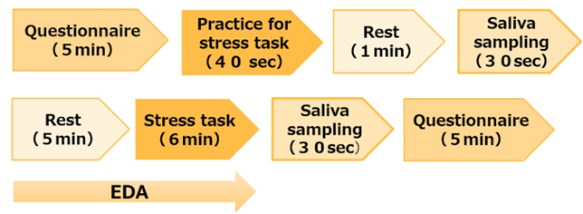
Procedure Experimental participants first wash their hands and gargle three times to control the measurement of salivary amylase, and then receive an explanation of the experiment. After that, they enter the experimental booth. The presence or absence of scent should not be communicated to the participants at the time of entry. After the participants sit down on a chair, they fill out a questionnaire on psychological indices. After filling out the questionnaire, the electrodermal activity meter is placed on the basal phalanges of the second and fourth fingers of the participants’ left hands. Next, the participants practice answering the stress task for 40 seconds to confirm how to operate the stress task described below. Participants answer the stress task using a monitor and a numeric keypad. After the practice, the participants rest for one minute, and then salivary amylase activity is measured by collecting saliva samples using a salivary amylase monitor (chip). After the measurement, the participants rest for five minutes and then perform the stress task for six minutes, as in the practice session, with the participants instructed to “work to get a higher score.” After the stress task, salivary amylase is measured again and a questionnaire is given.
Figure 1: Experimental procedure.
Experiments were conducted on two separate days, one with and one without the Orange-sweet perceptual threshold scent introduced to the participants. The second experiment was conducted at the same time of day as the first, within one week of the first experiment. To avoid order effects, half of the participants were exposed to the scent on day one, while the other half were exposed to the scent-free environment on day one. Strenuous exercise, eating, and tooth brushing were avoided for one hour prior to the experiment, as they can significantly distort the results of the salivary amylase measurement. To control the scent conditions, participants were asked not
Orange-Sweet Scent Reduces Stress Associated With Numerical Task 1217
to use perfume, hand cream, or other odorous substances on the day of the experiment.
Diffusion of Aroma and Its Amount The scent of Orange-sweet was generated by a nebulizer-type aroma diffuser using essential oil (Carris Seijo, lot number: ASC PGS10K3) extracted from the peel. The diffuser was placed out of sight, at a distance of three meters from the participants. In a previous study (Hashizume, 2011), it was found that inhalation of weak aroma conditions tended to improve stress. Therefore, in this study, the amount of aroma diffusion was set at the perceptual threshold. As a preliminary investigation to determine the threshold of aroma perception, we asked four people, who were different from the experimental participants, to evaluate the strength of the scent in the experimental booth using a six-step scent strength rating questionnaire. Based on the results of the preliminary study, the amount of aroma presented at the perception threshold was set to “the amount of aroma diluted twice with unscented MCT oil, sprayed by an aroma diffuser for five seconds, and stopped for 60 seconds”in this experiment. The ventilation fan was turned off when the scent was introduced, and the room was filled with the prescribed concentration of the scent when the participants entered the experimental room.
Stress Task The stress task is a subtraction task in which seven is continuously subtracted from 1000. The default answer time is five seconds per question, with a shorter answer time for each correct answer and a longer answer time for each incorrect answer. Specifically, the goal is to achieve a 50% correct response rate using the up-and-down method. The up-and-down method is a psychological measurement method in which stimuli are continuously adjusted in response to the participants’ responses (Kingdom & Prins, 2010). The response time of the next question decreases by a factor of 0.9 when the correct answer is given, while the response time increases by a factor of 1.11 when the time runs out or when the wrong answer is given. The stress task is created using a Python program, and the graphical user interface (GUI) is created using the Tkinter toolkit and displayed on a monitor.
Physiological Indices Physiological indices are measured by Plux biosignalsplux’s electrodermal activity (EDA) and salivary amylase activity (AMY value) using Nipro’s salivary amylase monitors and chips. The skin conductance level (SCL) is obtained from the EDA data measured at 400 Hz. It is known that SCL increases with stress (Posada-Quintero, 2016). Salivary amylase is secreted by both direct sympathetic innervation and norepinephrine action, and it has been found that salivary amylase activity increases with unpleasant stimuli and conversely decreases with pleasant stimuli (Yamaguchi, 2007).
Psychological Indices Psychological indices used in this study included scent intensity on a six- point scent intensity scale, room scent preference, the Profile of Mood States, 2nd Edition (POMS2) short version for adults, and the Japanese evaluation questionnaire for subjective symptoms of work-related fatigue, Jikakusho Shirabe. The scent intensity scale is a six-point scale ranging from no scent to strong scent in a room. Room scent preference was rated on a seven- point scale from very disliked to very liked. The POMS2 short version is a rapid assessment of fluctuating and transient emotions (Heuchert, 2015). The Jikakusho Shirabe, aims to capture changes in work-related fatigue over time and investigate fatigue after stressful tasks (Japan Society for Occupational Health, Working Group for Occupational Fatigue, 2002).
RESULT
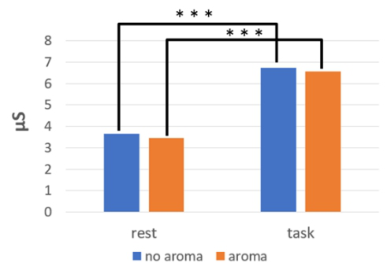
Physiological Indices For electrodermal activity, data from 19 participants were used, excluding one participant who had incomplete measurements. To obtain the skin conductance level (SCL) from the data acquired at 400 Hz, a 10th-order low- pass finite impulse response filter with a cut-off frequency of 0.4 mHz was applied. As shown in Figure 2, the SCL was significantly higher during the task than at rest. When aroma was present, the p-value was <0.001. Without aroma, the p-value was also <0.001. There was a statistically significant difference irrespective of the presence of aroma).
Figure 2: Comparison of SCL with and without aroma during rest and task.
Some of the salivary amylase activity (AMY) values did not follow a normal distribution; therefore, Steel-Dwass’s multiple comparison test was performed. However, there was no significant difference in AMY values, and individual differences were large.
Psychological Indices A t-test was applied to the results of response times and related scores for the subtraction tasks on two sets of data: one with aroma and the other
Orange-Sweet Scent Reduces Stress Associated With Numerical Task 1219
without aroma. However, no significant differences were found in the number of responses, percentage of correct responses, mean time to answer, or scores.
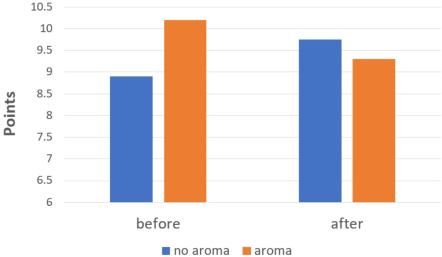
Additionally, a two-way ANOVA was conducted considering two factors: the presence or absence of aromatization (with or without aroma) and the timing of the implementation of the stress task (before and after the task). As a result, in one of the scales of the shortened version of POMS2, “Friendliness,” a p-value of 0.025 was observed, indicating a significant interaction (significant at the 5% level) between the “presence of aroma”and “before/after task” conditions (Figure 3). “Friendliness” represents a positive state or sociability due to interpersonal influences.
Figure 3: Comparison of “Friendliness” scale values of the POMS2 short version with and without aroma, before and after the task.
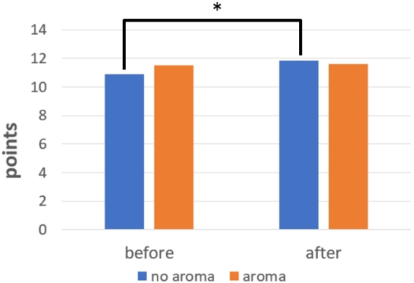
Multiple comparisons revealed a significant increase in “discomfort” before and after the task when the aroma was absent, but no change in discomfort before and after the task when the aroma was present (Figure 4). When the aroma was absent, the p-value was 0.026, which was significant at the 5% level. When the aroma was present, the p-value was 0.875, indicating no significant difference.
Figure 4: Comparison of “Discomfort” scale values of the POMS2 short version with and without aroma, before and after the task.
DISCUSSION
Physiological Indices The significant increase in SCL regardless of the presence of aroma suggests that the stress load induced by the stress task had a notable effect.
Efforts were made to control for salivary amylase levels, but large individual differences were observed. These results suggest that it is necessary to consider individual personality traits and baseline values rather than evaluating values from all participants uniformly (Tsunetsugu & Miyazaki, 2011). It will be necessary to use indicators such as personality traits.
Psychological Indices Since no differences were observed in the results of the numerical task as a stress task, it is likely that the scent did not affect performance measures such as speed and accuracy.
The effect of the perceived threshold of the Orange-sweet scent on one of the scales of the POMS2 short version, “discomfort,” was confirmed in the stress task. However, “Friendliness” showed an increase in value after the stress task in the absence of the scent, which was unexpected. We anticipated that the “Friendliness” scale would decrease after the stress task in the absence of the scent, but in fact, the value increased. One possible reason for this is that in the absence of the scent, the stress of performing the task caused the participants to become relatively more agitated than before the task, resulting in a corresponding increase in the “Friendliness” index, which indicates a positive mood. It is also possible that the stress increased the desire to “release stress by communicating with others,” and that this increased preference for interpersonal communication (possibly increasing sociability) led to an increase in the “Friendliness” index.
CONCLUSION
The present study suggests that the presence of an orange-sweet scent at the threshold of perception during a stress task may reduce discomfort. The presence of the scent caused a significant difference in the discomfort factor in the questionnaire evaluation items. In the future, it is highly likely that introducing this scent into work environments and facilities prone to discomfort will be effective. For example, incorporating an orange-sweet scent in offices and medical facilities may reduce stress and provide a more comfortable environment for employees and users.Future experiments will focus on changes in behavioral indicators, such as job performance, which cannot be determined by physiological or psychological indices alone.
ACKNOWLEDGMENT
The authors would like to express our deepest gratitude to Ms. Mai Yanagawa (KANSEI Design Limited) for her valuable research guidance and discussions. Furthermore, we would like to extend our heartfelt thanks to Dr. Toru Nakata (National Institute of Advanced Industrial Science and
Orange-Sweet Scent Reduces Stress Associated With Numerical Task 1221
Technology) and all the laboratory members of Chuo University for their enthusiastic research discussions and cooperation in experiments.
REFERENCES
Hashizume, S., Kawano, K., Sato, T., Kokubo, H., Kamada, A., Yamamoto, M., Katsuragawa, H., & Watanabe, T. (2011). Stress-reducing Activity of Aroma (Research Paper, The 31st Symposium on Life Information Science). Journal of International Society of Life Information Science, 29(1), pp. 76–81. https: //doi.org/10.18936/islis.29.1_76 Heuchert, J. P., & McNair, D. M. (2012). Profile of Mood States 2nd Edition™.
https://doi.org/10.1037/t05057-000 Ishihara, Shunichi. (2022). Relaxation Effect of Sweet Orange on Stress Tasks (in Japanese), Proceedings, Annual convention of the Japanese association of health psychology, 35, P1–02, p. 23. https://doi.org/10.11560/jahpp.35.0_23 Japan Society for Occupational Health, Working Group for Occupational Fatigue.
(2002). Jikakusho Shirabe [Japanese Evaluation Questionnaire for Subjective Symptoms of Work-Related Fatigue]. https://square.umin.ac.jp/of/jikakusyou- sirabe2.pdf (accessed July 22, 2024). Kingdom, F. A. A., & Prins, N. (2010). Psychophysics: A practical introduction.
Elsevier Academic Press. Ministry of Health, Labour and Welfare. (2022). Overview of patient survey 2020 (confirmed figures) (in Japanese). https://www.mhlw.go.jp/toukei/saikin/hw/kanja/20/dl/kanjya.pdf (accessed July 22, 2024). Posada-Quintero, H. F., Florian, J. P., Orjuela-Cañón, A. D., Aljama-Corrales, T., Charleston-Villalobos, S., & Chon, K. H. (2016). Power spectral density analysis of electrodermal activity for sympathetic function assessment. Annals of biomedical engineering, 44, pp. 3124–3135. https://doi.org/10.1007/s10439-016- 1606-6 Sato, Toshiaki. (2006). Stress Responses as modulators of the psychological functions
related to learning and memory: How does peripherally released epinephrine enhance memory? (in Japanese with English abstract), Journal of Health & Social Services, 4, pp. 39–69. https://tbgu.repo.nii.ac.jp/records/361 Tsunetsugu, Y., & Miyazaki, Y. (2011). Exploring individual differences in salivary stress markers (in Japanese), Forestry and forest products research institute (Ed.), Heisei 23 nenban kenkyu seika senshu, 2011, pp. 36–37. https://www.ffpri.affrc. go.jp/pubs/seikasenshu/2011/documents/p36-37.pdf (accessed July 22, 2024).
LISTED IN THE AHFE DIGITAL BOOKSTORE CATALOGUE
Explore the complete digital volume
Human Factors in Design, Engineering, and Computing
Read this individual research paper free through the original publisher, or explore the full digital proceedings book.
ISBN 978-1-964867-35-9
Explore this ISBN in the AHFE Bookstore ↗Listed in the July 2026 bookstore catalogue; search by ISBN to confirm current availability · Digital book purchase optional