Emiri Otsuka, Namgyu Kang (2023). Usability of Booking a Flight Ticket Using Airline Applications on Smartphones. In: Human-Centered Design and User Experience. AHFE Open Access, vol. 114, pp. 281–288. https://doi.org/10.54941/ahfe1004245
In recent years, using online has emerged as the predominant method to book an airline ticket. Following the COVID-19 pandemic, there has been a surge in the popularity of small-group travel in Japan, leading to an increasing number of smartphone users booking tickets. Consequently, the user-friendliness of airline applications profoundly impacts users' willingness to make purchases. This study aimed to visualize challenges and areas for improvement in airline ticket reservations focused on Japan Airlines and Thai Airways. Therefore, experimental investigations were conducted using these smartphone applications of two airlines. The experiments involved five participants who were tasked with navigating through the entire reservation process using the applications of the respective airlines. Subsequently, we gathered participants' impressions regarding their experience of booking a flight ticket with the retrospective protocol analysis as a qualitative method. The flow of the reservation process was primarily categorized into the following five segments: location selection, date selection, flight selection, and personal information input.The results from the experiment underscore the essential attributes of a user-friendly application for booking a flight ticket. These attributes include optimizing the presentation of information, effectively categorizing data, strategically placing buttons to minimize errors, and ensuring a consistent navigational experience. This study's outcomes highlight that enhancing the usability of applications requires deliberate attention to these factors. In conclusion, this study addresses the pressing concern of designing intuitive and user-friendly airline applications for booking a flight ticket. This study also effectively categorizes the reservation process into key stages by focusing on the applications of Japan Airlines and Thai Airways. This comprehensive analysis accentuates the importance of design considerations in promoting user satisfaction, enabling airlines to cater to the growing trend of online reservations and offer users a seamless experience for booking a flight ticket.
that they use the airline’s official website. As a result, online booking is becoming the mainstream for purchasing air tickets (PR TIMES, 2022). When booking accommodation or air tickets online, the reservation system’s usability significantly impacts purchase intent (Ani et al., 2019). Therefore, satisfaction with the air ticket reservation site affects the choice of the air- line (Yazid and Jantan, 2017). Thus, reservation systems, including websites and applications, play a crucial role in air ticket booking. As a result, many airlines are making large-scale website improvements and introducing new mobile applications as a marketing strategy to make it easier for users to book and manage their air tickets. In previous research, related research on accessibility and usability evaluation of airline websites, an assessment of the websites of airlines based in India was conducted. As a result, none of the websites of Indian airlines met the standard accessibility guidelines, and there were challenges such as problems with text in different languages, bro- ken links, and screen transitions that are difficult to understand for people with disabilities (Agrawal et al., 2019). Considering this context, the authors conducted a study using Google Lighthouse, a web accessibility assessment tool, to evaluate the websites of domestic airlines (Otsuka and Kang, 2022). As a result, all of the domestic airlines used in the experiment met the criteria set by Google Lighthouse in all items. Still, there were some challenges, such as insufficient color contrast and readability on the website and slow loading times, depending on the airline. Nevertheless, it was challenging to pinpoint precisely at which stage users experienced discomfort.
In addition, according to a study on the personal use of air ticket reserva- tion apps, the demand for booking using air ticket apps is increasing yearly, so airlines need to provide users with more interactive and attractive features (Suki and Suki, 2017). Therefore, the authors developed prototypes of appli- cations for three Japanese airlines and conducted an experiment involving air ticket bookings through these prototypes (Otsuka and Kang, 2023). The applications used were created in black and white to avoid the influence of the brand image, and information such as the brand logo was hidden. As a result, it was found that it is important to use the Gestalt laws, categorize information, and display the operations that users predict on the next screen to make applications that users feel more user-friendly. However, it’s impor- tant to note that this experiment was conducted with Japanese participants who were regular air travelers. Therefore, it must provide insights into users booking flights for the first time.
Therefore, in this study, we experimented with the reservation system of Japanese and Thai airline apps as a subjective evaluation for people who have yet to experience flying or booking. This study aims to visualize the challenges and improvements in the design and usability of the reservation system based on the experimental results.
METHOD
Experiment Procedure This experiment involved five university students in Thailand. Participants were instructed to utilize the Japan Airlines and Thai Airways applications to book round-trip flights from Bangkok to Tokyo between June 23 and July 3.
Usability of Booking a Flight Ticket Using Airline Applications on Smartphones 283
The experiment concluded once participants had successfully navigated the entire process, including selecting a destination, date, and flight, providing personal information, and choosing seats. In this experiment, since the par- ticipants had little prior experience in flying and making flight reservations, we decided to use existing applications, believing that this would minimize the influence of noise from brand image perceptions.
Analysis Method This study employed Retrospective think-aloud analysis. This analysis exam- ines thought processes by prompting participants to describe their thoughts and impressions while performing tasks, experiments, or surveys and record- ing the data. In this experiment, we utilized retrospective protocol analysis to encourage participants to reflect on their thoughts and reasons at specific moments while watching segmented 15-second portions of recorded experi- ment videos. This approach was employed not only to analyze the sequential flow leading to reservations but also to mitigate the potential distraction caused by participants using different languages.
RESULTS AND DISCUSSION
The results of the experiment conducted with airline applications revealed that the operational flow leading to completion can be primarily categorized into five phases: location selection, date selection, flight selection, inputting personal information, and seat selection. Table 1 represents a compilation of comments from Examinee A (Table 1). The findings and discussion are presented below.
Location Selection The task of selecting departure and destination locations was completed by all participants within a 30-second time frame. However, the Retrospective think-aloud analysis revealed variations in participant responses concerning the differences between the two airlines’ interfaces.
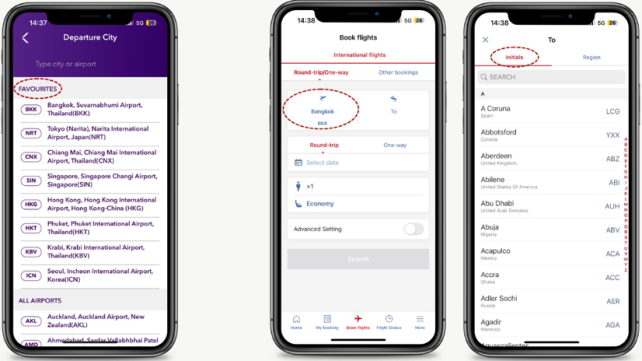
Thai Airways’ approach involves displaying frequently used locations as favorites when users select a location based on the region where the appli- cation is being used. In contrast, Japan Airlines sets the location where the application is being used as the departure point, with destinations presented alphabetically (Figure 1). Participants preferred to display their favorite locations as candidates, similar to Thai Airways’ approach. Additionally, participants suggested that Japan Airlines could optimize the process by pre-setting the departure point, thus reducing unnecessary user actions.
These findings suggest valuable insights for user interface design. Users can complete their tasks by modifying the interface to align with Japan Airlines’ approach of pre-setting the departure location and adopting Thai Airways’ method of displaying destination candidates in the order of user favorites. Such adjustments could reduce the time required for users to complete operations within the application.
284 Otsuka and Kang
Table 1. Retrospective think-aloud analysis for examinee A.
Table available in the original PDF paper.
Figure 1: Location selection screens for Thai Airways and Japan Airlines.
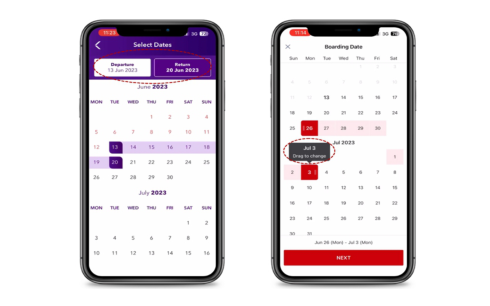
Date Selection In the context of date selection, it was observed that many participants took less time when using Japan Airlines’ interface. The reason for this advan- tage became apparent: Thai Airways’ date selection approach displayed the chosen date on top of the calendar upon tapping a date. Some participants who mistakenly perceived this as a button ended up wiping it multiple times (Figure 2).
Usability of Booking a Flight Ticket Using Airline Applications on Smartphones 285
This observation underscores the importance of minimizing user errors during date selection. To achieve this, the placement of potentially misleading buttons should be avoided, as seen in Thai Airways’ interface. Instead, a more user-friendly approach, similar to Japan Airlines’, where information or correction options are displayed near the selected date, can help alleviate user frustration. This design consideration can enhance the overall usability of the application and reduce user errors during date selection.
Figure 2: Date selection screens for Thai Airways and Japan Airlines.
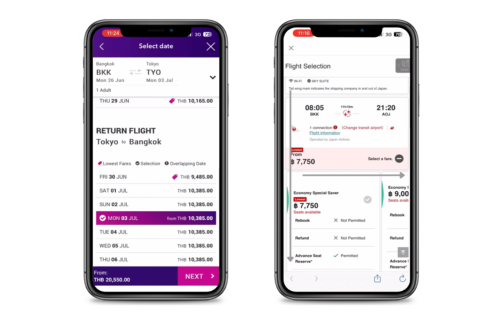
Flight Selection In the context of flight selection, several participants provided negative feed- back. Thai Airways’ approach initially displays the minimum fares for the preceding and following dates when selecting a flight before moving to the page for choosing the specific flight. Participants found this design problem- atic, especially when they had already decided on their travel date. Some inadvertently selected the wrong date due to the unclear distinction between flights at the border of their desired date. On the other hand, Japan Air- lines allows passengers to choose their class of service after selecting their flight. Participants expressed dissatisfaction with the transition from vertical to horizontal scrolling when selecting this class (Figure 3).
These observations highlight the importance of information categorization and maintaining consistency in the user interface, particularly in sections where a significant amount of information, such as flight details and class selection, is presented simultaneously. To alleviate user burden and enhance usability, user interfaces should ensure a seamless transition between dif- ferent sections and provide clear distinctions between relevant information categories.
Personal Information Input The input of personal information emerged as the most time-consuming aspect of this experiment. However, given the frequent personal information input in daily life, only some participants expressed dissatisfaction with the time it took.
286 Otsuka and Kang
Figure 3: Flight selection screens for Thai Airways and Japan Airlines.
Nevertheless, notable observations arose. On Thai Airways’ phone number input screen, some participants needed clarification due to the absence of instructions for entering the country code. Additionally, Japan Airlines, a Japanese airline, had a specification where passengers must input their family name first.
From these findings, it is evident that user assistance in scenarios with less common input requirements, such as the order of entering information like country codes or names during flight ticket reservations, is essential. Employ- ing user-friendly options is crucial to ensure users can easily comprehend and navigate these less frequently encountered input situations.
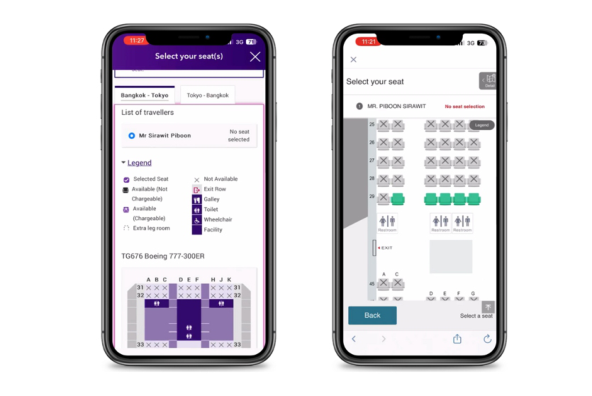
Seat Selection Thai Airways’ seat selection screen allows passengers to view all seats from the front, while Japan Airlines only displays vacant seats. Participants expressed varying opinions on these approaches. When seat availability dif- fers by class, some participants needed clarification when all seats were shown, as they mistakenly believed the front of the aircraft was fully occu- pied, as is the case with Thai Airways. Conversely, when only available seats were shown, as with Japan Airlines, participants found it challenging to assess the occupancy level and compare it with other flights (Figure 4).
These observations highlight the importance of designing seat selection interfaces that facilitate a clear understanding of seat availability, thereby reducing user stress. Color coding can enhance the user experience by dif- ferentiating available and occupied seats. By presenting seat availability as user-friendly, passengers can make more informed decisions when selecting their hearts and have a better overall experience during the booking process.
CONCLUSION
This study investigated the reservation systems of Japanese and Thai air- line applications, targeting users with limited flight booking experience.
Usability of Booking a Flight Ticket Using Airline Applications on Smartphones 287
Figure 4: Seat selection screens for Thai Airways and Japan Airlines.
We aimed to identify design challenges and potential improvements based on empirical findings.
Key findings include:
Location selection preferences favored displaying frequently used loca- tions as favorites, similar to Thai Airways’ approach.
Date selection highlighted the need for clear instructions and user-friendly design to minimize errors.
Flight selection indicated the importance of information categorization and interface consistency.
Personal information input, though time-consuming, raised minimal dis- satisfaction, but user assistance for less common input scenarios was recommended.
Seat selection interfaces benefit from clear seat availability presentation, including features like color coding.
In conclusion, this study provides insights into improving airline reserva- tion system design, particularly for novice users. User-friendly design and clear instructions can enhance the booking experience, benefiting a more comprehensive range of travelers.
REFERENCES
Emiri Otsuka and Namgyu Kang: Study on Measuring the Web Performance of Japanese Airlines Using Google Lighthouse, COWEKO2022 International Conference, pp. 111–116, 2022. Emiri Otsuka, Namgyu Kang: Usability of Reservation Systems of Japanese Airlines,
HCII2023. Gaurav Agrawal, Devendra Kumar, Mayank Singh, Diksha Dani: Evaluating Accessibility and Usability of Airline Websites, Advances in Computing and Data Sciences, pp. 392–402, 2019.
288 Otsuka and Kang
Mariam Azwa Yazid, Azrul Hazri Jantan: User Experience Design (UXD) of Mobile Application - An Implementation of a Case Study -, Journal of Telecommunica- tion, Electronic and Computer Engineering, pp. 197–200, 2017. Norazah Mohd Suki, Norbayah Mohd Suki: Flight ticket booking app on mobile
devices -Examining the determinants of individual intention to use-, Journal of Air Transport Management, 62, pp. 146–154, 2017. Nur Ani, Handrie Noprisson, Nazlena Mohamad Ali: Measuring usability and purchase intention for online travel booking – A case study in -, International Review of Applied Sciences and Engineering, 10(2), pp. 165–171, 2019. PR TIMES: We asked 1, 200 people! How do I purchase a ticket? https://prtimes.jp/main/html/rd/p/000000636.000044800.html (Viewed on 3 September 2022). Sekiya Sonoda and Yumiko Aoyama: New life and society suggested by the Corona
disaster, Keishin Journal of Life and Health, 4(2), pp. 1–13, 2020.
LISTED IN THE AHFE DIGITAL BOOKSTORE CATALOGUE
Explore the complete digital volume
Human-Centered Design and User Experience
Read this individual research paper free through the original publisher, or explore the full digital proceedings book.
ISBN 978-1-958651-90-2
Explore this ISBN in the AHFE Bookstore ↗Listed in the July 2026 bookstore catalogue; search by ISBN to confirm current availability · Digital book purchase optional