Haruki Tanaka, Kodai Furumachi, Haruaki Kobayashi, Namgyu Kang (2024). Air conditioner operating system based on the concept of Benefit of Inconvenience (Bol). In: Human Factors in Design, Engineering, and Computing. AHFE Open Access, vol. 159, pp. 721–729. https://doi.org/10.54941/ahfe1005639
Today, a growing body of research focuses on the "Benefit of Inconvenience (BoI)," a richness that can be enjoyed and, therefore, the physical and psychological labor it entails. There is also a movement to propose the "Benefit of Inconvenience Systems (BoI Systems)," things (Products and Services) that provide the BoI to users. The purpose of this study is to propose a new BoI System by analyzing conveniences in the living environment, the richness lost due to conveniences, and the adverse effects caused. In proposing a new BoI System, this study focuses on convenience and its adverse effects from two perspectives. First is the black box effect of adjusting the room temperature, resulting in the convenience of setting the room temperature at the touch of buttons by operating an air conditioner using a remote control. Second is the diminishment of the value of each photo, leading people to leave their photos without managing and reviewing them, a result of the convenience of the spread of smartphones, which allows anyone to take any number of photos quickly. By re-examining these conveniences and adverse effects, we propose "MemoCon (Memory Air Conditioner)," a BoI System that operates an air conditioner by estimating the temperature and air volume based on the visuals of photos taken in the past. The room temperature can be adjusted based on the user's intuition by operating the air conditioner through the visuals in the photos. In addition, selecting photos from a photo album on a smartphone creates an opportunity for the user to look back at the photos. After determining the specifications, we made a prototype for use as a smartphone application and a promotional video to show the actual environment in which "MemoCon" would be used so that the content of this proposal could be conveyed concretely.
BoI (Benefit of Inconvenience) refers to “the utility that inconvenience brings” (Kawakami, 2009). In other words, when convenience is considered to save labor, it is “an activity that not only spares labor but also finds pleasure (benefit) in it” (Kawakami, 2009). Labor is defined as physical operations, such as time-consuming labor and activities. That requires
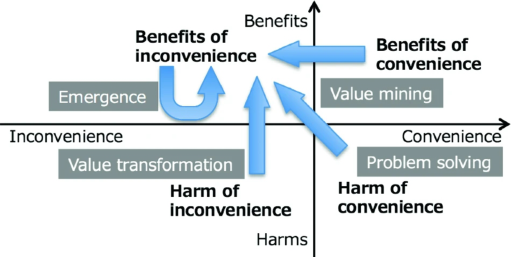
psychological load, such as consuming memory, thought, and cognitive resources (Kawakami, 2009). From these facts, BoI is the richness (benefit) specific to the effort that can be obtained by intentionally working the body and brain (inconvenience) (see Figure 1).
Figure 1: Four type of ideation for fuben-eki systems. (Adapted from Kawakami and Hiraoka, 2019).
Regarding the purpose of promoting BoI, Kawakami states, “I want to excavate events that have been overlooked due to the imposition of convenience but were important, and after organizing their benefits, I want to use them as guidelines for the next stage of design” (Kawakami, 2009). In other words, the BoI’s policy is to reconsider the conveniences given to us in response to the development of society and technology. In addition, looking at the inconveniences they have excluded also includes discovering the benefits that have been excluded at the same time. On the other hand, the Benefit of Inconvenience Systems Institute emphasizes that it is neither a trend that sounds the alarm about “the evils of a life surrounded by artifacts” nor a citizens’ movement that insists on “going back to the old way of life,” nor mere nostalgia (Kawakami, n.d.). In other words, the BoI’s Initiative is not a retrogressive effort to exclude the conveniences of the present or to return to the inconvenient conditions of the past.
Kitagawa’s research team introduced the groundbreaking concept of the ‘Degrading navigation system,’ a navigation system that intentionally blurs the frequently visited places, encouraging users to actively memorize their routes (Kitagawa, Kawakami, and Katai, 2010). This system challenges the user’s memory and spatial awareness, offering a unique approach to navigation. Shirakawa also proposed ‘HAKOBIYA,’ a social networking service that facilitates the transportation of goods from a traveler’s location to a client at the destination (Shirakawa, 2021). This innovative service fosters serendipitous encounters by encouraging users to visit places they wouldn’t normally consider. As described above, research on BoI is advancing, and there is a growing movement to propose and implement a system that incorporates BoI principles (BoI System) in the real world. While still in its early stages, this system holds the promise of revolutionizing our relationship
Air Conditioner Operation System Based on the Concept of Benefit of Inconvenience (BOI) 723
with technology and society, offering a fresh perspective on the role of convenience and inconvenience in our lives.
The purpose of this research is to analyze the conveniences in the real world, to find out the inconveniences that have been eliminated and their benefits, and to propose a BoI system that incorporates these conveniences. Specifically, we first investigate and analyze the conveniences in the living environment and then sort out the richness that the conveniences or the adverse effects have obscured. Next, we propose a new BoI system by establishing a guideline for system design and UI design. Then, we create a prototype based on the proposed BoI System and conduct user tests and evaluations. Here, we focus on “air conditioners” and “photographs” as conveniences in our living environment. The following section describes the reasons for choosing these research targets.
PROPOSED BOI SYSTEM CONCEPT We use an air conditioner as a modern room temperature control device. When we press a button on the remote control to change the value of the number on the display, the room temperature will change quickly and automatically. Changing the values requires only the push of a button, eliminating the need for complicated operations. In addition, the latest air conditioners incorporate AI to automatically adjust the temperature based on user usage patterns and weather conditions (Fujitsu, 2020). Thus, users can quickly and accurately set the ideal room temperature by automating and simplifying the room temperature operation. On the other hand, behind the simplified room temperature control operation is a hidden operation that the user must perform in the past (room temperature control black box). In other words, users are losing the opportunity to operate the air conditioner themselves. While this convenience makes the user’s life more efficient, it is also true that the trial-and-error process of adjusting the room temperature is being lost.
Second, we discuss photography. In recent years, smartphones have improved their original functions, such as cell phones and cameras, by selling the ability to take high-quality photos. As a result, taking photos with smartphones wherever a user goes and storing them for memories has become an established way of using smartphones. On the other hand, Asakawa points out that photos are taken to “look” at them later, but they are not looked back on (Asakawa, 2021). One possible cause is that users continue to take photos due to the “portability and ease of recording” of smartphones. Since the number of photos is not visible, they need to notice the large number of photos that have accumulated and eventually become lazy to search for photos from the past (Asakawa, 2021). In other words, users’ sense of security in being able to take many photos has diminished the value of each photo. In fact, according to a survey conducted by marketing research firm Cross Marketing, 36.5% of all respondents “do nothing in particular” to store photos taken with smartphones (Cross Marketing, 2023). In addition, 34.3% of the respondents “do nothing in particular” regarding how they enjoy the photos they take, the highest percentage (Cross
Marketing, 2023). As shown above, the current situation is that smartphone users today leave photos taken with their smartphones unattended without managing or looking back at them.
In this study, we propose a BoI system called ‘MemoCon (Memory air Conditioner)’ that operates the air conditioner by deriving the temperature and air volume from photos taken by the user in the past. This system is designed to ‘reintroduce a user-oriented trial-and-error process in operating the air conditioner’ and ‘provide an opportunity to revisit many photos stored on the smartphone,’ as discussed earlier. By addressing the common inconvenience of ‘time-consuming’ elements, it’s possible to combine these two aspects. Therefore, we propose the BoI System that empowers users to utilize the memories contained in the many photos stored on their smartphones in the trial-and-error process of adjusting the room temperature.
SPECIFICATIONS FOR MEMOCON We need the following conditions to implement the inconvenience.
We cannot set an air conditioner temperature numerically.
We cannot do the temperature setting of the air conditioner by a simple button operation.
In addition, the following conditions are necessary for implementation based on the concept.
We determine the temperature and air volume setting of the air conditioner by the information in the photograph.
The user must have enough room to view the photos when they set the air conditioner’s temperature.
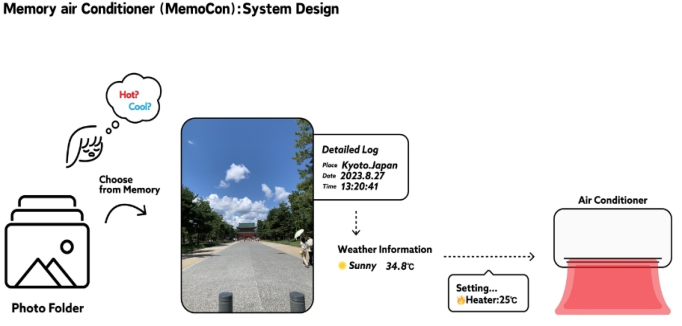
We propose a system and UI design for MemoCon based on these conditions. The following are the specifications for the “MemoCon” system design (see Figure 2). First, the system controls the temperature and switches between heating and cooling based on the location information in the photographs and the date and time. MemoCon derived the climate when the user took the photos from the database. The user needs to see the climate information then because the user adjusts the temperature setting and air flow rate by recalling the climate from the photo’s visual information.
Next, the user should keep the temperature control of the air conditioner from extremely hot or cold temperatures. For example, even if the temperature is adjusted using a photo of a tropical country where the temperature is likely 35 degrees Celsius or higher, the temperature is converted to the optimum temperature range for the room temperature, and the airflow rate is adjusted beyond that range. The optimal temperature range for the temperature setting is based on the temperature setting range of CORONA’s air conditioners, which is between 17 and 30 degrees Celsius (62.6 and 86 degrees Fahrenheit) (CORONA, n.d.).
The following is a specification of the UI design of “MemoCon. First, the remote-control operator selects a favorite photo from a photo album on the smartphone to adjust the temperature. In this case, we did not
Air Conditioner Operation System Based on the Concept of Benefit of Inconvenience (BOI) 725
include functions such as a list of photo selection history allowing the user to select photos through the photo selection and its auxiliary UI within the application. This process emphasizes the “reproduction of a memorable time and place” by giving the user ample room to view photos from the photo storage application on the user’s smartphone.
The user should be able to intuitively switch between the heating and cooling functions of the air conditioner and understand the air flow rate on the UI. For example, when the air conditioner is heating a room, the air conditioner-type icon’s color on the application UI changes into a red wave animation. Moreover, a blue wave animation means the air conditioner is cooling a room. When airflow is high, the wave animation will be significant and fast; when airflow is low, the wave animation will be small and slow.
Figure 2: MemoCon system design.
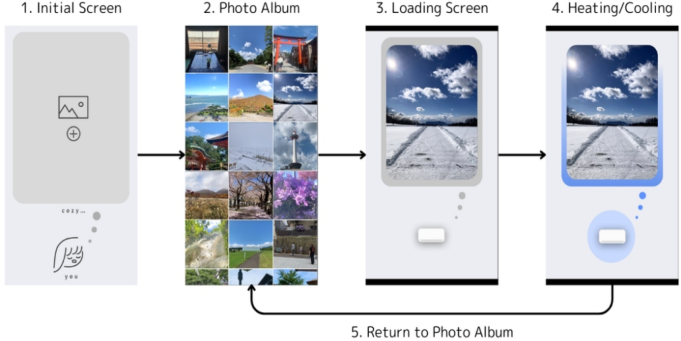
Prototyping Based on the determined system design and UI design specifications, we created a prototype of MemoCon in Figma. The prototype operates as follows (see Figure 3).
1. Upon startup, MemoCon displays the initial screen. 2. Pressing the “Add Photo” button moves the user to the photo selection screen (photo album). 3. Selecting a photo from the photo album moves the user to the loading screen. Then, an animation shows the air conditioner-type icon thinking about the photo’s information. 4. After loading, an animation that shows the heating/cooling function begins. Then, a red/blue wave animation indicating airflow is displayed around the air conditioner-type icon. 5. To change a photo, tap the displayed photo to return to the photo album.
Figure 3: Screen transition flow of MemoCon prototype.
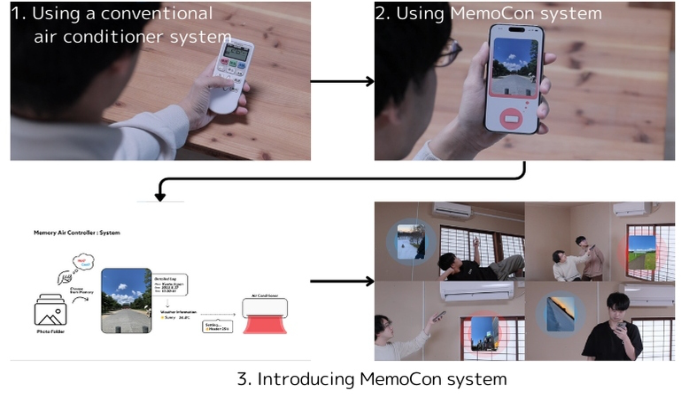
Then, we created a video introducing MemoCon (Figure 4). The video consists of three scenes: a scene in which a conventional air conditioner system is used, a scene in which the MemoCon system is used, and a scene in which the MemoCon system is introduced. This video clarifies the purpose and method of using MemoCon and makes it easy for the viewer to visualize how MemoCon is used.
Figure 4: Scene flow of MemoCon introduction video.
MEMOCON TEST (PROCEDURE) To investigate the evaluation of MemoCon’s system and UI, we conducted user tests and interviews of a prototype of MemoCon. The participants were five Japanese students in their 20s (Three males and two females / M = 22.4). We tested in the 251 Research Laboratory room at Future University
Air Conditioner Operation System Based on the Concept of Benefit of Inconvenience (BOI) 727
Hakodate - a 3.5m square, windowless, air-conditioned private room. The participants stopped using MemoCon on their own time. After that, we asked the participants of the test. In the interview, we asked about “Ease of use,” “Impressions of using it,” “Comparison with conventional remote- control operation,” “Operation method using photos,” and “Suggestions for improvement.” Although a user uses photos saved by themselves, for this user test, we preloaded eight photos of Japanese landscapes (two photos about spring, two photos about summer, two photos about fall, and two photos about winter) into the prototype for testing purposes. The concept of MemoCon is to recall the user’s memory of weather, temperature, etc., by taking photos by themselves. We designed the UI of MemoCon so that the air conditioner would move according to the selected photos that we prepared in charge of the test. The device used for the test was an iPhone SE2 smartphone.
MEMOCON TEST (RESULT AND CONSIDERATION) First, regarding “Ease of use,” we have gained many opinions about the animation on the application UI. The participant said, “I did not notice the animation that shows the airflow rate. Therefore, I would like to see a more intense action to indicate hotness/coldness to the user”. Specifically, participants suggested “more color variations”and “more intense animations in the app UI” as areas for improvement. Moreover, we obtained many opinions about the icon on the app UI. For example, the participant commented, “I wondered if there was any reaction when I touched the air conditioner-type icon on the UI. When we observed the participants operating the prototype, they all touched the air conditioner-type icon, which had nothing to do with switching photos when they switched photos for the first time. These results were about an inconvenience that we did not anticipate and its harmful effects (harm of inconvenience).
Second, the opinions revealed a discrepancy between the impression of the selected photo and the system’s cooling/heating selection based on it. For example, some users commented, “It was a hot summer photo, but the splashing water in the photo looked refreshing,” or “The photo looks cool, but it is hot. However, since this is a problem of interpretation of photos prepared in advance by us for the test, this problem will be solved when a user controls using photos in the original situation.
Third, the concept of a system that “allows remote control operation with the visual of a photograph” was highly evaluated. The participant said, “It is good that I can operate the room temperature sensitively through a photograph”. In addition, the comment, “I could get a sense of the temperature from the output of the air conditioner,” suggested the possibility that the user could easily recall the scene where the user had taken a photo.
Fourth, regarding the “animation of the air conditioner estimating the temperature from the photo” during the photo reading time, the participants commented, “By taking the time on purpose, it looked as if the air conditioner was thinking about the photo.” and “It was exciting to see the air conditioner judging the photo,” and “It was cute to see the air conditioner trying its best to imagine from the photo. Therefore, the “human-like” behavior of the air
conditioner, i.e., the anthropomorphic elements used in the design, gave a favorable impression to the participants.
Fifth, participants who said, “It is difficult to intuitively estimate the room temperature with numerical values” compared to conventional air conditioners expressed the opinion that “It was more interesting than operating the remote control with numerical values” and “It was easier to feel the temperature than just using numbers” through the experience of MemoCon. On the other hand, they said, “It was difficult to estimate the temperature from the numerical value”with the conventional air conditioner. On the other hand, one participant who said that he “felt the temperature from the numbers” with a traditional air conditioner commented, “I would like to adjust the room temperature by numbers. He also said, “I could feel a sense of communication with the air conditioner rather than one-way commands to it,” and “I could feel a sense of sharing photos (memories) with the air conditioner. In other words, the participants felt as if they were communicating with the air conditioner, not unilaterally but interactively. In addition, since communication between humans and the sharing of memories are “human activities,” they may have been a factor in the feeling above of “humanness” toward the air conditioner.
Sixth, the idea of the “operation method using photos” received positive comments from all the participants. Participants were asked to respond to the question, “When it is hot, I want to look back and collect cool photos”, “It gives me a chance to look back and take new photos”, and “It is fun to select a temperature that is about this good visually. Therefore, the use of photos for remote control operation “creates an opportunity to look back at the photos. Furthermore, participants also obtained “motivation to take new photos” and “enjoyment in selecting from among photos.
Lastly, as for “Suggestions for Improvement,” the participants suggested improvements to increase the convenience of MemoCon, such as a photo sorting function on the application and a photo learning function in the air conditioner. However, since these suggestions have little relevance to the policy of this study, which is to “Pursue benefits that can be obtained only through inconvenience,” they are not discussed in this paper.
CONCLUSION
Through this research, we proposed MemoCon, a BoI system based on operating a remote control with the taken photo by the user. In addition, the concept of MemoCon, which allows the user to operate the remote control with the visual of a photo”was significantly evaluated through user tests. The goal of this study, “Provide an opportunity to look back at the taken photos by a user,” was achieved using Memocon. Furthermore, the participants highly evaluated the UI design of MemoCon, which incorporates “Human- like features.” On the other hand, we pointed out some improvements to the MemoCon system design to prevent harm and inconvenience that we had not anticipated. To the location and time information embedded in the photos, the system needs to incorporate other surrounding information to reflect the situation in which the photo was taken. The UI of MemoCon was
Air Conditioner Operation System Based on the Concept of Benefit of Inconvenience (BOI) 729
also identified as an area for improvement—animations on the application UI need to be prepared to match the user’s impression. In addition, the display method of the air conditioner-type icons and their functions need to be improved so that users can operate them intuitively. Based on the above improvements, we will strive to improve the functionality of MemoCon in the future.
REFERENCES
Asakawa, J. (2021). Methods and Examples of Photo Organization in General Households, Journal of the Society of Photography and Imaging of Japan, Volume 84, No. 2. Cross Marketing. (2023) Survey on photos taken with smartphones and cameras (2023). Cross Marketing Website: https://www.cross-m.co.jp/report/lif e/20230419camera/. CORONA. (n.d.) What is the range of temperature settings on the remote control?.
CORONA Website: https://www.corona.co.jp/support/faq/2439.html. Fujitsu. (2020) nocria X. 2020 nocria X Series special page Website: https://www.fu jitsu-general.com/jp/products/aircon/2020/lineup/nocria-x/ai-aircon.html. Kawakami, H. (2009). Toward System Design based on Benefit of Inconvenience,
Academic Journal of Human Interface Society, Volume 11, No. 1. Kawakami, H. (n.d.) What’s BoI?. Further Benefit of a Kind of Inconvenience System Laboratory Website: https://fuben-eki.jp/en/whatsfuben-eki/. Kawakami, H and Hiraoka, T. (2019). Methods for Designing Systems with Benefits
of Inconvenience, HCII 2019 Lecture Notes in Computer Science, Volume 11583. Kitagawa, H. Kawakami, H. and Katai, O. (2010). Degrading navigation system as an explanatory example of “benefits of inconvenience”, Proceedings of SICE Annual Conference 2010, pp. 1738–1742. Shirakawa, T. (2021). Application of Inconvenience Benefits to Travel Commerce
and Its Large-Scale Social Implementation, The Society of Instrument and Control Engineers, Volume 60, No. 12.
LISTED IN THE AHFE DIGITAL BOOKSTORE CATALOGUE
Explore the complete digital volume
Human Factors in Design, Engineering, and Computing
Read this individual research paper free through the original publisher, or explore the full digital proceedings book.
ISBN 978-1-964867-35-9
Explore this ISBN in the AHFE Bookstore ↗Listed in the July 2026 bookstore catalogue; search by ISBN to confirm current availability · Digital book purchase optional