Namgyu Kang (2025). Hybrid Co-creative Design Process Combining In-person and Remote Situations. In: Affective and Pleasurable Design. AHFE Open Access, vol. 164, pp. 260–268. https://doi.org/10.54941/ahfe1006083
The COVID-19 pandemic has shifted towards remote co-creative design, but we are now returning to in-person collaboration. Some research suggests that in-person problem-solving situations may not always be as practical as remote situations. This study focused on in-person and remote scenarios using the Double Diamond Model in the co-creative design process. The Double Diamond model consists of four stages: "Discover" and "Define" to identify the right problem, followed by "Develop" and "Deliver" to determine the right solution. This research was conducted based on the hypothesis that combining in-person and remote co-creative design processes, guided by the Double Diamond model, could enhance overall effectiveness. To explore this, I analyzed the execution of in-person and remote co-creative design workshops and examined the differences between these two approaches. The results indicated that participants were most satisfied with the co-creative design process in the following order: in-person, hybrid, and then remote situations. Notably, during the "Discover" and "Define" stages — which involve gathering information and defining the problem — the hybrid situation proved more beneficial than the remote one. Conversely, in the "Deliver" stage, which focuses on determining the right solution, the in-person situation demonstrated more advantages than the hybrid one. Based on these findings, I plan to propose a hybrid co-creative design process and evaluate its effectiveness in an international workshop setting.
Flexibility is essential for navigating the significant changes brought about by increasing uncertainty. Advanced thinking skills are essential for leveraging extensive knowledge and experience to make informed decisions and address unresolved issues. Numerous co-creative design processes have been carried out, incorporating diverse perspectives. In response to the COVID-19 pandemic, remote co-creative processes in schools and organizations gained momentum; however, there has been a recent shift toward in-person collaboration. Despite this shift, conducting all aspects of co-creation in person remains crucial. Research by Yamauchi (2021) indicated that remote classes outperformed in-person sessions in terms of correct answer rates and
Hybrid Co-Creative Design Process Combining In-Person and Remote Situations 261
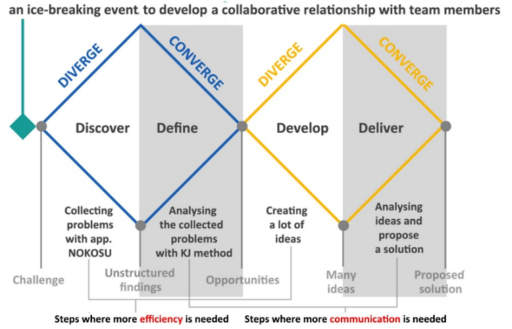
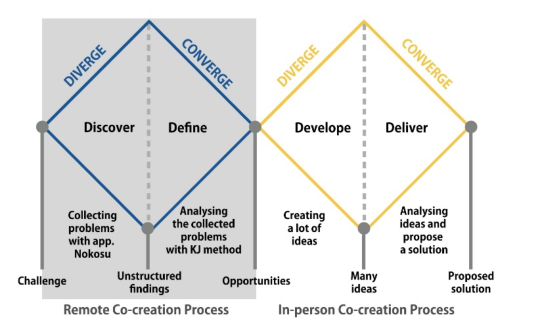
overall class satisfaction, particularly those employing active learning in real- time and interactive formats. Conversely, Suga (2020) argued that in-person interactions are more beneficial for tasks that involve logical discussion, refining one’s reasoning, and quickly identifying logic that surpasses that of others. Therefore, combining the strengths of both remote and in-person co-creation processes might enhance the development of the co-creative design approach. Based on these backgrounds, a recent analysis by the author’s research team (2023) examined remote and in-person creative design processes. Integrating these methods within the Double Diamond model (Figure 1) might lead to a more effective and sustainable co-creative design process.
Figure 1: The proposed hybrid co-creative design process with the double diamond model from previous research.
The Double Diamond model is a design thinking framework that divides problems into two stages: finding the right problem and the correct solution (Yamauchi, 2021). Hirano et al. (2013) state that design thinking is adequate for practicing co-creation in innovation creation.
Therefore, I plan, implement, and analyze a workshop using the proposed hybrid co-creative design process and the Double Diamond Model theory in this study. The results will help me propose a more compelling hybrid co-creative design process.
EXPERIMENT 1: AN EVALUATION EXPERIMENT WITH TWO WORKSHOPS For this research, our research team conducted the workshop twice: once in-person (referred to as the “in-person workshop”) and once remotely (referred to as the “remote workshop”). The same participants attended both workshops to standardize the evaluation criteria. Different themes were established for each workshop to minimize the influence of familiarity across the sessions.
262 Kang
The in-person and remote workshops followed the Double Diamond model, including the exploration, definition, development, and provision phases. In each phase, I anticipated that some participants might have limited experience with co-creative design processes. To enhance the efficiency of the co-creative design process, I introduced various applications and frameworks.
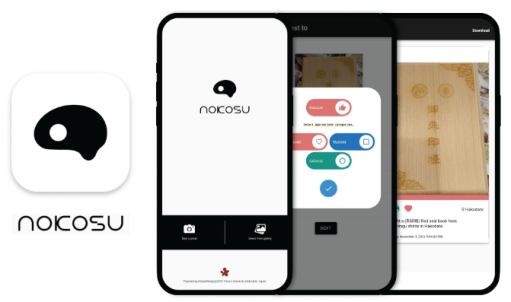
Specifically, during the exploration phase, we used an application called Nokosu. Nokosu is an ideal memory support application for a smartphone developed by Kang’s research team. With Nokosu, participants can record photos and text information, along with the Kansei (=emotions) they felt at the moment of discovery, whenever they encounter something new during fieldwork (Figure 2).
Figure 2: Nokosu Application for a co-creative design process.
The workshop was conducted twice: once in-person, referred to as the “in-person workshop,” and once remotely, referred to as the “remote workshop.” Twelve male and female university students from Future University Hakodate participated in both workshops. The participants were divided into three groups for the sessions.
Hybrid Co-Creative Design Process Combining In-Person and Remote Situations 263
The in-person workshop, which was held at Future University Hakodate on May 12 and May 19, 2023, was titled “Proposals for Improving the Waiting Experience at the University.” The remote workshop occurred at Future University Hakodate over three days: May 26, June 2, and June 9, 2023. Each participant was separated into individuals who conducted the workshop activity. Therefore, Zoom was used as the primary tool for their remote communication. The workshop theme was “Proposing Ideas for a Comfortable Space at Future University.” After completing all workshop phases, participants were also asked to complete a questionnaire.
Table 1 presents the questionnaire items used in Experiment 1.
Table 1: The 13 questionnaire items.
Table available in the original PDF paper.
Evaluation Questionnaires It is easy to understand others’ opinions and thoughts It is easy to understand what all group members think Others’ opinions and thoughts inspire new ideas My opinion and thought were understood within the group It is easy to summarize everyone’s thoughts, opinions, experiences, and ideas It is easy to visualize each person’s idea It is easy to review both one’s own and others’ thoughts, opinions, and ideas It is easy to gain new insights by reviewing There was a lively exchange of opinions within the group It is easy to logically develop ideas It is easy to come up with ideas that one had never thought of before It takes a lot of time It requires a lot of effort
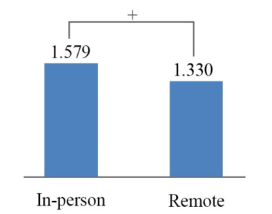
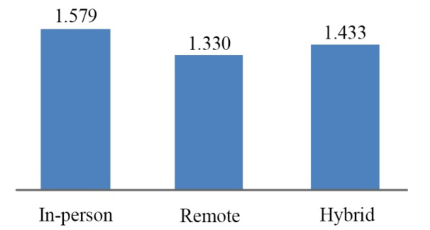
RESULT OF THE TWO WORKSHOPS When comparing the average scores of all questions across various stages of the Double Diamond model to assess the entire workshop co-creation process, the in-person workshop (M = 1.579) received higher evaluations than the remote one (M = 1.330) (F (1,10) = 4.52, p < 0.1).
Figure 4: Mean evaluation scores of in-person and remote.
During the development stage, in-person workshops scored higher (M = 2.543) than remote workshops (M = 2.000) on the questionnaire
264 Kang
item “It is easy to visualize each person’s idea” (F (1,10) = 6.92, p < 0.05). Additionally, the in-person workshop (M = 2.182) was rated higher than the remote workshop (M = 1.636) for the item “There was a lively exchange of opinions within the group” (F (1,10) = 6.92, p < 0.05). In the provisioning phase, a significant difference was also noted for the item “My opinion and thought were understood within the group” (F (1,10) = 5.71, p < 0.05).
However, no significant differences were found between the in-person and remote workshops in the exploration and definition phases. Additionally, previous research indicates that many physical constraints do not bind a remote co-creative process and are effective during the information collection stage. Given these findings, using a remote co-creative design approach is beneficial in the exploration and definition stages of the Double Diamond model.
Based on the results, Figure 5 illustrates the proposed hybrid co-creative design process, incorporating the Double Diamond model.
Figure 5: The proposed hybrid co-creative design process with the double diamond model.
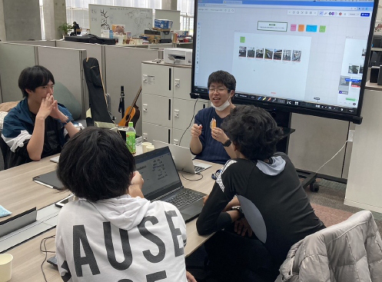
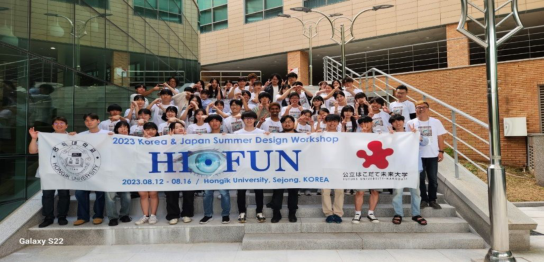
EXPERIMENT 2: AN EVALUATION EXPERIMENT WITH THE PROPOSED HYBRID CO-CREATIVE DESIGN PROCESS An evaluation experiment was conducted during the 2023 HI-FUN Design Workshop, an international design workshop held in Korea, to assess the effectiveness of the proposed hybrid co-creation process (Fig. 6).
This workshop will be referred to as the “Hybrid Workshop.” The hybrid workshop comprises four stages based on the Double Diamond model: exploration, definition, development, and delivery. The exploration and definition stages were conducted remotely, while the deployment and delivery stages were conducted in-person. The workshop took place over eight days remotely from August 4 to August 11, 2023, followed by five days with in- person activities from August 12 to August 16, 2023. It involved 50 university students from Japan and Korea, divided into 10 groups. During the remote
Hybrid Co-Creative Design Process Combining In-Person and Remote Situations 265
phase, participants co-created within their groups using communication tools such as LINE, KakaoTalk, Zoom, and Google Meet. The face-to- face phase was held at Hongik University in Sejong City, Korea, where participants collaborated in-person. The theme of this hybrid workshop was “Research and Design Proposals on the Enjoyment of Korea and Japan.” After completing all four stages, all participants were evaluated using the same questionnaire items in experiment 1.
Figure 6: HI-FUN design workshop using hybrid co-creative design process.
When comparing the mean scores of all question items across all stages, as an evaluation of the overall co-creation process of the workshops, the results ranked as follows: the in-person workshop at 1.579 (SD = 0.349), the hybrid workshop at 1.433 (SD = 0.479), and the remote workshop at 1.330 (SD = 0.388), in descending order of evaluation. Analysis of variance (ANOVA) was conducted on the mean scores between these three types of workshops, revealing no significant differences. Therefore, it was impossible to consider this ranking as indicative of the effectiveness of the co-creative design process.
Figure 7: HI-FUN design workshop using hybrid co-creative design process.
However, when the analysis was divided into four stages, evaluation differences were observed for each condition.
1) Exploring Stage During the exploration stage, a significant trend was observed between the hybrid co-creation process (M = 1.936) and the remote one (M = 1.364) in
266 Kang
the questionnaire item, “My opinion and thoughts were understood within the group” (F (1,57) = 2.85, p < 0.1). In addition, a significant trend was observed between the hybrid co-creation process (M = 1.872) and the in- person one (M = 1.000) in the questionnaire item “It is easy to logically develop ideas” (F (1, 57) = 4.68, p < 0.05). In the questionnaire item “It is easy to come up with ideas that one had never thought of before”a significant difference and a significant trend were observed between hybrid co-creation process (M = 2.021) and remote one (1.455) and in-person one (M = 1.182) (F (1, 57) = 5.13, p<0.05, F (1,57) = 3.51, p<0.1).
2) Definition Stage In the definition phase, a significant trend was observed between the hybrid co-creation process (M = 2.043) and remote one (M = 1.364) for the questionnaire item “It is easy to come up with ideas that one had never thought of before” (F (1, 57) = 3.27, p<0.1).
3) Development Stage During the development stage, the average values were higher for in-person and remote settings than for hybrid settings, and significant differences were observed in the responses to the questions. However, there were no significant differences between in-person, remote, and hybrid co-creation processes.
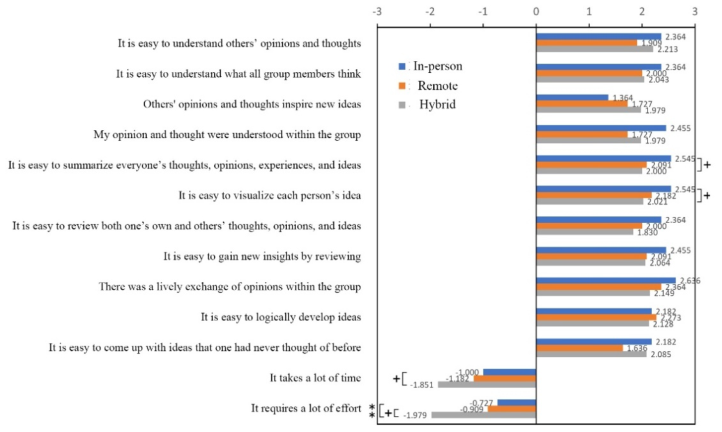
4) Delivery Stage On the contrary, many significant items existed between the delivery stages in-person, remote, and hybrid co-creation processes (Fig. 8).
Figure 8: Evaluation result of the delivery stage.
Hybrid Co-Creative Design Process Combining In-Person and Remote Situations 267
First, a significant trend was observed between the in-person co-creation process (M = 2.545) and the hybrid one (M = 2.000) in the questionnaire item “It is easy to summarize everyone’s thoughts, opinions, experiences, and ideas” (F (1, 57) = 3.18, p < 0.1). Next, a significant trend was observed between the in-person co-creation process (M = 2.545) and the hybrid one (M = 2.021) in the item “It is easy to visualize each person’s idea” (F (1, 57) = 3.00, p < 0.1). There was also a significant trend between the in- person co-creation process (-1.000) and the hybrid one (M = −1.851) in the item “It takes a lot of time” (F (1, 57) = 3.77, p < 0.1). Moreover, there was a significant difference between in-person co-creation process (M = −0.727) and remote one (M = −0.909) and hybrid one (M = −1.979) in the item “It requires a lot of effort” (F (1, 57) = 9.63, p<0.01, and F (M = 1, 57) = 6.65, p < 0.05).
The results indicated that participants were most satisfied with the co-creative design process in the following order: in-person, hybrid, and then remote situations. Notably, during the “Discover” and “Define” stages, which involve gathering information and defining the problem, the hybrid situation proved more beneficial than the remote one. Conversely, in the “Deliver” stage, which focuses on determining the right solution, the in- person situation demonstrated more advantages than the hybrid one. Based on these findings, I plan to propose a hybrid co-creative design process and evaluate its effectiveness in an international workshop setting.
CONCLUSION
The results of this study confirmed the effectiveness of the hybrid co- creation process in a remote setting. Additionally, in-person workshops received higher ratings than remote sessions during the provision phase. This difference may be attributed to the hybrid approach, which requires participants to transition between remote and in-person interactions. This process can be burdensome when adapting to different communication methods and software.
This study primarily utilized numerical values to compare and analyze the results. However, it is important to note that the quality of the co- creation process cannot be solely assessed through numerical data. As future work, I plan to analyze the content of post-co-creation interviews and conversations that occurred during the co-creation process. This will help us verify the effectiveness of the proposed co-creation process, identify factors that positively influence co-creation in various stages, and develop appropriate tools and software.
REFERENCES
Anastasia M. K. Schauer, Kenton B. Fillingim, Anna Pavleszek, Michael Chen, Katherine Fu. (2022). Comparing the Effect of Virtual and In-Person Instruction on Students’ Performance in a Design for Additive Manufacturing Learning Activity Research in Engineering Design, 33, pp. 385–394, 2022
268 Kang
Kang N., Sakaida R. and Johnson A. (2023). Analysis on Remote Global Co-Creative Design Process with Evaluation Grid Method, IEE Colloquium on Educational and Training Applications of ISDN, 2023 8th International Conference on Business and Industrial Research (ICBIR), pp. 1140–1145, 2023. Kyoko Miyazato (2022). A Hybrid Online/Face-to-Face Approach to Intercultural
Interactions in a Japanese Education Major University Context, JACET Selected Papers Vol. 8, pp. 25–54, 2022 Suga K. (2020). Korekarano Daigakukyouikunoarikata「JyuA」, No. 65, Kouekizaidanhoujin. Daigaku, Kijyunkyoukai (JUAA), p. 10. Yamauchi Y. (2021). Koronakaniokeru Daigakukyouikuno Onrainkato Situhosyou, Nagoyakoutoukyouikukenkyu, 21, pp. 5–25. https://www.mext.go.jp/content/ 20211118-mxt_kouhou01-000004520_1.pdf
LISTED IN THE AHFE DIGITAL BOOKSTORE CATALOGUE
Explore the complete digital volume
Affective and Pleasurable Design
Read this individual research paper free through the original publisher, or explore the full digital proceedings book.
ISBN 978-1-964867-40-3
Explore this ISBN in the AHFE Bookstore ↗Listed in the July 2026 bookstore catalogue; search by ISBN to confirm current availability · Digital book purchase optional