Kosuke Morinaga, Shigekazu Ishihara, Kazuya Kunisue, Shinji Kajikawa, Misa Kajikawa (2023). Characterization of Earplug Performance using Dummy Head Microphone Measurements. In: Human-Centered Design and User Experience. AHFE Open Access, vol. 114, pp. 478–483. https://doi.org/10.54941/ahfe1004266
This study evaluated the sound insulation properties of three distinct types of earplugs: Plug type A, Plug type B (both silicone), and a form type (polyurethane foam). The experiment employed a dummy head to account for the shape of the human head and ears when testing the earplugs’ sound insulation properties against white noise and sine waves. All three types of earplugs demonstrated significant noise attenuation within the frequency range of approximately 2500-4000 Hz when exposed to white noise. In the case of sine waves at 400 Hz, the largest discrepancy was observed when comparing conditions with and without earplugs. Specifically, the difference was approximately -11.9 dB for plug type A, -6.7 dB for plug type B, and -9.5 dB for the foam type. These findings provide valuable insights into the effectiveness of different earplug types in reducing noise levels.
In recent years, the global pandemic has led to a significant decrease in out- door activities, while simultaneously causing a surge in remote workand online learning(Kaltiainen & Hakanen, 2023; Puglisi, Blasio, Shtrepi, & Astolfi, 2021) (Chere & Kirkham, 2021; Seynhaeve, Deygers, Simon, & Delarue, 2022). Consequently, individuals are spending more time at home, necessitating the creation of a comfortable domestic environment. Improve- ments have been made to home office setups, and measures have been taken to reduce noise pollution within residential spaces. These measures include the use of soundproofing sheets and sound-absorbing materials to minimize noise generated from indoor activities. Additionally, sound insulation meth- ods have been employed to reduce ambient noise levels.While some of these strategies involve modifications to the physical space, others involve the use of personal devices such as headphones or earplugs. The terminology used to describe these products often includes “sound absorption”, “sound
Characterization of Earplug Performance Using Dummy Head Microphone Measurements 479
insulation”, and “soundproofing”. However, these terms are not always used consistently or accurately.
“Soundproofing” is a broad concept that encompasses methods such as “sound absorption” and “sound insulation”. There is a wide range of prod- ucts available for personal use, including various types of headphones and earplugs. Earplugs can be further categorized into silicon clay types, foam types, and plug types.
This paper will focus specifically on earplug-type devices, which are inserted into the ear canal to decrease the volume of audible sound.
In response to the increased usage and demand for earplugs, modifications have been made to enhance the comfort and usability of plug-type earplugs. Specifically, alterations have been made to the hardness of these devices. Fur- thermore, foamtype earplugs have been introduced as an alternative for users who find plug-type earplugs unsuitable.
The objective of this study is to examine the sound insulation properties of plugtype earplugs with varying degrees of hardness, as well as foam-type earplugs. This investigation aims to provide insights into the effectiveness of these different types of earplugs in reducing ambient noise levels.
METHOD
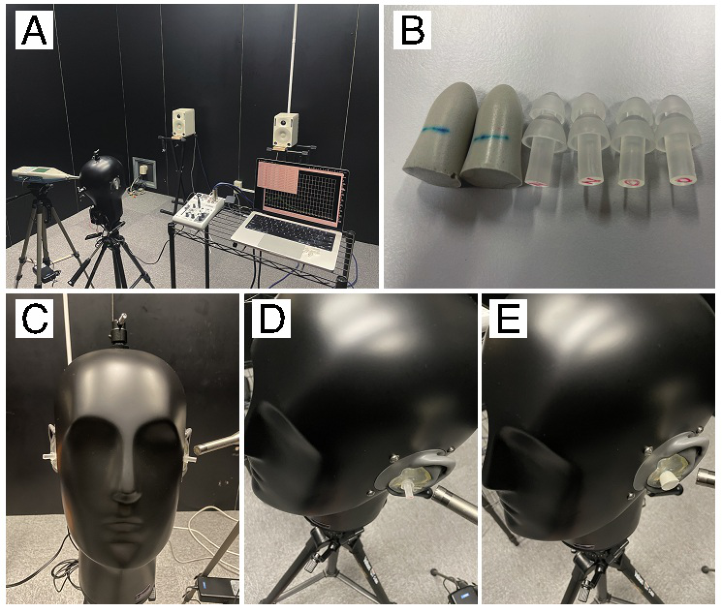
Environment The sound insulation experiments were conducted in a shielded room mea- suring 3m x 3m x 2.7m to ensure a quiet environment. The centre of the noise output speaker cone was positioned 94 cm above the floor. The speakers were placed adjacent to the wall, with the cone centres set 50 cm away from the room’s centre. A dummy head was positioned 140 cm away from the centre of the left and right speakers, with a precision sound level meter microphone set at ear level. The height of the dummy head’s sound-harvesting part and the sound level meter were aligned with respect to the speaker cone’s cen- tre. Measurements were taken with all airconditioning and climate control systems that might affect noise measurements switched off.
Equipment White noise and sine waves were generated from a 1029A Studio Monitor (GENELEC JAPAN Inc.) via Audio ToolBox ver. 3.1.0 (Black Cat Sys- tems). A precision sound level meter NA-27 (RION Co., Ltd.) was used to measure the noise volume. A B1-E Dummy Head with BE-P1 Binaural Microphones + Battery Box (Pawel Dobosz) was used as the dummy head. The volume indicated by the dummy head was recorded. The speakers and dummy head were controlled using a mixer audio interface AG03 (Yamaha Corporation) connected to a MKGR3J/A (Apple, Inc).
Procedure The frequencies were recorded in the range of 0–20000 Hz, which is audi- ble to humans. In this study, a dummy head was employed to simulate the
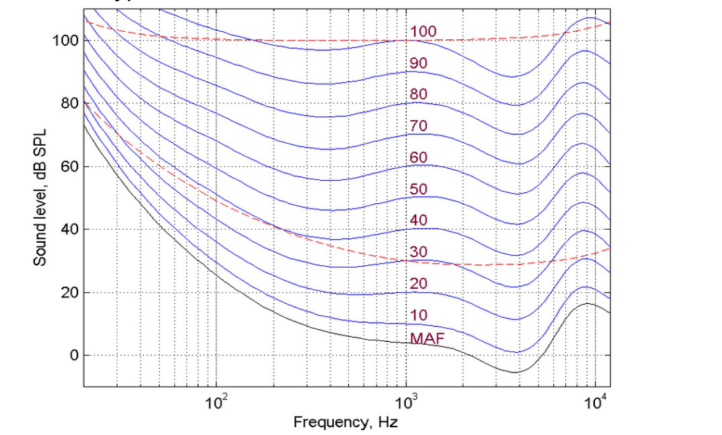
characteristics of human auditory perception. The specific attributes are illus- trated in Figure 2. This approach allowed for a more accurate representation of how sound is perceived by the human ear. Two types of noise were used: white noise and sine waves: the earplugs were compared at white noise and at 100, 200, 400, 800, 1000, and 1600 Hz for sine waves.
Figure 1: Acoustic environment and measurement conditions of sound insulation experiments. A: Acoustic environment of sound insulation experiments and arrange- ment of measurement equipment. B: Three comparable stuffs. foam type (Left), plug type B (Middle), plug type A (Right). C: During sound insulation measurements, both ears of the dummy head were plugged with earplugs. D: Dummy head with plug type. E: Dummy head with Form type.
In the experimental setup, the output sound was standardized at a level of 70 dB for both White noise and Sine wave. This sound level was accu- rately measured at the ear of the dummy head using a precision sound level meter (Fig. 1 C). The experiment utilized three distinct types of earplugs: plug type A, plug type B, and a form type (Fig.2 B) (Globalroad Co., Ltd.). Plug type A and B are both made of silicone, the form type is made of foamed polyurethane. Plug type B has the same flange shape as plug type A, but the hardness of the material was made softer than plug type A for wear- ing comfort. Sine waves were measured five times at each of six frequencies under four conditions (no earplugs, plug type A, plug type B, and form type) and white noise was also measured five times, for a total of 35 times × 140 measurements under four conditions. The characteristics at each frequency
Characterization of Earplug Performance Using Dummy Head Microphone Measurements 481
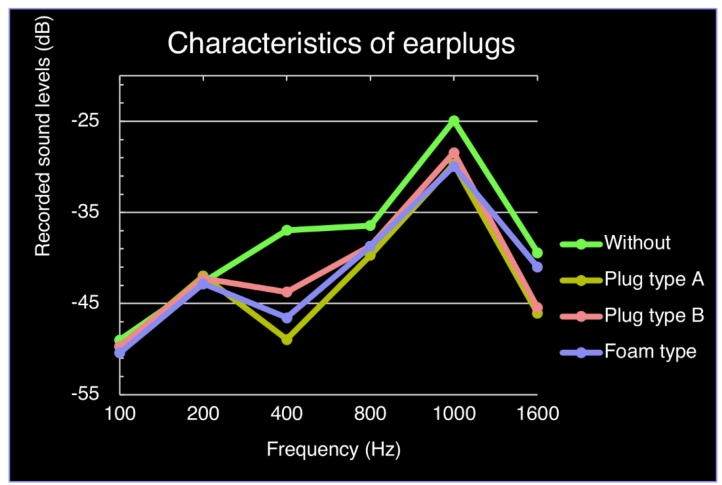
are shown in Fig. 3. The waveform peaks at each frequency for each condi- tion were extracted from the image and the average for each condition was plotted.
Figure 2: Auditory sensitivity exhibits considerable variation across different ani- mal species. The utilization of equal-loudness, or iso-loudness, contour plots serves as an effective tool to depict the frequency-dependent nature of human auditory sensitivity. These plots provide a visual representation of how the perception of loud- ness changes with frequency, thereby offering insights into the intricacies of human auditory perception.
RESULT
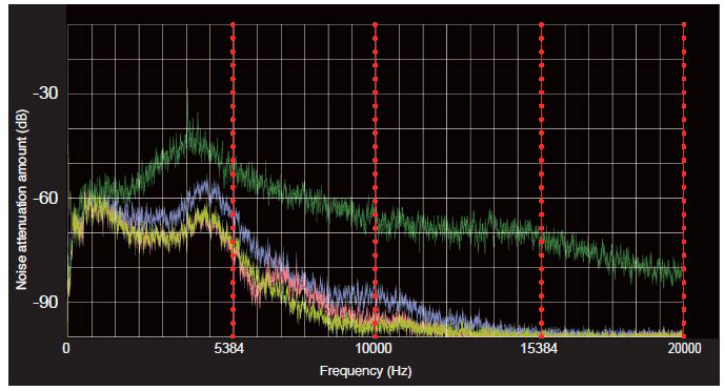
Fig. 3 shows the white noise results at 1000 Hz. The results for each condition are shown in four colours (Green: without plug, Yellow: plug type A, Pink: plug type B, Purple: form type). The sound insulation effect starts gradually between without and with earplugs from about the second half of 1000 Hz, and the graph in Fig. 2 shows that the noise between about 2500 and 4000 Hz is significantly attenuated. However, the sound insulation effect of the three types of earplugs decreases. around 5000 Hz. However, the sound insulation effect of the three types of earplugs decreases around 5000 Hz.
Figure 4 illustrates the attenuation for each sine wave under each condi- tion. At frequencies of 100 and 200 Hz, there is no discernible difference between conditions with and without earplugs. However, above 200 Hz, a difference begins to emerge. The largest discrepancy from the condition with- out earplugs occurs at 400 Hz, with a difference of approximately -11.9 dB observed for plug type A. From 800 Hz onwards, the difference between con- ditions with and without earplugs is smaller compared to the level at 400 Hz, but the results still demonstrate that earplugs are effective in reducing noise levels.
Figure 3: The graph in question has the noise attenuation amount (dB) represented on the vertical axis and Frequency (Hz) on the horizontal axis. The results of four distinct conditions are depicted by lines of different colors: Green represents the condition without a plug, Yellow corresponds to plug type A, Pink is indicative of plug type B, and Purple signifies the form type. This graphical representation allows for a clear comparison of the noise attenuation capabilities of the different earplug types across a range of frequencies.Figure 4: In the graph, the vertical axis represents the recorded sound levels in decibels (dB), while the horizontal axis denotes the corresponding frequencies in hertz (Hz). This arrangement allows for a comprehensive visualization of sound levels across various frequencies.
Characterization of Earplug Performance Using Dummy Head Microphone Measurements 483
CONCLUSION
In conclusion, this experiment has elucidated the characteristics of the sound insulation effect of each type of earplug. Many manufacturers’ catalogues only display attenuation in dB, leaving the frequency range in which the earplugs excel unclear. Even when the optimal frequency range of the earplugs is indicated, recorded results often do not reflect the structure of the head and ear because a dummy head is not used in measurements. In this experiment, measurements taken without earplugs in white noise were not flat due to the use of a dummy head. This is because they reflect the head and ear char- acteristics of the dummy head, thereby replicating conditions close to those experienced by a real human wearing earplugs.
The human head and ear are designed to pick up sounds in the 1000–5000 Hz range (Company, 2018). Figure 2 shows that the dummy head also picks up more sound than in other ranges within this frequency band when no earplugs are used. Under experimental conditions, the dummy head was set up so that it was at 70 dB at the ear; a level considered equivalent to that of a vacuum cleaner at the operator’s position (Salvendy, 2022). Under these conditions, all three types of earplugs provided good sound insulation.
differences in silicon hardness. Mass plays a significant role in sound insulation, and lightweight foam-type earplugs were found to be inferior to plug-type earplugs in terms of white noise from approximately 2000 Hz onwards.
However, their sound insulation effect was sufficient to make them an option for users who do not prefer plug-type devices. The characteristics of these earplugs were confirmed using both sine waves and audiograms. Future development of earplugs will verify these findings across a seven- octave range (250, 500, 1000, 2000, 4000 and 8000 Hz), similar to an audiogram. The characteristics identified in this study will be utilized in developing next-generation earplugs.
REFERENCES
Chere, B., & Kirkham, N. (2021). The Negative Impact of Noise on Adolescents’ Executive Function: An Online Study in the Context of Home-Learning During a Pandemic. Frontiers in Psychology, 12, 715301. doi: 10.3389/fpsyg.2021.715301. Company, T. E. K. (2018). Kodak’s Ergonomic Design for People at Work.
doi: 10.1002/9780470172469. Puglisi, G. E., Blasio, S. D., Shtrepi, L., & Astolfi, A. (2021). Remote Working in the COVID-19 Pandemic: Results From a Questionnaire on the Perceived Noise Annoyance. Frontiers in Built Environment, 7, 688484. doi: 10.3389/fbuil.2021.688484. Salvendy, G. (2022). Handbook of Human Factors and Ergonomics. doi: 10.1002/9781118131350.
LISTED IN THE AHFE DIGITAL BOOKSTORE CATALOGUE
Explore the complete digital volume
Human-Centered Design and User Experience
Read this individual research paper free through the original publisher, or explore the full digital proceedings book.
ISBN 978-1-958651-90-2
Explore this ISBN in the AHFE Bookstore ↗Listed in the July 2026 bookstore catalogue; search by ISBN to confirm current availability · Digital book purchase optional