Milei Chen, Weixing Huang, Tingru Zhang (2023). The Roles of Driving Style and Initial Trust on Trust towards Automated Vehicles. In: Human-Centered Design and User Experience. AHFE Open Access, vol. 114, pp. 600–609. https://doi.org/10.54941/ahfe1004280
User trust and acceptance are critical for the success of Automated Vehicles (AVs) in enhancing road safety and reducing driver workload. This study aims to investigate the influence of AV style (careful or aggressive) and driver style (careful or aggressive) on trust in AVs, while considering the role of initial trust level. A questionnaire-based survey was conducted with 204 participants, and responses were analyzed utilizing a Linear Mixed Model (LMM) with AV style, driver style and initial level as fixed effects. Two significant two-way interactions were observed: between driver style and AV style, and another between initial trust and AV style on trust. Specifically, careful AVs were rated with a higher trust than aggressive AVs by both driver groups. Additionally, aggressive drivers trusted aggressive AVs more than careful drivers, but careful AVs gain the same trust. Interestingly, participants with medium initial trust exhibited a less divergence in trust between different AV styles, yet the trust gaps between different trust groups consistently existed. These findings underscore the importance of aligning driver style, AV style, and initial trust levels to cultivate heightened trust in AVs.
The rapid advancements in deep learning algorithms, improved sensing devices, and vehicular communication technology have created favorable conditions for the development of autonomous vehicles (AVs). Numerous studies have shown that Level-3 AVs hold great potential to revolutionize future transportation with enhanced safety (Wang et al., 2020; Hirose et al., 2020), comfort (Moody et al., 2020), and efficiency (Singleton, 2018). How- ever, despite the more mature technology and lower probability of error, widespread adoption of Level-3 AVs remains challenging. Existing research indicates that a lack of trust is still a key barrier to the successful adoption of AVs (Xu et al., 2018; Zhang et al., 2021b).
Previous studies found that trust in AVs is influenced by the driving styles of AVs, with people tending to trust more careful AVs (Ekman et al., 2019; Lee et al., 2021; Oliveira et al., 2019) than aggressive ones. Additionally, studies showed that different drivers have varying expectations and trust in AVs due to individual differences (Zhang et al., 2021a), and individuals tend
The Roles of Driving Style and Initial Trust on Trust Towards Automated Vehicles 601
to exhibit higher trust in entities that are similar to themselves. For instance, drivers tend to trust the AVs that have human-like appearances (Verberne et al., 2015) and behaviours (Li et al., 2020). Given that AVs’ and human drivers’ behaviours reflect their driving styles, one could hypothesize that drivers are inclined to trust in AVs that match their own driving style. How- ever, prior research in this area showed divergent conclusions. Some studies indicated that drivers showed high acceptance for AVs with styles similar to their own (Haghzare et al., 2021; Sun et al., 2020; Ma and Zhang, 2021), while others suggested that both careful and aggressive drivers tended to trust careful AVs (Ekman et al., 2019).
Initial trust is another crucial factor affecting trust towards AVs (Hoff and Bashir, 2015; Zhang et al., 2020). Previous research consistently indicated that individuals with higher initial trust tend to sustain elevated trust after interacting with AVs (Manchon et al., 2021; Manchon et al., 2022; Ma and Zhang, 2021). Specifically, in the study by Manchon et al., (2021), the trust gap between high and low initial trust drivers is persistent, both after inter- acting with aggressive and careful AVs. Additionally, Manchon et al., (2021) observed an interaction between AV style and initial trust in AV trust. Low initial trust drivers showed a more decrease of trust in the aggressive AVs than high initial trust drivers, while this difference was not observed in care- ful AVs. The underlying assumption might be that initial trust would adjust the trust gaps between the AV style.
Questions such as whether a specific driving style elicits higher levels of trust universally, or if trust in AVs varies among different drivers based on their preferences and initial trust, remain largely unknow. It is, there- fore, important to investigate how initial trust, driver style and AV style affect users’ trust. For this purpose, we conducted an online questionnaire study.
METHOD
Participants This study employed the services of Wenjuanxing (www.wjx.cn) for sample collection and recruited 205 adult drivers holding Chinese driver’s licenses to participate in the survey.
Materials
Simulated Driving Scenarios The UC-WINROAD software was utilized to develop simulated driving sce- narios in which AVs drove either aggressively or carefully when dealing with typical driving events. Six driving events, namely car following, overtaking, yielding to pedestrians, obstacle avoidance, dilemma zone at traffic lights, and intersection right-of-way, were developed. In the first three events, the differences between aggressive and careful driving styles primarily pertained to driving parameters such as speed and distance. In the latter three events, the two driving styles were differentiated based on driving decisions such as go or stop choice. To ensure that user perception and preference would not
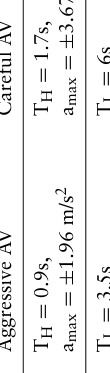
be influenced by AV failures, no accidents were presented in the scenarios. Table 1 presents the specific settings of how aggressive and careful AVs dealt with these events.
Questionnaire The entire questionnaire consists of four sections. The first section included questions to measure basic information about the participants, such as age, driving experience, and gender. The second section adopted the 10-item Ini- tial Trust Scale (ITS) to measure initial trust towards AVs (Manchon et al., 2021). Following was the Violation Subscale from the Driving Behaviour Questionnaire (V-DBQ) (Zhang et al., 2009) to assess the driving style of the participants. The last section presented participants with six driving scenarios. Following the approach used by Holthausen et al., (2020), partic- ipants were sequentially shown two driving styles for each current driving event before transitioning to the subsequent driving event. The order of driving styles for the same event was counterbalanced to avoid any bias. Fol- lowing the viewing of each driving video, participants were asked to rate their trust towards the specific AV in the video, using the 4 items adapted from the Trust Questionnaire (Sun et al., 2021). The 7-point Likert scale was used for all questions except for the demographic information related questions.
Statistical Analysis The study employed the k-means clustering analysis to classify drivers into different driving style and initial trust groups. Afterward, a Linear Mixed Model (LMM) was utilized to analyze the dependent variables, as the sample sizes across classified groups were uneven. In the LMM, initial trust level, driver style and AV style were modeled as fixed effects, while sample ID and scenarios were modeled as random effects.
RESULTS
A total of 205 responses were initially collected and 1 response was removed from further analysis due to all its questions had the same score. Of the remaining 204 participants, 81 were male, and 123 were female drivers. The average age of the participants was 31.94 years (SD = 5.78). Among them, the majority (n = 181) had obtained a college degree or higher, and almost all participants (n = 198) were currently employed (see Table 2).
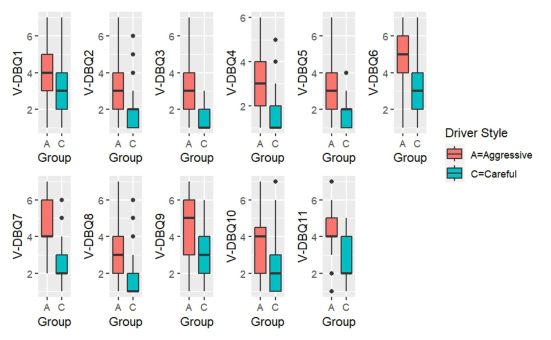
Driver Classification Participants were classified into different driving styles based on their stan- dardized V-DBQ scores. The NbClust function in R suggested that the optimal number of clusters was 2. As a result, we classified the participants into 2 groups using K-Means clustering analysis, with 133 being classified into the first group and 71 into the second group. An inspection of the item scores (Figure 1) indicated that the first group showed higher scores on all V- DBQ items than the second group. Therefore, the first group was as labeled as aggressive drivers, and the second group as careful drivers.
Similarly, based on ITS scores and as recommended by the NbClust func- tion, 3 initial trust groups, labelled as high, medium, and low, were identified.
The Roles of Driving Style and Initial Trust on Trust Towards Automated Vehicles 603
Equation reproduced from the original PDF.
change lane (Hang et al., 2021)
Aggressive AV Careful AV
Equation reproduced from the original PDF.
Pass Stop (Papaioannou, 2007)
Accelerate and pass Decelerate and yield (Li et al., 2021)
Immediately change
lane Stop and yield, then
a bridge, inside a tunnel). TH = 0.9s,
priority to pedestrians crossing the road. DS = 5m DS = 10m (Jayaraman et al., 2019)
traffic signal is displaying a flashing green light, signifying an
upcoming change to yellow.
encounters a vehicle approaching from left road of the
intersection at an equidistant position and equal velocity.
designated lane. Concurrently, vehicles behind the AV are
swiftly progressing in both the AV’s lane and the adjacent
safety lane.
Table 1. Scenarios in the AV driving task.
Table available in the original PDF paper.
Scenario Description Differentiation Origin
Car following The AV follows a vehicle ahead on the solid line road (e.g., on
Overtaking The AV overtakes a slow-moving vehicle. TL = 3.5s TL = 6s (Alarcon et al., 2016)
Yielding to pedestrians The AV approaches a zebra crossing with a stop sign and gives
Dilemma zone at traffic
lights The AV approaches an intersection with traffic signals. The
Intersection
right-of-way The AV reaches an intersection without traffic signals and
Obstacle avoidance The AV confronts an obstacle abruptly emerging in its
Note. TH = time headway, TL = lane change time, amax = maximum acceleration, DS = stop distance
Table 2. Summary of demographic variables.
Table available in the original PDF paper.
Equation reproduced from the original PDF.
Gender Male 81 Female 123 Education High school and below 6 Junior college /Undergraduate 181 Graduate 17
Occupation Students 5 Employed 198 Unemployed 1
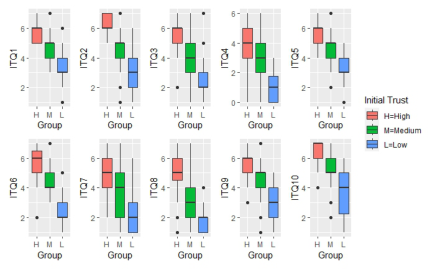
The item scores of the three groups are presented in Figure 2, and the average ITS score for each group was 5.53 (SD = 0.23), 4.22 (SD = 0.17) and 2.61 (SD = 0.33), respectively. The number of participants in each group was 79, 79, and 46, respectively.
Figure 1: Categorization of driver styles by V-DBQ item scores.Figure 2: Categorization of initial trust by V-DBQ item scores.
The Roles of Driving Style and Initial Trust on Trust Towards Automated Vehicles 605
Effects of Driver Style, Initial Trust, and AV Style A marginal R2 of 0.36 and a conditional R2 of 0.49 in LMM indicated fixed effects explained the primary variance. The results of the Fixed Effects in LMM are showed in Table 3. A significant interaction effect between AV style and driver style on their trust in AVs (p <.001) and a significant interaction effect between initial trust level and AV style on their trust in AVs (p = .023).
As shown in Table 4, the baseline trust score (careful AV, careful driver and high initial trust) is 6.04 points. Findings reveal that aggressive AV results in a 2.04-point decrease in trust compared to the baseline (p <.001). Moreover, compared to the high initial trust group, the trust score of the drivers with the medium initial trust level decreased by 0.57 points (p<0.001) and that of the low initial trust drivers decreased by 1.14 points (p<0.001). In particular, aggressive AVs increase trust by 0.72 points for aggressive drivers compared to careful drivers (p < 0.001).
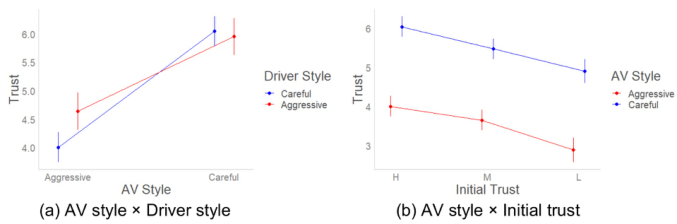
Note. A-AV: Aggressive AV, A-Driver: Aggressive Driver, M-IT: Medium Initial Trust, L-IT: Low Initial Trust. ***p <. 001, **p <.01, *p <.05, +p <.1 For the AV style × driver style interaction, the follow-up pairwise compar- ison analysis suggested that drivers reported higher levels of trust towards careful AVs compared to aggressive AVs, regardless of their own driving style
(both p <.001), as shown in Figure 3 (a). Additionally, aggressive drivers showed greater trust towards aggressive AVs compared to careful drivers (p = .002), but showed equal trust in careful AVs as careful drivers (p = .559).
Similarly, in the AV style × initial trust interaction, the pairwise compar- isons with Bonferroni-corrected adjustments revealed that drivers reported higher trust score (all p <.001) towards careful AVs compared to aggressive AVs, regardless of their initial trust level. Moreover, drivers with higher ini- tial level always report greater trust (all p<.05) than drivers with lower initial trust, regardless the AV style. However, as showed in Figure 3 (b), drivers with medium level of initial trust tend to show a less difference in trust between careful AV and aggressive AV.
Figure 3: Two-way interactions on trust.
DISCUSSION
The present study investigated the effects of AV style, driver style, and initial trust on drivers’ trust. Particularly, participants were exposed to different AV style by watching videos in which AVs dealt with driving events with either careful or aggressive styles. The two driving styles were differentiated based not only on driving parameters in non-dilemma scenarios but also on AV decision-making characteristics in the dilemma situations. The significant rating differences in attitude towards these two types of AVs suggested the effectiveness of the style manipulation.
Based on the results, we found that careful AVs were perceived as more trustworthy, corroborating previous research findings reported by Ekman et al., (2019). A possible contributing factor to the perceived higher trustwor- thiness of the careful AV was that drivers feel safer, as we created the careful AV with more careful driving decision such as longer following distance, and perceived safety is considered the foundation of trust in AVs (Zhang et al., 2019). We also found that aggressive drivers trusted aggressive AVs more compared to careful drivers, which is consistent with Ma and Zhang (2021). One possible explanation is aggressive drivers might have a higher acceptance of risk to achieve efficiency or prefer AVs align with their driving expectations and driving characteristics.
With regard to the effects of initial trust, the primary finding was the trust gap between initial trust groups persisted, confirming the significant role of initial trust in trust formation. This finding is consistent with the previous study (Manchon et al., 2021). However, drivers with medium initial trust
The Roles of Driving Style and Initial Trust on Trust Towards Automated Vehicles 607
were less sensitive to AV style than high and low initial trust driver. Possible drivers with more trust preference tend to show more preference in AV style.
The above findings have some practical implications. One is AV Style is the important factor in building the trust in AV and suggested AV manufacturers always prioritize driving safety and caution in the production of AV. Another is different drivers show various preference in AV styles. AV manufacturers should consider offering options for AV personalization to cater different demands and preferences, ultimately improving the user trust and experience in their products.
This study has several limitations. First, it utilized an online video ques- tionnaire as a preliminary exploration method, which may exist certain discrepancies with real-world experience. Additionally, the subjective nature of the employed scales may introduce some biases in the classification of drivers’ driving styles, potentially affecting the reliability of the research results.
CONCLUSION
This study comprehensively considered the impact of initial trust, driver style and AV style on AV trust. The finding indicated that careful AVs were per- ceived as more trustworthy than aggressive AVs, irrespective of driver styles. Moreover, aggressive drivers exhibited higher trust in aggressive AVs com- pared to careful drivers. In addition, the trust difference between initial trust groups is sustained, and medium initial trust drivers were slightly less influ- enced by AV style compare drivers with more trust preference. These results emphasize the importance of driving style and initial trust in shaping drivers’ trust in AVs. Understanding these factors can inform the design and develop- ment of AV technology, fostering and maintaining higher levels of trust and acceptance among drivers and contributing to its successful integration on the roads.
ACKNOWLEDGMENT
This research was supported by Shenzhen Basic Research General Project (JCYJ20210324100014040), Guangdong Provincial Natural Science Foun- dation General Project (2021A1515011610) and National Natural Science Foundation of China (72071170).
REFERENCES
Alarcon, G. M., Lyons, J. B., Christensen, J. C. (2016). The effect of propensity to trust and familiarity on perceptions of trustworthiness over time. Personality and Individual Differences, 94, 309–315. Ekman, F., Johansson, M., Bligård, L.-O., Karlsson, M. and Strömberg, H. (2019).
Exploring automated vehicle driving styles as a source of trust information. Transportation Research Part F: Traffic Psychology and Behaviour, 65, 268–279. Haghzare, S., Campos, J. L., Bak, K. and Mihailidis, A. (2021). Older adults’ acceptance of fully automated vehicles: Effects of exposure, driving style, age, and driving conditions. Accid Anal Prev, 150, 105919.
Hang, P., Lv, C., Xing, Y., Huang, C. and Hu, Z. (2021). Human-Like Decision Making for Autonomous Driving: A Noncooperative Game Theoretic Approach. IEEE Transactions on Intelligent Transportation Systems, 22, 2076–2087. Hirose, T., Sawaragi, T., Nomoto, H. and Michiura, Y. (2020). Functional safety
analysis of SAE conditional driving automation in time-critical situations and proposals for its feasibility. Cognition, Technology & Work, 23, 639–657. Hoff, K. A., Bashir, M. (2015). Trust in Automation: Integrating Empirical Evidence on Factors That Influence Trust. Human Factors, 57, 407–434. Holthausen, B. E., Wintersberger, P., Walker, B. N. and Riener, A. (2020). Situational
Trust Scale for Automated Driving (STS-AD): Development and Initial Valida- tion. 12th International Conference on Automotive User Interfaces and Interactive Vehicular Applications. Jayaraman, S. K., Creech, C., Tilbury, D. M., Yang, X. J., Pradhan, A. K., Tsui, K. M.
and Robert, L. P., Jr. (2019). Pedestrian Trust in Automated Vehicles: Role of Traffic Signal and AV Driving Behavior. Front Robot AI, 6, 117. Lee, J. D., Liu, S. Y., Domeyer, J. and DinparastDjadid, A. (2021). Assessing Drivers’ Trust of Automated Vehicle Driving Styles With a Two-Part Mixed Model of Intervention Tendency and Magnitude. Human Factors, 63, 197–209. Li, D. F., Liu, G. M., Xiao, B. (2021). Human-like driving decision at unsignalized
intersections based on game theory. Proceedings of the Institution of Mechanical Engineers Part D-Journal of Automobile Engineering. Li, J., Jiang, B., Dong, C., Wang, J. and Zhang, X. (2020). Analysis of Driver Decisions at the Onset of Yellow at Signalized Intersections. Journal of Advanced Transportation, 2020, 1–12. Ma, Z., Zhang, Y. (2021). Drivers trust, acceptance, and takeover behaviors in fully
automated vehicles: Effects of automated driving styles and driver’s driving styles. Accident Analysis & Prevention, 159, 106238. Manchon, J. B., Bueno, M., Navarro, J. (2021). Automation, Expert Systems Calibration of Trust in Automated Driving: A Matter of Initial Level of Trust and Automated Driving Style? Hum Factors, 187208211052804. Manchon, J. B., Bueno, M., Navarro, J. (2022). How the initial level of trust
in automated driving impacts drivers’ behaviour and early trust construction. Transportation Research Part F: Traffic Psychology and Behaviour, 86, 281–295. Moody, J., Bailey, N., Zhao, J. (2020). Public perceptions of autonomous vehicle safety: An international comparison. Safety Science, 121, 634–650. Oliveira, L., Proctor, K., Burns, C. G. and Birrell, S. (2019). Driving Style: How
Should an Automated Vehicle Behave? Information, 10. Papaioannou, P. (2007). Driver behaviour, dilemma zone and safety effects at urban signalized intersections in Greece. Accid Anal Prev, 39, 147–58. Singleton, P. A. (2018). Discussing the “positive utilities” of autonomous vehicles:
will travellers really use their time productively? Transport Reviews, 39, 50–65. Sun, P., Wang, X., Zhu, M. (2021). Modeling Car-Following Behavior on Freeways Considering Driving Style. Journal of Transportation Engineering, Part A: Systems, 147. Sun, X., Li, J. P., Tang, P. Y., Zhou, S. Y., Peng, X. J., Li, H. N. and Wang, Q. F. (2020).
Exploring Personalised Autonomous Vehicles to Influence User Trust. Cognitive Computation, 12, 1170–1186. Verberne, F. M. F., Ham, J., Midden, C. J. H. (2015). Trusting a Virtual Driver That Looks, Acts, and Thinks Like You. Human Factors, 57, 895–909. Wang, J., Zhang, L., Huang, Y., Zhao, J. and Bella, F. (2020). Safety of Autonomous
Vehicles. Journal of Advanced Transportation, 2020, 1-13.
The Roles of Driving Style and Initial Trust on Trust Towards Automated Vehicles 609
Xu, Z., Zhang, K., Min, H., Wang, Z., Zhao, X. and Liu, P. (2018). What drives people to accept automated vehicles? Findings from a field experiment. Transportation Research Part C: Emerging Technologies, 95, 320–334. Zhang, L., Wang, J. Q., Yang, F. R. and Li, K. Q. (Year) “A Quantification Method of
Driver Characteristics Based on Driver Behavior Questionnaire”, preceedings of the IEEE Intelligent Vehicles Symposium, Xian, PEOPLES R CHINA. 616–620. Zhang, Q., Yang, X. J., Robert, L. P. (2021a). Individual Differences and Expectations of Automated Vehicles. International Journal of Human–Computer Interaction, 1–12. Zhang, T., Tao, D., Qu, X., Zhang, X., Lin, R. and Zhang, W. (2019). The roles
of initial trust and perceived risk in public’s acceptance of automated vehicles. Transportation Research Part C: Emerging Technologies, 98, 207–220. Zhang, T., Tao, D., Qu, X., Zhang, X., Zeng, J., Zhu, H. and Zhu, H. (2020).
Automated vehicle acceptance in China: Social influence and initial trust are key determinants. Transportation Research Part C: Emerging Technologies, 112, 220–233. Zhang, T., Zeng, W., Zhang, Y., Tao, D., Li, G. and Qu, X. (2021b). What drives people to use automated vehicles? A meta-analytic review. Accid Anal Prev, 159, 106270.
LISTED IN THE AHFE DIGITAL BOOKSTORE CATALOGUE
Explore the complete digital volume
Human-Centered Design and User Experience
Read this individual research paper free through the original publisher, or explore the full digital proceedings book.
ISBN 978-1-958651-90-2
Explore this ISBN in the AHFE Bookstore ↗Listed in the July 2026 bookstore catalogue; search by ISBN to confirm current availability · Digital book purchase optional