Daigo Kosaka, Masahiro Hoshiba, Hiroyuki Nakamoto (2023). Quantitative Assessment of Eddy Current Inspection Technician Skills. In: Emerging Technologies and Future of Work. AHFE Open Access, vol. 117, pp. 270–276. https://doi.org/10.54941/ahfe1004427
In eddy current testing, it is desirable to keep sensor perpendicular to test surface, but it is difficult to automatically determine the sensor posture at inspection points with complex geometry, and the non-destructive testing technician manually operates the sensor. In such cases, it is necessary to ensure skill of the technicians as they are part of the non-destructive testing system. We are conducting research to establish a skills training method to efficiently develop non-destructive testing technicians. The behavior of licensed and unlicensed subjects was measured while inspecting defects around bolt holes. There was a clear statistical difference between the sequences of licensed and unlicensed subjects.ts will be established, and a prototype real-time skill teaching system will be built to verify the validity of the proposed method.
Eddy Current Testing (ECT) is a Non-Destructive Technique (NDT) mainly used to measure the electromagnetic properties of metals and to inspect defects on metal surfaces. The ECT detection signals are affected by both the defects and the distance between specimens and ECT sensors, such as a coil. Therefore, to inspect complex geometries, the NDT technicians man- ually manipulate the sensor to maintain the distance when it is difficult to automatically determine the proper position of ECT sensors. In such cases, it is necessary to ensure the technician is skilled as he or she is part of the non- destructive inspection system. However, to the best of our knowledge, there is no description of skills in the national or international literature on ECT or NDT (Bray, D. et al., 1997, Cartz, L., 1995, JSNDI, 2016). We are conduct- ing research to establish a skills training method to efficiently develop NDT testing technicians with sufficient skills (Matsuo, K. et al., 2013, Nakamoto, H. et al., 2022).
Previous skill assessment studies have quantified the subjectivity of a skilled worker’s movements by measuring them with an IMU (Enokibori et al., 2013, Harding, J. et al., 2008, Sakuma, M., 2006). These studies looked at analog components of skill, such as acceleration and trajectory of movement. In addition, there is a previous study that used eth- nomethodology to identify the reasons for not being able to use the functions of a copier (Suchman, L., 1987). This previous study deals with the digital
Quantitative Assessment of Eddy Current Inspection Technician Skills 271
component of the skill of “operating the buttons on a copier”. The field of NDT requires the simultaneous operation of sensors (analog skill) and equip- ment (digital skill). This is because sensor scanning methods and instrument settings affect inspection results. The importance of skills can be seen in the fact that the standard “ISO 9712 Non-destructive testing - Qualification and certification of NDT personnel” has been established as a standard to ensure the skills of people. Another problem is the scarcity of literature on ECT skills. Compared to previous studies, our study is novel in that it simultane- ously deals with skill elements in different data formats, i.e., sensor operation (analog skill) and equipment operation (digital skill) performed by NDT technicians, and in that it evaluates inspection quality based on sensor signals.
In this paper, an experimental setup is described for measuring a sequence of a test subject’s actions while applying ECT. Next, we discuss the mea- surement results of that sequence of qualified and unqualified ECTs. Finally, future plans necessary to propose effective skill teaching methods in ECT will be discussed.
EXPERIMENTAL SETUP FOR SKILL MEASUREMENT
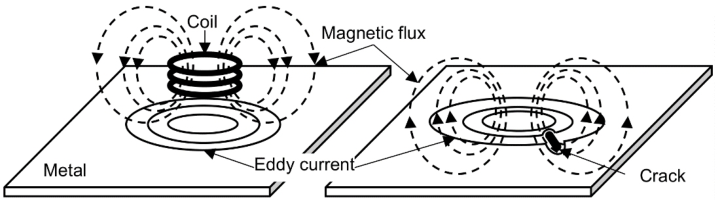
Figure 1 shows the principle of ECT. The distance between the specimens and ECT sensors such as coils is called the “liftoff”. In general, liftoff signals are larger than crack signals. Therefore, it is important to move the sensor while keeping the sensor posture in order to detect small cracks.
Figure 1: Principle of ECT.
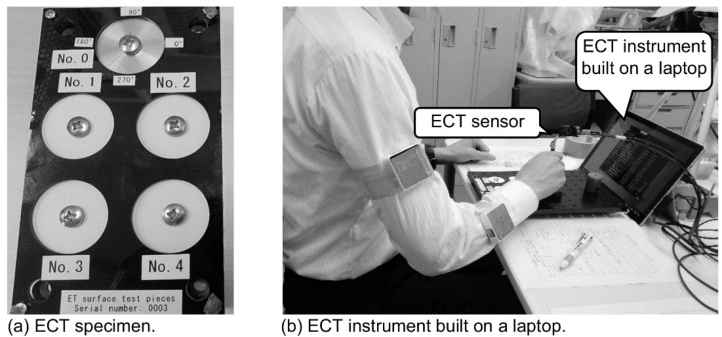
Figure 2 (a) shows an ECT specimen. Five aluminum alloy washers are embedded in this specimen. Radial cracks are machined into washers from the center of the fastener hole. However, the washer surface is masked so that test subjects cannot identify the location and size of cracks other than the reference crack. Therefore, we conducted inspection tests in which subjects scanned the area around the fastener hole with the ECT sensor to look for cracks, and we compared the skills of qualified and unqualified subjects dur- ing the experiment. A photograph of a test subject and the experimental setup in our study is shown in Figure 2 (b). The experimental setup consists of an ECT sensor (AT-129, Actuni Co., Ltd.) and a full digital software ECT instru- ment built on a laptop computer, with the sensor and laptop connected via a data acquisition unit (Analog Discovery 2, NI). This experimental setup is capable of synchronously recording ECT signals and the subject’s instrument
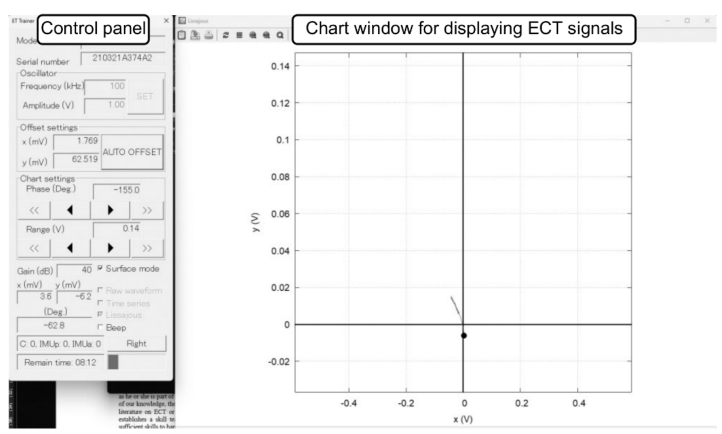
operation records. The screen of the ECT instrument is shown in Figure 3. The test subjects had to maintain the correct sensor posture without looking at the sensor. This is because the subjects had to look at the screen where the ECT signal was displayed in order not to miss crack signals on the screen. This process is similar to copying words in a book without looking at the tip of a pen.
Figure 2: Experimental setup.Figure 3: Screen of ECT instrument used by test subjects.
SKILL MEASUREMENT RESULTS AND DISCUSSION Three licensed and three unlicensed test subjects participated in this skill assessment experiment. Each subject applied ECT to five specimens. There- fore, the number of sample ECT record inspection results is 30. The subjects
Quantitative Assessment of Eddy Current Inspection Technician Skills 273
received a 10-minute explanation of ECT, followed by 10 minutes of ECT practice using the ECT instrument. The maximum inspection time was 10 minutes for each sample. There was one reference washer and four masked washers in each specimen. The subjects first adjusted the ECT instrument using the reference washer and then inspected the masked washers for cracks. Table 1 shows errors included in the results of the inspections by the subjects. There were three errors in 15 tests performed by licensed subjects. There were 10 errors in 15 tests performed by unlicensed subjects. The p-value of these results is 0.083. It is possible that the difficulty level of the ECT test was not appropriate. We attempted to identify the skills required of ECT technicians based on the ECT signals measured by the test subjects, and the subjects’ records of operating the ECT equipment.
Table 1. Errors included in results inspected by the subjects.
Table available in the original PDF paper.
Times Licensed subject 1
Licensed subject 2
Licensed subject 3
Unlicensed subject 1
Unlicensed subject 2
Unlicensed subject 3 1st a × 1 - - b × 1 a × 2 - 2nd - - c × 1 - c × 2 - 3rd - - - - - a × 1 4th - - c × 1 - c × 2 - 5th - - - - c × 2 -
a: overlooking error, b: over detection error, c: crack position error.
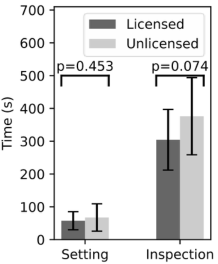
First, the difference between licensed and unlicensed subjects in the time spent setting up and inspecting the equipment relative to the time spent on a single experiment was examined. Figure 4 shows the time spent by subjects on inspection tests. In the figure, “Setting” is the time spent setting the ECT instrument. “Inspection” is the time spent inspecting specimens. The error bars show the unbiased standard deviation of the time. There was no signifi- cant difference between the average times spent on setting and inspection by licensed and unlicensed subjects.
Figure 4: Time spent by subjects on the inspection test.
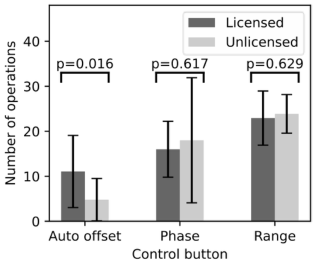
The number of button presses on the ECT device was examined. Figure 5 shows the number of buttons pressed on the control panel. The “Auto offset”
button is used to move the ECT signal to the origin on the chart window. This button can be used to reduce an effect of drift in the output signals of the ECT instrument. The “Phase” button is used to change the phase of the ECT signal. In general, the phase is adjusted so that the liftoff signal has a negative direction of the x-axis on the chart windows of the ECT instrument. This allows changes in the ECT signal in the y-axis direction on the chart to be considered crack signals. The “Range” button is used to change the ranges of the x and y axis on the chart. The range is adjusted so that the crack signals appear larger on the chart. These operations are important to detect small cracks. The number of times the “Auto offset”button was pressed by licensed subjects was clearly higher than for the unlicensed subjects. However, there was no significant difference between the number of times the “Phase” and “Range” buttons were pushed by the subjects. The licensed subjects used the “Auto offset” button at least twice for each washer. The unlicensed subjects used the button only once for each washer. These results indicate that the licensed subjects were more aware of the location of the zero point of the ECT signal than the unlicensed subjects.
Figure 5: Number of times buttons were pushed on the control panel.
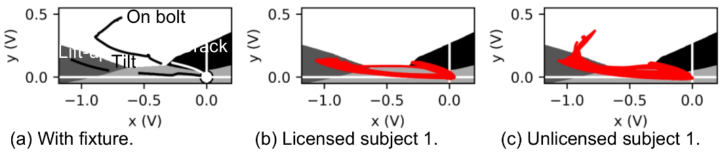
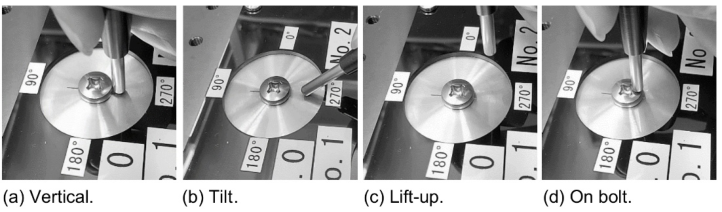
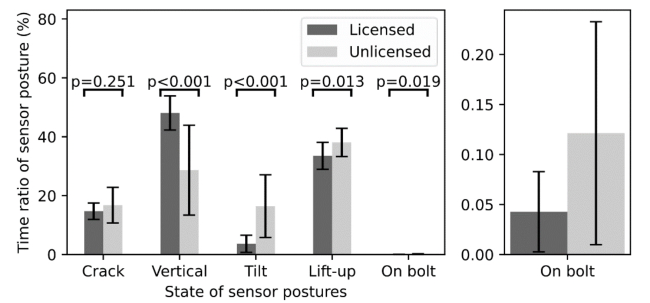
The sensor postures of the licensed and unlicensed subjects during the ECT inspections were compared. Figure 6 (a) shows a trajectory of the ECT signal measured as reference data. This trajectory was measured while maintaining the sensor posture using a fixture. Figure 6 (b), (c) show trajectories of the ECT signals measured by a licensed person and an unlicensed person. Com- pared to the trajectory of the unlicensed person, the trajectory of the licensed person has more shape in the area where it was drawn. The subject’s sen- sor postures were classified into “Crack” state and the four states shown in Figure 7 using the data in Figure 6 (a) as training data. Figure 8 shows the time ratio of each sensor posture in inspection time estimated from the mea- sured ECT signals. The time ratio of the “Vertical”state during the inspection time was about 48% of the inspection time for the licensed subjects, while it was about 29% for the unlicensed subjects. The time ratio of the “Tilt” state during the inspection time was about 4% of the inspection time for the licensed subjects, while it was about 16% for the unlicensed subjects. The number of times the sensor rode on the bolt during the inspection by
Quantitative Assessment of Eddy Current Inspection Technician Skills 275
the unlicensed subjects was greater than that of the licensed subjects. These results indicate that the sensor movements of the unlicensed subjects were unstable. The p-values of “Vertical” and “Tilt” were the smallest in all sensor posture states. Therefore “Vertical” and “Tilt” are promising candidates for traits or skill scores to describe licensed and unlicensed subjects.
Figure 6: ECT signal trajectories.Figure 7: States of sensor postures.Figure 8: Time ratio of each sensor posture in inspection time estimated from the measured ECT signals.
CONCLUSION
We conducted experiments to statistically compare the behavior of three licensed and three unlicensed test subjects while inspecting defects around bolt holes. The experiment showed that the licensed subjects pressed cer- tain buttons on the device significantly more often. They also held the sensor
perpendicular to the test surface with less tilt variation. The ECT signal corre- lates with the orientation of the sensor, and keeping the sensor perpendicular to the test surface is an important factor in ECT. Therefore, these measure- ments are promising candidates for traits or skill scores to describe licensed and unlicensed subjects.
In the future, we aim to determine the elements of real-time skill assessment and establish an inspection skill teaching method that incorporates these elements. A prototype real-time skill teaching system using the established teaching method will be developed and its effectiveness will be confirmed. In the future, the excellent skills used in the teaching system will be applied to sensor posture control of cooperative robots and developed into a general- purpose automated NDT method that can maintain an appropriate sensor posture according to the inspection surface.
ACKNOWLEDGMENT
This work was supported by JSPS KAKENHI Grant Number JP22K04632. We would like to thank AMIC Co., Ltd. for their cooperation as test subjects.
REFERENCES
Bray, D., Stanley, R. (1997) “Nondestructive Evaluation”, CRC Press. Cartz, L. (1995) “Nondestructive Testing, ASM International”, ASM International. Enokibori, Y., Mase, K. (2013) “Reproduction of Expert’s Subjective Skill-Level Evaluation with Wearable Acceleration and Gyroscope Sensors on Metal-Filing”, Transactions of the Japanese Society for Artificial Intelligence, Vol. 28, No. 4, pp. 391–399 (Japanese). Harding, J. et al. (2008) “Technology and half-pipe snowboard competition”, The
Engineering of Sport, Vol. 7, pp. 467–476. JSNDI (2016), “Eddy Current Testing II”, The Japanese Society for Non-Destructive Inspection. Matsuo, K., Nakamoto, H., Kosaka, D., Kobayashi, F. (2021) “Estimation of probe
angles based on inertial measurement and human skill assessment”, In Interna- tional Conference on Applied Human Factors and Ergonomics, pp. 415–422. Nakamoto, H., Kosaka, D. (2022) “Quantification of Skill Evaluation Based on the State Transition of the Probe for Eddy Current Testing”, Journal of The Japanese Society for Non-Destructive Inspection, Vol. 71, No. 4, pp. 177–182 (Japanese). Sakuma, M., Asai, S (2006) “System for Visualization of Manual Welding Skill
Using Visual Sensors”, Journal of The Japan Welding Society, Vol. 75, No. 8, pp. 653–657. Suchman, L. (1987) “Plans and situated actions: The Problem of Human-Machine Communication”, Cambridge University Press.
LISTED IN THE AHFE DIGITAL BOOKSTORE CATALOGUE
Explore the complete digital volume
Emerging Technologies and Future of Work
Read this individual research paper free through the original publisher, or explore the full digital proceedings book.
ISBN 978-1-958651-93-3
Explore this ISBN in the AHFE Bookstore ↗Listed in the July 2026 bookstore catalogue; search by ISBN to confirm current availability · Digital book purchase optional