Ichiro Hirata, Hiroyuki Nakamoto, Takashi Nonaka (2023). Comparison of Backpacks with Air Mesh Back Panels and Curved Boards in Standing Position. In: Human-Centered Design and User Experience. AHFE Open Access, vol. 114, pp. 21–26. https://doi.org/10.54941/ahfe1004217
We designed a prototype backpack to reduce the physical load on students. The main features of the prototype structure were a three-dimensional pad back panel and a curved board. The prototype has a curved surface board inside the padded back panel. This increases the contact area between the backpack and the student's back. To verify the effectiveness of the prototype fit, we compared the prototype to a conventional backpack. Twelve participants were recruited from elementary school students and preschool students. There were significant differences in neck and hip angles when compared to the prototype. Postural measurements showed that carrying a conventional backpack resulted in tilting posture. Stabilometry was measured and found to be more unstable in the conventional backpack. Body pressure distribution measurements showed that the prototype distributed body pressure better. Compared to the prototype, the lower edge of the conventional backpack locally touched the lower back. On the other hand, the padded air mesh back panel of the prototype had a large area of contact with the lumbar region. The results of the comparison between the prototype and the conventional backpack showed that the children's posture changed. This indicated that the prototype was effective in reducing the load on the children.
Japanese elementary school students carry backpacks to school. The main compartment of the backpack holds many textbooks and supplementary materials. In addition, water bottles are stored next to the backpack. There- fore, an elementary school student has to carry an approximate 4 kg back- pack to school every day (H. Morooka, 2009). Carrying a heavy backpack is not only hard on the student’s body, but also poses a health risk (W.G. Mackenzie, 2003). This is not only a problem in Japan. Many elementary school students in China and other Asian countries also carry backpacks to school (S. Layuk, 2020 and T.L. Hernández, 2020). Therefore, this study proposed a school backpack structure to reduce the load on backpacks used by elementary school students. Then, we analyzed the effectiveness of this backpack through experiments.
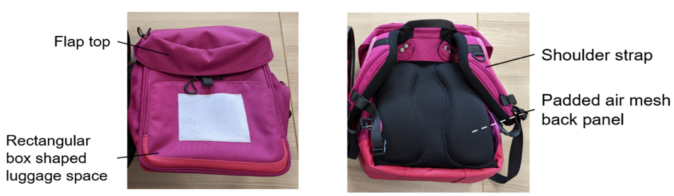
DEVELOPED SCHOOL BACKPACKS Our prototype backpack is shown in Figure 1. To increase the contact area between the bag and the student’s back, a three-dimensional padded back panel and a curved board are included in the prototype. The prototype was 320 mm wide, 200 mm deep, 370 mm high, and weighs 1.33 kg. The surface of the padded back panel is covered with air mesh material. The flap top is shorter than conventional bags.
Figure 1: Prototype backpack.
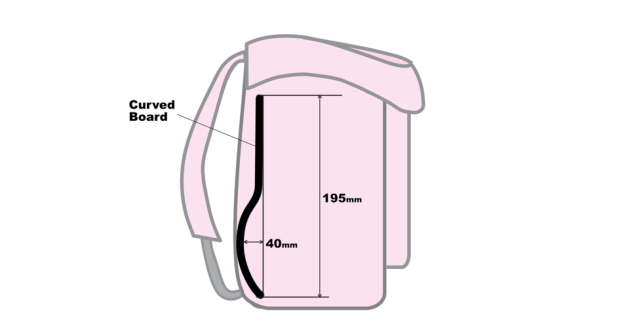
A cross-sectional view of the prototype structure is shown in Figure 2. The prototype uses a curved panel for the padded backrest. The curved plate is made of hard plastic. It is 195 mm wide and 1.5 mm thick. Viewed from the side, the bottom of the board is curved and protrudes 40 mm. This curved version is pressed against the padded back panel. This structure allows the backpack to be in close contact with the student’s back.
Figure 2: Structure of prototype backpack.
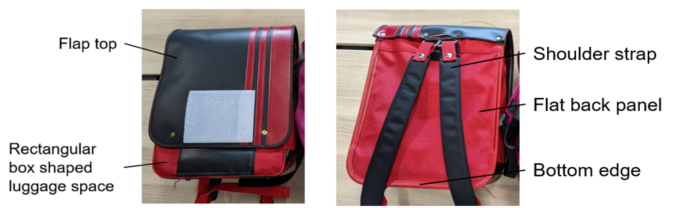
CONVENTIONAL BACKPACK A conventional backpack consists of rigid shells. The backpack has a rect- angular box shape with a flap, and its structure is shown in Figure 3. The backpack is 290 mm wide, 180 mm deep, and 375 mm high, and weighs 1.10 kg.
Comparison of Backpacks With Air Mesh Back Panels and Curved Boards 23
Figure 3: Conventional backpack.
EXPERIMENTAL CONDITION An experiment was conducted to compare the prototype with a conventional backpack. Twelve children took part in the experiment. The experimental participants were elementary school students and preschool students, with a mean and standard deviation of 6.8 ± 1.3 years for age. The height and weight of the experimental subjects were 119.0 ± 5.6 cm and 23.0 ± 4.1 kg, respectively.
The length of the shoulder strap of the backpack was 140 mm. This was calculated based on the length of the horizontal portion of the shoulder strap when extended horizontally with the backpack on the back. However, for one short participant, the length was set at 130 mm. The weight was 3.93 kg for the prototype and 3.90 kg for the conventional backpack with textbooks.
Informed consent was obtained from all participants and their parents before the experiment. This study was approved by the Ethics Committee of the Graduate School of Systems Informatics, Kobe University (R04-01) in accordance with the Declaration of Helsinki.
In the experiment, pressure distribution, posture, and stabiliometry were measured with the backpack on the participant’s back. We measured three patterns: “with nothing on the back”, “with the prototype on the back”, and “with a conventional school bag on the back”. During the measurement, the participants were asked to maintain their posture for 30 seconds.
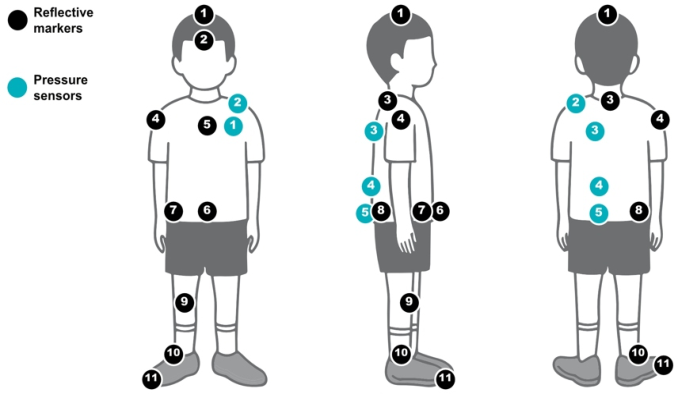
To measure the pressure distribution, the pressure between the partici- pant and the backpack was measured. Five air-pack type pressure sensors (AMI3037-P1, AMI Techno Corporation., Ltd.) were attached to the left side of the participant’s body for measurement. Posture while carrying the backpack was measured using a motion capture system (VENUS3D, Novitec Co., Ltd.). Reflective markers were placed at 11 locations on the right side of the body and measured with an infrared camera. Stabilometry was measured using a force plate (TFG-4060, Tec Gihan Co., Ltd.).
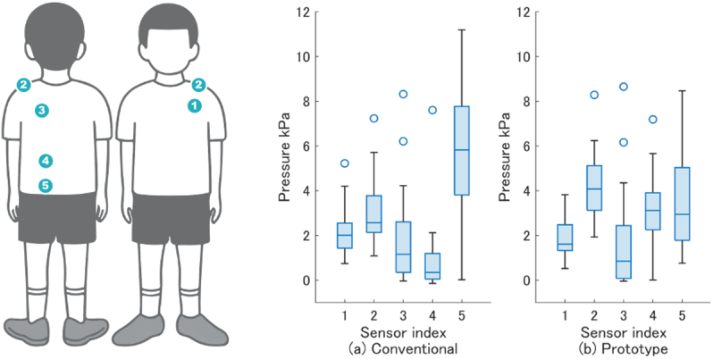
The mounting positions of the pressure sensor and reflective markers are shown in Figure 4. Pressure sensors #1 and #2 measured the pressure between the skin around the shoulder and the shoulder straps, while the others mea- sured the pressure between the back and the back panel. Reflective markers were placed on the head with #1 and #2, neck with #3, shoulder with #4, chest with #5, lumbar with #6 through #8, and leg with #9 through #11.
Figure 4: The mounting positions of the pressure sensor and reflective markers.
RESULTS AND DISCUSSION
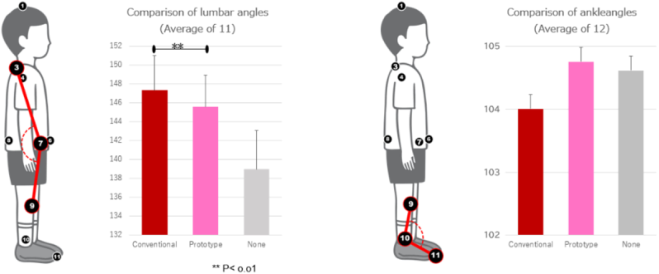
Posture Comparison Among the results of the posture comparisons, the lumbar (left) and ankle (right) angles where the differences were more pronounced are shown in Figure 5. Note that the motion capture system was unable to catch infrared marker #7 on one subject. Therefore, data from 11 subjects were averaged for the comparison of lumbar angles. For the ankle, the angles of all 12 sub- jects were averaged for comparison. The comparison graphs also included the angle during normal standing as a reference value. There was a significant dif- ference (P value less than 0.01) between the conventional and the prototype for the waist angle comparison. No significant difference was found for the ankle angle, but there was a difference between the conventional and the pro- totype. The ankle angle results showed that the subjects leaned forward when wearing the conventional backpack. On the other hand, the ankle angle when carrying the prototype was not much different from the ankle angle during normal standing.
Figure 5: Mean of posture comparison.
Comparison of Backpacks With Air Mesh Back Panels and Curved Boards 25
From these results it can be concluded that carrying the conventional backpack results in a forward leaning posture, while carrying the prototype backpack results in a more upright back than when carrying nothing at all. By comparing postures, we were able to confirm the effectiveness of the padded curved plate used in the prototype.
Stabilometry
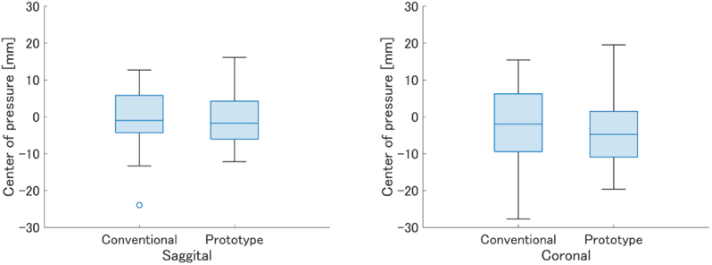
Figure 6 shows the results of a comparison of the stabiliometry when wear- ing two types of backpacks. This graph compares the means of the “absolute center of gravity values”. The error bars in Figure 6 represent the standard deviation. The left graph shows the forward/backward direction (+ is for- ward). The right graph shows the left-right direction (+ is right). It was found that there was little difference in the center of gravity in the front-back direc- tion. Considering the results of the posture comparisons, it can be inferred that the subjects adjust their posture to increase stability by changing their posture.
Figure 6: Box-and-whisker plots of stabiliometry.
Pressure Distribution The mean pressures are shown in Figure 7. The means were calculated from the pressure data of all participants. Sensor #1 and sensor #3 had no signif- icant difference between the two backpacks. Sensor #2 on the clavicle was above 3 and 4 kPa. But the difference in pressure of sensor # 2 was small. Regarding the sensor # 4, the conventional backpack slightly touches the lumbar spine. The prototype had a pressure of more than 3 kPa. Sensor # 5 also showed a difference between the two backpacks. The pressure of the conventional backpack was high and that of the prototype was not so high. Therefore, the lower edge of the conventional backpack touched the lower back locally. Localized pressure in the lumbar region can cause low back pain. On the other hand, the padded air-mesh back panel of the prototype touched the lower back with a large area. This large area is presumed to create friction and stabilize the comfort of the prototype.
Figure 7: Mean of pressure sensor.
CONCLUSION
In this study, we proposed the backpack structure for elementary school stu- dents and conducted verification experiments to confirm its effectiveness. In the verification experiment, the prototype backpack with the three- dimensional padded back panel and a curved board was compared with the conventional backpack. It was found that the posture when carrying the backpack was better than that of the conventional backpack, and the pressure exerted when carrying the prototype was distributed. These results indicate that the load on the child is reduced.
REFERENCES
Harumi Morooka, Tomoko Kawakami and Hideo Morooka. (2009). Discussion on School Bags Using Shoulder Strap Pressure for Reducing Body Load, Journal of Fiber Science and Technology, 65(12), pp. 325–331, in Japanese. Semuel Layuk, Tri Martiana, Bongakaraeng Bongakaraeng. (2020). School bag
weight and the occurrence of back pain among elementary school children, Journal Public Health Research, 9(2):1841, pp. 191–194. Tania López Hernández, Marina Caparó Ferré, Sílvia Giné Martí, Isabel Salvat Salvat. (2020). Relationship between School Backpacks and Musculoskeletal Pain in Children 8 to 10 Years of Age: An Observational, Cross-Sectional and Analytical Study, International Journal of Environmental Research and Public Health, 17, 2487. William G Mackenzie, Jayanth S Sampath, Richard W Kruse, Geraldine J Sheir-Neiss.
(2003), “Backpacks in Children”, Clinical Orthopaedics and Related Research, 409, pp. 78–84.
LISTED IN THE AHFE DIGITAL BOOKSTORE CATALOGUE
Explore the complete digital volume
Human-Centered Design and User Experience
Read this individual research paper free through the original publisher, or explore the full digital proceedings book.
ISBN 978-1-958651-90-2
Explore this ISBN in the AHFE Bookstore ↗Listed in the July 2026 bookstore catalogue; search by ISBN to confirm current availability · Digital book purchase optional