Hiroyuki Nakamoto, Kento Kawanishi, Ichiro Hirata (2023). Effects of Filtered Air- and Bone-conduction Sounds’ Presentation in Mastication on Food Texture. In: Human-Centered Design and User Experience. AHFE Open Access, vol. 114, pp. 27–32. https://doi.org/10.54941/ahfe1004218
Food texture is an essential sensation for food palatability, as well as taste and aroma, and is particularly important for solid foods. Among food textures, crispness is one of the most popular food textures in various countries. There are many snack foods with crisp textures in the market. They contribute to the sales amount. Hence, food companies need to develop new snack foods with good crispness for consumers' palatability.For mechanical textures, humans generally perceive force, bone-conduction sound, and air-conduction sound through the senses of tactile and hearing. This indicates that food texture is a multisensory perception. There are some reports that a high-frequency sound changes food texture to make it crispier. These reports showed that the filtered sound parameters of one of the senses changed the texture of the food. It has the potential to add a crisp texture to the original texture. In comparison with other languages, the Japanese language has many food texture descriptors of 445. Crispness descriptors such as saku-saku and kari-kari have differences from each other. Native Japanese speakers use the texture terms properly. The influence of the filtered masticatory sound on the crispness descriptors in Japanese is unclear.This study investigates the influence of air- and bone-conduction sounds on crisp texture by sensory evaluation. Air-conduction sounds during mastication are converted into digital data by a microphone. The sound data are filtered by high-pass or low-pass filters and are presented to the participants of sensory evaluation by a headphone or a bone-conduction earphone. For comparison, the sound data were also presented without filtering. This process from the conversion to presentation is performed in real time. The sample of sensory evaluation used nine commercially available foods; potato chips, hardtacks, thin rice crackers, pretzel sticks, thin cookies, sablés, thick rice crackers, deep-fried cookies, and stick-shaped sweet potato chips. Participants were eight students aged 22.9 ± 0.83 (mean ± standard deviation). They bit each sample three times and recorded the degree of texture on the visual analog scale of three texture descriptors; saku-saku, kari-kari, pari-pari.In the results of the sensory evaluation, saku-saku had no significant influence by the low-pass or high-pass filter and the headphone or bone-conduction earphone. On the other hand, low-pass filtered sound decreased the evaluation values of kari-kari and pari-pari of most samples by the headphone. This suggests that saku-saku tends to be influenced by the perception of force than air- and bone-conduction sounds. Kari-kari and pari-pari were influenced by sound. Some samples such as thin cookies and sablés had a difference between the influence of low-pass and high-pass filters by the headphone. Kari-kari and pari-pari are sensitive to the frequency of the sound. Since there are different tendencies among the three crispness descriptors, the effective addition of crispness by sound requires a detailed design of the filter frequency for each object descriptor in Japanese.
Food texture is one of the perceptions in mastication as taste and aroma (Bourne, 2002). Regarding the contribution to the deliciousness of solid foods, food texture plays a more dominant role than the others (Matsumoto and Matsumoto, 1977; Pellegrino and Luckett, 2020). Hence, food compa- nies need to develop new products with good food textures. Food texture is expressed by various descriptors such as crisp, crunchy, and crumbly. Besides, there are differences in the number of descriptors depending on the country (Bourne, 2002; Nishinari et al., 2008). The deliciousness between countries also has differences. However, some textures are commonly pre- ferred as crispness (Szczesniak, 1971; Rohm, 1990; Luckett and Seo, 2015). Taste buds and olfactory cells perceive taste and aroma on a one-to- one basis. On the other hand, food texture is perceived from mainly force sense in the periodontal membrane and hearing sense. The hearing sense has two conductive paths: air and bone paths. Their sounds are
called air-conduction sounds and bone-conduction sounds. Due to the using multiple senses, food texture is a multimodal perception integrated with the multiple senses (Dacremont et al., 1991; Spence, 2015). This means that if one of the senses changes, the perceived texture of the food also changes.
Some studies confirmed that the change in food texture occurred to the change in biting and chewing sounds. Edmister and Vickers (1985) investigated the effects of sound on crispness in foods. They had their subjects evaluate the sounds by normal biting and chewing them and by only listening to the sounds of someone else eating them. Zampini and Spence (2004) reported that the amplification of high-frequency air- conduction sound enhanced the crispness of potato chips. There was a report of a device to feedback bone-conductive sound by changing the frequency of mastication sound (Koizumi et al., 2011). However, the dom- inance between frequency-modulated feedback air-conduction and bone- conduction sounds on Japanese texture descriptors has not been sufficiently investigated.
In this study, the dominance between air-conduction and bone-conduction sounds on food texture is verified through experiments with sound devices. We have participants evaluate three food textures and eight food sam- ples. Low-pass and high-pass filters cut chewing sound components in high and low frequencies. The participants listen to the real-timely modulated sound and evaluate the food textures. Based on the sensory evaluation, the effects on food texture by air-conduction and bone-conduction sounds are revealed.
METHOD
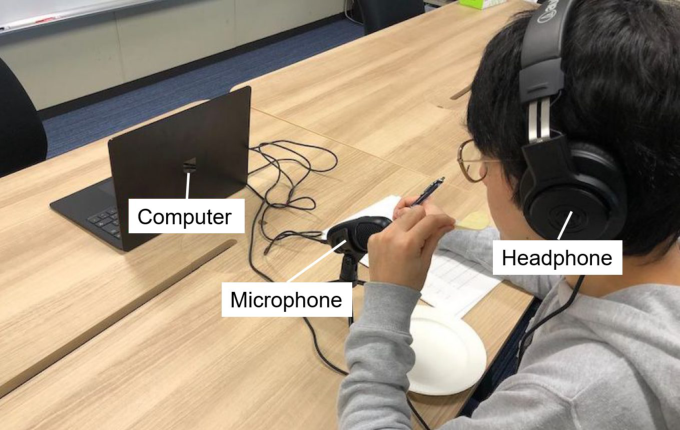
Auditory Presentation This study investigates the effects of auditory presentation on food texture. An experimental setup for auditory presentation is shown in Fig. 1. Partic- ipants wear an over-ear type headphone or an open-ear type earphone to hear air- or bone-conduction sounds, respectively. A microphone in front of a participant digitizes his chewing sound. A laptop computer modulates the sound data by a low-pass filter (LPF) or a high-pass filter (HPF) and outputs the filtered sound to the headphone or earphone. Therefore, participants hear their modulated chewing sounds in this experiment. The cut-off frequency of the LPF and HPF was 2093 Hz. The recording and filtering on the computer were performed by Python 3.11 and pyaudio 0.2.13.
Food Texture and Foods For the evaluation of the effect of the auditory presentation, this study chose three texture descriptors; sakusaku, karikari, and paripari. Their definitions are shown in Table 1. Sound in chewing is dominant in these descriptors. People whose native language is Japanese can explain the difference between them. They also recognized the definitions in Table 1.
Effects of Filtered Air- and Bone-Conduction Sounds’ Presentation 29
Figure 1: Experimental setup.
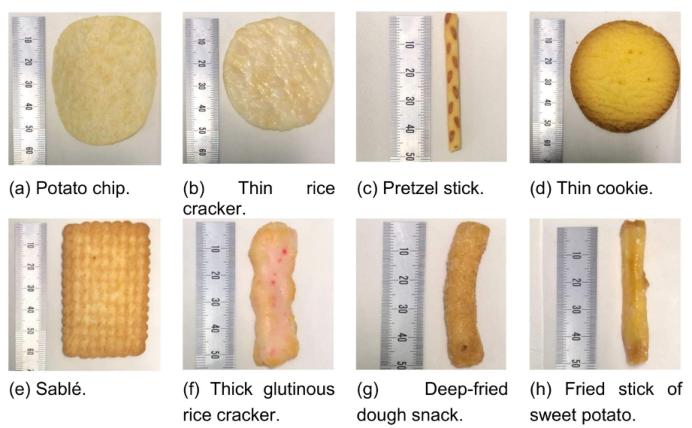
As samples including the food textures of the descriptors, this study chose eight commercially available foods; potato chips (Chipstar, Yamazaki- Biscuits Co., Ltd.), thin rice crackers (Seven premium usuyaki senbei, Hizatsukiseika Co., Ltd.), pretzel sticks (Pretz, Ezaki Glico Co., Ltd.), thin cookies (Moon light, Morinaga Co., Ltd.), sablés (Coconut sablé, Nissin Cisco Co., Ltd.), thick glutinous rice cracker (Teyaki arare, Shinko Seika Co., Ltd.), deep-fried dough snack (White karinto snacks, Natsume Seika Co., Ltd.), and fried stick of sweet potato (Imokenpi, Yokoyama Syokuhin Co., Ltd.). The samples are shown in Fig. 2. They are usually available in Japan. Hence, almost participants are used to eating them.
Table 1. Texture descriptors, their definitions in this study.
Table available in the original PDF paper.
Descriptor Definition Sakusaku Easily broken by biting with a weak force Karikari Short fracture with a relatively strong force in a mastication Paripari Breaking thin foods with a relatively high-frequency sound
Sensory Evaluation Participants were eight students aged 22.9 ± 0.83 (mean ± standard devia- tion, male:female = 7:1). They bit and chewed each sample three times and marked the degrees of the three textures on the visual analog scale which had a scale from 0 to 100. The filter’s conditions of the auditory presentation were three; no filter, high pass, and low pass. The device’s conditions ware two; air and bone conduction. The participants evaluated three times for all conditions. This study was approved by the Ethics Committee of the Kobe
University Graduate School of System Informatics (No. R02-01) in accor- dance with the Helsinki Declaration. Written informed consent was obtained from all study participants. The sensory evaluation results were anonymized and converted into data so that individuals could not be identified. The statistical analysis of the results was carried out using MATLAB (R2022a, Mathworks, Inc, USA).
Figure 2: Snack food samples.
RESULT AND DISCUSSION
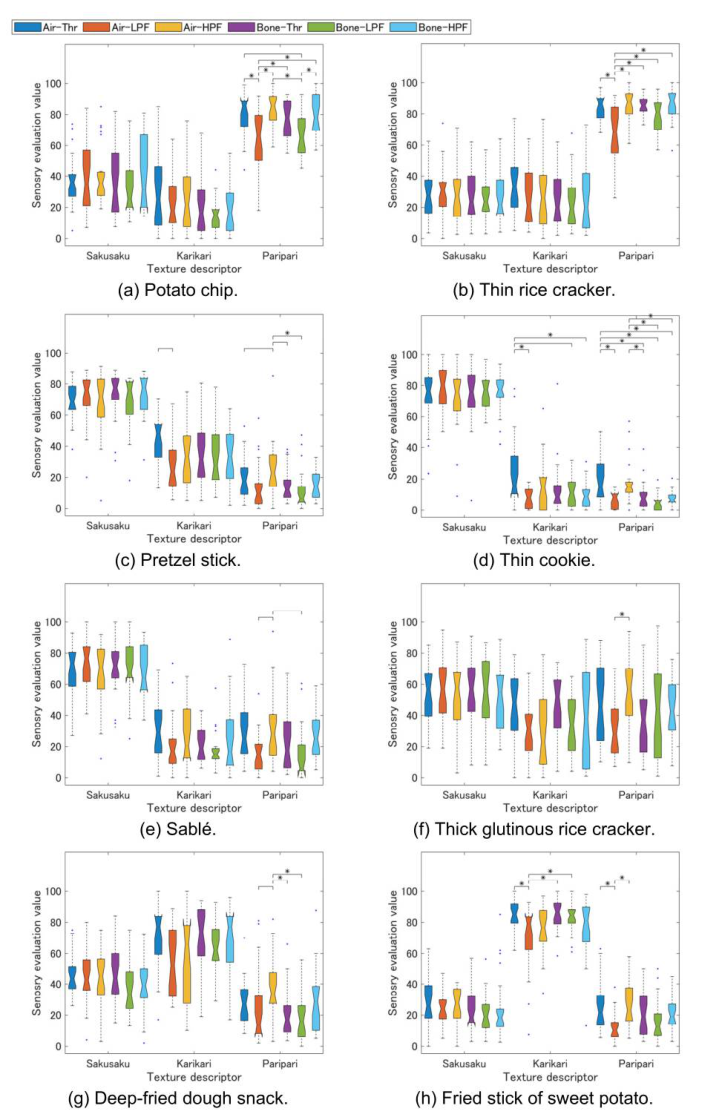
The sensory evaluation results are shown in Fig. 3, which includes signifi- cant differences between two conditions of a texture descriptor calculated by Tukey’s honestly significant difference test. Samples (a) and (b) had higher paripari than the others. Sakusaku was high for samples (c), (d), and (e), and karikari was high for samples (g) and (h). Sample (f) had middle values in the three descriptors.
In the results, sakusaku had no significant difference between the low- pass or high-pass filter and the air- or bone-conduction sound. On the other hand, low-pass filtered sound decreased the evaluation values of karikari and paripari of most samples by the air-conduction sound. These results suggest that sakusaku tends to be influenced by the perception of force than air- and bone-conduction sounds. Although karikari and paripari were affected by both sounds, paripari is more sensitive to the frequency of air- conduction sounds like potato chips and thin rice crackers. The tendency of potato chips’ results is coincident with that of an earlier study (Zampini and Spence, 2004). The effects of the low- and high-pass filters in bone- conduction sound were small. This study used the same cut-off frequency for air- and bone-conduction sounds. In the next step, the filter frequency for bone-conduction sound should be chosen to fit the characteristics of human hearing.
Effects of Filtered Air- and Bone-Conduction Sounds’ Presentation 31
Figure 3: Box plots of eight samples in sensory evaluation. The notch’s center of each box shows the median. The upper and lower lines in each box represent the 75th and 25th percentiles, the maximum and minimum values in the whiskers represent the maximum and minimum values for non-outlier data, and the dots represent outliers. Brackets with and without ‘*’ mean the significant differences of p < 0.01 and p < 0.05 in the texture descriptors, respectively.
CONCLUSION
This study investigated the effects of air- and bone-conduction sounds for the three Japanese descriptors through the experiment with sound devices. In the eight samples used in the experiments, we confirmed that the auditory presentation affected the texture of the thin snacks. It especially weakened Paripari by the low-pass filter.
In future works, we study the effects of different frequencies on food texture.
ACKNOWLEDGMENT
This work was supported by JSPS KAKENHI Grant Number JP20K12026.
REFERENCES
Bourne, M. C. (2002) Food Texture and Viscosity, Concept and Measurement, 2nd edn. Cambridge, Massachusetts: Academic Press. Edmister, J. A., Vickers, Z. M. (1985) “Instrumental Acoustical Measures of
Crispness in Foods”, Journal of Texture Studies. Volume 16. Dacremont, C., Colas, B., & Sauvageot, F. (1991) “Contribution of air-and boneconduction to the creation of sounds perceived during sensory evaluation of foods”, Journal of Texture Studies, Volume 22. Koizumi, N., Tanaka, H., Uema, Y., Inami, M. (2011) “Chewing jockey: aug-
mented food texture by using sound based on the cross-modal effect”, Proceedings of the 8th International Conference on Advances in Computer Entertainment Technology. Luckett, C. R., Seo, H.-S. (2015) “Consumer Attitudes Toward Food Attributes”, Journal of Texture Studies, Volume 46. Matsumoto, N., Matsumoto, A. (1977) “Taste of Food”, Journal of Cookery Science
of Japan, Volume 10, No. 2. Nishinari, K., Hayakawa, F., Xia, C.-F., Huang, L., Meullenet, J.-F., Sieffermann, J.- M. (2008) “Comparative Study of Texture Terms: English, French, Japanese and Chinese”, Journal of Texture Studies, Volume 39. Pellegrino, R, Luckett, C. R. (2020) “Aversive textures and their role in food
rejection”. Journal of Texture Studies, Volume 51. Rohm, H. (1990) “Consumer Awareness of Food Texture in Austria”, Journal of Texture Studies, Volume 21. Spence, C. (2015) “Eating with our ears: assessing the importance of the sounds of
consumption on our perception and enjoyment of multisensory flavour experi- ences”, Flavour, Volume 4. Szczesniak, A. S. (1971) “Consumer awareness of texture and of other food attributes, II”, Journal of Texture Studies, Volume 2. Zampini, M., Spence, C. (2004) “The Role of Auditory Cues in Modulating the
Perceived Crispness and Staleness of Potato Chips”, Journal of Sensory Studies, Volume 19.
LISTED IN THE AHFE DIGITAL BOOKSTORE CATALOGUE
Explore the complete digital volume
Human-Centered Design and User Experience
Read this individual research paper free through the original publisher, or explore the full digital proceedings book.
ISBN 978-1-958651-90-2
Explore this ISBN in the AHFE Bookstore ↗Listed in the July 2026 bookstore catalogue; search by ISBN to confirm current availability · Digital book purchase optional