Dalibor Andrijevic, Tara Kazi, Christopher Thrope (2026). With Pixels & Timber: Application of Mixed Reality for Human-Centered Train Design & Engineering. In: Advances in Human Factors of Transportation. AHFE Open Access, vol. 224, pp. 430–437. https://doi.org/10.54941/ahfe1007871
Modern metro train design projects must balance evolving customer requirements, diverse stakeholder expectations, and the need for early, reliable engineering decisions. Conventional validation methods—document-based analyses, static CAD reviews, and late-stage physical mock‑ups—often reveal design issues too late, resulting in costly redesigns, schedule risks, and inefficient stakeholder involvement. To overcome these challenges, the Siemens Mobility project team developed an award‑winning Mixed Reality (MR) Human Factors (HF) and Customer Experience (CX) testing and validation approach—deployed in the ongoing Sydney Metro – Western Sydney Airport (SM-WSA) project—that merges physical prototyping with immersive Virtual Reality (VR) environments. The approach employs cost‑effective wooden or 3D‑printed structures augmented with a high-end Virtual Reality (VR) visualisation, enabling MR-based interactive evaluation of the train interior's user facing elements. This setup allowed rapid exploration of dozens of design variants and enabled evidence‑based design engineering decision making significantly earlier in the project. The method proved particularly effective for pre-validating a few design areas, such as stopping‑marker positioning, inclusivity & accessibility, and design options such as seat fabrics or headrests.The MR‑driven review workflow, combined with user performance- and behaviour-based system tests, demonstrated measurable benefits. First, evidence‑based Human Factors engineering became possible through precise spatial assessments using integrated haptic and visual feedback, enabling more confident design assurance and acceptance. Second, co‑creation and collaboration improved through intuitive, immersive engagements with train operators, accessibility committees, and end users, aligning with ISO 9241‑110 principles for human‑centred design. These sessions enhanced understanding, consensus-building, safety and engineering assurance and overall CX validation. Third, risk reduction and early design freeze were achieved by resolving issues before the high‑fidelity mock‑up stage, reducing Non‑Compliance Costs (NCCs), and preventing downstream costs from schedule disruptions.
Designing modern metro trains sometimes involves high complexity, open- loop customer technical specifications, early design-freeze pressure, and Received March 25, 2026; Revised April 29, 2026; Accepted May 14, 2026; Available online July 20, 2026
With Pixels & Timber: Application of Mixed Reality for Human-Centred Train 431 diverse user and stakeholder needs. Traditional processes often surface issues too late, causing NCCs and schedule risks. For the SM-WSA project, physical prototypes were combined with immersive Virtual Reality (VR) environments to form visuo-haptic MR for the HF engineering and CX design to evaluate the train’s design early. This facilitated rapid exploration of design variants, and enabled to validate compliance with anthropometric, usability, safety, and accessibility requirements before the high-fidelity mock-up manufacturing which is aligned very closely to the final design engineering freeze.
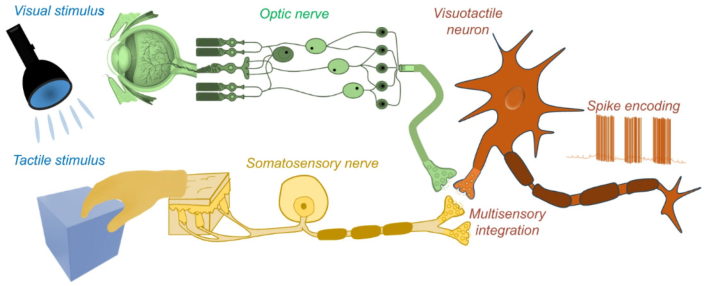
The rationale of applying visuo-haptic MR is that the human nervous system integrates visual and haptic cues in a statistically optimal fashion: it fuses time-contingent spatially precise visual data with its proprioceptive haptic confirmation using Bayesian-like weighting of both sensorimotor inputs (see Figure 1).
Figure 1: Schematic representation of multisensory integration of visual and tactile information within the nervous system (from Sadaf et al., 2023).
The sensory alignment of physical affordances—edges, windows, doors openings, handholds, seats—with the virtual content—surface colours, lighting, ambience, information screens, indicators—results in seamless interactive experience with naturally lower cognitive load in the users with whom to test the designs (Jerald, 2016). This enables ecologically valid assessments of reach, sightlines, legibility, and human behaviour – essential aspects for the design of a human-centred train. Thus, multisensory integration underpins the suitability of the MR approach to make earlier, more reliable engineering decisions.
The SM-WSA Human Factors Integration and the Customer Experience Design Programs were prepared early in the project by considering requirements from standards, such as ISO 9241-110 and -210, ISO 11226, AS 7470, AS 7533, including the Australian Disability Standard for Accessible Public Transport. Often, train design workflows defer high-fidelity physical mock-ups to late phases to alignment with the design engineering schedule to maximize the fidelity of the testable design progress. This goes at the expense of limited design impact of user feedback performed at that late stage with the real train’s user touchpoints. For SM-WSA, different mock-ups were required per specification for the three Design Stages (DSs) to support timely HF
integration since the train type was going to have novel features for Sydney Metro, such as mixed seating type. Among the factors for the late impact limitation are the frozen engineering inputs to the supply chain which faces challenges to change train hardware so close to manufacturing, assembly and installation. MR closes this gap by enabling early high-quality visibility of potential equipment integration and user-based issues. By doing so, normal and safe as well as abnormal operational scenario rehearsal becomes possible, rapid variant switching in the digital-virtual representation. Also, co-creation and feedback gathering across engineering teams become possible, with the customer, the operator and maintainer, the accessibility stakeholders and the end users, the passengers.
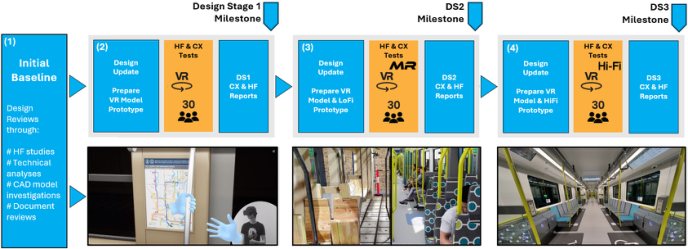
GENERAL METHODOLOGY AND THE TESTING CYCLE (1) The initial baseline during Design Stage 1 (DS1) was set by pre-verifying the design of the Driver-Machine Interface (DMI), the seat arrangement and the user touchpoints (e.g. Help Point [HP], Passenger Information Displays [PIDs] etc.) in the train interior through interdisciplinary design reviews (based on Creo Parametric Visualizations) and digital human modelling (Siemens Tecnomatix “Jack & Jill”). One of the criteria was for example the design suitability against anthropometric envelopes for reachability and for the visibility of passenger and user touch points.
Figure 2: Overall project HF & CX test and review process; MR setup deployed during DS2. (2) The resulting confirmed and pre-verified geometric space was utilized to create a visually compelling, real-time interactive and immersive 3D application via the Unreal Engine which stood as the project’s anchor for train visualization across the engineering teams (see Figure 2, left). A “Vive Focus 3” Head-Mounted Display (HMD) was utilized to present the immersive train environment.
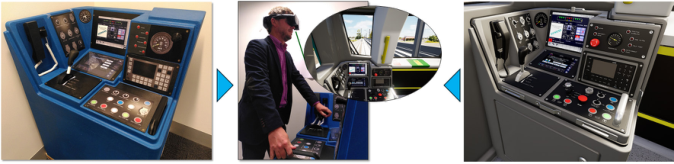
(3) After the VR-based design review, the train model has been updated for DS2 and served as the reference configuration for the MR testing setup. Here, the VR model was perceptually aligned with physical low-fidelity mock-ups – the saloon: manufactured from wood and metal, the DMI: from Styrofoam – to complete the “hybrid” MR mock-up (see Figure 2, middle and
Figure 3, middle). The approach served as the test bed for the pre-validation for the reach, visibility and usability of user-facing elements. MR enabled variant toggling for the following user touchpoints, among others:
Seat headrest presence
Help Point variants
Flip-up seat configuration
Platform Screen Door, incl. Emergency Door
Seat fabrics options.
This enabled evidence-based decisions much earlier in the train lifecycle. (4) Subsequently, for the DS3, high-fidelity mock-up was deployed to confirm the results from the MR based testing. During each Design Stage, HF & CX issues were logged, reviewed in interdisciplinary working groups and solutions – formulated as derived design requirements – were implemented by the engineering teams (see Figure 2).
In each HF & CX testing phase, users were recruited – for saloon review: n = 30, for DMI review: n = 8 – and stakeholders were involved included Train Operators (TOs), maintainers, and accessibility representatives.
MIXED-REALITY-BASED HF & CX TESTING In this section we present the two areas in which the MR setup was deployed with a measurable impact on project development: the DMI and the passenger saloon. With MR, these two train design areas achieved advanced HF & CX verification and validation status quite early in the project.
Case A – Driver-Machine Interface The SM-WSA train is a driverless vehicle (GoA4) which under specific circumstances requires a human as the TO for reaching specific functions and goal states (such as the morning preparation for daily operation or train breakdown). The DMI enables a TO to assume control over the train.
The user touchpoints for the MR DMI were assessed with n = 8 users in MR. These include the usability of the Master Controller (MC), the visibility, reachability and usability of the train controls (buttons and gauges, i.e. speed and brake pressure), such as the Train Control Management System display, the ergonomics of the safe holding options and the handset (telephone) ergonomics.
Figure 3: Illustration of how physical (left) and virtual (right) models enable multimodal experience operating the DMI (middle).
For the DMI the overall ergonomics based on Australian Anthropometrics was assessed. For instance, the original DMI baseplate height for the main control elements (buttons and the MC) prompted posture concerns. MR-guided testing iterations established a higher positioning, balancing sightlines through the window, the reachability, and the adjacent emergency-door geometry. At the same time, to accommodate the plate height to as many users as possible, Ovako Working Posture Analysis scores indicated 10° trunk flexion acceptable for ~73% of the population, while 20° flexion for the tallest users remained acceptable due the limited exposure of less than 30 min of train operation. For the MC geometry and interaction, the MR testing helped to haptically optimize towards symmetric angular displacement of the motoring/braking position of the MC lever to be clearly distinguishable from the emergency brake position via haptic notches. Wrist angles stayed within comfort ranges for motoring/braking actions and the ergonomically suitable vigilance device push down forces were confirmed for both, the initial pressing to start driving as well as for the sustained pressing during driving, rendering the MC system early in the project fit for end users.
Case B – Passenger Saloon The design of the passenger saloon was developed with a strong emphasis on ergonomic suitability, HF best practice, and compliance with customer and regulatory requirements. Evaluation activities focused on ensuring that the saloon environment accommodates the Australian target user population from 5th-percentile females to 95th-percentile males.
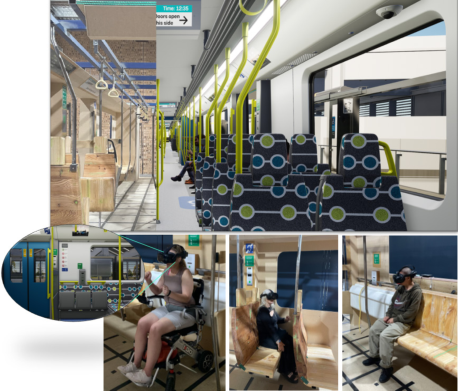
Key user touchpoints were assessed with n = 30 users in MR. These include the HP, the visibility and legibility of the PIDs from varying viewing locations, and the passenger seating along with circulation spaces for safe and efficient movement; also, multipurpose areas intended for the storage of luggage, prams, and bicycles (see Figure 4).
Figure 4: Passenger Saloon of physical (upper left) and virtual (upper right) models, when fused (lower row), enable multimodal, ecologically valid passenger testing experience.
With Pixels & Timber: Application of Mixed Reality for Human-Centred Train 435 Special attention was given to wheelchair-accessible spaces and the Platform–Train Interface to confirm conformity with Australian accessibility standards and to provide an inclusive experience for passengers with reduced mobility.
The MR approach unlocked early design validation of the spatial location of the PIDs and the layout of the user interface content by user-checking the identifiability and the legibility of the content information. Minimum acceptance was achieved across challenging positions while providing to the CX team, who drafted the style guide, early information about acceptable font sizes and colour contrasts between fonts and backgrounds.
For the handhold options (e.g. 3 strap hanger types) pre-validation and the circulation areas, such as wheelchair space and multipurpose area, was performed with reachability heat maps guiding placement of the grab points. Furthermore, stakeholder reviews facilitated elimination of head-strike risk via redesigned grab pole terminals. Draught screen height in the wheelchair and multipurpose areas was determined and the geometrical interfaces to the seats were improved.
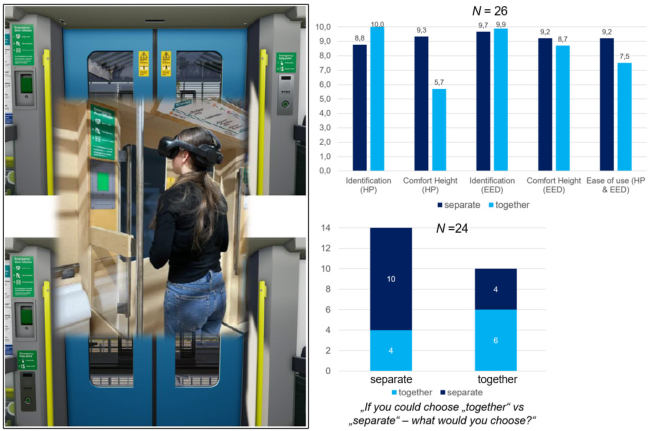
Two Help Point variants were subject to evaluation due to conflicting goals from the customer requirement specification (Figure 5): variant A (“separate” – HP in the right, Emergency Egress Device [EED] in the left door pillar) versus variant B (“together” – HP and EED on left door pillar). The differences in the outcome of key performance criteria – identification, reach comfort and usability – determined that variant A was superior to variant B.
Figure 5: Illustration of how the physical HP options, variant A – HP & EED on “separate” door pillars vs variant B “together” on the left door pillar, which were fused with the VR model enabling conclusive performance-based as well as preference-based design testing.
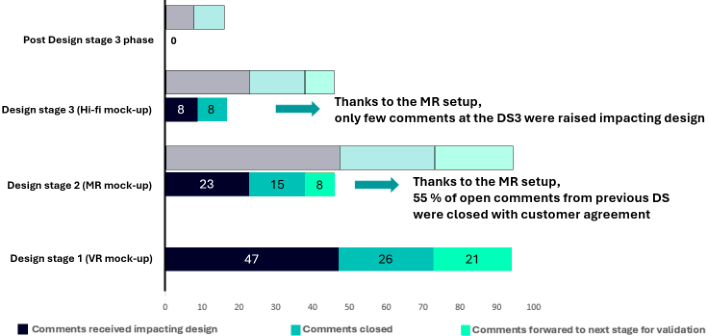
HF & CX ISSUE LOG AND THE PROGRAM-LEVEL IMPACT Open Points (OPs) covered throughout the design stages included, among others, potential lighting/glare, stopping-marker visibility, and DMI posture and control interfaces issues; space trade-offs for HP/EED locations, entrapment, luggage storage, and bike storage (Figure 6). MR expedited closure by enabling realistic rehearsals and rapid design comparison already in DS2. Items beyond the train scope (e.g., final station stopping-marker placement) were transferred to multi-disciplinary teams for resolution. All critical user-safety and accessibility issues were addressed prior to DS3 completion.
The MR HF & CX approach avoided significant NCCs, reduced rework by front-loading decisions, enabled earlier design freezes, and lowered schedule risk. Stakeholder satisfaction increased via immersive co-creation, with the MR setup serving as a framework for common understanding of the train’s design. The project document submissions benefited from clear traceability of the issues (HF & CX issue log closures). As indicated in pale colours in Figure 6, hypothetical late identification of HF & CX issues – assuming their emerging in the high-fidelity mock-up, without the MR setting – would have deferred hardware design changes to the post-design project phase. This would have significantly impacted delivery schedule with sensitive and potentially difficult project trade-off between accepting the significant cost overruns for the changes or leaving user-misaligned design as-is to align with the project and supply chain schedules.
Figure 6: OP backlog across the project’s design stages (note the single digit number of claims in DS3); transparent shaded colours: hypothetical OPs, if HF & CX tests would have been executed later, indicating costly delayed design freeze and manufacturing.
CONCLUSION & OUTLOOK By integrating physical-haptic inputs with high-end virtual visual content and grounding the approach in multisensory fusion theory, MR not only elevated the reliability and timeliness of HF and CX evidence delivery in
With Pixels & Timber: Application of Mixed Reality for Human-Centred Train 437 the SMWSA project; it also exhibited one of its central merits: while HF and CX work programs are often executed separately in projects, MR enabled seamless collaboration between these two, all while being embedded in a blend of human-centred review and mock-up approaches supporting different outcomes at different stages of the SM-WSA project. The method reduced dependency on early physical samples, reduced NCCs and rework, accelerated design freezes and improved design acceptance.
Of wider industrial relevance, MR offers a blueprint for human-centred design reviews and continuous lifecycle V&V in Digital Twin workflows – digital systems emulating exactly the behaviours of their physical counterparts (“twins”). It is a repeatable and scalable capability for human-centred railway engineering and intuitive stakeholder communication. Further emerging directions include cross-system MR collaboration, for instance operation with Platform Screen Doors, stations infrastructure, depot-integrated vehicle maintenance and virtual training. The real-time spatial co-creation and HF verification can be extended to other Siemens Mobility platforms (high-speed and commuter trains), and it may be deployed for the V&V of Siemens Industrial Metaverse environments where factories, machinery and production processes can be tested before they are physically developed and deployed.
ACKNOWLEDGMENT
The authors thank the Siemens Mobility Metro project team, Sydney Metro Human Factors, Customer Experience and the wider project team, Atlantic Design Ltd. for the provision of the virtual model and industrial design support, Buro North for the extensive on-site testing execution support and comprehensive CX reporting, TO representatives from the RATP Group, accessibility advisory groups, and customer stakeholders for their contributions and insights throughout the testing and design process.
REFERENCES
AS 7470 — Human Factors Integration in Engineering Design. AS 7533 — Australian standard for ergonomics/rail contexts. Dreyfuss, H. The Measure of Man and Woman: Human Factors in Design. DSAPT 2002 — Disability Standards for Accessible Public Transport (Australia). ISO 11226 — Ergonomics. Evaluation of static working postures. ISO 9241-110 — Ergonomics of human-system interaction. Dialogue principles. ISO 9241-210 — Human-centred design for interactive systems. Jerald Jason (2016): The VR Book – Human-Centered Design for Virtual Reality; ACM | Morgan & Claypool. Marc O. Ernst & Martin S. Banks (2002): Humans integrate visual and haptic
information in a statistically optimal fashion, Nature Volume 415, pages 429–433 (2002). Muhtasim Ul Karim Sadaf, Najam U Sakib, Andrew Pannone, Harikrishnan Ravichandran & Saptarshi Das: A bio-inspired visuotactile neuron for multisensory integration, Nature Communications, Volume 14, Article number: 5729 (2023). SM-17-00000045 Sydney Metro Human Factors Integration Standard. TS 04977:01 Human Factors Integration- Rolling Stock. TS 04978:01 Human Factors Integration General Requirements.
LISTED IN THE AHFE DIGITAL BOOKSTORE CATALOGUE
Explore the complete digital volume
Advances in Human Factors of Transportation
Read this individual research paper free through the original publisher, or explore the full digital proceedings book.
ISBN 979-8-950676-00-0
Explore this ISBN in the AHFE Bookstore ↗Listed in the July 2026 bookstore catalogue; search by ISBN to confirm current availability · Digital book purchase optional