Dimitrios Ziakkas, Debra Henneberry (2024). The Challenges of the Implementation of Artificial Intelligence (AI) in Transportation. In: Advances in Human Factors of Transportation. AHFE Open Access, vol. 148, pp. 58–65. https://doi.org/10.54941/ahfe1005195
The implementation of Artificial Intelligence (AI) into transportation systems signifies a fundamental change that holds the potential to improve overall sustainability, safety, and efficiency. However, this transformation is not without its challenges, particularly concerning human factors and ergonomics. Firstly, the ergonomic integration of AI systems in transportation requires careful consideration of human-AI interaction. Unlike traditional systems, AI-driven technologies often involve complex algorithms that are not inherently intuitive to human operators. This complexity can lead to a disconnect between how the system operates and how users understand it. For instance, in autonomous vehicles, drivers may be required to take control in certain scenarios. The ergonomic challenge here lies in ensuring that the transition between AI and human control is seamless and that the user is adequately informed and prepared to take over. Another significant challenge is addressing the variability in human behavior and expectations. AI systems, designed based on standard models of behavior, may not adequately account for the wide range of human responses and interactions. This gap can lead to scenarios where AI systems behave in unexpected or counterintuitive ways to human users, potentially causing confusion and reducing the overall efficiency and safety of the transportation system. CAE Advanced Air Mobility (AAM) research case study focuses on the implementation and certification of AAM in the FAA/EASA environment.The reliability and trustworthiness of AI systems also pose a major ergonomic challenge. To fully integrate AI into transportation, users must trust these systems. This trust depends on the transparency and explainability of AI decision-making processes. Nevertheless, numerous AI algorithms, especially those rooted in deep learning, are frequently regarded as 'black boxes' owing to their intricacy and absence of interpretability. Developing AI systems that are both advanced and transparent is a significant hurdle that needs to be addressed.Data privacy and security are also paramount concerns. AI systems in transportation rely heavily on data, including personal and sensitive information. Ensuring the privacy and security of this data while utilizing it for AI processes is a complex challenge, requiring robust encryption methods and strict data handling policies. Moreover, the ergonomic aspect involves designing systems that not only protect data but also respect user privacy preferences and norms.The implementation of AI in transportation is a multifaceted challenge, requiring a holistic approach that considers human factors and ergonomics. As we move towards more AI-integrated transportation systems, it is essential to address these challenges through interdisciplinary research, collaboration, and a user-centered design approach.
The Challenges of the Implementation of Artificial Intelligence (AI) in Transportation 59
INTRODUCTION
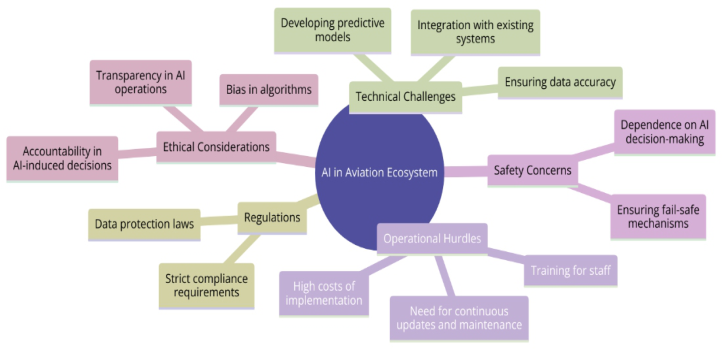
Human Factors Engineering commences with system conceptualization and concludes with system disposal by recognizing the necessity for compre- hensive integration of human capabilities (cognitive, physical, sensory, and team dynamics) into system design (Ziakkas et al., 2023). AI’s role in aviation ranges from predictive maintenance using machine learning algo- rithms to improving air traffic management and flight training/operations through advanced data analytics. The transition to AI-driven systems is in its early stages but shows promise for a transformative impact on the aviation ecosystem globally (Figure 1).
Figure 1: Domains of AI integration in the aviation ecosystem.
AI technologies are pivotal in aviation safety. They monitor aircraft systems and analyze data from various sources to identify and mitigate potential hazards. AI optimizes flight schedules, crew scheduling, and maintenance in operations, contributing to cost reduction and efficiency enhancement. The Federal Aviation Administration (FAA) and the European Union Aviation Safety Agency (EASA) are exploring AI for flight train- ing, operations, air traffic control, and other operational improvements (EASA, 2023a).
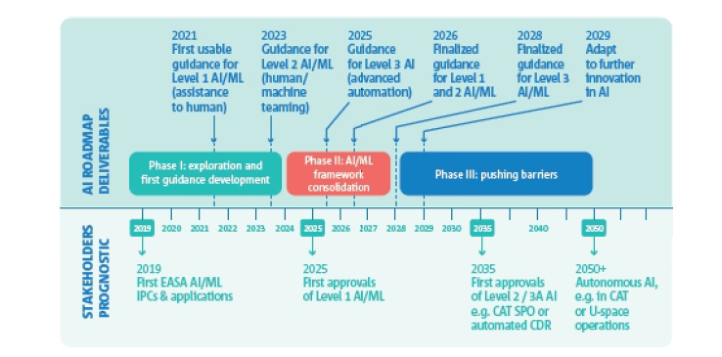
Moreover, the Human-Centric approach to AI in aviation, emphasized by EASA’s AI Roadmap 2.0, focuses on integrating AI technologies while ensuring human operators remain at the core of decision-making. The approach addresses the ethical, regulatory, and trust-related challenges in AI implementation. It recognizes the indispensable role of human oper- ators in complex decision-making, emotional intelligence, adaptability, and ethical reasoning, areas where AI cannot replace human judgment (EASA, 2023b).
Figure 2: EASA AI roadmap (EASA, 2023b).
The scope of AI in aviation encompasses various techniques, including machine learning, deep learning, logic- and knowledge-based approaches, and traditional statistical methods. These AI techniques enhance training, flight planning, navigation, and operational control. In order to ensure safety, system performance, and public trust during the transition to AI-driven sys- tems, it is important to adopt a balanced and human-centered approach, despite the potential for automation (ICAO, 2015).
AI integration in aviation promises numerous benefits, including improved safety through predictive maintenance and hazard prediction, increased oper- ational efficiency by optimizing flight paths and maintenance operations, and an enhanced passenger experience through personalized services and real-time assistance (Kaber, 2021).
METHODOLOGY
The Purdue research project aims to assess the impact of Artificial Intel- ligence in Aviation through the utilization of qualitative and quantita- tive methodologies. This study uses an inductive research methodology to explore the implementation of human-centered design utilizing AI. The research teams at Purdue – Coventry Universities examine the impact of human-centered design and artificial intelligence on the aviation environ- ment following a lean / 6sigma approach. This approach enables the cost- effective and streamlined incorporation of artificial intelligence into the transportation industry. Figure 3 illustrates the utilization of artificial intel- ligence (AI) in the aviation ecosystem, using the concept of the Research Onion proposed by Saunders (2019). Yin (2014) contends that concen- trating on a singular research setting encompassing several facets, referred to as AI, might result in efficient problem-solving and the production of specialized insights that are customized to the particular operational structure.
The Challenges of the Implementation of Artificial Intelligence (AI) in Transportation 61
Figure 3: Research methodology presentation.
The following analysis - findings sections present the creation of AI inte- gration tools and the identified challenges. It focuses on the reviewed and analyzed methods, approaches and challenges involved and supported by significant academic research and industry reports from January 2018 to February 2023 (Ziakkas et al., 2023a).
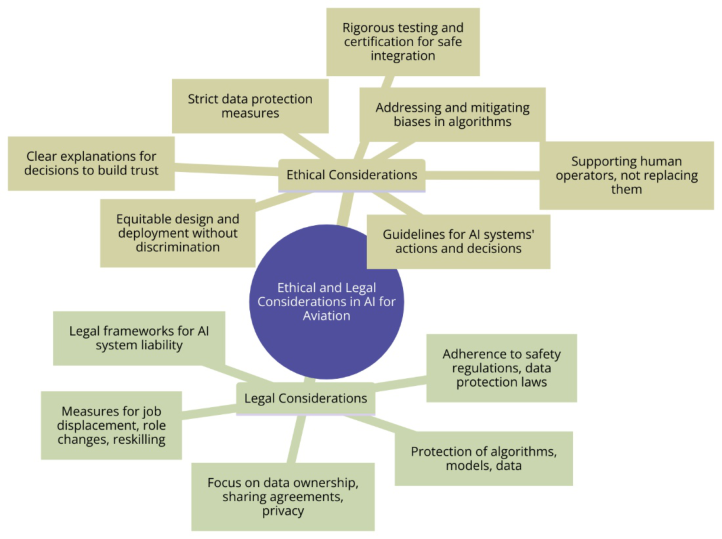
ANALYSIS Implementing Artificial Intelligence (AI) in aviation involves critical ethical and legal considerations to ensure AI systems’ responsible and ethical use. The following identified considerations revolve around safety, transparency, biases, fairness, accountability, data privacy, human autonomy, regulation compliance, liability, intellectual property, data governance, and employment implications.
Ethical Considerations
1. Safety: AI systems in aviation must undergo rigorous testing and cer- tification to minimize risks and ensure safe integration into aviation operations. 2. Transparency and Explainability: AI systems should be transparent and provide clear explanations for their decisions to build trust among users. 3. Biases: Addressing and mitigating biases in AI algorithms is crucial to ensuring fair treatment and equal opportunities within the aviation ecosystem. 4. Fairness: AI systems must be designed and deployed equitably, without discrimination based on race, gender, or nationality. 5. Accountability: Clear guidelines and regulations are needed to establish who is accountable for AI systems’ actions and decisions. 6. Data Privacy: Strict data protection measures must be in place to respect privacy rights and comply with data protection regulations. 7. Human Autonomy and Responsibility: AI systems should support human operators, not replace their decision-making authority.
Legal Considerations
1. Compliance with Regulations: AI in aviation must adhere to aviation safety regulations, data protection laws, and other legal requirements. 2. Liability and Responsibility: Legal frameworks should define liability and responsibility among AI system manufacturers, operators, and regulators.
3. Intellectual Property: Legal considerations should address the protection of proprietary algorithms, models, or data involved in AI systems. 4. Data Governance: Responsible data practices are essential, focusing on data ownership, sharing agreements, and data privacy. 5. Employment and Workforce Considerations: AI’s impact on the work- force necessitates measures to address job displacement, role changes, and reskilling.
These considerations are crucial for ensuring safety, building trust and pub- lic perception, avoiding biases, ensuring legal compliance, protecting privacy and data, maintaining human control, and considering the societal impact. Ethical and legal frameworks guide AI’s responsible development and deploy- ment, promoting trust, mitigating risks, and ensuring that AI contributes positively to the aviation industry.
International and regional regulations, such as those from the International Civil Aviation Organization (ICAO), General Data Protection Regulation (GDPR), national data protection laws, and national aviation regulations, provide a legal structure for AI in aviation. These frameworks address data privacy, security, intellectual property, and compliance, ensuring AI systems are developed and operated within legal boundaries (Ziakkas et al., 2023b).
Figure 4 presents the identified ethical and legal consideration of the implementation of AI in the aviation ecosystem.
Figure 4: Ethical and legal considerations presentation.
The Challenges of the Implementation of Artificial Intelligence (AI) in Transportation 63
FINDINGS CAE existing study focusing on Advanced Air Mobility (AAM) utilizes AI in several innovative ways (CAE, 2021). AI Adaptive Learning and Train- ing Analytics Platforms are crucial for personalizing training programs by tracking individual and cohort performance. This system improves training quality and anticipates future needs efficiently and objectively. Flight simula- tion data and biometric and psychometric data are essential for AI systems to assess pilots’ performance and enable adaptive training. These advancements are expected to evolve from crew assistance developments to human/machine collaboration, eventually leading to autonomous systems.
Purdue – Coventry – CAE research team initial findings focuses on the following areas (Ziakkas et al., 2023c):
AI Adaptive Learning and Training Analytics: AI-based adaptive learning offers personalized learning paths, enhanc- ing the training experience. Learning ecosystems incorporate various platforms and systems, ensuring a comprehensive learning environment. This includes a wide variety from academic completion to immersive envi- ronments, ensuring a tailored and efficient training program. AI-driven adaptive flight training orchestrates learning sequences and recommends optimal educational content delivery based on individual learning styles and activity patterns.
Behavioral and Cognitive Techniques: The aviation industry is exploring new training methods to improve pilot training efficiency. Competency-Based Training and Assessment (CBTA) and the Threat & Error Management (TEM) framework focus on understanding and leveraging pilot behavior to enhance training quality. AI integrates various models from rich data sources to provide auto- matic assessment and system adaptation, optimizing training sessions and decision-making.
Pilot Profile and Biometry Data Analysis: A comprehensive pilot profile, built from various data sources, enables personalized training and advanced insights into the learning experi- ence. Neuroscience and biometric data analysis objectively measure key pilot characteristics, supporting competency-based training approaches. AI models assist in understanding pilot behaviors, enhancing safety, and training quality.
AI Optimization of Training Operations: AI optimizes training operations by predicting schedule modifications, enabling proactive resource management. This leads to cost reductions and increased business revenue. AI also plays a crucial role in simulator predictive maintenance, reducing downtime and maintenance costs.
Immersive Environment and Closed-Loop Flight Training: AI advancements are revolutionizing immersive flight training through natural language processing and reinforcement learning. Closed-loop adaptive training dynamically adjusts the curriculum based on compre- hensive data analytics, aiming for continuous improvement in training and
operations. This approach aligns with the competency framework of vari- ous training programs and enhances the automation of the flight training process.
Advanced Air Mobility and Airline Operations: AAM is expected to generate a significant demand for pilots, necessi- tating efficient training methods. AI contributes to intelligent and scalable air traffic control solutions, considering environmental impact, safety, and public acceptance. AI also finds applications in airline operations, improv- ing quality and efficiency through trajectory-based operations, pricing strategies, and crew management.
A high-level presentation of the literature review findings is depicted in the following table (Table 1).
Table 1. Literature review findings overview.
Table available in the original PDF paper.
AI Application in Aviation Organizations Application Area Predictive Maintenance Airbus, Boeing, GE Aviation Flight Operations
Dynamic Flight Pricing Amadeus, Sabre Customer Service Chatbots and Virtual Assistants Qatar Airways, Turkish Airlines, Lufthansa, Delta Airlines, KLM Personalized Travel Experience Qantas, United Airlines
Security and Surveillance NEC, AnyVision Airport Operations Baggage Handling SITA, Vanderlande
Air Traffic Control (ATC) Optimization NATS, Raytheon Traffic Management Airport Ground Operations Gategroup, Swissport
Flight Risk Assessment Airbus Safety and Compliance Regulatory Compliance Monitoring IBM, SAS
Roster Scheduling CrewFacts, Jeppesen Crew Management and Training
VR-Based Training CAE,VRPilot Autonomous Flight Systems EHang, Joby Aviation Advanced Air Mobility
Traffic Management for UAM AirMap, Unifly Predictive Maintenance for eVTOLs Lilium,Vertical Aerospace
This table provides an overview of the various uses of AI in the aviation industry, emphasizing the revolutionary potential of these technologies.
The Challenges of the Implementation of Artificial Intelligence (AI) in Transportation 65
CONCLUSION
Ethical and legal considerations are fundamental to the responsible imple- mentation of AI in aviation. Addressing these considerations ensures AI sys- tems’ safety, fairness, transparency, and compliance, contributing positively to the aviation industry. Collaborative efforts among industry stakehold- ers are essential to navigate these challenges and responsibly harness AI’s potential benefits.
ACKNOWLEDGMENT
The authors thank faculty members of Purdue University and Coventry University, for their invaluable feedback contributing to this work.
REFERENCES
CAE. (2021). Pilot Training for Advanced Air Mobility. EASA. (2023a). Artificial Intelligence Roadmap 2.0: Human-centric approach to AI in aviation. EASA. (2023b). EASA Concept Paper: guidance for Level 1 & 2 machine learning
applications Proposed Issue 02. International Civil Aviation Organization (ICAO). (2015). Manual of criteria for the qualification of flight simulation training devices: Volume I - Aeroplanes (Doc 9625) (4th ed.). https://store.icao.int/en/manual-of-criteria-for-the-qualification -of-flight-simulation-training-devices-volume-i-aeroplanes-9625-1 Kaber, D. B., and Boy, G. A. (2011). Advances in cognitive ergonomics. CRC
Press/Taylor & Francis. Saunders, M., Lewis, P., & Thornhill, A. (2019). Research Methods for Business Students Eighth Edition. In Research Methods for Business Students. Pearson Education Limited. Yin, R. K. (2014). The case study handbook: A practical guide for practitioners,
researchers, and students. (6th ed.). Sage Publications. Ziakkas, D., Pechlivanis, K., and Keller, J. (2023a). The implementation of Artificial Intelligence (AI) in aviation collegiate education: A simple to complex approach. Intelligent Human Systems Integration (IHSI 2023): Integrating Peo- ple and Intelligent Systems, AHFE Open Access, 69. AHFE International, USA. https://doi.org/10.54941/ahfe1002863 Ziakkas, D., Sarikaya, I., and Natakusuma, H. C. (2023b). EBT-CBTA in aviation
training: The Turkish Airlines case study. Engineering Psychology and Cognitive Ergonomics: HCII 2023 Lecture Notes in Computer Science, 14018, 188–199. https://doi.org/10.1007/978-3-031-35389-5_14 Ziakkas, D., and Vink, L.-S. (Eds.). (2023c). Implementation guide for artificial intelligence in aviation: A human-centric guide for practitioners and organizations.
LISTED IN THE AHFE DIGITAL BOOKSTORE CATALOGUE
Explore the complete digital volume
Advances in Human Factors of Transportation
Read this individual research paper free through the original publisher, or explore the full digital proceedings book.
ISBN 978-1-964867-24-3
Explore this ISBN in the AHFE Bookstore ↗Listed in the July 2026 bookstore catalogue; search by ISBN to confirm current availability · Digital book purchase optional