Dimitrios Ziakkas, Marc St-hilaire, Konstantinos Pechlivanis (2024). The role of digital twins in the certification of the Advanced Air Mobility (AAM) systems. In: Intelligent Human Systems Integration (IHSI 2024): Integrating People and Intelligent Systems. AHFE Open Access, vol. 119, pp. 476–486. https://doi.org/10.54941/ahfe1004512
AAM (Advanced Air Mobility) is an emerging field in aviation that concentrates on developing AAM/electric vertical takeoff and landing (eVTOL) aircraft for urban air mobility. AAM can use human-centered design to provide an advanced emerging environment of the eVTOL aircraft and its operating environment, allowing for a more efficient and cost-effective development process – concentrating on human factors/ergonomics, training, certification, and qualification. According to the EASA Artificial Intelligence Roadmap (EASA, 2023a), industrial actors expect the first crew assistance/augmentation developments in 2022–2025. Automation will gradually ramp up to human/machine collaboration between 2025 and 2030, culminating with human supervision or fully autonomous systems the year 2035 after. To achieve those milestones, the EASA guidance for Machine Learning proposal (EASA, 2023b) for Level 1 Artificial Intelligence (assisting humans) and Level 2 Artificial Intelligence (human-machine collaboration) aims to proactively address forthcoming EASA guidelines and safety standards about machine learning (ML) applications with safety implications. It guides applicants who incorporate AI/ML technologies into systems designed for safety or environmental purposes.Moreover, it provides guidelines covering the following building blocks that lead to Trustworthy AI: AI Trustworthiness Analysis, AI Assurance, Human Factors for AI, and AI Safety Risk Mitigation. CAE - Purdue proposes a research case study for digital twins in AAM that targets designing and remote testing prototypes - eVTOL aircraft simulator devices. By creating a digital twin of the AAM flying/simulator device, designers (Purdue Human Factors team – CAE network) and Subject Matter Experts (SMEs) aim to test different configurations and scenarios. This allows the research team to identify human factor – certification challenges before building the physical prototype. The Artificial Intelligence (AI) research roadmap of the Purdue School of Aviation and Transportation Technology (SATT) focuses on the potential to increase the effectiveness and efficiency of AAM design by providing a realistic and immersive experience (lean process for training/certification, transition to A.I. - AAM environment). In addition, this study concentrates on mitigating residual risk in the 'AI black box.' The Artificial Intelligence (AI) certification outcomes and learning assurance challenges were analyzed and evaluated.
The Role of Digital Twins in the Certification of the Advanced Air Mobility (AAM) Systems 477
INTRODUCTION
A digital twin is a virtual representation or replica of a physical object, sys- tem, or process. It encompasses not only the object’s geometric shape but also its behavior, performance, and attributes. Creating a digital twin enables real-time monitoring, analysis, and simulation of the physical counterpart to improve its design, operation, and maintenance (Borole et al., 2023).
Critical characteristics of digital twins include:
1. Real-time Data: The digital twins are connected to sensors and data sources in the physical object or system, allowing them to receive real-time data, just as the physical object does. 2. Simulation: Digital twins can simulate the behavior and performance of the physical object under various conditions. This helps in testing, optimization, and decision-making. 3. Data Analysis: They use analytics and algorithms to process and analyze data, providing insights and predictions about the physical twin. 4. Control and Monitoring: Digital twins can control or monitor their phys- ical counterparts. For instance, in the context of manufacturing, a digital twin can optimize a production process in real-time. 5. Historical Data: They store historical data, which can be used for trend analysis, performance improvements, and maintenance predictions.
Digital twins are applied in various fields, including manufacturing, health- care, transportation, and aerospace, to improve efficiency, safety, and decision-making. The concept of digital twins is closely related to the Internet of Things (IoT), as the data from physical objects and systems are typi- cally collected and transmitted through IoT sensors and devices to create and update the digital twin (Mark Asch, 2022; Shackelford, 2020). The development and application of digital twins continue to grow as technology advances and as they prove valuable in enhancing performance and reducing costs in various industries.
The topic of discussion pertains to AAM certification challenges in the aviation ecosystem and the development of an Intelligent Human Machine Interface (HMI). Based on research conducted by CAE, the advent of UAM- AMM is expected to generate a supplementary requirement for pilots, who will be required to possess extra skill sets to navigate the complex UAM- AAM traffic situation effectively. Contemporary educational methodologies, such as adaptive learning, employ self-paced student-centric training pro- grams incorporating immersive technologies. The early training program integrates Virtual Reality (VR), Mixed Reality (MR), and Augmented Real- ity (AR) technologies to qualify initial pilots and subsequently enhance pilot training efficiency and cost-effectiveness (Jeong et al., 2021). According to the EASA Artificial Intelligence Roadmap (EASA, 2023a), industrial stake- holders are projected to observe the initial progress in crew assistance and augmentation between 2022 and 2025. The gradual convergence of automa- tion and human-machine collaboration is anticipated to transpire throughout the timeframe spanning from 2025 to 2030. The culmination of this progress will be achieved by incorporating either human oversight or completely
autonomous systems, which are projected to be implemented post-2035 (EASA, 2023a).
Digital twins play a crucial part in the certification process of Advanced Air Mobility (AAM) systems, which involve the development and opera- tion of electric vertical takeoff and landing (eVTOL) aircraft, as well as the accompanying infrastructure for urban air transportation.
Additional physiological sensors can be utilized in Unmanned Aerial Vehi- cle (UAV) and AAM applications to enhance the effectiveness of the Human- Machine Interface (HMI). This can be achieved by integrating advanced technologies like voice recognition and biometric sensors. These sensors analyze cockpit communications, visual scan patterns, and detect the pilot’s cognitive load. Implementing machine-based monitoring and enhancing the human cognitive state mitigates cognitive overload and reduces the need for human monitoring in decision support systems, thereby addressing potential issues such as trust and loss of situational awareness in HMIs. The integration of AI into pilot systems can facilitate pilot interaction within an urban envi- ronment inhabited by other eVTOL aircraft, which exhibit realistic behaviors and engage in interactions with one another. An intelligent air traffic control system can be developed to facilitate interactions between human pilots and autonomous aircraft, enabling them to seek clearances and routing. Lastly, this simulation can effectively emphasize the interplay of these systems during a training exercise involving an emergency landing, necessitating impromptu coordination among the human pilot, ATC, and autonomous aircraft (Borole et al., 2023).
CAE AI Adaptive Learning and Training Analytics platform focuses on monitoring the performance of learners at both the individual and cohort levels. This platform aims to optimize and customize training programs by leveraging data analytics. Flight Training Data Analytics refers to a cohe- sive set of technologies that are employed to gather and analyze substantial amounts of flight training data. The primary objective is to automatically detect training events, such as maneuvers, and provide instructors with automated assessments for grading purposes. Additionally, a wide array of reporting tools is made available to trainees, instructors, and managers for comprehensive data analysis (CAE, 2021).
To achieve these objectives, the EASA guidance for the proposal on ML in Level 1 AI (AI - human assistance) and Level 2 AI (human-machine collab- oration) aims to address future EASA guidelines and safety standards about ML applications with safety implications in a proactive manner. This guid- ance offers guidelines to those integrating artificial intelligence and machine learning technologies into systems specifically designed to address safety or environmental concerns. The document presents a defined set of principles encompassing the essential elements that lead to constructing AI systems that can be deemed trustworthy. These components include the analysis of AI trustworthiness, the assurance of AI systems, the consideration of human fac- tors in AI development, and the mitigation of risks associated with AI safety (EASA, 2023b).
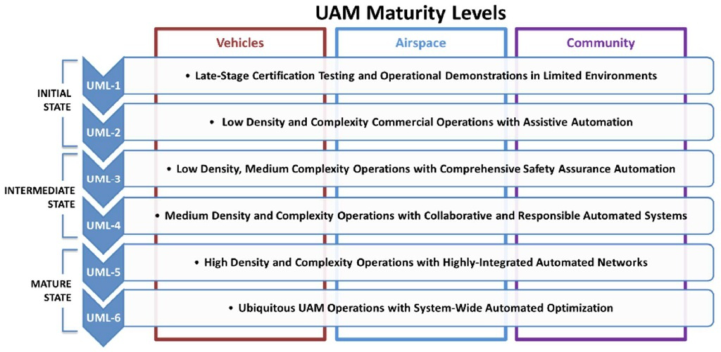
The framework of Urban Air Mobility is characterized by a hierarchi- cal arrangement with six discrete levels, each denoting a particular phase of
The Role of Digital Twins in the Certification of the Advanced Air Mobility (AAM) Systems 479
advancement toward the ultimate objective of entirely automated and opti- mized operations. Currently, the technologies that have been developed and are ready for practical implementation greatly enhance the effectiveness of missions close to UML-2.5. In this particular context, technologies based on artificial intelligence (A.I.) are currently being utilized to aid in the secure exe- cution of tasks inside an explicitly specified setting, even in situations where direct visual interaction is unattainable. The aforementioned procedures are carried out near commercial activities following the NASA Maturity levels illustrated in Figure 1.
The planning of AAM/UAM infrastructure plays a pivotal role in facili- tating the sector’s development. To guarantee the sustainability of business operations, it is imperative to evaluate various social acceptance factors, such as noise levels, operational sustainability, and affordability. Furthermore, an assessment of aircraft performance, TLOF (Touchdown and Lift-off Area) procedures, and electrical power consumption is necessary. Furthermore, utilizing a multi-layered digital twin is highly appropriate for generating syn- thetic data and assessing the efficacy of a proposed network. Previous studies have effectively employed the methodologies of K-Mean (Jeong et al., 2021) and Mixed Integer Programming (Vázquez, 2021).
The existing Air Traffic Control (ATC) Concept of Operations (ConOps) and systems are not explicitly intended to effectively manage the unique char- acteristics of low altitude, dense, and highly dynamic traffic encountered in UAM - AAM operations. Developing resilient and compatible urban air mobility (UAM) - Air Traffic Management (ATM) systems is essential. The extant literature assessment conducted by Lascara et al. (2019) examines the difficulties and offers distinct operational strategies for the integration of highly automated Urban Air Mobility (UAM) operations into the National Airspace System (NAS). The suggested framework can be utilized as an ini- tial reference for conducting concept assessments of an Airspace Integration Framework. It comprises four key components: Augmented Visual Flight
Rules, Dynamic Delegated Corridors, Automated Decision Support Services, and Performance-Based Operations. The CAE and Purdue research ques- tions focus on identifying the effects on air traffic managers responsible for controlling a specific airspace with AAM traffic (Ziakkas et al., 2022).
Additionally, the research aims to determine the impacts on other visual flight rules (VFR) traffic within that airspace and instrument flight rules (IFR) traffic in the surrounding area. Furthermore, the research assesses the deci- sion support capabilities for ATC, unmanned traffic management (UTM), and operators. Lastly, the research aims to identify any necessary procedural changes or additions required to facilitate the operation.
METHODOLOGY
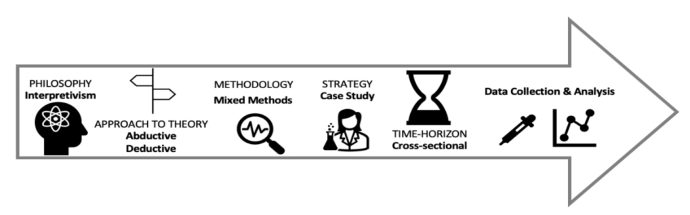
CAE Purdue proposes to evaluate the role of the Digital Twins’ in the certifi- cation of Advanced Air Mobility systems using qualitative and quantitative methods. A clear change management plan will guide this assessment. This study uses an inductive research style to examine human-centered design in AAM. According to CAE (2021), digital twins’ capabilities offer a structured research plan for the certification of AAM systems. This study also explores how human-centered design affects the AAM systems certification taking into account the operating costs. The lean approach is important because it eliminates unnecessary design steps. This method allows cost- and time- efficient testing and qualification, minimizing AAM operator implementation costs. Figure 2 shows how aircraft AAM systems certification uses the dig- ital twin⣙s technology. This diagram is based on Saunders et al. (2019) Research Onion concept.
Figure 2: Digital twins implementation in the human–centered design approach in AAM certification based on research onion proposal as adapted from Saunders et al. (2019).
According to Yin (2014) concentrating on a single research environment with multiple dimensions (Digital Twins) paves the way for the efficient res- olution of challenges and the acquisition of unique insights that are adapted to the particular operational framework, such as the AAM. This makes it possible to resolve certification challenges effectively. Researchers are able to gather qualitative insights from participants (AAM designer proposals/ operators) when they use a case study as a framework for the interpretivist paradigm. This makes the use of the AAM certification case study via digital twins a helpful tool. Within the concept of digital twins, this article uses a
The Role of Digital Twins in the Certification of the Advanced Air Mobility (AAM) Systems 481
case study technique to investigate the AAM operational framework, design, and remote testing of prototypes for eVTOL aircraft simulator devices.
The research proposal of Purdue focuses initially on the collection and analysis of primary data of the digital twins’ AAM certification concept. This will be accomplished through the use of remote access to the CAE AAM prototype simulator, with the primary attention being placed on particular study areas that have been identified by subject matter experts (SMEs) who were purposefully chosen to participate. According to Bryman & Bell (2015), the method of data collection will be supplemented with semi-structured interviews. This method offers a compromise between the data collection process and the research participants’ ability to share their thoughts and opinions.
FINDINGS The strategic development of AAM/UAM infrastructure is paramount in facilitating the sector’s growth and progress. To ensure the long-term viabil- ity of commercial activities, it is crucial to assess a range of social acceptance variables, including but not limited to noise levels, operational sustainability, and affordability. Furthermore, it is imperative to consider the incorpora- tion of the AAM with logistic and mobility infrastructure, encompassing its closeness to airports, docks, and bus terminals. In addition, it is necessary to evaluate aircraft performance, Touchdown and Lift-off Area (TLOF) proto- cols, and electrical power usage. Moreover, the utilization of a multi-layered digital twin will be particularly suitable for generating synthetic data and evaluating the effectiveness of a suggested network. Prior research has suc- cessfully utilized the approaches of K-Mean clustering (Jeong et al., 2021) and Mixed Integer Programming (Vázquez, 2021).
Based on a study conducted by CAE (2021), it has been determined that implementing UAM will result in an increased need for pilots. Furthermore, these pilots will be required to possess supplementary skill sets to navigate the demanding UAM–AAM traffic environment effectively. Contemporary educational methodologies, such as adaptive learning, employ self-paced student-centric training programs incorporating immersive technologies. Vir- tual Reality (VR), Mixed Reality (MR), and Augmented Reality (AR) tech- nologies are integrated into the initial training program to qualify new pilots to scale up pilot training to meet increasing demand. This approach not only minimizes resource usage but also enhances cost-effectiveness in training.
Furthermore, Purdue SATT’s team suggests incorporating the aspects of the EASA AI technology roadmap into the human-centered design method- ology in the AAM field. Moreover, the Purdue research team proposes the implementation of the EASA AI technology roadmap elements in the human– centered design approach in AAM. The implementation of AI in aviation following a human-centric approach facilitate the certification and training syllabus – CBTA requirements (Ziakkas et al., 2023).
Incorporation of supplementary physiological sensors in the context of Unmanned Aerial Vehicle (UAV) applications has the potential to augment the efficacy of the Human-Machine Interface (HMI). This objective can be
accomplished by integrating sophisticated technology such as voice recogni- tion and biometric sensors. These sensors analyze cockpit communications, visual scan patterns, and identify the cognitive strain of the pilot. The utiliza- tion of machine-based monitoring and enhancement of the human cognitive state aims to alleviate cognitive overload and minimize the requirement for human supervision in decision-support systems. This approach effec- tively tackles trust-related concerns and the potential decline in situational awareness within HMIs.
The integration of AI capabilities has the capacity to enhance pilots’ inter- action with an urban environment populated by other eVTOL aircraft, which demonstrate genuine behaviors and engage in realistic interactions among themselves. The development of an advanced air traffic control system holds the potential to enhance communication and coordination between pilots and autonomous aircraft, allowing for the efficient acquisition of clearances and routing instructions. Finally, this particular situation illustrates the oper- ational efficacy of these systems within the context of an emergency landing training exercise, wherein an unanticipated requirement for seamless coor- dination arises among the human pilot, ATC, and autonomous aircraft. The transition of the traditional simulation to the implementation of the Digital Twins research protocol is the main research target for a lean approach to certification challenges.
Finally, CAE - Purdue research aims to identify challenges and propose certification–training solutions to the following areas:
Human Automation/Autonomy Teaming using Digital Twins
Crew Resource Management (CRM) Principles for Remote and Dis- tributed Teams in a Digital Twins environment.
ANALYSIS To optimize the facilitation of UAM – AAM operations, decision-making support systems must demonstrate effective use and interchange of informa- tion with existing and conventional air traffic ATC services. There has been a noticeable upward trajectory in using enhanced automation assistance for tactical deconfliction measures within the Air Traffic Management (ATM) field. The phenomena can be attributed to the imperative need for ATM systems to possess a significant degree of automation and intelligence. The primary objective of the Purdue proposal is to develop and execute a digital twin framework for an advanced automated system that manages and coor- dinates air traffic, including unmanned aircraft systems (UAS) - AAM and conventional aircraft. This objective will be achieved by employing digital twins and a prototype simulator designed for AAM. The system under con- sideration will be founded upon AI technology. Furthermore, the main aim of this study is to investigate and address concerns about the understandability of complex algorithms in scenarios where human operators are responsible for making decisions that directly impact safety and the AAM systems certifi- cation. In their work (Xie et al., 2021) undertook a comprehensive review of the existing literature pertaining to the utilization of AI in the field of ATM for the purpose of incident prediction and accident risk evaluation. The current
The Role of Digital Twins in the Certification of the Advanced Air Mobility (AAM) Systems 483
study examines the application of the XGBoost technology inside this partic- ular domain. This study aims to offer a thorough explanation of AI model that has been subjected to training, as well as the expected outcomes linked to it.
Furthermore, comprehensive deliberations are undertaken regarding the optimal approaches for enhancing the trust between the ATC and the system through redesigning the HMI interface. The growing importance of AI has increased the complexity of machine learning models, often referred to as “black boxes.” As a result, there is a need to prioritize transparency by inte- grating Explainable AI (XAI) techniques. The research conducted by CAE presents a novel aircraft incident and accident prediction model that incor- porates the XGBoost algorithm. The algorithm discussed above plays a vital role as an essential element within the ATM/UTM Decision Support System (DSS).
The following are examples of how digital twins can enhance the certifi- cation process of AAM, as outlined by CAE (2021):
1. Design and Prototyping:
Digital twins facilitate the generation of virtual prototypes for eVTOL aircraft and their corresponding systems. Digital twins are a valuable tool for engineers and designers, enabling them to create and evaluate multiple configurations through modelling and testing. This capability significantly diminishes the necessity for physical prototypes. 2. Simulation and Testing: The utilisation of CAE Digital twins allows for the extensive simula- tion of eVTOL aircraft and their individual components. This encom- passes the examination of many environmental variables, such as ATC, system malfunctions, and emergency situations, in order to guarantee both safety and efficiency. 3. Flight Testing:
With the implementation of CAE Digital twin technology, it becomes possible to mimic various flying characteristics and situations. This enables the conduct of extensive virtual flight testing, which in turn expedites the certification process. 4. Data Collection and Analysis: Digital twins can generate a wealth of data during simulation and testing, hence aiding in the fulfilment of certification requirements. 5. Regulatory Compliance:
The CAE Digital Twins can assist organisations in ensuring that their AAM systems adhere to regulatory norms. The process of sim- ulating adherence to certification -airworthiness requirements facili- tates the identification and resolution of non-compliance issues, thus streamlining the overall compliance management process. 6. Training and Skill Development: The utilisation of digital twins facilitates the development of train- ing syllabi for pilots, maintenance workers, and air traffic controllers, thereby guaranteeing the adequate preparation of those engaged in AAM systems operations.
7. Predictive Maintenance:
Digital twins can be used to monitor the health and performance of AAM systems, predicting maintenance needs and reducing downtime. 8. Emergency Response Planning: Digital twins can simulate abnormal and emergencies and response strategies, allowing for comprehensive preparedness and safety assess- ments. 9. Public Acceptance and Urban Planning:
Digital twins can be used to model the impact of AAM systems on urban infrastructure, noise, and environmental considerations. This helps gain public acceptance and ensures AAM systems are integrated safely into urban environments. 10. Lifecycle Management: Digital twins can support the entire lifecycle of AAM systems, from design and certification through operation and maintenance, helping ensure long-term safety and compliance. By integrating digital twins and simulation into the AAM certification process, regulatory authorities, manufacturers, and operators can better understand aircraft behavior, improve safety, and expedite the certification of these innovative urban air mobility solutions. This approach not only saves time and resources but also helps ensure that AAM systems meet the rigorous safety and performance standards necessary for urban air transportation.
In addition, the proposed research aims also to augment the progress of an Air Traffic Management/Unmanned Traffic Management (ATM/UTM) pro- gram by employing AI algorithms and investigating methods of explaining the results produced by the model using Explainable AI (XAI).
CONCLUSION
Based on the EASA Artificial Intelligence Roadmap (EASA, 2023a), it has been projected by industrial stakeholders that the early advancements in crew assistance/augmentation will likely occur during the timeframe of 2022 to 2025. The expected timeline for the gradual integration of automation and collaboration between humans and machines is projected to take place between the years 2025 and 2030. This progression is anticipated to reach its conclusion by 2035, with the implementation of either human supervision or fully autonomous systems. The proposal put forth by the EASA centers around two levels of AI integration. Level 1 AI pertains to the utilization of AI systems to aid humans, while Level 2 AI pertains to the cooperation and interaction among humans and machines. The main aim of this proposal is to discuss the upcoming rules and safety requirements set by the EASA in relation to the certification of applications for AAM systems that have safety consequences. The focus of the suggested research case revolves around the integration of digital twins within the context of AAM. The main objective of this study is to develop and evaluate prototypes of eVTOL aircraft simulator devices using design and remote testing methodologies.
The Role of Digital Twins in the Certification of the Advanced Air Mobility (AAM) Systems 485
The utilization of digital twins and simulation techniques in the certifica- tion of AAM systems, such as eVTOL aircraft, has the potential to greatly shorten the certification process and improve safety measures.
ACKNOWLEDGMENT
The authors thank faculty members of Purdue University and the CAE research team for their invaluable feedback contributing to this work.
REFERENCES
Borole, Y., Borkar, P., Raut, R., Balpande, V., & Chatterjee, P. (2023). Digital Twins: Internet of Things, Machine Learning, and Smart Manufacturing. De Gruyter. https://doi.org/10.1515/9783110778861 Bryman, A., & Bell, E. (2015). Business research methods (4th ed.). Oxford
University Press. CAE. (2021). Pilot Training for Advanced Air Mobility. EASA. (2023a). Artificial Intelligence Roadmap 2.0: Human-centric approach to AI in aviation. EASA. (2023b). EASA Concept Paper: guidance for Level 1 & 2 machine learning
applications Proposed Issue 02. Goodrich, K. H., & Theodore, C. R. (2021). Description of the NASA Urban Air Mobility Maturity Level (UML) Scale. In AIAA Scitech 2021 Forum. American Institute of Aeronautics and Astronautics. https://doi.org/doi:10.2514/6.2021- 1627 Jeong, J., So, M., & Hwang, H.-Y. (2021). Selection of Vertiports Using K-Means
Algorithm and Noise Analyses for Urban Air Mobility (UAM) in the Seoul Metropolitan Area. In Applied Sciences (Vol. 11, Issue 12). https://doi.org/10. 3390/app11125729 Lascara, B., Lacher, A., DeGarmo, M., Maroney, D., Niles, R., & Vempati, L. (2019).
Urban Air Mobility Airspace Integration Concepts. Mark Asch. (2022). Part I: The Foundations of Digital Twins? the Tools. In A Toolbox for Digital Twins: From Model-Based to Data-Driven (pp. 1–3). Society for Industrial and Applied Mathematics. https://doi.org/doi:10.1137/1. 9781611976977.pt1 Saunders, M., Lewis, P., & Thornhill, A. (2019). Research Methods for Business
Students Eighth Edition. In Research Methods for Business Students. Pearson Education Limited. Shackelford, S. J. (2020). Governing the Internet of Things. In Governing the Internet of Things (p. 256). Oxford University Press. https://doi.org/10.1093/wentk/ 9780190943813.003.0005 Vázquez, M. H. (2021). Vertiport Sizing and Layout Planning through Integer
Programming in the Context of Urban Air Mobility. Technical University of Munich. Xie, Y., Pongsakornsathien, N., Gardi, A., & Sabatini, R. (2021). Explanation of Machine-Learning Solutions in Air-Traffic Management. In Aerospace (Vol. 8, Issue 8). https://doi.org/10.3390/aerospace8080224 Yin, R. (2014). Case Study Research: Design and Methods (5th ed.). SAGE
Publications.
Ziakkas, D., Henneberry, D., & Flores, A. (2023). Competency-Based Training and Assessment (CBTA) Framework in Global Aviation Training. AHFE (2023) International Conference. https://doi.org/10.54941/ahfe1003728 Ziakkas, D., Plioutsias, A., & Pechlivanis, K. (2022). Artificial Intelligence in aviation
decision making process. The transition from extended Minimum Crew Opera- tions to Single Pilot Operations (SiPO). In T. Ahram, J. Kalra, & W. Karwowski (Eds.), Artificial Intelligence and Social Computing. AHFE (2022) International Conference. https://doi.org/http://doi.org/10.54941/ahfe1001452
LISTED IN THE AHFE DIGITAL BOOKSTORE CATALOGUE
Explore the complete digital volume
Intelligent Human Systems Integration (IHSI 2024): Integrating People and Intelligent Systems
Read this individual research paper free through the original publisher, or explore the full digital proceedings book.
ISBN 978-1-958651-95-7
Explore this ISBN in the AHFE Bookstore ↗Listed in the July 2026 bookstore catalogue; search by ISBN to confirm current availability · Digital book purchase optional