Awwal Arigi, Ibrahim Aliyu, Jinsul Kim (2024). A preliminary analysis of a nuclear power plant startup for a physics-based model of a digital twin. In: Intelligent Human Systems Integration (IHSI 2024): Integrating People and Intelligent Systems. AHFE Open Access, vol. 119, pp. 487–495. https://doi.org/10.54941/ahfe1004513
Digital twins are a new paradigm that can revolutionize the way we work and manage complex systems due to its varied capabilities including, remote monitoring, controls, and prediction. Models are often used in engineering to represent the physical properties of the system concerned. However, the human is a fundamental part of nuclear power plant system function. Thus, a model is considered that will adequately represent not only the physical properties but the function of the human as well. The startup operation of a NPP is a representative process where the human plays a crucial role in the success of the operation. This paper shows a preliminary analysis of a representative NPP where the knowledge of the physical parameters and realistic operational functions have been leveraged for a potential digital twin. The work is based on a set of parameters defined in literature including, the physical data, the observable data, the physical inputs, the digital inputs, and others. The aim is to develop a comprehensive probabilistic digital twin model of the desired system.
Digital twins (DT) are a new paradigm that can revolutionize the way we work and manage complex systems due to its varied capabilities including remote monitoring, controls, and prediction. In a succinct definition, some authors (Schulse et al., 2018) describe DT as a representation of ‘real objects or subjects with their data, functions, and communication capabilities in the digital world’. The authors go on to say that DT ‘enable networking and thus the automation of complex value-added chains’ all the while working ‘as nodes within the internet of things’. The major capabilities of a digital twin include real time monitoring and control, greater efficiency and safety, predictive maintenance and scheduling, scenario and risk assessment, and better intra- and inter-system synergy and collaboration. Others are, more efficient and informed decision support system, personalization of products and services, and better documentation and communication (Rasheed et al., 2020).
DTs are applicable and have already been applied in several industries albeit in different forms. Some of the industries where the technology is becoming apparent include, health, meteorology, education, process and manufacturing, transportation, energy production, business, and other indus- tries (Rasheed et al., 2020) (Rathore et al., 2021). Although the nuclear industry can be considered as part of the intersection of the process and energy industries, the adoption of DT technologies is scant. This is not unex- pected because historically, the nuclear industry has been slow to adopt emerging technologies because of its uniquely combined high safety and secu- rity nature. However, research into the adoption of DTs (as with many other emerging technologies) in nuclear systems have gained traction in recent years. Most of the current research in this area for the nuclear industry has focused on the technical challenges of implementation (Yadav et al., 2021) (Kochunas & Huan, 2021) (Prantikos et al., 2022), safeguards and secu- rity implications (Yadav et al., 2023), applications for the next generation of advanced reactors (Browning et al., 2022) (Wilsdon et al., 2023), or spe- cific system applications like prediction of flow-induced vibration (Mohanty & Vilim, 2021). However, the consideration of the human actions and procedures in DT has largely been neglected.
The human plays a significant role in the operation of the current nuclear fleet of reactors and is a fundamental part of nuclear power plant (NPP) sys- tem function. While there is still debate as to the role of the human in future technology applications, lessons can be learned in the current use of human actions with procedures and their performance in the operations of NPP for future developments of DTs. Unlike the standard full-power operation, the power-increase operation requires significantly more decision-making and therefore increases the potential for human errors. While previous studies have investigated the use of artificial intelligence (AI) techniques for NPP control, none of them have addressed the specific challenges of adapting the current system for DT applications. Thus, this paper considers a DT model that will adequately represent not only the physical properties but the func- tion of the human as well in NPP startup operations. The rest of the paper describes the startup operation of an NPP and the preliminary proposed mod- els. Thereafter, a brief discussion of our model and planned future work is provided.
PRINCIPLES OF A NPP STARTUP OPERATION Physics-based models are typically used to simulate the physical assets of a plant and their physical phenomena. In the case of a NPP, such phenomena can include, heat transfer, neutronics, mass transfer, and many others. Cur- rently there are multi-physics codes that can model multiple plant phenomena simultaneously. A DT must achieve an integrated model of all relevant phe- nomena. Thus, an overview of the physical processes occurring during a NPP startup operation are given here.
The power start-up scenario of a nuclear power plant (NPP) involves increasing the reactor power until the full-power condition is achieved. Unlike the standard full-power operation, the power start-up scenario
A Preliminary Analysis of a Nuclear Power Plant Startup for a Physics-Based Model 489
involves constant monitoring, several decision-making points, and more com- plicated manipulations due to the automatic and safety functions of many systems being disabled. Throughout the scenario evolution, several system parameters are consistently changing. Thus, further increasing the potential for system instability where the operation is incorrectly implemented.
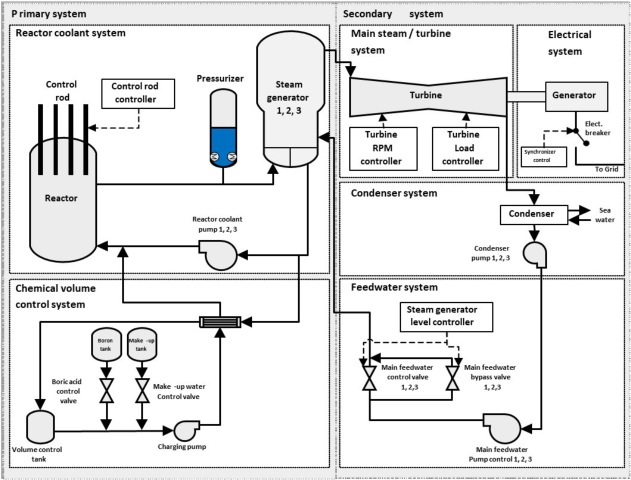
The Pressurized Water Reactor System of an NPP NPPs are conventionally used to generate baseload electricity, but several types are in existence today mostly varying depending on the type of coolant, moderator, or number of loops. The pressurized water reactor (PWR) uses light water for cooling and moderation with a two-loop design. In the primary loop, water is pumped via the reactor coolant pump (RCP) to the reactor pressure vessel (RPV), through to the steam generator (SG), and back again to the RCP. The pressurizer (which manages the pressure in the loop) is also located along the primary loop. The secondary loop is where the water from the condenser is pumped by the main feedwater pump (MFP) through to the SG. From there, steam continues in the loop to the turbines and back to the condenser as water.
Along with the primary systems, there are several controllers that work to keep the system stable. Some of them are the control rod controller, the SG level controller, the boric acid control valve, and the turbine load controller. The schematic on Figure 1 shows a simple depiction of a so called ‘3-loop PWR’ including some important controllers within the overall PWR system.
Figure 1: A typical PWR system of an NPP.
Analysis of the Startup Operations of an NPP This study considers the startup operation of a typical Westinghouse 3-loop PWR. In this reference plant, the operators follow general operating proce- dures (GOPs) for controlling systems and components during the start-up operation. The GOPs include 1) Reactor coolant system filling and vent- ing, 2) Cold shutdown to hot shutdown, 3) Hot shutdown to hot standby, 4) Hot standby to 2% reactor power, 5) Power operation at greater than 2% power, and 6) Secondary system heat-up and start-up. The increase of a NPP power from 2% to 100% is the part of the startup operation that increase the temperature and power to the normal conditions for electricity generation.
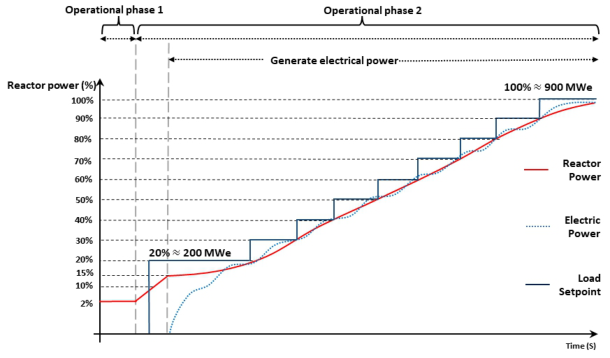
There are six major parameters that serve as milestones for operators in the successful performance of the start-up operation including pressurizer level, reactor coolant temperature, reactor coolant pressure, SG pressure, SG level, and reactor power. The power-increase operation consists of two major operational ranges: 1) maintaining the reactor power at 2% and 2) increasing the reactor power from 2% to 100%.
In the first operational range, the positions of all control rods are adjusted (withdrawn) to 100% (i.e., banks A, B, & C to step 228 and bank D to step 220) while maintaining the reactor power at 2%. Withdrawing the control rods causes the reactor power to increase. However, increas- ing the boron concentration reduces the reactor power. Thus, the boron concentration is simultaneously increased from 637ppm to 727ppm as the control rods are withdrawn, thereby keeping the power stable at 2%. In the second operational range the boron concentration is gradually reduced from 727ppm to 457ppm, allowing a steady reactor power-increase up till 100%.
The turbine load controller is used mainly in the second operational range to keep the turbine revolutions per minute (RPM), turbine power accelera- tion rate, and load setpoint as prescribed by the operating procedures. Some of the setpoints are 1800RPM (at reactor power of 10%), acceleration of 2Mwe/min (at reactor power above 10%), load setpoint of 100Mwe (at reac- tor power of 10-20%), load of 200Mwe (at reactor power of 20-30%). See the load setpoints controls as depicted in Figure 2.
Feedwater (FW) pump 1 is operated at the first operational phase while FW pumps 2 and 3 are operated in the second operational phase. Main FW pumps 2 and 3 are started at reactor power of 40% and 80% respec- tively. However, the condenser pumps #2 and #3 are operated at reactor powers of 20% and 50% respectively. The synchronizer is activated when the reactor power exceeds 15% and the turbine is at 1800RPM. The SG feedwater valves and pressurizer relief valves are automatically controlled to manage the steam generator and pressurizer levels. The average tempera- ture is also maintained because it depends on the reactor power. Meanwhile, various portions of the RCP, CVCS, makeup water system, and nuclear ser- vice water systems or equipment must be operational to support the RCS fill and vent.
A Preliminary Analysis of a Nuclear Power Plant Startup for a Physics-Based Model 491
Figure 2: NPP startup operational phases.
PROPOSED MODEL OF HUMAN ACTIONS FOR NPP DIGITAL TWINS Operator activities play a significant role in the successful ramp up of power to 100%. Thus, it is necessary to understand and represent the human activ- ities in DTs for an accurate depiction of the plant operations in the scenario. According to cognitive psychology texts, human tasks are generally grouped into monitoring process parameters/trends, processing/understanding infor- mation, decision-making, and control actions. However, it is necessary to define the task types that aid modelling of the specific scenario for a DT. For this purpose, the PWR startup operation procedure (which has 21 steps) was analysed. The defined tasks are decision making, discrete control, and continuous control. Table 1 shows examples of task definitions based on the actions as directed by the procedures. It should be noted that conventionally, all tasks in NPP operations are highly procedural. This means that these task definitions based on the operating procedures have high fidelity.
Table 1. Example procedure actions and task definitions.
Table available in the original PDF paper.
Step Task Type Action 1 Decision Making Determine the rate of power increase in %/h 2 Continuous Control Withdraw all control rods to the position of 100% reactor power while maintaining the reactor power at 2% through boration. 3 Continuous Control If all the control rods are withdrawn, increase the reactor power from 2% to 6%–10% by reducing the boron concentration. 4 Discrete Control If the reactor power is 10%, the turbine RPM setpoint is 1800 RPM. ... ... ... 21 Discrete Control If the reactor power is between 90% and 100%, the load setpoint is 900 MWe.
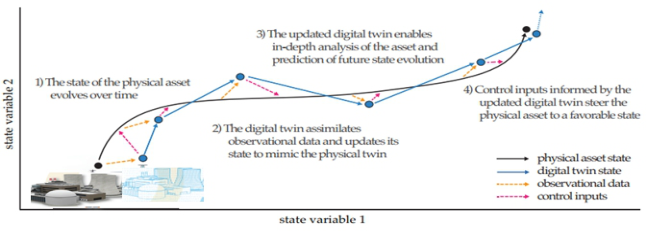
The PGM Modeling Approach To demonstrate the transformation of a baseline NPP into a unique DT result- ing in experimental data for model calibration and performance evaluation, we consider a probabilistic graphical model (PGM) approach to modeling digital twins. The ‘PGM’ for DT was proposed by (Kapteyn et al., 2021) where they considered the physical asset and it’s digital twin evolving in their respective states through time as depicted in Figure 3. The DT can estimate the state (current and future) of the physical asset based on observational data and thus is able to provide optimal control inputs to direct the physical asset to the desired states.
Figure 3: Conceptual model of a physical asset and its digital twin, evolving over time through their respective state spaces (modified from Kapteyn et al., 2021).
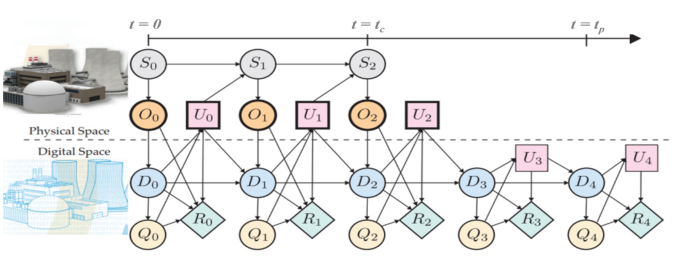
Mathematical Abstraction for the Startup Operation Including Human Actions A mathematical abstraction must begin with the definition of significant vari- ables necessary for the model. In the case of our model, there are six variables that are considered: the physical state (St), observable data (Ot), digital state (Dt), control inputs (Ut), quantities of interest (Qt), and reward (Rt). Phys- ical states are the parameterized states of the physical assets. Digital states are the parameters that define the computational models comprising the dig- ital twin. Observable data is the available information describing the state of the physical asset. Control inputs are the actions or decisions that influ- ence the digital asset. Quantities of interest refer to the parameters describing the asset that are estimated via model outputs. Reward quantifies the overall performance of the asset-twin system.
The interaction between the physical asset and its digital twin is facilitated through information flow. For example, the information flow in the form of observational data ot, from physical assets to its digital twin, updating the corresponding digital state in the process. Quantity of interest Qt ∼p(qt) are then computed by the updated digital twin model. The digital state and the computed quantity of interest serve as control input ut from the digital twin back to the physical asset. For the realm of NPP startup operation in the physical asset alone, these control inputs and quantities of interest are human cognitive actions or automated. The reward for the timestep Rt ∼p(rt) is determine by all these quantities. Upper-case represent the random vari- ables while the lower-case denotes their values. Meanwhile, the graph edges
A Preliminary Analysis of a Nuclear Power Plant Startup for a Physics-Based Model 493
are encoded through a conditional probability or a deterministic function to represent the dependencies between variables.
The PGM approach allows us to define known or assumed conditional independence. The model encodes both the physical and digital state based on Markov assumption observable through data. By exploring the conditional independence, the joint distributions over variables can be factorized in the model as follows: p D0, . . . , Dtc, . . . , Q0, . . . , Qtc, R0, . . . , Rtc o0, . . . , otc, . . . , u0, . . . , utc
h
i
Equations and mathematical formulas are available in the original paper PDF.
0update
t 0QoI
Where,
, (2)
0update
Dt
0evaluation
Rt
By expanding the states to include digital state, quantity of interest and reward variable, the state can be predicted to tp. The factors in Equation 1 are conditional probability distributions that characterize the interactions in the models comprising the digital twins. The Bayesian inference algorithm leverage the equation to enable key digital twin capabilities such as asset monitoring, prediction, and optimization.
Formally, the system is modeled using a dynamic Bayesian network with the inclusion of decision nodes. The graph represents the system from initial timestep, t = 0, to current timestep, t=tc, and into future timestep, t=tp as illustrated in Figure 4. The nodes in the graph are random variables, denoting each quantity at discrete point in time. The time evolution of the physical asset state St∼p(st) and digital state Dt∼p(dt) are represented by the upper and lower left-to-right path in Figure 4, respectively.
Figure 4: A dynamic decision network for the NPP’s physical asset and its digital twin. The nodes with bold outlines are observed quantities while others are estimated using probability distribution (adapted from Kapteyn et al., 2021).
Based on the system physical quantities and human cognitive actions, the PGM parameters in the startup operation of the NPP is abstracted as shown on Table 2.
Table 2. A representation of the PDM parameters for the startup operation of a PWR plant.
CONCLUSION AND FUTURE WORK This paper addresses the challenge of representing complex human actions of the startup operations in an NPP’s digital twin. This effort is a preliminary work that establishes a framework that will be expanded for a complete DT system where models intelligently inform the control system to manage the NPP startup operation within the prescribed limited conditions of operation. Furthermore, we can tackle the underlying computation challenge by formu- lating the problem as a multi-user game, where the NPP assets can partially offload tasks to a DT-enabled in-network computing. Thereafter, simulation results will demonstrate the effectiveness of proposed methods in capturing complex human actions and optimal resource allocation in the DT-enabled NPP.
A Preliminary Analysis of a Nuclear Power Plant Startup for a Physics-Based Model 495
ACKNOWLEDGMENT
The authors would like to acknowledge the Institute for Energy Technology, Norway for supporting this work. This research was also supported by the MIST (Ministry of Science and ICT), Korea, under the Innovative Human Resource Development for Local Intellectualization support program (IITP- 2023-RS-2022-00156287) supervised by the IITP.
REFERENCES
Browning, J. et al., 2022. Foundations for a Fission Battery Digital Twin. Nuclear Technology, Volume 208, pp. 1089–1101. Kapteyn, M. G., Pretorius, J. V. R. & Willcox, K., 2021. A probabilistic graph-
ical model foundation for enabling predictive digital twins at scale. Nature Computational Science, Volume 1, pp. 337-347. Kochunas, B. & Huan, X., 2021. Digital Twin Concepts with Uncertainty for Nuclear Power Applications. Energies, 14(4235). Mohanty, S. & Vilim, R. B., 2021. Physics-Infused AI/ML Based Digital Twin Frame-
work for Flow-Induced Vibration Damage Prediction in a Nuclear Reactor Heat Exchanger, Illinois 60439: Argonne National Laboratory. Prantikos, K., Tsoukalas, H. L. & Heifetz, A., 2022. Physics-Informed Neural Network Solution of Point Kinetics Equations for a Nuclear Reactor Digital Twin. Energies, 15(7697). Rasheed, A., San, O. & Kvamsdal, T., 2020. Digital Twin: Values, Chal-
lenges and Enablers From a Modeling Perspective. IEEE Access, Volume 8, pp. 21980–22012. Rathore, M. M. et al., 2021. Role of AI, Machine Learning, and Big Data in Digital Twinning: A SLR, Challenges, and Opportunities. IEEE Access, Volume 9, pp. 32030–32052. Schulse, M., Priggemeyer, M., Atorf, L. & Rossmann, J., 2018. Experimentable
Digital Twins—Streamlining Simulation-Based Systems Engineering for Indus- try 4.0. IEEE TRANSACTIONS ON INDUSTRIAL INFORMATICS, 14(4), pp. 1722–1731. Wilsdon, K., Hansel, J., Kunz, M. R. & Browning, J., 2023. Autonomous control of heat pipes through digital twins: Application to fission batteries. Progress in Nuclear Energy, Volume 163, p. 104813. Yadav, V. et al., 2021. Technical Challenges and Gaps in Digital-Twin-Enabling
Technologies for Nuclear Reactor Applications, Idaho 83415: Idaho National Laboratory. Yadav, V. et al., 2023. Digital Twins for Nuclear Safeguards and Security Applications. Knoxville, TN, Proceedings of the 13th Nuclear Plant Instrumenta- tion, Control & Human-Machine Interface Technologies (NPIC&HMIT 2023) Conference.
LISTED IN THE AHFE DIGITAL BOOKSTORE CATALOGUE
Explore the complete digital volume
Intelligent Human Systems Integration (IHSI 2024): Integrating People and Intelligent Systems
Read this individual research paper free through the original publisher, or explore the full digital proceedings book.
ISBN 978-1-958651-95-7
Explore this ISBN in the AHFE Bookstore ↗Listed in the July 2026 bookstore catalogue; search by ISBN to confirm current availability · Digital book purchase optional