Akiko Kondo, Satoshi Togawa (2024). A Basic Study of the Influence of Tourism Awareness on Behavior. In: Intelligent Human Systems Integration (IHSI 2024): Integrating People and Intelligent Systems. AHFE Open Access, vol. 119, pp. 823–829. https://doi.org/10.54941/ahfe1004547
In 2023, for the first time, the population of all 47 prefectures in Japan declined. Going forward, Japan will continue to face a long-term, rapid population decline and an aging society with declining birthrates, which no other country in the world has experienced. Under these circumstances, the promotion of tourism interaction is one of the most important issues. This is because tourism has a wide-ranging impact on local employment and the local economy, as well as improving local vitality. Under these circumstances, it is necessary to elucidate the mechanism of tourism interaction.With the promotion of DX (Digital Transformation), the use of AI and IoT has become much more advanced and easier than before. On the digital twin (virtual space), unlike the conventional metaverse space, the real space environment can be completely reproduced, and monitoring and simulation can be performed. This calls for the use of this technology for tourism interaction. This is because in the digital twin space, its reproduction AI has been constructed based on AI analysis methods based on actual data, and simulations that are difficult to experiment with are now possible. On the other hand, the reproduction and simulation do not take into account people's consciousness and thoughts, and as with generative AI, they adopt the best-fitting results based on numerical precision, and are not capable of clarifying the specific factors that bring about the results.The purpose of this study is to clarify the relationship between tourism factors and performance, taking into account the influence of people's awareness and thoughts about tourism on their actual behavior. This study is a basic analysis in clarifying the mechanism of tourism interaction considering people's awareness as a factor.Specifically, the analysis is as follows. The survey asked about people's awareness of tourism, including the importance of each item they seek in tourism, the importance of each item in their choice of tourist destination, and the results of actual tourism. Based on the results of this survey, a tourism interaction model that takes into account people's awareness is constructed. Open data will be used for socioeconomic indicators. In constructing the model, we will formulate it based on the theory of individual utility maximization. In addition, policy simulations will be conducted using the constructed model. In the process of constructing the model, we propose a method to quantify people's awareness. In addition, by conducting simulations using the constructed model, we will provide information that will contribute to future tourism exchange policies.
In 2023, for the first time, the population of all 47 prefectures in Japan declined. It is predicted that Japan will continue to face a long-term, rapid population decline and an aging society with fewer children than any other country in the world has ever experienced. In this situation, the promotion of tourism interaction is one of the most important issues. This is because tourism has a wide-ranging impact on local employment and the local econ- omy, as well as improving local vitality. Under these circumstances, it is necessary to elucidate the mechanism of tourism interaction.
With the promotion of DX (Digital Transformation), the use of AI and IoT has become much more advanced and easier than before. On the digital twin (virtual space), unlike the conventional metaverse space, the real space envi- ronment can be completely reproduced, and monitoring and simulation can be performed. This calls for the use of this technology for tourism interaction. This is because in the digital twin space, its reproduction AI has been con- structed based on AI analysis methods based on actual data, and simulations that are difficult to experiment with are now possible. On the other hand, the reproduction and simulation do not consider people’s consciousness and thoughts, and as with generative AI, they adopt the best-fitting results based on numerical precision, and are not capable of clarifying the specific factors that bring about the results.
The purpose of this study is to clarify the relationship between tourism factors and performance, considering the influence of people’s awareness and
thoughts about tourism on their actual behavior. This study is a basic anal- ysis in clarifying the mechanism of tourism interaction considering people’s awareness as a factor.
Specifically, the following analysis will be conducted. Regarding attitudes toward tourism, we will use a questionnaire to ask about the importance of each item in terms of what people seek in tourism, the importance of each item in selecting a tourist destination, and the actual number of times people have actually visited a tourist destination. Based on the survey results, the relationship between people’s awareness and tourism behavior will be quantitatively clarified using factor analysis and binomial logistic regression.
EXISTING STUDIES AND CHARACTERISTICS OF THIS STUDY We review existing studies that are closely related to this study and summarize the characteristics of this study.
Much study related to tourism attractiveness and impact analysis has been done over the years.
Several reviews on this theme also exist (e.g. Kondo et al., 2017). Regard- ing tourism in Japan, Muroya (1998) analyzed the evaluative structure of attractiveness in tourism spots in order to evaluate the attractiveness of tourism attractions. Kamata et al. (2006) conducted factor analysis to understand the structure of attractiveness of Japanese tourist attractions and then examined the relationship between these tourism factors and tourism demand. Some studies have proposed ways to capture and analyze the eco- nomic impact of tourism (Stynes, 1997), and others have found that the image of a tourist destination when visited leads to revisits and recommendations to others (Chen et al., 2007). Furthermore, there is a study (Hamimah et al., 2020) that clarified tourism motives centered on food from a questionnaire. As for quantitative analysis, there are also results that constructed a cross- sectional and panel model (Xiang et al., 2010) and applied a gravity model (Konsnan, 2013). In addition, some studies have analyzed the structure of behavior using factor analysis and logit models to determine the impact of the pandemic on tourism-related firms under COVID-19 (Haisheng et al., 2021). Another study (Juan et al., 2006) estimated a logit model for tourism destina- tion choice that revealed that the effects of distance and price are moderated by tourists’ motives.
Thus, there are many studies on tourism. In this study, we clarify the impor- tance of each item in tourist attraction and destination selection, and then clarify the influence of people’s awareness on their actual tourism behavior.
IMPORTANCE OF TOURISM DESTINATION SELECTION FACTORS As we have mentioned, social conditions have changed, and the situation sur- rounding tourism has also changed dramatically. In this study, a web-based questionnaire survey was conducted nationwide in order to clarify the aware- ness of tourism and each factor of tourism purpose and destination selection. The summary and distribution of respondents are shown in Table 1.
A Basic Study of the Influence of Tourism Awareness on Behavior 825
Table 1. Survey summary.
Table available in the original PDF paper.
Period| March 13, 2023 - March 20, 2023 Number of Responses| Valid responses: 1,032 [Number distributed: 10,175] Characteristic Sample Characteristic Sample
Gender Occupation Male 547 Public employee Female 554 Executive 16 Age group Company employee(clerical) 144 Under 15 88 Company employee(technical) 89 15 −19 170 Company employee(other) 114 20 −29 172 Self-employee 43 30 −39 170 Freelance 37 40 −49 170 Housewife/ Househusband 128 50 −59 161 Part-time job 118 Over 60 170 Student 260 Area Other Hokkaido 60 Marital status 110 Tohoku 77 Unmarried Kanto 414 Married 630 Chubu 173 Presence of children 470 Kinki 206 With 404 Chugoku 47 Without 697 Shikoku 23 Kyushu 101
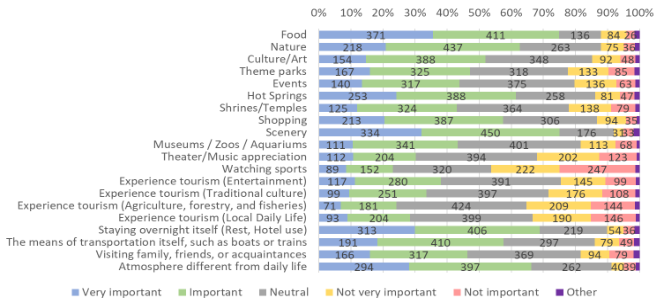
In this study, in order to clarify what factors lead people to tourism behav- ior, the importance of each item as a tourism purpose or attraction was investigated in the questionnaire. 20 items were answered from 6 options, each of which was selected by the respondents. Figure 1 shows the distribu- tion of the importance of each item as a tourism purpose or attraction, and the correlation coefficients show the relationship among the 20 items. Among the experience tourism indicators, only the three indicators of “Entertainment, Traditional culture, and Agriculture, forestry, and fisheries” exceeded 0.6, while the other indicators had low correlations. The distribution of impor- tance shows that the importance of tourism attractions related to resources that have long taken root in the tourism destination, such as Food, Nature and Scenery, is high. Also, the importance of lodging, transportation, and an atmosphere different from daily life to relax from the daily routine is also high.
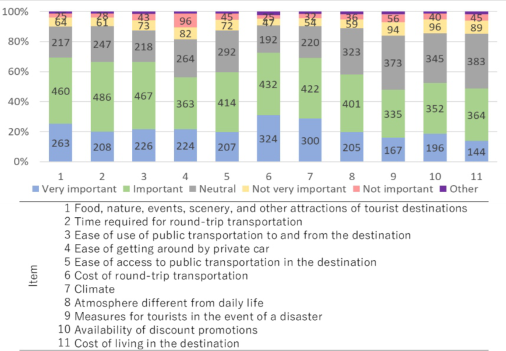
Figure 2 shows the distribution of the importance of the factors in deter- mining the tourist destination. One of the items in the factors determining the tourist destination is an indicator of tourist purpose and attractiveness, as indicated above. From the correlation coefficients among these 11 items, ease of using public transportation at the tourist destination and ease of using public transportation to and from the destination are above 0.6 at 0.65, but the relationships among the other factors are relatively low. All items are highly important, including transportation accessibility and climate. It is clear that respondents are currently deciding on their travel destinations based on a number of factors, including the attractiveness of the tourist destination, transportation convenience, weather, and cost of living.
826 Kondo and Togawa
Figure 1: Importance of tourism purpose and attractions.Figure 2: Factors determining destination.
INFLUENCE OF IMPORTANCE OF FACTORS DETERMINING TOURIST DESTINATION ON BEHAVIOR In deciding on a tourist destination, it became clear that people consider many factors in addition to the purpose and attractiveness of the destination, such as transportation convenience to the destination, convenience at the tourist site, and an atmosphere different from that of everyday life. Based on this, we will quantitatively clarify the influence of people’s awareness on their tourism behavior by clarifying what factors they evaluate and decide on when selecting a destination.
Factor Analysis of Tourism Factors In order to elucidate the structure that leads to the decision and action on tourism destinations, a factor analysis is conducted. The results of the factor analysis of tourism importance are shown in Table 2. For the fac- tor extraction method, the maximum likelihood method was applied, and for the rotation method, the Promax method with oblique rotation was employed. In this case, χ2= 1,382, with a significance probability p<0.0001. From the pattern matrix of the factor analysis, the first factor consists of
A Basic Study of the Influence of Tourism Awareness on Behavior 827
transportation convenience and availability of discount campaigns. It can be interpreted as a factor representing “convenience and efficiency/atmosphere” because it includes items for climate and atmosphere, which are different from residence. The second factor is interpreted as representing “experience and activity”, the third factor is interpreted as representing “art, culture and calmness” and the fourth factor is interpreted as representing “active”. Furthermore, the fifth factor is interpreted as a factor representing “extraor- dinary/restful” because it is composed of indicators that represent relaxation away from daily life.
Table 2. Results of factor analysis of tourism importance.
Table available in the original PDF paper.
Variables Factor1 Factor2 Factor3 Factor4 Factor5 Cost of round-trip transportation .757 −.091 −.065 −.056 .063 Cost of living in the destination .717 .058 −.052 .055 −.141
Ease of use of public transportation to and from the
.699 .008 −.091 .001 .055
destination Time required for round-trip transportation .691 −.087 −.026 .025 .049 Ease of access to public transportation in the destination .652 .099 −.092 .022 .084
Climate .635 −.098 .094 −.050 .039 Measures for tourists in the event of a disaster .623 .068 .192 −.023 −.120 Availability of discount promotions .621 .023 −.027 .052 .006
Ease of getting around by private car .496 −.009 .115 .012 −.072 Atmosphere different from residential areas .473 .031 .121 −.101 .139 Experience tourism (Agriculture, forestry, and fisheries) −.033 .961 −.006 −.078 −.003
Staying overnight itself (Rest, Hotel use) −.004 .035 −.118 .017 .758 Atmosphere different from daily life .047 −.003 .106 −.002 .639 The means of transportation itself, such as boats or trains .094 .214 −.089 .055 .519
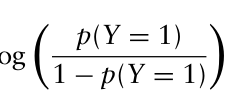
Influence of Tourism Factors on Behavior How do each of the factors in determining the tourism destination affect the behavior of actually sightseeing? In order to clarify this, we assume the following basic binomial logit model for domestic tourism, with whether or not one actually visits the destination as the explained variable and the factors including the above five factors as the explanatory variables. In the equation, xi is an explanatory factor such as a factor or attribute, and Y is the explained variable indicating whether to travel or not.
n X
log
βixi (1)
= β0 +
Equation reproduced from the original PDF.
The results of the regression analysis are shown in Table 3. The results indicate that in addition to gender and age, the factors that influence tourism behavior are the “convenience and efficiency/atmosphere” factor, the “experience/activity” factor, and the “unusual/restful” factor. Our lives have changed dramatically since the COVID-19 pandemic. This is not only in terms of behavioral restrictions in the midst of the spread of infection, but also in terms of our lifestyles and the way we spend our time. This suggests that factors such as the need to spend time away from one’s daily routine and to relax may have had an impact.
Table 3. Binomial logit model estimation result.
Table available in the original PDF paper.
Variable Estimation Results Statistic Coefficient Standard error p-value Mean σ Min. Max.
Domestic Travel - 0.76 0.43 0 1
0.756 0.244 .002 ** 1.43 0.50 0 2
Gender (Male=1, Female=2) −0.420 0.155 .007 ** 1.50 0.50 1 2 Age group (7 categories) −0.246 0.054 .000 ** 4.21 1.90 1 7 Area (8 categories) 0.070 0.049 .150 4.02 1.77 1 8 Occupation (11 categories) −0.147 0.029 .000 ** 7.11 3.05 1 11 Marital status (Unmarried=1, Married=2) −0.094 0.247 .704 1.63 0.48 1.00 2.00 Presence of children (With=1, Without=2)
The purpose of this study was to clarify the behaviors that lead people to decide to visit a destination and to actually visit it, as well as their aware- ness of tourism. Regarding the importance of the purpose and attractions of tourism, the results showed that the importance of the original local attrac- tions of the destination, such as food and nature, as well as the ability to
A Basic Study of the Influence of Tourism Awareness on Behavior 829
relax and get away from daily life through travel, were highly important. In addition to these attractions and purposes, the respondents also considered a wide range of other factors, such as transportation convenience and climate, when visiting a tourist destination. The importance of tourism factors was categorized into five factors, including “convenience and efficiency/atmo- sphere,” “experience and activity,” and “extraordinary/restful. Using these factors, we clarified the influence of tourism awareness on actual tourism behavior. Based on these results, we will further develop a model that can be used for simulation.
ACKNOWLEDGMENT
This work was supported by JSPS KAKENHI Grant Numbers 22H03854, 21K02844.
REFERENCES
Chen, C. F. and Tsai, D. (2007). How Destination Image and Evaluative Factors Affect Behavioral Intentions?, Tourism Management, Vol. 28, Issue 4, 1115–1122. Haisheng Hu, Yang Yang, Jin Zhang (2021). Avoiding Panic during Pandemics:
COVID-19 and Tourism-related Businesses, International Journal of Tourism Management, Vol. 86, 104316. Hamimah, H. Y., Hanim, A., N. (2020). Motivation in Food tourism in Penang, Journal of Marketing Advances and Practices, Vol. 2, No. 1, 38–49. Juan L. Nicolau and Francisco J. Mas (2006). The Influence of Distance and Pro-
cess on the Choice of Tourist Destinations: The Moderating Role of Motivations, International Journal of Tourism Management, Vol. 27, 1–22. Kamata, H. and Yamauchi, H. (2006). The Factor of Influence for Tourism Demand: Trying to Measure “Attractiveness of Tourism Destination”, International associ- ation of traffic safety science, Vol. 31, No. 3, 186–194. Kondo, A., Kondo, A. (2010). Development of Migration and interaction models
between regions in consideration of their mutual relationship. Proceedings of the 12th World Conference of Transport Research, 1–22. Kondo, A., Kondo, A. and Togawa, S. (2017). Current Situation of Inbound Tourism in Japan and Inbound Tourist Behavior Model, Proceedings of the 15th Inter- national Conference on Computers in Urban Planning and Urban Management, 1–19. Kosnan, S. S. A. and Ismail, N. W. (2013). Determinants of International Tourism
in Malaysia: Evidence from Gravity Model, Journal of Economy Malaysia, 47(1), 131–138. Muroya, M. (1998). Attractiveness Estimation of Tourist Destination, Transport Policy Studies’ Review, Vol. 1, No. 1, 14–25. Stynes, D. J. (1997). Economic Impacts of Tourism: A Handbook for Tourism
Professionals, University of Illinois, Tourism Research Laboratory, 1–32. Xiang, Z. and Gretzel (2010). Role of social media in online travel information search, Tourism Management, Vol. 31, Issue 2, 179–188.
LISTED IN THE AHFE DIGITAL BOOKSTORE CATALOGUE
Explore the complete digital volume
Intelligent Human Systems Integration (IHSI 2024): Integrating People and Intelligent Systems
Read this individual research paper free through the original publisher, or explore the full digital proceedings book.
ISBN 978-1-958651-95-7
Explore this ISBN in the AHFE Bookstore ↗Listed in the July 2026 bookstore catalogue; search by ISBN to confirm current availability · Digital book purchase optional