Satoshi Togawa, Akiko Kondo, Kazuhide Kanenishi (2023). Designing a Learning History Storing Framework with Blockchain Technology for Against Multi Hazards. In: Application of Emerging Technologies. AHFE Open Access, vol. 115, pp. 75–81. https://doi.org/10.54941/ahfe1004304
On February 24, 2022, Russian forces began their invasion of Ukraine. As of May 2023, approximately 20% of Ukraine has been occupied by Russia, and the war is still ongoing. Conflicts and wars devastate many buildings, infrastructure, regional transportation networks, and telecommunications networks. The outbreak of war threatens the very existence of not only the occupied territories but also the nation itself. Obviously, this has a major impact on the continuity of social life itself.On January 30, 2020, the World Health Organization declared COVID-19 a Public Health Emergency of International Concern. This declaration remained in effect until its termination on May 5, 2023. During this period, the pandemic caused global logistical outages and disrupted human interaction. The outbreak of infection caused by the pandemic restricted the ability of people to meet or talk directly with each other.Extreme weather events caused by climate change are becoming more frequent and more damaging every year. In July 2022, temperatures exceeding 40°C were observed in eastern England for the first time in recorded history. Abnormally high temperatures caused by heat waves lead to major fires in the region. The largest wildfire in southwestern France burned more than 19,000 hectares of land. It is reported that more than 34,000 residents were evacuated.Whatever the cause, natural disasters or conflicts, they generally have a significant impact on the lives of citizens and social activities. The impacts are long-lasting. Depending on the type of disaster, the disaster recovery frameworks that have been effective in the past may not work in some situations.In the field of higher education, such as university education, the use of learning analysis, which aims to clarify learners' learning behavior based on their learning history, is being actively pursued. Learning histories are stored in public clouds such as Amazon Web Services and Google Cloud Platform, and are protected by the large-scale disaster recovery mechanism of cloud storage. However, the outbreak of war or regional conflict, or the occurrence of a disaster that threatens the survival of a country itself, makes it difficult to provide public cloud services, which are merely private commercial services. We must ensure that the learning history of learners, which cannot be recovered once it is lost, is stored and maintained even in multi-hazard situations.In this study, we construct a learning history storing framework that applies blockchain technology in order to store and maintain learners' learning history even in multi-hazard situations. By applying the decentralized and autonomous nature of blockchain technology, the learning history can be maintained and restored even in the event of a functional failure or data loss of information communication networks or data centers due to a disaster. In this presentation, we describe the design of a blockchain mechanism for learning history retention and describe a learning history retention mechanism linked to an existing Learning Management System. The design and effectiveness of the prototype system implemented for validation are also described.
On February 24, 2022, Russian forces began their invasion of Ukraine. As of May 2023, approximately 20 percent of Ukraine has been occupied by Russia, and the war is still ongoing. Conflicts and wars devastate many buildings, infrastructure, regional transportation networks, and telecommu- nications networks. The outbreak of war threatens the very existence of not only the occupied territories but also the nation itself. Obviously, this has a major impact on the continuity of social life itself.
On January 30, 2020, the World Health Organization declared COVID-19 a Public Health Emergency of International Concern. This declaration remained in effect until its termination on May 5, 2023 (United Nations News, May 5, 2023). During this period, the pandemic caused global logistical outages and disrupted human interaction. The outbreak of infec- tion caused by the pandemic restricted the ability of people to meet or talk directly with each other. Extreme weather events caused by cli- mate change are becoming more frequent and more damaging every year.
In July 2022, temperatures exceeding 40 degree were observed in eastern England for the first time in recorded history (BBC News, October 14, 2022). Abnormally high temperatures caused by heat waves lead to major fires in the region. The largest wildfire in southwestern France burned more than 19,000 hectares of land. It is reported that more than 34,000 residents were evacuated (France24 News, July 19, 2022).
Whatever the cause, natural disasters or conflicts, they generally have a significant impact on the lives of citizens and social activities. The impacts are long-lasting. Depending on the type of disaster, the disaster recovery frameworks that have been effective in the past may not work in some situations.
In the field of higher education, such as university education, the use of Learning Analysis, which aims to clarify learners’ learning behaviour based on their learning history, is being actively pursued. Learning histories are stored in public clouds such as Amazon Web Services (AWS) and Google Cloud Platform (GCP) and are protected by the large-scale disaster recovery mechanism of cloud storage. However, the outbreak of war or regional con- flict, or the occurrence of a disaster that threatens the survival of a country itself, makes it difficult to provide public cloud services, which are merely pri- vate commercial services. We must ensure that the learning history of learners, which cannot be recovered once it is lost, is stored and maintained even in multi-hazard situations.
In this work, we construct a learning history storing framework that applies blockchain technology in order to store and maintain learners’ learn- ing history even in multi-hazard situations. By applying the decentralized and autonomous nature of blockchain technology, the learning history can be maintained and restored even in the event of a functional failure or data loss of information communication networks or data centers due to a disaster. In this presentation, we describe the design of a blockchain mechanism for learning history retention and describe a learning history retention mecha- nism linked to an existing Learning Management System. The design and effectiveness of the prototype system implemented for validation are also described.
CURRENT STATUS AND ISSUES OF LEARNING RECORD STORE ENVIRONMENT Generally, learning history is generated by an LMS such as Moodle (Moodle LMS, 2001) or Canvas (Canvas LMS, 2015). This includes the learner’s login and logout status on the LMS, his or her efforts on assignments, and the results of tests provided on the LMS. Learning history is the history of the learner’s use of the LMS, and is basically generated continuously and sequentially.
Learning Analytics, which aims to clarify the relationship between learning behaviour and learning outcomes by analysing learning history, has also been actively pursued, and Learning Record Store (LRS) has been proposed as a framework for storing learning history for Learning Analytics. The Learning
Designing a Learning History Storing Framework With Blockchain Technology 77
Record Store (LRS) has been proposed as a framework for storing learning history for Learning Analytics.
Learning Locker (Learning Locker, 2013) is a concrete implementation of LRS that uses MongoDB (MongoDB, 2009) as its data store infrastruc- ture. MongoDB is a document-oriented database that can easily handle large amounts of data. To ensure redundancy in MongoDB, the Sharding and Replication functions are available. Sharding function is basically imple- mented for workload load balancing. The Replication function replicates the data set written to the primary server to the secondary server. To achieve data retention against disasters regardless of the cause, it is necessary to configure a MongoDB cluster with the Replication function activated.
We examine the possibility of data loss and disappearance against multi- hazards when MongoDB clusters with activated MongoDB Replication func- tion are built and operated in on-premise environment and cloud service environments.
Consider building and operating a MongoDB cluster in an on-premise environment. In this case, multiple physical servers are generally procured to build a cluster, and the cluster is installed and operated at a site. Systems operated in on-premise environments, such as university campuses, are gen- erally less resilient to multiple hazards than those in data centers. System operation in an on-premise environment at a single site cannot eliminate the possibility of system and data damage even in the event of a relatively local- ized disaster. Even if a cluster configuration is employed, the entire cluster will be damaged.
To avoid vulnerability to any disasters in on-premise environments, the use of cloud services such as AWS and GCP can be considered. Espe- cially, AWS provides Amazon DocumentDB (Amazon DocumentDB, 2019), a managed service compatible with MongoDB. DocumentDB uses a multi availability zones configuration without any special configuration, and has extremely high redundancy even in its standard configuration. An AWS region typically consists of three or more availability zones (AZs), with one AZ consisting of multiple data centers. When locating each AZ, main- tain several kilometers from the other AZs. This is to avoid outages due to power outages or lightning strikes. On the other hand, all AZs are located within 100 km of each other for the purpose of minimizing latency. AWS regions typically have high enough availability while taking latency into account. Data loss within a region is unlikely to occur in a normal scale disaster.
With the ongoing Russian invasion of Ukraine, over 20% of Ukrainian territory is now under Russia’s effective control. The invasion of Ukraine resulted in the devastating destruction of several Ukrainian cities. This is larger than the area completely encompassing Paris, France and London and Manchester, England. The distance from Paris to Manchester is over 600 km. This is well beyond the AZ placement rules in the AWS region. In other words, the outbreak of war or conflict risks the complete destruction of multiple AWS regions. In this case, the loss of data held in the destroyed regions is unavoidable.
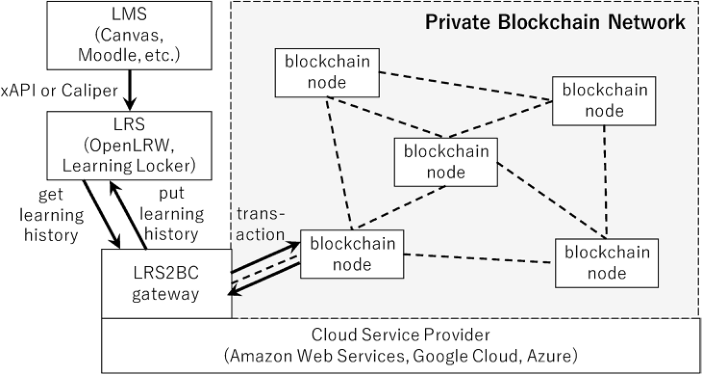
LEARNING HISTORY STORING FRAMEWORK WITH BLOCKCHAIN TECHNOLOGY In this section, we describe a blockchain-based learning history store. Figure 1 shows the concept of the proposed framework. LMSs such as Can- vas LMS and Moodle are implemented an interface to export learning history to the LRS.
The data integration interface between LMS and LRS is realized as Expe- rience API (xAPI) (Experience API, 2013) and Caliper Analytics (Caliper Analytics, 2015), it is implemented as a RESTful API.
The learning history output from the LRS is passed to the LRS to Blockchain gateway (LRS2BC gateway), which is part of the proposed frame- work. The LRS2BC gateway is responsible for data input and output to the learning history store cluster, which is implemented as a private blockchain.
Figure 1: Blockchain based learning history storing framework.
One way to implement a blockchain network is to use a blockchain infrastructure that is already in operation, such as Ethereum (Ethereum, 2015). This can be achieved through the framework of Decentralized Appli- cations (Dapps) based on smart contracts. However, many Dapps have already been implemented on the Ethereum platform, and it takes a con- siderable amount of time to update the blockchain. In addition, since the Dapps are implemented in a public environment, privacy concerns remain.
In a private blockchain, the number of nodes that can participate in the blockchain is limited. This allows for a closed blockchain network, which means that the participants can be controlled. The private blockchain net- work eliminates privacy issues. The generated blockchain network is used only as a learning history store. It is therefore free from interference by other applications. Hyperledger Fabric (Hyperledger Fabric, 2015) can be used as a framework to build a private blockchain.
Designing a Learning History Storing Framework With Blockchain Technology 79
The peer nodes of a private blockchain are implemented on a cloud service such as AWS. Depending on the implementation of the blockchain frame- work, peer nodes are often implemented on Docker (Docker, 2013) con- tainers. Therefore, by running the Docker container on the virtual machine provided by the cloud service, the same blockchain can theoretically be con- figured on any cloud service. This means that the proposed private blockchain is not dependent on a single cloud service provider. The nodes can be dis- tributed horizontally across multiple cloud service providers, so that even if a cloud service provider experiences a service outage, the private blockchain in operation will not lose its functionality.
Pear nodes do not run only on the cloud service provider. On-premise servers are built to run peer nodes and Docker containers. By running peer nodes in this environment, a certain level of availability can be guaranteed in the event of a failure on the Cloud Service Provider’s side. However, the on- premise environment itself does not maintain sufficient availability against disasters, so it is only a complementary role.
EXPERIMENTAL USE AND RESULTS In this section, we describe the implementation of a prototype system built to verify the effectiveness of the proposed framework, and we describe experi- mental use and results. In order to verify the minimum functionality of the proposed framework, we did not build the system on multiple cloud ser- vice providers. Amazon Web Services was used as the cloud service for the prototype implementation. Multiple virtual machine instances were created using Amazon Elastic Compute Cloud (EC2), an AWS virtual machine ser- vice, and docker packages were installed in each instance. Hyperledger Fabric was installed in each virtual machine instance and configured as a peer node.
Table 1 shows the environment used to build the prototype implementation.
Table 1. Component specification of prototype system.
Table available in the original PDF paper.
Item Specification AWS EC2 instance type t2.small AWS EC2 instance image Amazon Linux 2023 Hyperledger Fabric version v2.5.0 Learning Locker version v7.1.1
An EC2 instance was generated on a Virtual Private Cloud (VPC) of AWS, and Learning Locker was implemented as the LRS. A private blockchain was created using Hyperledger Fabric. Five blockchain peer nodes were gener- ated and deployed for functional verification. In order to verify the minimum functionality, Learning Locker and the blockchain network were placed in the same VPC. It was confirmed that the generated transactions were recorded in the ledger according to the chaincode script as smart contract.
In this evaluation experiment, a single VPC is configured on a single cloud platform. In other words, both LRS and blockchain networks are configured on a single VPC. In the future, we will verify whether private blockchains
can function as an overlay network in the cloud by using virtual machines configured on multiple cloud service providers as the operating platform.
Cloud service providers each offer blockchain services. AWS offers Ama- zon Managed Blockchain, Google Cloud offers Blockchain Node Engine, and Oracle Cloud Infrastructure offers Blockchain Platform as managed services. While these managed services make it relatively easy to create a blockchain network, it is not possible to configure a blockchain network that spans other cloud service providers. Manual configuration of blockchain nodes is still required to configure a blockchain network as an overlay to multiple cloud service providers.
CONCLUSION
In this paper, we described the current situation of severe disasters caused by climate change and urban destruction caused by the war in Ukraine, and then identify the problems of maintaining learning histories using existing cloud services. Secondary, we described to clarify the problems of learning history store using existing cloud services. Then, we described a proposal and concept of a learning history store based on a private blockchain. Finally, we described the results of an evaluation experiment to verify the effectiveness of the proposed system.
In the future, we plan to refine the design of the private blockchain that constitutes the learning history store and to improve its availability by, for example, configuring the private blockchain as an overlay network spanning AWS and Google Cloud.
ACKNOWLEDGMENT
This work was supported by JSPS KAKENHI Grant Numbers 21K02844, 22K12292.
REFERENCES
Amazon DocumentDB (2019). Amazon DocumentDB Website: https://aws.amazon .com/documentdb/, Accessed July 13, 2023. BBC News (October 14, 2022). “Climate change: Summer 2022 smashed dozens of
UK records”, BBC News Website: https://www.bbc.com/news/science-environme nt-63244353. Caliper Analytics (2015). IMS Global Learning Consortium, Caliper Analytics Website: https://www.imsglobal.org/activity/caliper, Accessed July 20, 2023. Canvas LMS (2015). Canvas LMS Website: https://www.instructure.com/en- au/canvas, Accessed July 5, 2023. Docker (2013). Docker Inc., Docker Website: https://www.docker.com/, Accessed
July 22, 2023. Ethereum (2015). Ethereum Website: https://ethereum.org/, Accessed July 20, 2023. Experience API (2013). xAPI Website: https://xapi.com/, Accessed July 20, 2023. France24 News. (July 19, 2022). “As France battles wildfires, experts call for a rethink of forest management”, France24 News Website: https://www.france24 .com/en/europe/20220719-as-france-battles-wildfires-experts-call-for-a-rethink -of-forest-management.
Designing a Learning History Storing Framework With Blockchain Technology 81
Hyperledger Fabric (2015). Hyperledger Foundation, Hyperledger Fabric Website: https://www.hyperledger.org/projects/fabric, Accessed July 22, 2023. Learning Locker (2013). Learning Locker Website: https://learningpool.com/ learning-record-store/, Accessed July 5, 2023. MongoDB (2009). MongoDB Website: https://www.mongodb.com/, Accessed July 10, 2023. Moodle LMS (2001). Moodle Website: https://moodle.org/, Accessed July 5, 2023. United Nations News (May 5, 2023). “WHO chief declares end to COVID-19 as a
global health emergency”, UN News Website: https://news.un.org/en/story/2023/ 05/1136367.
LISTED IN THE AHFE DIGITAL BOOKSTORE CATALOGUE
Explore the complete digital volume
Application of Emerging Technologies
Read this individual research paper free through the original publisher, or explore the full digital proceedings book.
ISBN 978-1-958651-91-9
Explore this ISBN in the AHFE Bookstore ↗Listed in the July 2026 bookstore catalogue; search by ISBN to confirm current availability · Digital book purchase optional