Zhanna Gabbassova (2025). An Alternative Approach to Distributed Data Communication Systems. In: Human Interaction and Emerging Technologies (IHIET-AI 2025): Artificial Intelligence and Future Applications. AHFE Open Access, vol. 161, pp. 225–231. https://doi.org/10.54941/ahfe1005913
In today's increasingly interconnected world, the demand for efficient, resilient and fault tolerance distributed data communication systems is paramount. This research explores a novel alternative approach to address the challenges of traditional distributed systems. The study investigates the integration of cutting-edge technologies, such as decentralized networks, blockchain, and Software-Defined Wide Area Network (SD-WAN), to revolutionize data communication. This alternative approach aims to enhance system efficiency, scalability and reliability while reducing vulnerabilities associated with centralized systems. By leveraging decentralization principles, networking automation approaches and distributed ledger technology, it prioritizes data efficiency, integrity, security, presenting a transformative vision for network infrastructure. This research contributes to the ongoing discussions about distributed data transmission systems. It opens up a new perspective and paves the way for future achievements in this field.
Distributed data communication systems have become the backbone of modern information exchange, supporting a plethora of applications from cloud computing to the Internet of Things (IoT). These systems have traditionally relied on centralized architectures, which, while functional, pose significant challenges, including single points of failure, data security vulnerabilities, and scalability issues. In response, this research explores an alternative approach, leveraging decentralization principles, networking automation, and distributed ledger technology to address these challenges and open the door for future advancements in the field of data communication. This paper delves into the fundamental shifts in design philosophy, aiming to develop systems that not only optimize data efficiency but also present a paradigm shift, offering a pioneering perspective on Software-Defined Wide Area Network (SD-WAN) systems.
While distributed data communication systems present a robust infrastructure for modern information exchange, they often grapple with a prevalent challenge: the trade-off between consistency and availability. In distributed systems, ensuring consistency of data across various nodes while maintaining high availability becomes a complex task. The ‘CAP theorem,’ proposed by Brewer in 2000, posits that in a distributed system, it
is impossible to simultaneously achieve consistency, availability, and partition tolerance. This theorem accentuates the predicament faced by distributed systems architects: a need to strike a delicate balance between these three attributes.
The pursuit of consistency across all nodes in a distributed system could potentially lead to decreased availability or increased response times, especially in the face of network partitions or failures. On the other hand, prioritizing availability may compromise the integrity of data consistency, leading to eventual conflicts or discrepancies within the system.
This inherent conflict has fueled a quest for innovative solutions that can navigate this delicate equilibrium. Our research delves into this precise challenge, seeking alternative methodologies that, while harnessing decentralization and automation, also address this fundamental conundrum in distributed systems architecture.
In the realm of distributed networks, Software-Defined Wide Area Network (SD-WAN) solutions have emerged as a promising technology, offering centralized control and dynamic management of network traffic. However, the implementation of SD-WAN introduces its own set of challenges. While SD-WAN systems promise flexibility and cost-efficiency, they are confronted with issues related to fault-tolerance, excessive traffic and security vulnerabilities, particularly in the context of widely distributed data communication.
BLOCKCHAIN BASED NETWORKING In this research, we delve into the innovative realm of blockchain-based networking. It’s important to clarify that in the context of this research, ‘blockchain’ transcends the traditional associations with cryptocurrency and financial systems. Instead, we explore the technology from the standpoint of reliable synchronization across all nodes involved. We view it as a powerful broadcast system that can be developed as a robust alternative to traditional SD-WAN solutions for distributed networks. This blockchain-based approach not only addresses the challenges posed by centralized architectures but also opens the door to a pioneering perspective on Software-Defined Wide Area Network (SD-WAN) systems within the broader framework of distributed data communication.
Why SD-WAN is Not a Panacea in Distributed Automated Networks ISD-WAN (Software-Defined Wide Area Network) is a pivotal technology reshaping the landscape of modern network architectures. SD-WAN fundamentally revolutionizes how data is transmitted across geographically dispersed locations by utilizing software-defined networking techniques.
SD-WAN represents a shift from traditional, hardware-centric network infrastructures towards a software-driven approach. It offers dynamic, centralized control over network traffic management, providing agility, flexibility, and efficiency in data transmission. This technology optimizes the use of available network resources by dynamically steering traffic based on predefined policies and network conditions.
An Alternative Approach to Distributed Data Communication Systems 227
Moreover, SD-WAN introduces the concept of overlay networks, which operate independent of the underlying physical network. By abstracting the control plane from the data plane, SD-WAN enables centralized management, allowing for rapid configuration and real-time adjustments to network policies and traffic routing. This capability results in improved application performance and efficient utilization of network resources.
However, despite its transformative capabilities, SD-WAN faces various challenges in real-world implementations, including issues with scalability, security vulnerabilities, complex management, and the limitations of point-to-point communication for transmitting controller messages. These challenges prompt the exploration of alternative solutions, such as the innovative application of blockchain-based networking, which your research endeavours to explore as a reliable, decentralized, and scalable alternative for SD-WAN systems in distributed networks.
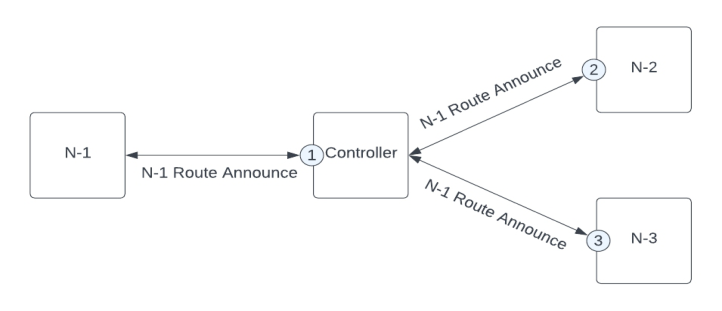
Using point-to-point connectivity in Software-Defined Wide Area Network (SD-WAN) systems introduces challenges centred on the risk of single points of failure, heightened latency due to individual message transmission, and limited scalability complexities. These drawbacks include the vulnerability to single points of failure affecting the entire network, increased latency attributed to the accumulation of individual message paths, and limited scalability, hindering effective network expansion and management due to intricate individual connection handling. In the following diagram, I will review the default SD-WAN networking approach, specifically addressing the architecture of point-to-point – client-to-controller, and its associated drawbacks. Let’s observe the current packet flow for a comprehensive understanding of the present setup (Figure 1).
As illustrated in the diagram, the updating process within the SD-WAN network reveals a significant number of asynchronous steps required for disseminating updates across the nodes. For instance, in a network topology comprising 3 SD-WAN nodes and 1 controller, it is evident that
228 Gabbassova
3 asynchronous steps are necessary to update each member of the network with only one route update from the N-1 node. Extrapolating this scenario, in a larger network of, for example, 100 SD-WAN nodes, the process would necessitate a staggering 100 asynchronous steps to propagate a single route update across the entire network.
This scenario underscores not only the issue of time delays in updating the network but also, significantly, the overarching concern of a single point of failure within this architecture. In a network of 100 SD-WAN nodes dependent on a single controller, the potential risk is immense. The failure of this single controller could result in a complete halt in communication across all 100 nodes until the controller is restored, leading to critical disruptions and network downtime. This vulnerability emphasizes the urgent need for a more resilient and fault-tolerant network architecture that mitigates the risks associated with a single point of failure.
Blockchain Based Pipeline Synchronization As we approach the core of this research, it becomes evident that the inherent limitations of the prevalent point-to-point server-client architecture in SD-WAN networks demand a paradigm shift. It is at this juncture that we propose a state-of-the-art approach designed to address and resolve these downsides comprehensively. Not only does this innovative approach aim to rectify the challenges of SD-WAN architecture, but it also fosters a novel telecommunications approach capable of immediate, distributed data updates across the entirety of the network. The forthcoming sections will delve into the intricate details of this cutting-edge methodology, offering a solution that revolutionizes the conventional infrastructure and serves as a gateway to a more resilient and efficient network architecture.
The adoption of blockchain technology as a synchronous, fault-tolerant data pipeline presents a ground-breaking departure from the default point-to-point messaging method within SD-WAN systems. By harnessing blockchain capabilities, this approach revolutionizes data synchronization, offering decentralized fault tolerance and synchronized communication across network nodes.
This alternative architecture ensures that each network node retains individuality while simultaneously participating in a synchronized network. This decentralized structure obviates the necessity for a central controller, guaranteeing continuous synchronization across the network. In the event of a node failure, the blockchain-based system facilitates rapid recovery upon reconnection to the network, eliminating the vulnerability associated with a single point of failure and ensuring uninterrupted network operation.
Furthermore, the proposed blockchain model streamlines data transmission by establishing an efficient, synchronized pipeline among all network nodes. This mechanism ensures immediate and uniform updates without the reliance on a central control point, significantly reducing the multi-step process inherent in traditional point-to-point communication methods.
An Alternative Approach to Distributed Data Communication Systems 229
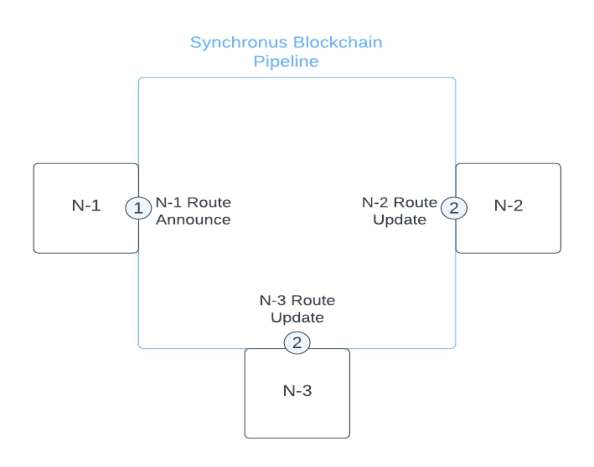
With a comprehensive vision of the proposed concept, an illustrative diagram delineating the data flow, which will be provided next (Figure 2), will complement the ensuing discussion. This diagram elucidates the practical manifestation and operational flow of the concept I propose. In the diagram provided, the streamlined data flow demonstrates a significant improvement in the transmission of Route Update announcements across the network.
The illustration highlights a succinct two-step process: first, N-1 publishes the Route Announcement, and second, the remaining N-n nodes promptly receive the Route Update while subscribed to the Blockchain data pipeline. This efficient process consistently ensures that the transmission takes only two steps, regardless of the number of nodes within the infrastructure.
Figure 2: Blockchain based data pipeline and subscriber model route update flow.
This reduction in necessary steps to update the entire network represents a marked improvement in the update propagation process, enhancing the network’s efficiency and diminishing the complexities associated with updating larger networks. In alternative terms, this technological advancement signifies a controllerless iteration of SD-WAN. It shifts the traditional controller function to the individual nodes, enabling the distribution of core computational processes. This innovative framework empowers the end nodes, expediting the network’s convergence process. Moreover, it facilitates the manipulation of networks and the swift integration of updates among neighbouring nodes, aligning with the connectivity speed. This transformative approach decentralizes control, significantly accelerating the network’s adaptability and enhancing the efficiency of data dissemination and system convergence.
230 Gabbassova
Security and Fault Tolerance Aspects In examining the security and fault tolerance aspects, it’s essential to note that within the SD-WAN framework, the commonly utilized IPSEC protocol for data encryption, while widespread, may not always provide the level of security and efficiency desired, particularly when relying on statically generated certificates. Concerns arise as IPSEC has been observed to potentially consume over 30% of data throughput, posing a significant impact on network performance. In contrast, blockchain technology is renowned for its robust security attributes, utilizing hashes and consensus algorithms adopted by nodes. Leveraging these features presents a notable opportunity to ensure robust data transmission security.
Notably, the fundamental concept we have developed within the blockchain technology pertains to a distributed Public Key Infrastructure (PKI) algorithm.
This architecture enables an automatic rotation and alteration of security protocols based on blockchain hashes. These changes are implemented in an automated manner, regulated by a timer set by the user. This adaptable and dynamic approach ensures the continuous evolution and fortification of security measures, a crucial aspect in mitigating potential security threats and ensuring data integrity within the network.
Fault tolerance serves as a pivotal aspect shaping our research approach. In the proposed system architecture, true distribution is a defining characteristic. Any node within the network can go offline, yet the network remains operational. However, beyond this crucial feature lies an integral aspect of restoration. Upon a node’s return to online status, it automatically synchronizes its database by comparing it with other network nodes. This methodology grants us the capability to maintain and continuously synchronize an N number of nodes throughout the network. This functionality empowers ensuring robust fault tolerance, seamless network operation and users to consistently verify, compare, analyse, and restore databases as required.
CONCLUSION
In the current landscape, the proliferation of network devices, servers, smartphones, and IoT systems has heightened the urgency for swift, uninterrupted access to networks. This scenario has given rise to a demand for new methodologies and advancements in technology. In response, the research advocates a state-of-the-art paradigm that not only redefines the architecture of SD-WAN but also reimagines the broader realm of distributed systems architecture.
The proposed approach centers on the utilization of a blockchain-based data pipeline. This revolutionary framework offers a departure from the traditional linear, point-to-point methodologies. Instead, it introduces a novel methodology where clients connect to a synchronized blockchain-based system, enabling the simultaneous reception of requisite information. This transformative shift reflects a fresh perspective on the prevailing challenges in network systems.
An Alternative Approach to Distributed Data Communication Systems 231
By embracing this innovative model, the approach emphasizes the core principles of distribution, independence, security, and fault tolerance within network systems. This departure from the conventional sequential approach is aimed at addressing the intricacies and vulnerabilities of modern networks. The infusion of decentralized, secure, and fault-tolerant features aims to instigate a robust, adaptive, and resilient network architecture, catering to the evolving demands and challenges of today’s intricate network environments.
REFERENCES
Awasthi, A. (2020). SD-WAN (Software Defined-WAN) Technology Evaluation and Implementation. Global Journal of Computer Science and Technology. Retrieved from https://globaljournals.org/GJCST_Volume20/1-SDWAN-Software-Defined -WAN.pdf. Brewer, E. (2000). Towards Robust Distributed System. Proceedings of the 19th
Annual ACM Symposium on Principles of Distributed Computing (PODC), 7–10. Gooley, J., Yanch, D., Schuemann, D., & Curran, D. (2020). Cisco Software-Defined Wide Area Networks: Designing, Deploying and Securing Your Next Generation WAN with Cisco SD-WAN. Cisco Press. Michel, O., & Keller, E. (n.d.). SDN in Wide-Area Networks: A Survey. Retrieved
from https://olivermichel.github.io/doc/sdwan-sds17.pdf.
LISTED IN THE AHFE DIGITAL BOOKSTORE CATALOGUE
Explore the complete digital volume
Human Interaction and Emerging Technologies (IHIET-AI 2025): Artificial Intelligence and Future Applications
Read this individual research paper free through the original publisher, or explore the full digital proceedings book.
ISBN 978-1-964867-37-3
Explore this ISBN in the AHFE Bookstore ↗Listed in the July 2026 bookstore catalogue; search by ISBN to confirm current availability · Digital book purchase optional