Stefan Oelbracht, Andreas Kneißler (2023). Addressing the Practical Challenges of Implementing Blockchain in Engineering and Manufacturing. In: Application of Emerging Technologies. AHFE Open Access, vol. 115, pp. 165–174. https://doi.org/10.54941/ahfe1004313
This paper describes the state of the art and the potential for realized application of blockchain technology in the machinery and equipment industry for secure exchange of process and product data between the supplier and the customer.Since its introduction and increasing popularity in the financial industry, Blockchain has become a transformative technology with significant impact on various industries. It has attracted significant attention and interest in sectors such as supply chain management, insurance, and agriculture. The use of blockchain in manufacturing and engineering is even more novel.By providing a decentralized and immutable ledger, blockchains can enable secure and transparent transactions, streamlined supply chain management, improved traceability of products, and greater trust in the integrity and validity of data between participants in a network.Aside from cryptocurrencies, interest, understanding, use, and implementation of blockchain technology are still at an early stage. Consequently, blockchain technologies are still encountering various problems and limitations. These include excessive energy consumption for computational tasks, suboptimal efficiency of consensus mechanisms, significant computational overhead in network systems, and low transaction throughput rates. The significant latency in transactions can lead to uncertainty among participants. In addition, blockchain is not suitable for current engineering and manufacturing applications due to its high energy requirements and the need for high computational power, large storage space, and high CPU power for the consensus algorithms.In reviewing the existing literature, it becomes evident that while a significant amount of research has been conducted on blockchain applications in various fields, the focus has been primarily on descriptive and theoretical proposals. Despite the increasing focus on research and the growing number of published papers on blockchain applications outside of cryptocurrencies, there is a distinct lack of empirical studies that provide an accurate analysis of the technology's effectiveness in practice.While new frameworks are being proposed that attempt to address these issues and limitations, their validation and testing in real-world operational environments is limited.The limited number of cases in the literature addressing the operational implementation of blockchain-based approaches indicates that significant practical challenges, such as the speed of communication between machines, must be resolved before the technology can gain widespread adoption beyond the cryptocurrency space.With this in mind, it is critical to test blockchain applications in some real industrial environments to determine their viability and address any practical shortcomings. Identifying and addressing these challenges will be necessary to improve the effectiveness and efficiency of Blockchain-based systems.In addition, it is imperative to investigate whether blockchain approaches are suitable for manufacturing and engineering applications. This can be achieved by exploring potential hybrid systems that incorporate proven data management approaches, especially for simple components (e.g., temperature sensors). The aim is to ensure optimal performance and minimize potential risks and unnecessary complexity without sacrificing the positive aspects such as anti-counterfeiting and barrier-free data availability.
In recent years, blockchain technologies (BCT) and their data management approaches have gained substantial attention due to their potential to rev- olutionize multiple industries like agriculture, supply chain, insurance, and finance (Chen et al., 2022). However, there’s a growing interest in applying BCT to engineering and manufacturing (M&E) processes at an increasing rate and scope (Kasten, 2020). The value of incorporating blockchain (BC) lies in its ability to create a reliable ecosystem, ensuring the integrity of critical manufacturing data and enabling seamless integration of smart manufactur- ing practices, such as digital twins (Kobzan et al., 2022; Hasan et al., 2020). BC’s decentralized and secure data management capabilities offer promising
solutions to enhance transparency, traceability, and efficiency in manufac- turing (Guo, Zhang, and Zhang, 2022). Corporations have recognized these prospects and established research initiatives and consortia to advance BC implementation, evident through participants like IBM, Bosch, Siemens, Visa, and Fujitsu in the Hyperledger project by the Linux Foundation (Members | Hyperledger, no date). Additionally, the transformative potential of dis- tributed ledger technologies (DLT) prompted the International Organization for Standardization (ISO) to create the technical committee “ISO/TC:307 Blockchain and distributed ledger technologies,” specifically focusing on standardizing these technologies to overcome integration challenges. While significant research and effort have been dedicated to DLT advancement, the combination of BC and smart manufacturing is still in its nascent stages and confronts numerous technical challenges (Guo, Zhang, and Zhang, 2022). As Kasten (2020) indicates, much of the existing research lacks practical vali- dation through experiments and real-world application. Addressing practical challenges of implementing BC in an industrial context, especially where real- time requirements are crucial, is complex (Garrocho et al., 2020). Through empirical studies, valuable insights can be gained into the successful integra- tion of BC solutions and their impact on smart manufacturing. Building upon Garrocho et al.’s (2020) work, the objective is to develop a solution that facil- itates blockchain-based machine-to-machine communication (M2M) while upholding real-time requirements. Once achieved, deeper BC integration into manufacturing processes becomes feasible. The remainder of this paper is structured as follows: Section II delves into existing literature and research on implementing BC in M&E, highlighting the scarcity of empirical studies, and outlining practical BC challenges. Section III outlines specific research objectives aimed at bridging these gaps and evaluating the practicality of implementing BC in industrial settings.
BACKGROUND AND RELATED WORK Blockchain and Smart Contracts
BC is a decentralized and immutable digital ledger technology (DLT), enables secure and transparent transaction recording across a distributed node net- work. Unlike centralized databases, it operates peer-to-peer, allowing trust- less transactions (Chen et al., 2022). While the terms BC and Distributed Ledger Technology are often used interchangeably, BC refers to the realiza- tion of a distributed ledger (Isaja and Soldatos, 2018). This paper employs both terms synonymously. A BC comprises cryptographically linked blocks, each containing transactions and optional data. Tampering with a block invalidates subsequent blocks, ensuring data transparency and immutability (Mohamed and Al-Jaroodi, 2019). In M&E, BC presents multiple advan- tages. It provides an improved view of the production process and associated supply chain, allowing enhanced traceability (Westerkamp, Victor, and Küp- per, 2020). This visibility enhances efficiency and responsiveness, particularly for recalls and quality control. BC also enables smart contracts, automating processes without intermediaries (Garrocho et al., 2020). In manufacturing,
Addressing the Practical Challenges of Implementing Blockchain 167
these contracts can streamline compliance checks and inventory manage- ment, reducing costs. Moreover, BC’s decentralized structure heightens data security (Mohamed and Al-Jaroodi, 2019), a critical aspect in engineering applications (Mandolla et al., 2019). By offering transparent, traceable, and secure transactions, BCT holds significant promise for transforming M&E sectors.
Industry 4.0 and the Industrial Internet of Things (IIoT) The IIoT and Industry 4.0 are two interconnected concepts that are rev- olutionizing the landscape of modern industries. The IIoT refers to the integration of physical devices, sensors, and machines with the internet, enabling them to collect, exchange, and analyze data autonomously. This interconnectedness empowers industries to achieve real-time monitoring, data-driven decision-making, and enhanced efficiency. On the other hand, Industry 4.0 represents a comprehensive paradigm shift in manufacturing, characterized by the fusion of cutting-edge technologies such as IIoT, artifi- cial intelligence, big data analytics, and advanced robotics. Industry 4.0 aims to create so called “smart factories,” where machines and systems can com- municate and cooperate with one another seamlessly (Gambhire, Guja and Pathak, 2019). The overlapping nature of IIoT and Industry 4.0 lies in the common goal of leveraging digital technologies to drive industrial transfor- mation. IIoT serves as a foundational component of Industry 4.0, providing the necessary infrastructure for data acquisition and communication (Piv- oto et al., 2021). Through IIoT, sensors and devices collect vast amounts of data from machines and production processes, contributing to the creation of data-driven insights in Industry 4.0. The integration of IIoT within Industry 4.0 enables unprecedented levels of automation and connectivity throughout the entire value chain. Data gathered from IIoT devices enables intelligent decision-making and predic- tive maintenance, leading to increased productivity and cost savings. By combining IIoT with artificial intelligence and advanced analytics, Industry 4.0 empowers businesses to optimize manufacturing processes, personalize products, and respond rapidly to changing market demands.
M2M Communication At its core, M2M describes the fundamental concept of direct communica- tion and interaction between any connected devices. As it consists of three main components. A data end point, a communication network and da data integration point. In this regard M2M is not a novel concept and the basis of every logic-controller, SCADA-System, or any other system where infor- mation needs to be exchanged. (Martins, Gonçalves and Petroni, 2019) A sensor that sends a signal to an actor could be interpreted as a basic M2M- Network. But in the rapidly evolving landscape of Industry 4.0 and the IIoT, enabling more complex forms of M2M becomes ever more impor- tant (Martins, Gonçalves and Petroni, 2019). Devices, particularly smart and intelligent ones, with the ability to communicate with each other in a reliable and efficient manner are the basis for a comprehensive automation
168 Oelbracht and Kneißler
and digitalization of industrial processes. This interconnectedness is a central concept for this transformation, where devices, machines, and systems are forming a cohesive network and ecosystem of cyber-physical systems. M2M serves as a linchpin in establishing these connections between entities and thereby, empowering them to share data and collaborate in real-time. Further- more, M2M empowers industries to gather and analyze vast streams of data, enabling data-driven decision-making and process improvement. The real- time insights gained from interconnected devices facilitate agile responses to dynamic production requirements and enable the achievement of higher levels of operational efficiency and productivity (Martins, Gonçalves and Petroni, 2019). In the context of IIoT, M2M extends beyond traditional machine con- nectivity to encompass a wide array of smart devices, sensors, and actuators that permeate industrial processes.
Digital Twin A digital twin presents virtual representation of a physical object, process, or system, with the aim of capturing its entire lifecycle and characteristics in a digital format. This virtual replica is continuously updated with real- time data from sensors, providing a dynamic and accurate reflection of the physical counterpart (Vilas-Boas, Ridrigues and Alberti, 2023). The main reason for adopting a digital twin approach is its ability to enhance decision- making and optimize performance throughout the product lifecycle. During the design phase, engineers can use digital twins to simulate and test var- ious scenarios, identifying potential flaws and make improvements before physical production even begins. This streamlines the development process, reduces costs, and accelerates time-to-market (Mandolla et al., 2019). In manufacturing, digital twins play a pivotal role in monitoring and opti- mizing production processes. By collecting and analyzing data from sensors embedded in machines and equipment, manufacturers can assess perfor- mance, predict maintenance needs, and ensure quality control. This proactive approach can minimize downtime, reduces waste, and maximizes overall effi- ciency (Hasan et al., 2020). These benefits continue into the operational phase once the product is deployed (Mandolla et al., 2019). Furthermore, it can facilitate remote diagnostics and troubleshooting, minimizing the need for physical intervention. The digital twin’s capabilities extend beyond indi- vidual products to entire systems and factories. By integrating multiple digital twins into a larger digital twin ecosystem, manufacturers can gain a holistic view of their operations, enabling data-driven decision-making and process optimization on a larger scale.
Related Research In our literature research we found several reviews and surveys discussing the current literature on BC, industry 4.0, IIoT and their implementation in M&E. Though not as comprehensive our experience matched the findings by Kasten and Guo et al. First we will explore some use cases of BCT in an industrial context and then further explore the research gap mentioned in the introduction. As BC as shown great potential for a transparent, secure, and
Addressing the Practical Challenges of Implementing Blockchain 169
traceable process in several industries (ISO, 2022; Chen et al., 2022) there is no shortage of possible use cases for this technology in M&E since it offers various advantages. Addressing issues such as system coordination, trust, data sharing and security issues (Guo, Zhang, and Zhang, 2022). In their work Mandola et al., conceptualized a way to exploit BCT to form the basis for a digital twin of an additively manufactured part for the aircraft industry. By separating the production process into observable phases and creating a block for each of these that contains a record of all relevant sensor data and engineering documents identified by their digital signature. Thus, creating an immutable digital twin of the product that can be used for e.g., an analy- sis in case of failure or for predictive maintenance, which is of paramount importance in the aircraft industry (Mandolla et al., 2019). Though there is a plethora of possible use cases, finding studies specifically focusing on the application of BCT in M&E proved quite challenging. As shown by Guo, Zhang, and Zhang (2022), a lot of research effort is focused on BCT and Industry 4.0. But the two topics are mostly researched separately and the research regarding the integration of BCT in modern industrial processes is still at a very early stage. Earlier reviews and surveys came to a similar conclu- sion (Martins, Gonçalves and Petroni, 2019; Leng et al., 2021; Chen et al., 2022). Thereby enforcing the findings by Guo, Zhang, and Zhang. (2022) Complementarily to this a systematic review of the literature on M&E by Kasten (2020), in which 110 publications were examined, found a severe lack of experimental data. Of these 110 publications only 13 included any empiri- cal analysis of their approaches. Of these 13 six performed an experiment and seven used a formal case study for demonstration. All other publications were theoretical or propositional in nature. Notwithstanding a substantial increase in the number of publications on this topic each year as well as growing sig- nificantly on a year-on-year basis, the identified issue persists. Leaving a lot of the practical challenges of this promising technology without a proven solution.
Practical Challenges and Limitations of Blockchain Technology As the research on this topic is still in its early stages, as mentioned before, several issues arise in the application of BCT. Although the issues of a specific implementation are deepened on the specific field of the implementation sev- eral key issues are found most publications regarding the topic. One of the most prevalent issues is the lack of performance of BCT, compared to estab- lished systems (Paik et al., 2019; Garrocho et al., 2020; Guo, Zhang and Zhang, 2022; Chen et al., 2022). This refers to the necessary energy as well as the computational performance. Though the main issue arises from the lack of computational efficiency several other problems derive themselves from this aspect. Such as high latency, low transaction rates, scalability of the sys- tem. As blocks can only be appended with this technology large disk-space consumption as well as several problems that also occur in other big-data applications are problems that need to be considered. These problems lead to an overall worse performance than traditional database solutions, which makes BC in its current form not yet suitable for IoT devices and thereby
170 Oelbracht and Kneißler
also the IIoT and modern industrial processes in general (Yun, Goh, and Chung, 2020).
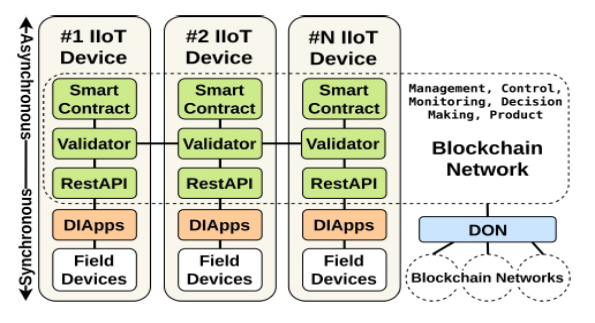
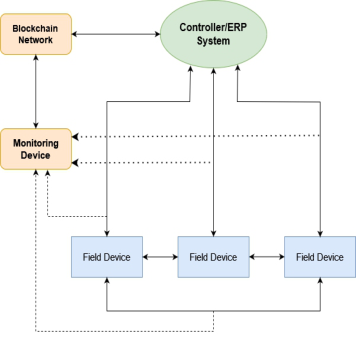
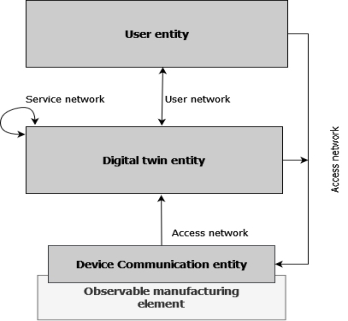
RESEARCH OBJECTIVES Our primary goal is to provide empirical evidence regarding the feasibility of BC applications in M&E, potentially resolving practical implementation challenges. Our intention is to design a system utilizing DLT that extracts data directly from the industrial process without disruption while retaining DLT and IIoT advantages. In their approach Garrocho et al. (2020) facilitated M2M through a BC network, addressing the time-critical aspect of this foun- dational layer (see Figure 1). Our approach seeks to maintain this essential communication with consistent latency. We propose introducing a monitor- ing device at the physical layer of the OSI Model, without altering the current communication infrastructure (see Figure 2). This device, serving as both a BC network node and an edge computing unit, ensures reliable communi- cation. The monitored signals are then incorporated into the BC network, possibly pre-filtered. This should eliminate the computationally demanding consensus mechanism from IIoT devices, averting interference with the pro- cess’s time-sensitive demands. This approach follows a similar structure to the reference architecture for digital twin models in ISO-23447-4 FIG-A.1., of which a simplified version is shown in Figure 3 where the digital twin receives information from the OMEs and the user entity the network these use to communicate.
Figure 1: Blockchain-based M2M communication architecture to IIoT. (Adapted from Garrocho et al., 2020.)
This approach uses DLT to their strengths namely immutability. By record- ing and immutably saving process data the basis for a secure digital-twin model is created by default, as all data created by producing machines would be immutably stored. Furthermore, as the monitoring device would listen in on currently existing communication infrastructure this would not need to be changed and would therefore fit on most legacy systems. As pointed out by Garrocho et al. (2020) the primary factor the main factor for the high
Addressing the Practical Challenges of Implementing Blockchain 171
variability in the latency are the amounts of operations performed on the BC which is due to its standard operation and consensus algorithm. They used a Proof of Elapsed Time (PoET) consensus mechanism for permission- less BC networks. PoET and other Nakamoto-type consensus mechanism assume a permissionless network of nodes and try to discourage the distribu- tion of faulty or malicious information through their consensus mechanism (Nakamoto, 2008) In most industrial contexts it can be assumed that all nodes in the network are known and trusted, therefore limiting the need for Nakamoto-type consensus algorithms.
Figure 2: Blockchain-based M2M communication architecture to IIoT.Figure 3: Information exchange example between OMEs, user and digital twin, simplified. (Adapted from IS, 2021.)
Consensus mechanisms for permissionless networks such as practical byzantine fault tolerance would be appropriate inside a factory as they tend to be faster than Nakamoto-type consensus algorithms, depending on the metric observed (Guo, Zhang, and Zhang, 2022). Consensus-mechanisms for permissionless as well as permissioned networks should tested and compared
172 Oelbracht and Kneißler
regarding their viability in an IIoT-Context. Possible metrics for this compar- ison are Read Latency, Read Throughput, Transaction Latency, Transaction Throughput (Hyperledger Blockchain Performance Metrics White Paper | Hyperledger, no date). Data for these metrics should be collected under varying circumstances such as node distance, consensus mechanism and num- ber of nodes to be able to check for scalability of the approach. We expect that this approach will allow for communication in the device layer while in compliance with time-sensitivity requirements of real-time applications in an IIoT-Environment and enable a save and immutable storage of production data for further use.
Scope and Limitations At first a viable solution that allows for communication with, between and control of industrial processes in accordance with their specific requirements and allows for immutable storage via a BC based network must be estab- lished. This paper and therefore our initial approach focuses on this aspect first and foremost. Additionally, our approach as well as the approach by Garacho et al. (2020) does not yet address possible security and data validity issues on the data-transport layer. Further practical challenges will arise in this approach, but they do offer great opportunity to address and solve them. Some of these are discussed in the following section.
Future Research Goals As this approach would circumvent the challenges encountered by Garro- cho et al. (2020) edge computing devices could be added in the future to further improve the performance of the BC network. For example, by filter- ing the monitored signals to reduce the size of the BC (Barenji et al., 2019). After the device layer different BC approaches with methods that are to slow for the device layer but offer greater security and better methods for data analytics, could still be viable as the requirements for industrial automation and control systems differ from a typical IT-network (Didier, 2012). Further the question if at one point in the networks communication layers the whole communication can be based on a BC network or if mirroring all the network communication via monitoring devices to a BC network, used for storage and data analysis, but not direct communication with and between IIoT-devices, is a viable solution offers further research opportunity.
ACKNOWLEDGMENT
We acknowledge support by the Open Access Publication Fund of the Westfälische Hochschule, University of Applied Science.
REFERENCES
Barenji, A. V., Li, Z., Wang, W. M., Huang, G. Q. and Guerra-Zubiaga, D. A. (2019).
Blockchain-based ubiquitous manufacturing: a secure and reliable cyber-physical system. International Journal of Production Research, 58(7), pp. 2200–2221. doi: https://doi.org/10.1080/00207543.2019.1680899.
Addressing the Practical Challenges of Implementing Blockchain 173
Chen, Y., Lu, Y., Bulysheva, L. and Kataev, M. Yu. (2022). Applications of Blockchain in Industry 4.0: a Review. Information Systems Frontiers. doi: https://doi.org/10. 1007/s10796-022-10248-7. Didier, P. (2012). Reference Architectures for Industrial Automation and Control
System. 2012 ODVA Industry Conference & 15th Annual Meeting October 16- 18, 2012 Stone Mountain, Georgia, USA. Available at: https://www.odva.org/wp- content/uploads/2022/06/2012_ODVA_Conference_Didier_FINAL.pdf Gambhire, G., Gujar, T. and Pathak, S. (2018). Business Potential and Impact of Industry 4.0 in Manufacturing Organizations. 2018 Fourth International Con- ference on Computing Communication Control and Automation (ICCUBEA). doi: https://doi.org/10.1109/iccubea.2018.8697552. Garrocho, C. T. B., Klippel, E., Anderson Vieira Machado, Celio, Frederico, C. and
Augusto, R. (2020). Blockchain-based machine-to-machine communication in the industry 4.0 applied at the industrial mining environment. doi: https://doi.org/10. 1109/sbesc51047.2020.9277852. Guo, X., Zhang, G. and Zhang, Y. (2023). A Comprehensive Review of Blockchain Technology-Enabled Smart Manufacturing: A Framework, Challenges and Future Research Directions. Sensors, [online] 23(1), p. 155. doi: https://doi.org/10.3390/ s23010155. Hasan, H. R., Salah, K., Jayaraman, R., Omar, M., Yaqoob, I., Pesic, S., Taylor,
T. and Boscovic, D. (2020). A Blockchain-Based Approach for the Creation of Digital Twins. IEEE Access, 8, pp. 34113–34126. doi: https://doi.org/10.1109/ac cess.2020.2974810 Hyperledger Blockchain Performance Metrics White Paper | Hyperledger (no date).
Available at: https://www.hyperledger.org/learn/publications/blockchain-perfor mance-metrics. Hyperledger Foundation Supporting Members – Hyperledger Foundation. [online] Available at: https://www.hyperledger.org/about/members. Isaja, M. and Soldatos, J. K. (2018). Distributed Ledger Architecture for Automa-
tion, Analytics and Simulation in Industrial Environments. IFAC-PapersOnLine, 51(11), pp. 370–375. doi: https://doi.org/10.1016/j.ifacol.2018.08.321. International Organization for Standardization (2022). Blockchain and distributed ledger technologies – Use cases (ISO Technical Report No. 3242: 2022). https: //www.iso.org/standard/79543.html International Organization for Standardization (2021). Automation systems and
integration — Digital twin framework for manufacturing — Part 4: Informa- tion exchange (ISO Standard No. 23247-4:2021). https://www.iso.org/standard /78745.html Kasten, J. E. (2020). Engineering and Manufacturing on the Blockchain: A Systematic Review. IEEE Engineering Management Review, p. 1. doi: https://doi.org/10. 1109/emr.2020.2964224. Kobzan, T., Biendarra, A., Schriegel, S., Herbst, T., Muller, T. E. and Jurgen
Jasperneite (2018). Utilizing Blockchain Technology in Industrial Manufacturing with the help of Network Simulation. doi: https://doi.org/10.1109/indin.2018. 8472011. Leng, J., Ye, S., Zhou, M., Zhao, J. L., Liu, Q., Guo, W., Cao, W. and Fu, L.
(2021). Blockchain-Secured Smart Manufacturing in Industry 4.0: A Survey. IEEE Transactions on Systems, Man, and Cybernetics: Systems, 51(1), pp. 237–252. doi: https://doi.org/10.1109/tsmc.2020.3040789. Mandolla, C., Petruzzelli, A. M., Percoco, G. and Urbinati, A. (2019). Building a digital twin for additive manufacturing through the exploitation of blockchain: A case analysis of the aircraft industry. Computers in Industry, 109, pp. 134–152. doi: https://doi.org/10.1016/j.compind.2019.04.011.
174 Oelbracht and Kneißler
Martins, G. D., Gonçalves, R. F. and Petroni, B. C. (2019). Blockchain in manufacturing revolution based on machine to machine transaction: a systematic review. Brazilian Journal of Operations & Production Management, 16(2), pp. 294–302. doi: https://doi.org/10.14488/bjopm.2019.v16.n2.a10. Mohamed, N. and Al-Jaroodi, J. (2019). Applying Blockchain in Industry 4.0
Applications. [online] IEEE Xplore. doi: https://doi.org/10.1109/CCWC.2019. 8666558 Nakamoto, S. (2008). Bitcoin: a Peer-to-Peer Electronic Cash System. [online] Available at: https://bitcoin.org/bitcoin.pdf Paik, H.-Y., Xu, X., Bandara, H. M. N. D., Lee, S. U. and Lo, S. K. (2019). Analysis
of Data Management in Blockchain-Based Systems: From Architecture to Gover- nance. IEEE Access, 7, pp. 186091–186107. doi: https://doi.org/10.1109/access .2019.2961404. Pivoto, D. G. S., de Almeida, L. F. F., da Rosa Righi, R., Rodrigues, J. J. P. C., Lugli, A. B. and Alberti, A. M. (2021). Cyber-physical sys- tems architectures for industrial internet of things applications in Industry 4.0: A literature review. Journal of Manufacturing Systems, 58, pp. 176–192. doi: https://doi.org/10.1016/j.jmsy.2020.11.017. Vilas-Boas, J. L., Rodrigues, J. J. P. C. and Alberti, A. M. (2022). Convergence of Distributed Ledger Technologies with Digital Twins, IoT, and AI for fresh food logistics: Challenges and opportunities. Journal of Industrial Information Integration, p.100393. doi: https://doi.org/10.1016/j.jii.2022.100393. Westerkamp, M., Victor, F. and Küpper, A. (2019). Tracing Manufacturing Pro-
cesses Using blockchain-based Token Compositions. Digital Communications and Networks, [online] 6(2). doi: https://doi.org/10.1016/j.dcan.2019.01.007. Yun, J., Goh, Y. and Chung, J.-M. (2020). DQN based Optimization Framework for Secure Sharded Blockchain Systems. IEEE Internet of Things Journal, p. 1. doi: https://doi.org/10.1109/jiot.2020.3006896.
LISTED IN THE AHFE DIGITAL BOOKSTORE CATALOGUE
Explore the complete digital volume
Application of Emerging Technologies
Read this individual research paper free through the original publisher, or explore the full digital proceedings book.
ISBN 978-1-958651-91-9
Explore this ISBN in the AHFE Bookstore ↗Listed in the July 2026 bookstore catalogue; search by ISBN to confirm current availability · Digital book purchase optional