Mohammad Amin Kuhail, Jose Berengueres, Fatma Taher, Sana Khan (2024). Integrating Generative AI Into the Design Process: A Case Study on Space Haptic Boots. In: Human Interaction and Emerging Technologies (IHIET-AI 2024): Artificial Intelligence and Future Applications. AHFE Open Access, vol. 120, pp. 186–194. https://doi.org/10.54941/ahfe1004568
Developing a product that satisfies certain standards follows a methodical approach known as the design process. It involves multiple phases of requirement elicitation, analysis, conceptualization, and evaluation. Generative Artificial Intelligence (AI) tools like ChatGPT have impacted the design process in various engineering fields, but there is limited research on how to integrate AI tools into the design process effectively. In a case study, we used ChatGPT to design an innovative object - a space boot with haptic technology. We explored various prompt methods and found that the process is iterative, requiring multiple adjustments to the prompts. This research paper highlights the design process and its evaluation methods, discusses its limitations, and provides a plan for future improvements.
The design process is a crucial and systematic procedure that aims to create a product, solution, or object that meets specific requirements and objectives in a creative and organized way. The approach to the design process varies depending on the designer and their preferences (Coyne, 1990). However, in general, it involves multiple phases of requirement elicitation, analysis, con- ceptualization, and evaluation (Sl˘atineanu et al., 2021). The design process is highly iterative in engineering projects (Albert & Tullis, 2022; Yamada et al., 2022), meaning that it often involves repeating multiple phases before moving on to the next one. This iterative approach enhances the quality and functionality of the project by using feedback from the system as research for successive versions of the project.
The advent of generative Artificial Intelligence (AI) tools, such as Chat- GPT, has impacted the design process in various engineering fields (Ahmad
Integrating Generative AI Into the Design Process: A Case Study on Space Haptic Boots 187
et al., 2023; Ray & Majumder, 2023). Users of these tools engage in a process called “prompt engineering,” which involves carefully crafting their prompts to achieve the desired output. Prompt engineering is a systematic procedure by which a user can refine their input parameters to attain their desired out- put (Shin et al., 2020). It is often used in conjunction with task descriptions to provide additional guidance to a specific AI model. Prompt engineering is essentially a way of instructing AI to perform specific tasks. The rise of gener- ative AI tools and prompt engineering has led to concerns about their impact on the workforce. While AI tools have been found to increase productivity in complex tasks, they have also raised fears of job losses (Dell’Acqua et al., 2023). Despite recent studies reviewing the use of AI in various disciplines such as civil, structural, and design (Thai, 2022; Aloisio et al., 2023; Yüksel et al., 2023), the question of how to actually integrate them into the engineering process effectively. In this case study, we embarked on a project to design an innovative object - a space shoe with haptic technology. We utilized the power of ChatGPT to assume diverse stakeholder roles and assist in the compre- hensive haptic shoe design process, which included gathering requirements, creating prototypes, and executing a test plan. To evaluate the design space, we explored various prompt methods, such as zero-shot and super-prompt. Throughout the work, we found that the process is iterative in nature, requir- ing multiple adjustments to the prompt in order to effectively incorporate new contextual information and ensure its proper consideration. This research paper explores the specificities of the design process behind the creation of haptic shoes with ChatGPT and highlights the methods for evaluating the accuracy and effectiveness of the design. The study also discusses the limitations of our work and provides a plan for future improvements.
RELATED WORK
Historical Background on the Engineering Design Process The engineering design process consists of various disciplines and methods, such as Agile, Waterfall, and Lean UX (Roy et al., 2008; Beitz et al., 1996). All these methods have steps or phases that describe, categorize, and time- box the tasks needed for project completion. As technology evolves, so do these methods. For instance, Agile methodology would not have made sense in software development before collaboration tools such as email, chat, ver- sion control systems, and more than one computer per team became available. Agile methodology is now the most popular method in software development (Cohen et al., 2004). Interestingly, Agile’s origins lie in the hardware indus- try (Riby & Sutherland, 2016), showing how methodologies applied in one domain can be adopted and improved in other domains.
Generative AI Generative AI uses deep learning models to create human-like content (Lin et al., 2023). Recently, thanks to tools like OpenAI’s ChatGPT, pow- erful technology has gained popularity (Hu, 2023). Generative AI not only
presents a response but also creates content, surpassing Conversational AI in human-like interactions.
AI has had a profound impact on organizations, societies, and individuals. It excels in systematic reasoning, learning from input variations, predicting, and adapting to changes in its environment. In its early stages, AI primarily focused on supervised and unsupervised learning, drawing inspiration from nature and biology to computationally solve data-intensive problems. Tradi- tional AI algorithms, including neural networks, genetic algorithms, decision trees, random forests, support vector machines, and k-means clustering, were limited by their dependence on structured data for both model build- ing and information processing (Duan et al., 2019). Newer AI algorithms now handle unstructured data, emphasizing deep learning and reinforce- ment learning. Algorithms like convolutional and recurrent neural networks excel in analyzing diverse data, while industry demand has spawned Natu- ral Language Processing (NLP) algorithms like BERT, LSTM, and language models for automation (Kushwaha and Kar, 2021). These algorithms initially required abundant data and significant computational resources, posing chal- lenges for real-world applications. However, newer AI models like federated learning and tiny machine learning have addressed these issues and found adoption in industrial applications. They’ve tackled the “cold start problem,” where data for initial training is lacking. Additionally, reinforcement learning has gained prominence in marketing and financial management applications (Singh et al., 2022).
Generative AI, a new generation of AI, plays a vital role in various fields, with two notable examples being StyleGAN (Karras et al., 2019) and OpenAI’s GPT. StyleGAN, developed by NVIDIA, excels in generating diverse and highly realistic images through a style-based approach, expanding possibilities for digital art. OpenAI’s GPT series, particularly GPT-3, has rev- olutionized natural language processing by producing human-like text with exceptional fluency and coherence, advancing tasks like question answer- ing, essay writing, and conversation (Brown et al., 2020). These instances highlight generative AI’s transformative potential in creative industries, con- tent creation, and human-machine interaction, paving the way for further progress in image synthesis and text generation.
Generative AI offers potential applications in a variety of industries, including business, education, healthcare, and content generation. Genera- tive AI solutions offer a wide array of applications for businesses, spanning marketing and sales, operational processes, IT and engineering tasks, risk management, legal functions, human resources, financial operations, as well as employee optimization in utility settings (Chui et al., 2022). Genera- tive AI has diverse roles in education and research. It assists students with information retrieval, subject-related queries, and multilingual writing. For educators, it generates teaching materials, grades assignments, and creates lesson plans. It also creates personalized educational content, enhancing engagement and learning outcomes (Kasneci et al., 2023). In the realm of academic research, it serves as a valuable resource for self-learners in open education by providing tailored guidance and feedback (Firat, 2023). Gener- ative AI can also revolutionize the healthcare sector. With ChatGPT’s ability
Integrating Generative AI Into the Design Process: A Case Study on Space Haptic Boots 189
to pass medical licensing exams (Kung et al., 2023), it is evident that gener- ative AI can play a significant role in patient interaction, clinical diagnosis support, telehealth services, health education, advice, and promotion, thus reshaping healthcare in various ways. Generative AI can be used to develop new drugs and treatments.
Bilgram & Laarmann (Bilgram and Laarmann, 2023) discuss how gen- erative AI models can enhance the early stages of innovation, including exploration, ideation, and digital prototyping, based on six months of experi- mentation in innovation projects. Their experimentation provides real-world examples of AI-assisted approaches for tasks such as user journey map- ping, idea generation, and prototyping. It suggests that generative AI has the potential to revolutionize early prototyping by delegating tasks to AI agents, resulting in quicker iterations and cost savings.
METHOD
Design Process This section showcases the use of prompt engineering to design a haptic boot for space exploration, particularly tailored for extravehicular activities (EVAs) on celestial bodies like Mars. Prompts are used to generate innovative design concepts based on stakeholder perspectives and system requirements. Safety and ethics standards are adhered to during the design process. The following are the elements of the design process:
Zero-shot Prompt: We used an initial, basic prompt to design a haptic boot, but it lacked specificity and essential details.
Super-prompt: As a second step, we used a super-prompt, simulating a NASA design engineer’s role. It yielded a comprehensive design that included technical details and relevant components, although certain parts were impractical due to their size and weight.
Iterative Design Process: We continued the design process by identify- ing stakeholders with ChatGPT, then developing use cases, collecting requirements, and integrating safety and ethics standards.
Initial Design: ChatGPT, in the role of a NASA engineer, proposed a design for haptic boots after analyzing the use cases, user stories, and shall-style requirements gathered in the previous stage. The proposal included sensor models and components as placeholders and highlighted the significance of collaboration and validation with NASA’s engineering team.
Design Refinement: Adopting the role of a safety engineer, chatGPT eval- uated the design, suggesting improvements across multiple aspects and ensuring safety standards and requirements were met.
Design Evaluation Plan: As a test engineer, chatGPT outlined a compre- hensive testing plan, covering various aspects and emphasizing radiation- hardened components, astronaut comfort, and iterative improvements.
Design Evaluation Criteria: Test protocols and cases were provided by the test engineer persona of chatGPT, addressing mechanical, sensor, com- munication, power, ergonomics, safety, environmental, and data storage testing.
Design Verification: To ensure compliance, we evaluated the final design against the requirements that were gathered.
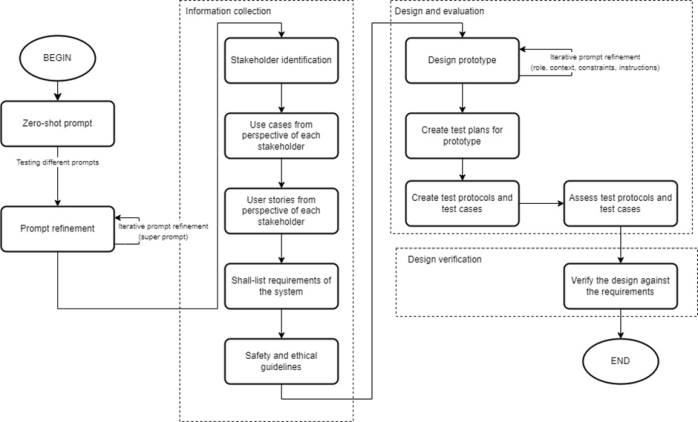
The development of a haptic shoe using prompt engineering involves a series of steps, as illustrated in Figure 1. The first step is information collec- tion, where data on the intended design is gathered and analyzed. The second step involves testing and refining prompts, which are the signals sent to the shoe to produce haptic feedback.
The third step is to consider safety and ethical guidelines, ensuring that the shoe meets the necessary standards. Once this is done, the design and evaluation phase begins. This phase includes creating a prototype, which is a preliminary version of the shoe that allows for further testing and refining.
The next step is to develop test plans and protocols, which will be used to evaluate the shoe. These test plans include assessing test cases, which are scenarios designed to test the shoe’s functionality in various situations. Finally, the design is verified against the requirements, ensuring that it meets the necessary specifications.
Figure 1: Prompt engineering design process.
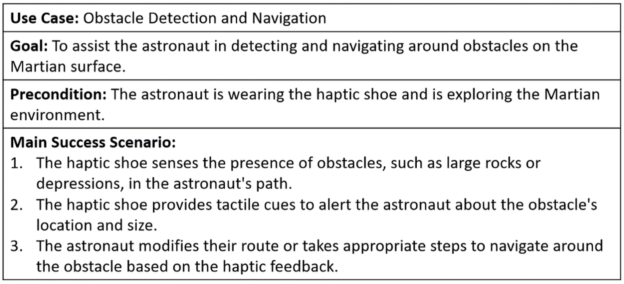
Results and Preliminary Evaluation In Figure 2, there’s an example use case generated by ChatGPT from the per- spective of an astronaut. This use case outlines the requirements for how the haptic shoe should function on the Martian surface. It should be able to detect obstacles and provide tactical cues to alert the astronauts of any poten- tial dangers. Additionally, it should give feedback about the location and size of the obstacles, which will help the astronaut navigate accordingly.
Integrating Generative AI Into the Design Process: A Case Study on Space Haptic Boots 191
Figure 2: An example of a use case generated by ChatGPT from an astronaut’s perspective.
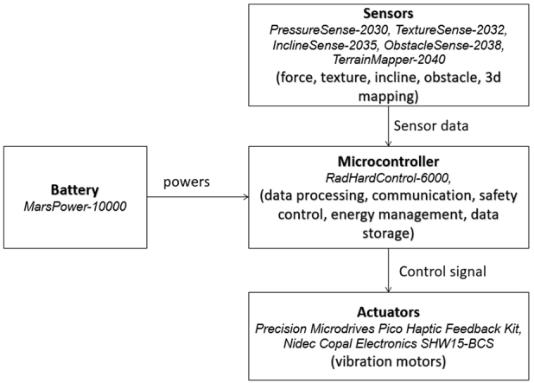
Figure 3 shows the overview of the design generated by ChatGPT. The sensors collect data about the user’s environment, such as the force applied to the shoe, the texture of the ground, the incline of the ground, the presence of obstacles, and a 3D map of the surroundings. The microcontroller processes this data and generates control signals for the actuators. The actuators then vibrate the shoe to provide haptic feedback to the user. The system is powered by a battery.
During our preliminary meeting with a subject matter expert, we con- ducted an assessment to gather the necessary requirements that would deter- mine the functionalities of haptic shoes for space exploration. We explored various use cases to determine the most crucial functionalities that haptic shoes must possess, such as providing feedback on the surface of an unknown planet or alerting astronauts of potential hazards. The use cases are appar- ently useful and form a basis for brainstorming, but the stakeholders must be engaged to ensure that all necessary functionalities are included. Assessing the requirements generated by ChatGPT against some of IEEE 830 quality stan- dards, the provided requirements fall short. For instance, the requirements are not traceable as we do not their actual source. In assessing the design overview, we discovered that apart from two components, the haptic shoe design generated by ChatGPT comprises components that are not currently available in reality. These components are essentially placeholders that were generated by the language model. However, we observed that there are two actuators capable of providing the desired haptic feedback effect, namely the precision Microdrives Pico Haptic Feedback Kit and Nidec Copal Electron- ics’ vibration motors. Hence, the rest of the components in the design are inconsequential as they are not available in real life and are solely generated by the language model.
DISCUSSION AND FUTURE WORK We used a haptic boot for space exploration to showcase the practical poten- tial but also the limitations of AI-driven design. The iterative design process used incorporated various personas such as a NASA engineer and a safety
engineer. This allowed for a comprehensive approach to the design, address- ing technical, safety, and ethical aspects. In our opinion is a cost-effective way to identify major blind spots in a project.
Figure 3: Overview of the system generated.
However, we also noted that some AI-generated components do not exist in reality (hallucination). This underscores the importance of human-in-the- loop, oversight and validation in the design process. The generated use cases, particularly from the astronaut’s perspective, provided valuable insights into the potential functionalities and challenges of the haptic boot on celestial bodies like Mars. While the AI model was able to brainstorm innovative concepts, the need for stakeholder engagement beyond the AI-generated per- sonas became evident to ensure the practicality and relevance of the design. We highlight, the identification of two suitable real-life actuators capable of providing the desired haptic feedback. Moving forward, our focus using note- books such as Semantic Kernels to codify the process. Additionally, a more in-depth evaluation using established standards, such as the IEEE 830 quality criteria, will be incorporated.
In the future, we plan to evaluate solutions using established standards such as IEEE 830 quality criteria and by checking the suggested components against the market.
ACKNOWLEDGMENT
This research was funded by the joint UAEU-ZU grant no. R22021.
REFERENCES
Ahmad, A., Waseem, M., Liang, P., Fahmideh, M., Aktar, M. S. and Mikkonen, T., 2023, June. Towards human-bot collaborative software architecting with chatgpt. In Proceedings of the 27th International Conference on Evaluation and Assessment in Software Engineering (pp. 279–285).
Integrating Generative AI Into the Design Process: A Case Study on Space Haptic Boots 193
Albert, B. and Tullis, T., 2022. Measuring the User Experience: Collecting, Analyzing, and Presenting UX Metrics. Morgan Kaufmann. Aloisio, A., Quaranta, G., Contento, A. and Rosso, M. M., 2023, August.
Physics-Based and Machine-Learning Models for Braking Impact Factors. In Inter- national Conference on Experimental Vibration Analysis for Civil Engineering Structures (pp. 81–88). Cham: Springer Nature Switzerland. Beitz, W., Pahl, G. and Grote, K., 1996. Engineering design: a systematic approach. Mrs Bulletin, 71. Bilgram, V. and Laarmann, F., 2023. Accelerating Innovation with Generative AI:
AI-augmented Digital Prototyping and Innovation Methods. IEEE Engineering Management Review. Brown, T., Mann, B., Ryder, N., Subbiah, M., Kaplan, J. D., Dhariwal, P., Neelakantan, A., Shyam, P., Sastry, G., Askell, A. and Agarwal, S., 2020. Language models are few-shot learners. Advances in neural information processing systems, 33, pp. 1877–1901. Chui, M., Roberts, R. and Yee, L., 2022. Generative AI is here: How tools like
ChatGPT could change your business. Quantum Black AI by McKinsey. Cohen, D., Lindvall, M. and Costa, P., 2004. An introduction to agile methods. Adv.
Comput., 62(03), pp. 1–66. Coyne, R., 1990. Logic of design actions. Knowledge-Based Systems, 3(4), pp. 242–257. Dell’Acqua, F., McFowland, E., Mollick, E. R., Lifshitz-Assaf, H., Kellogg, K., Rajendran, S., Krayer, L., Candelon, F. and Lakhani, K. R., 2023. Navigating the Jagged Technological Frontier: Field Experimental Evidence of the Effects of AI on Knowledge Worker Productivity and Quality. Harvard Business School Technology & Operations Mgt. Unit Working Paper, (24–013). Duan, Y., Edwards, J. S. and Dwivedi, Y. K., 2019. Artificial intelligence for decision
making in the era of Big Data–evolution, challenges and research agenda. Inter- national journal of information management, 48, pp. 63–71. Firat, M., 2023. How chat GPT can transform autodidactic experiences and open education. Department of Distance Education, Open Education Faculty, Anadolu Unive. Hu, K. (2023) CHATGPT sets record for fastest-growing user base - analyst
note, Reuters. Available at: https://www.reuters.com/technology/chatgpt-sets-re cord-fastest-growing-user-base-analyst-note-2023-02-01/ (Accessed: 28 October 2023). Karras, T., Laine, S. and Aila, T., 2019. A style-based generator architecture for generative adversarial networks. In Proceedings of the IEEE/CVF conference on computer vision and pattern recognition (pp. 4401–4410). Kasneci, E., Seßler, K., Küchemann, S., Bannert, M., Dementieva, D., Fischer, F.,
Gasser, U., Groh, G., Günnemann, S., Hüllermeier, E. and Krusche, S., 2023. ChatGPT for good? On opportunities and challenges of large language models for education. Learning and individual differences, 103, p. 102274. Kung, T. H., Cheatham, M., Medenilla, A., Sillos, C., De Leon, L., Elepaño, C., Madriaga, M., Aggabao, R., Diaz-Candido, G., Maningo, J. and Tseng, V., 2023. Performance of ChatGPT on USMLE: Potential for AI-assisted medical education using large language models. PLOS Digit Health 2 (2): e0000198. Kushwaha, A. K. and Kar, A. K., 2021. MarkBot–a language model-driven chatbot
for interactive marketing in post-modern world. Information systems frontiers, pp. 1–18.
Lim, W. M., Gunasekara, A., Pallant, J. L., Pallant, J. I. and Pechenkina, E., 2023.
Generative AI and the future of education: Ragnarök or reformation? A para- doxical perspective from management educators. The International Journal of Management Education, 21(2), p.100790. Ray, P. P. and Majumder, P., 2023. The Double-Edged Sword of AI in Biomedical Engineering: ChatGPT’s Controversial Impact on Research and Collaboration Paradigms. Annals of Biomedical Engineering, pp. 1–2. Riby, D. and Sutherland, J., 2016. Understanding agile management. Harvard
Business Review. Roy, R., Hinduja, S. and Teti, R., 2008. Recent advances in engineering design optimisation: Challenges and future trends. CIRP annals, 57(2), pp. 697–715. Shin, T., Razeghi, Y., Logan IV, R. L., Wallace, E. and Singh, S., 2020. Auto-
prompt: Eliciting knowledge from language models with automatically generated prompts.arXiv preprint arXiv:2010.15980. Singh, V., Chen, S. S., Singhania, M., Nanavati, B. and Gupta, A., 2022. How are reinforcement learning and deep learning algorithms used for big data based deci- sion making in financial industries–A review and research agenda. International Journal of Information Management Data Insights, 2(2), p. 100094. Sl˘atineanu, L., Oroian, B., Condrea, I., Botezatu, C., Hri¸tuc, A., Boca, M. A.,
Cotea¸t˘a, M. and Dodun, O., 2021, February. Elaboration of the initial require- ments in the design activities. In IOP Conference Series: Materials Science and Engineering (Vol. 1037, No. 1, p. 012002). IOP Publishing. Thai, H. T., 2022, April. Machine learning for structural engineering: A state-of-theart review. In Structures (Vol. 38, pp. 448–491). Elsevier. Yamada, Y., Genovese, S., Depew, C., Cos, R., Kuwahara, H. and Inoue, T.,
2022. Reduce Environmental Impact and Carbon Footprint for Cost Competitive Process Plant Design: Integrating AVEVATM Process Simulation with mode- FRONTIER®. In Computer Aided Chemical Engineering (Vol. 49, pp. 211–216). Elsevier. Yüksel, N., Börklü, H. R., Sezer, H. K. and Canyurt, O. E., 2023. Review of artificial intelligence applications in engineering design perspective. Engineering Applications of Artificial Intelligence, 118, p. 105697.
LISTED IN THE AHFE DIGITAL BOOKSTORE CATALOGUE
Explore the complete digital volume
Human Interaction and Emerging Technologies (IHIET-AI 2024): Artificial Intelligence and Future Applications
Read this individual research paper free through the original publisher, or explore the full digital proceedings book.
ISBN 978-1-958651-96-4
Explore this ISBN in the AHFE Bookstore ↗Listed in the July 2026 bookstore catalogue; search by ISBN to confirm current availability · Digital book purchase optional