Lan Zhang, Xiaoli Wu, Biao Yan, Qian Li, Xingcan Yang (2024). Experimental Paradigms and Their Knowledge Associations in Studies of Information Processing: A Review. In: Neuroergonomics and Cognitive Engineering. AHFE Open Access, vol. 126, pp. 242–252. https://doi.org/10.54941/ahfe1004757
Experimentation is the foundation of empirical science and is an important research method of mental cognition. The experimental paradigm, as an important part of experimental research method, is a relatively fixed task program, which is mainly used to describe certain psychological phenomena clearly and accurately. However, the application of experimental paradigms is characterized by mixed task content and complex paradigm type. This paper reviews typical experimental paradigms which are used to study information-processing such as perception, attention, working memory and long-term memory, in terms of paradigm origins, task procedures, research results and development. Based on the review of various experimental paradigms, the knowledge relevance between them are further sorted out in the aspect of task procedure characteristics and research trend. It provides reference for the application and design of experimental paradigms in studies of information processing.
Psychology is a discipline that studies psychological phenomena and their laws. From the perspective of psychological research method, the research routes of different psychological schools are mainly divided into Objective- experimental Paradigms and Subjective-Experiential Paradigms (Che, 2003). The objective-experimental paradigms utilize experimental and observational methods to acquire objective knowledge of psychology, which advocate the objectivity and positivity of psychological research methods (Peng, 2008). Researchers have designed numerous experimental paradigms based on objective experimental research methods, which play a crucial heuristic and theoretical role in basic psychological research.
Experimental Paradigms and Their Knowledge Associations in Studies 243
THE SOURCE AND DEVELOPMENT OF OBJECTIVE-EXPERIMENTAL PARADIGMS The objective-experimental paradigm is a theoretical model of scientific psychology based on positivism in mainstream Western psychology, which believes that psychology can obtain objective knowledge about human psy- chology and behaviour through objective empirical methods. The objective- experimental paradigm originated from the study of behaviourism, establish- ing stimulus-response paradigms including observation, conditioning, oral reporting, and testing (Li, 1997). However, this type of paradigm completely denies the existence of consciousness, and the S-R model used to explain behaviour does not conform to the actual laws of human behaviour. With the rapid development of computer science, the information processing paradigm with the main goal of exploring the internal psychological mechanisms has emerged, which transcends the limitations of the stimulus-response paradigm and fully reflects the comprehensive research characteristics of psychology based on experiments. The information processing paradigm believes that the process of obtaining, storing, processing, refining, and applying infor- mation involves cognitive activities such as sensation, perception, memory, attention, representation, thinking (Solso et al., 2019). Due to the difficulty in observing psychological processes, it is necessary to rely on experimental methods to design stimuli (input) and responses (output) to infer the internal processes of psychology. These experimental methods are specifically mani- fested as fixed task program experimental paradigms, used to describe and express certain psychological phenomena clearly and accurately, as well as test certain hypotheses or newly proposed concepts (Chen, 2017).
This paper analyses task design, research objectives of typical experimental paradigms based on the different stages of information processing, such as perception, attention, and memory.
PERCEPTION EXPERIMENT PARADIGM Perception is a high-level cognitive process that explains sensory informa- tion (Zhu, 2016). Typical experimental paradigms include visual search experiment, priming paradigm, negative priming paradigm, and global-local paradigm.
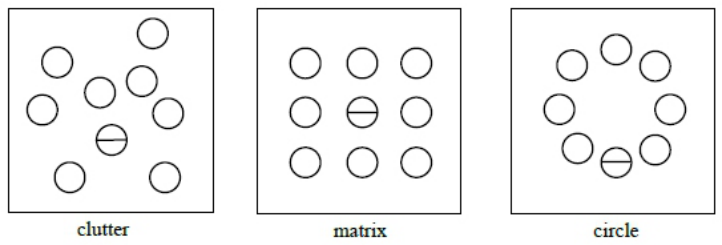
Visual Search Paradigm The visual search paradigm requires that target and distractor are presented simultaneously. Participants extract the target from a large amount of infor- mation and respond according to the task. The material is usually in the form of pictures, letters, etc., and is presented in three types: clutter, matrix, and cir- cle (see Figure 1). Treisman (1980, 1985), Theeuwes (1991), Bacon (1994), Luck (1994), Wolfe (2003), et al. have used the visual search paradigm to study feature integration theory, automated processing theory, and guided search models in the areas of perception.
Figure 1: The arrangement types of visual search paradigm.
Priming Paradigm The priming paradigm is an experimental task that studies unconscious pro- cessing at the perceptual level, by presenting the priming stimulus to the participant in advance and then presenting the probing stimulus to generate the priming effect. A word-identification task designed by Meyer (1971). The process involves two phases: prime display and probe display which present- ing two stimuli separately, participants need to determine whether the stimuli in the probe display are non-word or word. If the words are the same or related between the prime stimulus and the probe stimulus, the response time of participants is significantly shortened. Marcal (1983) designed a masking priming paradigm and found that the priming effect can still occur even after the detection word is masked.
Negative Priming Paradigm Negative priming can reflect the operation of non-target stimuli. The task consists of two sequentially display of stimulus (prime display, probe display), both of which contain target and distractor. The task is to require participants to determine the target item of the stimulus while ignoring the interference item of the stimulus. The experimental design showed that the target in the probe display was the same as the distractor in the prime display, resulting in a delay in the response to the target, which known as negative effect (Houghton and Tipper, 1994; Tipper, 1985; Tipper and Cranston, 1985).
Global-Local Paradigm Navon (1977) designed a global-local paradigm to investigate visual infor- mation processing, which advocates the primacy of information about the overall pattern or structure. This paradigm uses the letters “H”, “S”, and “O” to design a composite stimulus that forms a material with both local and global features (see Figure 2). The experiment was divided into the con- ditions of consistency and inconsistency between local and global features, and participants were required to discriminate between local and global fea- tures of the material. Miller (1981), Robertson (1993) used this paradigm to investigate the global priority theory of visual perceptual processing.
Experimental Paradigms and Their Knowledge Associations in Studies 245
Figure 2: Example of a global-local paradigm stimulus (Navon, 1977).
Figure available in the original PDF paper.
ATTENTION EXPERIMENT PARADIGM Attention is the concentration of sensory or psychological events, with the functions of selection, orientation, amplification, inhibition, and allocation. Typical experimental paradigms include Stroop paradigm, Simon paradigm, Flanker paradigm, spatial cueing paradigm, multi-target tracking paradigm, and rapid serial visual presentation paradigm.
Stroop Paradigm The American psychologist Stroop (1935) discovered the Stroop effect in a colour-naming experiment in 1935. The experimental stimuli were word “green” displayed in red colour (colour and meaning were different) and word “red” displayed in red colour (colour and meaning were same). Par- ticipants were asked to report what word was on the screen. It was found that the response time was shorter at the condition of congruent than for the condition of contradictory (Hermans et al., 1999; Egner et al., 2008).
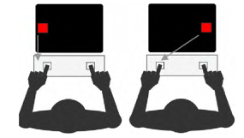
Simon Paradigm The Simon paradigm was proposed by Simon and Rudell (1967), mainly manifested as conflicts between target features and reaction positions. Partic- ipants are required to press the left button when they see red, while ignoring the spatial position of the colour presentation (see Figure 3). The perfor- mance of participants is better when the position of stimulus and response appear on the same side compared to the opposite side, which is known as the Simon effect.
Figure 3: Example of simon paradigm.
Flanker Paradigm Flanker paradigm, proposed by Eriksen and Ericksen (1974), is one of the basic paradigms for studying inhibitory control, conflict processing, and per- ceptual load (Paquet et al., 1997; Chanceaux et al., 2013; Myriam et al., 2014). stimulus usually consist of a central target and some distractors
located on both sides of the target. Two types of flankers (compatible, incom- patible) were included in the experiment to attract attention (see Figure 4). Participants need to respond to central stimuli and ignore bilateral stimuli. It leads to a phenomenon of slowed response and increased error rate when the central target is different from the bilateral distractor, which is called the Flanker effect.
Figure 4: Example of flanker paradigm stimulus.
Spatial Cueing Paradigm The spatial cueing paradigm is a typical experimental paradigm for study- ing spatial attention orientation and spatial attention capture ability (Eriksen et al., 1986; Egly et al., 1994; Sahan et al., 2015). Posner (1980) designed peripheral cues and central cues to guide spatial attention. The experiment was divided into two stages: prime and probe. During the prime phase, participants were given two types of cues: central cues which in the centre and peripheral cues which at either side. The task is to determine the target position and respond during the probe phase.
Multi-Target Tracking Paradigm The multi-objective tracking paradigm is mainly used to study the attentional processing of visual information in dynamic scenes. During the prime phase, some stimuli are labelled as targets, while others are distractors. In the probe phase, all objects perform independent and random movements. The partic- ipants are required to track the target and report whether a certain object is the target phase after the movement (Pylyshyn and Storm, 1988).
Rapid Serial Visual Presentation Paradigm (RSVP Paradigm) The RSVP paradigm is a typical experimental paradigm for studying atten- tional detachment, where the stimulus sequence contains two targets (T1, T2) and distractors. The duration of stimulus presentation is limited, usu- ally presented sequentially at the same position in the speed of 100 ms of each. Participants need to identify whether they can perceive target T1 and T2 (Potter, 1976; Raymond et al., 1992).
MEMORY EXPERIMENT PARADIGM Researchers explored the memory functions of encoding (memory), stor- ing (retention), and extracting (recall and recognition). Typical experi- mental paradigms include change perception paradigm, recall reporting
Experimental Paradigms and Their Knowledge Associations in Studies 247
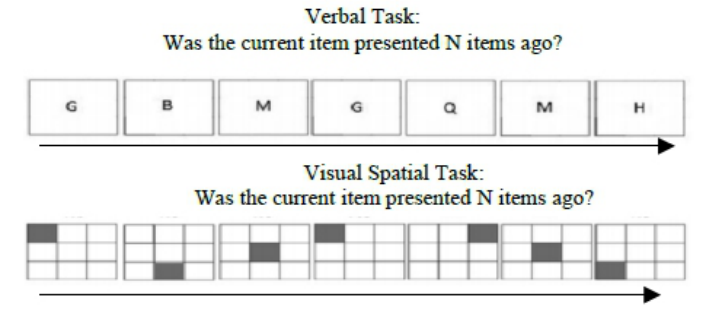
N-Back Paradigm N-back paradigm originated from Kirchner’s (1958) research about working memory of continuous processing ability. It refers to asking the participant to compare the current stimulus with the nth to last stimulus and press a button based on the comparison result (Watter et al., 2001; Pergher et al., 2019; Wang et al., 2019). According to the location of the target stimulus in the current N-Back task, it can be named 1-Back, 2-Back, and 3-Back tasks to distinguish task difficulty. There are typical examples of letter matching and position matching tasks in the N-Back paradigm (see Figure 5).
Figure 5: Example of N-back paradigm.
Change Detection Paradigm Change detection paradigm first appeared in Phillips’s (1974) research of sensory storage and short-term visual memory. The characteristic of this paradigm is the formation of short-term visual memory through manipu- lating Inter stimuli interval (ISI). Presenting one or a set of targets to the participants in the phase of memory. Then, the screen only presents the back- ground colour without any visual information. In the detection stage, one or a set of visual stimuli are presented to the participants again, requiring them to determine whether the detection item is the same as the target. Phillips (1977), Luke (1997, 2001), Vogel (2001) explored the storage and capacity issues of visual working memory by using the change detection paradigm.
Associative Recognition Paradigm The associative recognition paradigm was first proposed by Humphreys (1976) to study associative memory in long-term memory. Its characteris- tic is that the items that need to be learned and remembered appear in pairs
(such as A-B; A-colour of A; A-b). Participants are required to correctly rec- ognize paired items and their relationships during the testing phase after memorizing.
Deese Roediger McDermott Paradigm Deese (1959) designed Deese Roediger McDermott (DRM) paradigm by uti- lizing semantic associations between old items and critical lures to induce erroneous memory. For example, participants first learned a series of words (such as toast, butter, jam, butter, Dim sum, milk), which were semantically related to a Critical Lure (such as bread). During the detection phase, par- ticipants were randomly presented with old item, critical lure, and unrelated item. The participants need to determine whether each word has appeared during the encoding stage. The results showed that the participants had a significantly higher false memory rate for critical lure than for unrelated item (Roediger and Mc Dermott, 1995; Kurkela and Dennis, 2016).
CONCLUSION
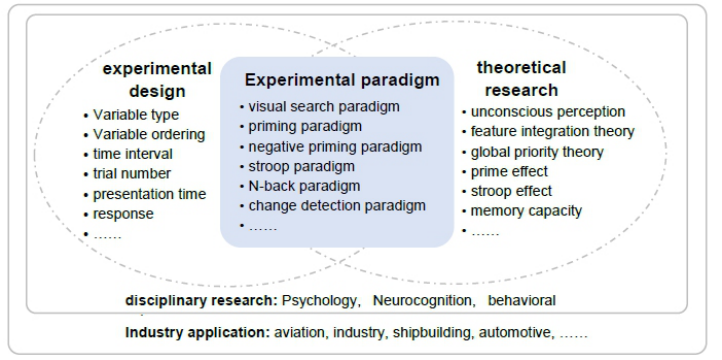
The experimental paradigm plays an important and practical role in solving possible explanatory problems in psychological research, and in promoting the development of a unique scientific methodology in cognitive research. Psychological research can be considered as examining the impact of two (or more) psychological construct on another psychological construct (Meiser, 2011). A large number of studies use experimental paradigms to hypoth- esis verification or theoretical empirical research. The composition of the experimental paradigm requires attribute settings such as variable type, vari- able ranking, display time, and number of experiments. Therefore, attribute setting and research theory are an integral and interrelated part of the experimental paradigm (see Figure 6).
Experimental Paradigms and Their Knowledge Associations in Studies 249
It can be observed that some experimental paradigms have similarities in program design (independent variables, task flow, etc.), partly because they are used to validate the same theory or hypothesis. For example, Stroop paradigm, Simon paradigm, and Flanker paradigm all conduct attention research by designing conflicts between target stimuli and interfering stim- uli (Ridderinkhof et al., 2004). On the other hand, some paradigms have heuristic value and contribute to the emergence of new theoretical and empir- ical methods. Griffin (2003), Landman (2003) applied the change detection paradigm to study and found that participants who provided clues during the working memory retention stage performed better. Subsequent research scholars drew inspiration from the spatial cue design paradigm to study the post cue effect in working memory.
A large number of experimental paradigms were designed from the 1950s to the end of the 20th century, which not only contributed to the devel- opment of psychological research (Anderson et al., 2021; Schoth and Liossi, 2017), but also advances other disciplines such as neurocognition (Janapati et al., 2022), behavioural science (Lange, 2022), and psychopathol- ogy (Bujarski and Ray, 2016). The experimental paradigm lays the theoretical foundation for exploring the essence of information acquisition, processing, storage. Moreover, the experimental paradigm combined with disciplinary research has been widely applied in various industries such as aviation, indus- try, shipbuilding, automotive, which are able to improve human-machine efficiency and promote industry development.
The visual search paradigm is a research methodology that explores how individuals identify and locate specific targets in a range of distractors. We used this paradigm to investigate the effects of flicker and other dynamic highlighting on the visual cognitive performance of nuclear power operators. Participants were presented with displays containing both target and non- target. Then they were instructed to look for the target while ignoring the distractors. The results of the experiment demonstrated that certain flick- ering characteristics, such as a specific frequency and position, significantly influenced attention capture and visual search performance. This understand- ing has implications for a wide range of applications, from enhancing the usability of interfaces to improving the effectiveness of visual displays in high- stakes environments like nuclear power control systems. Overall, the visual search paradigm provides a powerful tool for exploring the complexities of visual attention and cognition, enabling researchers to gain insights into how individuals respond to visual information.
ACKNOWLEDGMENT
This work was supported by State Key Laboratory of Nuclear Power Safety Monitoring Technology and Equipment (K-A2021.419), the National Nature Science Foundation of China (52175469), and Jiangsu Province Nature Science Foundation of China (BK20221490).
REFERENCES
Anderson, A., Hartley, S., Bucci, S. (2021). A Systematic Review of the experimental induction of auditory perceptual experiences. Journal of behavior therapy and experimental psychiatry, Volume 71. Bacon, W. F., Egeth, H. E. (1994). Overriding stimulus-driven attentional capture.
Perception & psychophysics, Volume 55, No. 5. Bujarski, S., Ray, L. A. (2016). Experimental psychopathology paradigms for alcohol use disorders: Applications for translational research. Behaviour research and therapy, Volume 86. Chanceaux, M., Grainger, J. (2013). Constraints on letter-in-string identification in
peripheral vision: Effects of number of flankers and deployment of attention. Frontiers in Psychology, Volume 4, No. 119. Che, W. B (2003). The Developmental Tendency of Psychological Paradigms: Synthesis of objective-experimental and Subjective-experiential paradigms. Studies in Dialectics of Nature. Volume 5. Chen, L. (2017). The three cornerstones of cognitive science. Bulletin of National
Natural Science Foundation of China. Volume 31, No. 3. Deese, J. (1959) On the prediction of occurrence of particular verbal intrusions in immediate recall. Journal of Experimental Psychology, Volume 58. Egly, R., Driver, J., Rafal, R. D. (1994). Shifting visual attention between objects
and locations: evidence from normal and parietal lesion subjects. Journal of Experimental Psychology: General, Volume 123, No. 2. Egner, T., Etkin, A., Gale, S., Hirsch, J. (2008). Dissociable neural systems resolve conflict from emotional versus non-emotional distracters [J]. Cerebral Cortex, Volume 18. Eriksen, B. A., Eriksen, C. W. (1974). Effects of noise letters upon the identification
of a target letter in a nonsearch task. Perception and Psychophysics, Volume 16, No. 1. Eriksen, C. W., St James, J. D. (1986). Visual attention within and around the field of focal attention: a zoom lens model. Perception & Psychophysics, Volume 40, No. 4. Eriksen, C. W., Yeh, Y. (1985). Allocation of attention in the visual field. Journal
of Experimental Psychology: Human Perception and Performance, Volume 11, No. 5. Griffin, I. C., Nobre, A. C. (2003). Orienting attention to locations in internal representations. Journal of cognitive neuroscience, Volume 15, No. 8. Hermans, D., Bongaerts, T., DeBot, K., Schreuder, R. (1998). Producting words in
a foreign language: Can speakers prevent interference from their first language. Bilingualism: Language and Cognition, Volume 1. Houghton, G., Tipper, S. P. (1994). A model of inhibitory mechanisms in selective attention. In Dagenbach, D. and Carr, T. H. (Eds.), Inhibitory processes in attention, memory, and language (pp. 53–112). San Diego, CA: Academic Press, Inc. Humphreys M S. (1976) Relational information and the context effect in recognition
memory. Memory & Cognition, Volume 4, No. 2. Janapati, R., Dalal, V., Sengupta, R. (2022). Advances in Experimental Paradigms for EEG-BCI. Proceedings of the 2nd International Conference on Recent Trends in Machine Learning, IoT, Smart Cities and Applications: ICMISC 2021 Lecture Notes in Networks and Systems. Kurkela, K. A., Dennis, N. A. (2016) Event–related f MRI studies of false memory: An
Experimental Paradigms and Their Knowledge Associations in Studies 251
Landman, R., Spekreijse, H., Lamme, V. A. F. (2003) Large capacity storage of integrated objects before change blindness. Vision Research, Volume 43, No. 2. Lange, F. (2022). Behavioral paradigms for studying pro-environmental behavior: A
systematic review. Behavior research methods. Volume 55, No. 2. Li, W. (1997). The Current Situation and Basic Trends of Psychological Science at the Turn of the Century. Quarterly Journal of Shanghai Academy of Social Sciences. Volume 4. Luck, S. J., Hillyard, S. A. (1994). Electrophysiological correlates of feature analysis
during visual search. Psychophysiology, Volume 31, No. 3. Luck, S. J., Vogel, E. K. (1997). The capacity of visual working memory for features and conjunctions. Nature, Volume 390, No. 6657. Marcal, A. J. (1983). Conscious and unconscious perception: Experience on visual
masking and word recognition. Cognitive Psychology, Volume 15, No. 2. Meiser, T. (2011). Much Pain, Little Gain? Paradigm-Specific Models and Methods in Experimental Psychology. Perspectives on Psychological Science, Volume 6, No. 2. Meyer, D. E., Schvaneveldt, R. W. (1971). Facilitation in recognizing pairs of words:
Evidence of a dependence between retrieval operations. Journal of experimental psychology, Volume 90, No. 2. Miller, J. (1981). Global precedence in attention and decision. Journal of Experimental Psychology Human Perception & Performance, Volume 7, No. 6. Myriam, C., Sebastiaan, M., Jonathan, G. (2014). Effects of number, complexity,
and familiarity of flankers on crowded letter identification. Journal of Vision. Volume 14, No. 6. Navon, D. (1977). Forest before trees: the precedence of global features in visual perception. Cognit Psychol, Volume 9, No. 3. Paquet, L., Craig, G. L. (1997). Evidence for selective target processing with a low
perceptual load flankers task. Memory & Cognition, Volume 25, No. 2. Peng, Y. S. (2008) The Disintegration and Reconstruction of Human Beings: A Methodological Study of Western Psychology. Hunan: Hunan Education Press. Pergher, V., Wittevrongela, B., Tournoyb, J., Schoenmakersc, B., Hullea M. M. V.
(2019). Mental workload of young and older adults gauged with ERPs and spec- tral power during N-Back task performance. Biological Psychology, Volume 146. Phillips, W. A. (1974). On the distinction between Sensory Storage and Short-Term Visual Memory. Perception & Psychophysics, Volume 16, No. 2. Phillips, W. A., Christie, D. F. (1977). Components Of visual memory. Quarterly
Journal of Experimental Psychology, Volume 29, No. 1. Posner, M. I. (1980). Orienting of attention. Quarterly Journal of Experimental Psychology, Volume 32, No. 1. Potter, M. C. (1976). Short-term conceptual memory for pictures. Journal of
Experimental Psychology: Human Learning & Memory, Volume 2. Pylyshyn, Z. W., Storm, R. W. (1988). Tracking multiple independent targets: Evidence for a parallel tracking mechanism. Spatial Vision, Volume 3, No. 3. Raymond, J. E., Shapiro, K. L., Arnell, K. M. (1992). Temporary suppression of
visual processing in an RSVP task: An attentional blink? Journal of Experimental Psychology: Human Perception and Performance, Volume 18. Ridderinkhof, K. R., Van, den., Widenberg, W. P. M, Wijnen J, Burle, B. (2004).
Response inhibition in conflict tasks is revealed in delta plots. In M. I. Posner (Ed.), Cognitive neuroscience of attention. (pp. 369–377). The Guilford Press. Robertson, L. C., Egly, R., Lamb, M. R., Kerth, L. (1993). Spatial attention and cuing to global and local levels of hierarchical structure. Journal of Experimental Psychology Human Perception & Performance, Volume 19, No. 3.
Roediger, H. L., Mc Dermott, K. B. (1995) Creating false memories: Remembering words not presented in lists. Journal of Experimental Psychology: Learning, Memory, and Cognition, Volume 21, No. 4. Sahan, M. I., Verguts, T., Boehler, C. N., Pourtois, G., & Fias, W. (2016). Paying
attention to working memory: Similarities in the spatial distribution of attention in mental and physical space. Psychonomic bulletin & review, Volume 23, No. 4. Schoth, D. E., Liossi, C. (2017). A Systematic Review of Experimental Paradigms for Exploring Biased Interpretation of Ambiguous Information with Emotional and Neutral Associations. Frontiers in psychology, Volume 8. Simon, J. R., Rudell, A. P. (1967) Auditory S-R compatibility: the effect of an irrel-
evant cue on information processing. Journal of Applied Psychology, Volume 51, No. 3. Solso, R., Maclin, O., Maclin, M. (2019). cognitive psychology. Shanghai: Shanghai People’s Press. Stroop, J. (1935). R. Studies of interference in serial verbal reactions. Journal of
Experimental Psychology, Volume 18 Theeuwes, J. (1991). Cross-dimensional perceptual selectivity. Perception and psychophysics, Volume 50, No. 2. Tipper, S. P. (1985). The negative priming effect: Inhibitory priming by ignored
objects. Quarterly Journal of Experimental Psychology Human Experimental Psychology, Volume 37A. Tipper, S. P., Cranston, M. (1985). Selective attention and priming: Inhibitory and facilitatory effects of ignored primes. Quarterly Journal of Experimental Psychology, Volume 37A. Treisman, A. M., Gelade, G. (1980). A feature-integration theory of attention.
Cognitive Psychology, Volume 12, No. 1. Treisman, A., Souther, J. (1985). Search asymmetry: a diagnostic for preattentive processing of separable features. Journal of experimental psychology: General, Volume 114, No. 3. Vogel, E. K., Woodman, G. F., Luck, S. J. (2001). Storage of features, conjunctions,
and objects in visual working memory. Journal of Experimental Psychology- Human Perception and Performance, Volume 27, No. 1. Wang, X., Pan, D., Li, X. (2019). The Neural Mechanism of Working Memory Training Improving Emotion Regulation. Paper presented at the 12th Interna- tional Conference on Brain Informatics (BI), Hainan Univ, Haikou, PEOPLES R CHINA. Wang, X., Wang, D., Wang, Y., Sun, Q., Bao, X., Liu, C., Liu, Y. (2019). Compared
to outcome pressure, observation pressure produces differences in performance of N-back tasks: an ERP study. Neuroreport, Volume 30, No. 11. Watter, S., Geffen, G. M., Geffen, L. B. (2001). The n-back as a dual-task: P300 morphology under divided attention. Psychophysiology, Volume 38, No. 6. Wolfe, J. M., Butcher, S. J., Lee, C., Hyle, M. (2003). Changing your mind: On
the contributions of top-down and bottom-up guidance in visual search for feature singletons. Journal of Experimental Psychology-Human Perception and Performance, Volume 29, No. 2. Zhu, Y. (2016). Experimental psychology. Beijing: Peking University Press.
LISTED IN THE AHFE DIGITAL BOOKSTORE CATALOGUE
Explore the complete digital volume
Neuroergonomics and Cognitive Engineering
Read this individual research paper free through the original publisher, or explore the full digital proceedings book.
ISBN 978-1-964867-02-1
Explore this ISBN in the AHFE Bookstore ↗Listed in the July 2026 bookstore catalogue; search by ISBN to confirm current availability · Digital book purchase optional