Tia Cotton, Lynsay Shepherd (2024). Practising Safe Sex(t): Developing a Serious Game to Tackle Technology-Facilitated Sexual Violence. In: Human Factors in Cybersecurity. AHFE Open Access, vol. 127, pp. 176–186. https://doi.org/10.54941/ahfe1004777
Modern society relies on the Internet for socialisation, entertainment, and business, whilst the COVID-19 pandemic has expedited the digitalisation of many services. Heightened incidences of cybercrime have accompanied increased Internet usage, including acts of technology-facilitated sexual violence (TFSV). Measures to prevent further TFSV victims are limited, and growing pressures on law enforcement mean few support resources are available. This paper presents an innovative game-based mitigation for TFSV education. We developed a serious game in the form of an online visual novel, with each chapter revolving around an aspect of TFSV. Pre and post-game surveys were conducted with 45 participants to explore their experience with the game and understanding of TFSV. The findings highlight that games-based interventions have the potential to act as an effective tool against TFSV. The broader implications of the work focus on suggestions for law enforcement and the role of games-based mitigations to reduce victimisation.
In recent years, society has witnessed the rapid digitalisation of services, alongside an increased reliance on technology and the internet. Opportunistic criminals have taken advantage of this societal shift, and incidences of cyber- crime, such as technology-facilitated sexual violence (TFSV) have increased. TFSV incorporates a range of sexual offences carried out via digital technolo- gies and is covered by the Sexual Offences Act 2009 (Scottish Parliament, 2009) and The Abusive Behaviour and Sexual Harm Act 2016 (Scottish Par- liament, 2016). Whilst these laws can help support a victim after a crime has taken place, law enforcement and specialist charities have limited resources to educate people on how to protect themselves before a crime occurs.
During the pandemic, people were more likely to engage in virtual sexual activity if they were not cohabiting with a partner, compared to pre-pandemic sexual experiences (Mercer et al., 2021). Sexting was also used as a coping mechanism (Bianchi et al., 2021) and those who were isolated were more likely to use technological methods to facilitate sexual activity compared to
Practising Safe Sex(t): Developing a Serious Game to Tackle Technology-Facilitated 177
those living with partners (Lehmiller et al., 2020). As more people engaged in virtual sexual activities, reported cases of TFSV subsequently increased.
Existing measures are provided on platforms where instances of TFSV may occur (Meta, 2022; PornHub, 2022). These include policies, reporting mech- anisms and digital fingerprinting. However, these measures can be bypassed and have multiple flaws in their execution (Henry, 2021). Other support consists of simple text pointing to existing charities or helplines, and thus do not facilitate education about TFSV. Serious games have previously been used to educate people about cybersecurity (Scholefield and Shepherd, 2019; Coull et al., 2016.), and can serve as an educational resource to help prevent further TFSV victimisation.
This paper provides an overview of measures available to prevent TFSV, before presenting an innovative game-based visual novel, “Practising Safe Sex(t)”, alongside user evaluation results.
RELATED WORK
Technology-Facilitated Sexual Violence TFSV offences can be categorised as “Image-Based Sexual Abuse”, “Video Voyeurism”, “Sending Unsolicited Sexual Images” and “The Use of Technol- ogy to Facilitate In-Person Sexual Violence”. Within these categories, there are specific crimes - some of which have been given media-friendly names - such as Sextortion, Revenge Porn, and Cyber Flashing (Fisico and Harkins, 2021). Victims of non-consensual image sharing may experience “anger, guilt, and depression, damaged relationships with partners, family, employers, job loss, social isolation, and even suicide” (Fisico and Harkins, 2021). Similarly, a study by Champion, Oswald, and Pedersen (2021) investigated the psycho- logical effect TFSV has on victims, identifying a link between TFSV and the likelihood of a victim committing suicide. Victims can feel bullied and black- mailed, traumatised by their images being distributed online without their consent (Powell et al., 2020).
Victims are typically directed to law enforcement after an incident has occurred. Law enforcement is expected to be able to support the victim and begin legal proceedings. However, the unprecedented rise in cybercrime dur- ing the pandemic has meant that existing models of policing may have to change to facilitate victim support and TFSV education (Horgan et al., 2021).
Police Scotland (2020) has documented the rise in TFSV, with 30% of all cyber offences occurring in 2020 being recorded as sexual offences and noted that “policing in Scotland is blurred by the use of technology to aid, and facilitate crime”; as a result, they seek to move away from “reactive actions” to “proactive and preventative actions” such as cyber education and early intervention.
To proactively tackle sexual violence, Police Scotland (2021) launched a sexual violence campaign – “Don’t Be That Guy”. The campaign targets men, who are more likely to be perpetrators of TFSV (Zhong et al., 2020). The campaign generated a national conversation about sexual violence against
178 Cotton and Shepherd
women - both in person and online - and was praised for placing the onus of sexual violence on the perpetrator instead of the victim.
Victims can be guided to specialist support after their experience, such as Rape Crisis Scotland (2022) and Victim Support Scotland (2022). How- ever, research has found that support workers are struggling to effectively help victims of online intimate partner violence and TFSV (Tanczer et al., 2021). Individuals surveyed admitted there is a lack of assistance, train- ing, and support for workers to administer adequate support for victims of technology-facilitated abuse and TFSV.
Many social media platforms contain measures to prevent TFSV from occurring (Meta, 2022; PornHub, 2022; Reddit, 2022), including poli- cies, reporting abilities, AI, and digital fingerprinting; however, these can be flawed. Policy mitigations, such as terms of use, have ambiguous wording which blurs the lines of what can be considered non-consensual or abusive. Reporting non-consensual images or abusive content requires the content to be viewed then reported; it is reviewed by a human or AI, which decides if the content is harmful. Digital fingerprinting can be used to identify images, though this can be bypassed (Henry, 2021).
Application-based support measures for TFSV are being developed, such as the “FollowIt” (2022) app which can be used to record technology-facilitated stalking incidents. The logs are permissible in Scottish courts as valid evidence if a victim decides to take legal action.
The Potential of Serious Games for TFSV Education Defined as “a game in which education (in its various forms) is the primary goal, rather than entertainment” (Michael and Chen, 2005), serious games help the user learn about a topic whilst playing, unlike games used simply for enjoyment purposes only. Using game mechanics such as time pressure, rewards, and puzzles, serious games are used across various domains includ- ing healthcare (Maheu-Cadotte et al., 2021) and business (Riedel and Hauge, 2011). Perhaps one of the most well-known serious games in recent years is “Foldit” (2008), a puzzle-based game where the player is tasked with folding proteins whilst competing against others. The ultimate goal of the game is to help researchers identify if the folding patterns can be applied to real-world proteins, potentially helping cure diseases.
Serious games have also been used to educate people about cybersecurity topics, including phishing (CJ et al., 2018), password security (Schole- field and Shepherd, 2019), and attack/defence scenarios (Yamin et al., 2021), therefore they can serve as an appropriate mechanism to address the challenges associated with TFSV.
Summary TFSV has continued to increase as more people gain access to the internet. TFSV has a devastating mental and emotional impact on victims, and in some cases, leads to physical harm. Mitigations to educate and support people are limited. This is due to a lack of proactive actions, scarce resources, and insufficient support. Reactive measures on social media platforms are not
Practising Safe Sex(t): Developing a Serious Game to Tackle Technology-Facilitated 179
fail-safe and can be bypassed. To proactively educate people about TFSV, a games-based approach has the potential to educate people about TFSV in an accessible way.
METHODOLOGY
The “Practicing Safe Sex(t)” serious game was developed as a visual novel, using Ren’Py, which allows for cross-platform compilation e.g., allowing the game to run on the web. Visual novels are text-based interactive stories which allow players to make decisions within the game. Characters interact with the player directly and ask for advice on what they should do in their current situation and the player can choose different options. As a visual novel game, it requires the player to click to continue the story and does not require a high level of technical ability.
Game Development and Narrative Each of the five chapters was designed to revolve around categories of TFSV as described by Fisico and Harkins (2021). There were no character photos, allowing the player to build their own idea of who the character is; this was deliberate so the player can relate to them and immerse themselves into the created scenario.
In the revenge porn chapter, a friend has had private images of themselves posted on social media by an ex-partner; what should she do to get the images removed? In the chapter on sextortion, a friend has become a victim, and the extorter is now threatening to send the video to friends and family if they do not send money. To address the issue of up-skirting, a player is on the train where they see a person with their phone underneath a woman’s skirt – how do they react? Non-consensual image sending is explored through the scenario where the player is at the pub with friends, discussing dating apps. Two of the friends admit to sending private images to people who have not consented and two of the friends have been victims in the past. Finally, the scenario on technology to facilitate sexual violence sees the player having a conversation with a cousin who went on a date with a girl after speaking on a dating app. The cousin’s behaviour changed afterwards, becoming more withdrawn from friends and family. What advice can the player give?
Chapter content was based on existing literature, including victim state- ments gathered through specialist charities, social media, and news outlets (e.g., Revenge Porn Helpline, 2021; SurvivorsUK, 2021). The resources used ensured the chapters were as accurate as possible when discussing the victims’ emotions and actions and how the crime is typically carried out. Although women are often the victims of TFSV, care was taken to incorporate how non- binary, gender non-conforming and male victims may deal with the aftermath of TFSV.
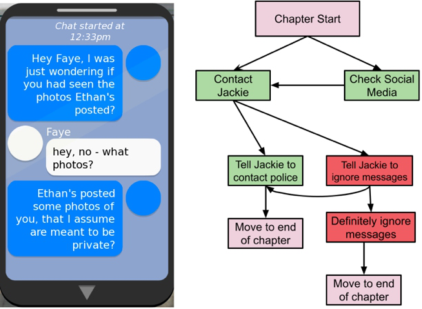
When the player chooses an option within a chapter, it affects the conver- sation and actions the victim takes, however, the overall outcome is generally the same. The Sextortion chapter differs in that it has two different outcomes. If the player recommends ignoring the extorter, images are leaked. In the alter- native outcome, the player was taken through the process of how to remove
180 Cotton and Shepherd
images, as they would if this situation happened in real life. The decision tree for the Sextortion chapter can be found in Figure 1.
To facilitate text-based conversations in each chapter, phone assets from itch.io were used (Nighten, 2021). It allowed for more than one message on the screen, and the player could scroll through the received messages (Figure 1). To create a more immersive story and to aid in world-building, royalty-free images were used for backgrounds, including images of break- rooms and bedrooms.
Characters can refer to the player by a name of their choosing and commu- nicate through texting and informal language (such as lack of capitalisation and grammar). Characters can go offline/online and send multiple messages rather than one large message; this was incorporated to add more authenticity to interactions. Rather than breaking chapter flow by having characters dis- cuss crimes and laws, information pages interspersed between chapters were easier to read and digest. These pages incorporate short pieces of text-based information about game play, crimes, laws, advice, and support.
Figure 1: On the left is a phone asset showing messages in-game. On the right is a decision tree for the sextortion chapter highlighting player choices and the outcomes.
Evaluation Before conducting the “Practising Safe Sex(t)” study, an application was submitted to the university ethics committee; approval was granted for performing a user evaluation of the game with people over eighteen.
Participants were asked to read through an information sheet containing trigger warnings related to sexual violence and detailing what the experiment would involve. The survey conducted before participants played the “Practis- ing Safe Sex(t)” game asked for demographics and questions about existing knowledge of TFSV, alongside the likelihood of seeking help from friends and family should the participant become a victim. At the end of the game, par- ticipants were asked to complete a post-game survey which asked how they felt about the game and if they felt it was effective as an educational TFSV tool. All data were anonymised.
Practising Safe Sex(t): Developing a Serious Game to Tackle Technology-Facilitated 181
Finally, participants were provided with a debrief, indicating how to con- tact the research team with further questions and reiterating where they could get support if they were affected by any of the issues raised during the experiment.
RESULTS AND DISCUSSION
The study was advertised on social media and at a security conference. The survey was open for responses from March-April 2022 and recruited (n = 45) participants.
Demographics Most participants (n = 21) were 18-24, while the oldest (n = 4) were between the ages 55-64. Over half of the participants (n = 28) identified as male, 13 as female, and four as transgender/gender non-conforming. All participants (n = 45) described their ethnicity as white. The majority (n = 31) identified as heterosexual. Most participants were from Scotland (n = 37). The demo- graphic profile is similar to the target audience of the “Don’t Be That Guy” campaign (Police Scotland, 2021).
Existing Knowledge of TFSV Before playing the visual novel game, 46.6% of participants (n = 21) said they knew what TFSV was, whilst fourteen said “No” and ten answered “Maybe”. After playing the game, just under 84.4% of participants (n = 38) said they learned about TFSV. The participants who answered “No” and “Maybe”, explained they already knew about TFSV.
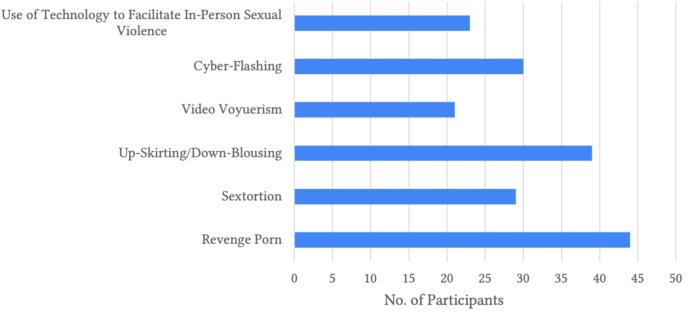
Before playing the game, participants were asked if they had heard of var- ious TFSV crimes (Figure 2). All but one had heard of revenge porn. Video voyeurism was the least recognisable, with only 21 participants having heard of the crime.
Figure 2: Summary of participant’s pre-game knowledge of TFSV crimes.
182 Cotton and Shepherd
Knowledge of Available Support Before playing the game, when asked if they knew where they would seek advice if they were a victim, most participants said “No”(n = 17) or “Maybe” (n = 15). Only 13 participants knew where they would go to seek help. When asked again after playing the game, nearly all participants (n = 42) knew where to get help.
Participants were asked if they would approach a family member or a friend if they were to become a victim of TFSV. In the pre-game survey, 17 participants said they would not approach a family member, whilst 18 said they would possibly approach them, and 10 said they would ask a family member for help. Embarrassment was cited as a reason participants would not ask family for help or advice, with fear of victim blaming as a reason.
“Its [sic]a personal experience. The same as if it was non technology based and these types of things are not something I would feel safe sharing with my family” – P06
“they lack an understanding of the complexity of trauma in general and would probably cause more problems……then [sic] likely blame the technology itself and ban it, or blame me as a victim to some extent.” – P45 In the post-game survey, the responses indicated a positive change, with 19 participants saying they would ask a family member for help. Fourteen said they would possibly approach them, and 12 said they still would not approach a family member. Of those who said no, embarrassment was a factor. One participant said they would recommend that their family play the game to start an open conversation about TFSV.
“if my family played this game or a similar game-based narrative story I actually think it might make the topic less touchy and make these crimes more open for discussion. I really believe this is a great way to introduce someone to these topics and educate on the right actions to take.” – P31 Participants were also asked how likely they were to approach a friend if they were a victim of TFSV. Just over half of participants (n = 26) said they would ask a friend for help, whilst 14 said “Maybe”, and five said “No”. Again, embarrassment was cited as a reason they would not ask for help. Participants also explained that they feared being bullied or judged by a friend.
“i would feel they might turn on me and bully me” – P33
“I don’t feel comfortable talking to them as they are judgemental and that’s not something I need to deal with” – P06 When compared to the post-game survey, at least 75% of participants (n = 34) said they would speak to a friend if they were a victim of TFSV, whilst eight participants said “Maybe”, and three said “No”.
LGBTQ+ participants were less likely to approach a family member than heterosexual participants. In the pre-game responses, only three out of four- teen LGBTQ+ participants said they would be comfortable asking family for help. After playing, only four out of fourteen said they would.
Practising Safe Sex(t): Developing a Serious Game to Tackle Technology-Facilitated 183
Male participants were also less likely to approach family members and preferred to approach friends. Research on gender inclusiveness regarding sexual violence suggests that men are taught at a young age that they should not be emotional as it is a feminine trait, and myths that men cannot be sexually assaulted are still very common (Turchik et al., 2016).
In terms of seeking help, 18 participants said they would go to the police, whilst 12 mentioned seeking specialist charities. However, two responses expressed distrust in the police, indicating they felt they would not be taken seriously, which draws parallels with the 2018 report by the North Yorkshire Police, Fire & Crime Commissioner (2018) on why revenge porn victims do not report their experiences.
Participants also mentioned they would seek help online, through helplines and support groups: “Local authorities, online helplines” – P39, “Police, online support groups” – P35, however many support helplines are open for limited hours. For example, the Rape Crisis Scotland (2022) helpline is only available 5pm-midnight, and emails aim to be answered within four working days. Meanwhile, emailing Safeline (2022), can take two working days for a response. The Revenge Porn (2022) has a chatbot available for out-of-hours support, which has the option to leave contact details for workers to get back in touch during work hours through different mediums, including Facebook Messenger.
Overall View of the Game After playing the game, participants were asked if they felt the narrative was suitable for educating people about TFSV. A large majority of par- ticipants (n = 40) said “Yes”, whilst three said “Maybe” and two said “No”. Most participants noted the story was believable and easy to under- stand. The game was seen to be immersive, breaking the crimes down into easy-to-understand chapters. Participants said the game was educational, informative, and interactive and preferred it to reading articles or watching videos.
“I like how the interactive element means that you’re more likely to pay attention to the content, whereas an article/report/block-of-text might not have the same result.” – P30
“It was a lot more interesting than just reading an article about it. Also made you think about how you would react if it actually happened to a someone you knew and in turn made you really think about the consequences.” – P24 One participant said they had learned more than they would have if they watched a video, and the emotions invoked by the chapter design “...made the game feel real. That these events were happening right before me.” - P31. This was the aim of using the visual novel and having the player as the main character, which was an effective choice for the game as an educational tool.
The results from the post-survey highlight that the game has a posi- tive impact on the TFSV knowledge of a player, and it encouraged them to consider a range of support sources. This was a promising finding and
184 Cotton and Shepherd
shows that games-based approaches to serious topics such as TFSV can prove successful.
Limitations The sample size is limited (n = 45) and focuses on a homogeneous group, however, the qualitative insights gained from the free text questions provided rich data for analysis. Some participants indicated they had problems with the web browser version of the game owing to compatibility issues with MacOS and Google Chrome. These participants were asked to use Mozilla Firefox, which resolved any issues. Others mentioned the game would not support scrolling with a trackpad.
CONCLUSION
Through a Scottish lens, the research has provided an overview of measures available to prevent TFSV, examined existing knowledge of TFSV and req- uisite support, and presented a novel game-based approach, “Practising Safe Sex(t)”.
The game-based approach showed potential in educating participants about TFSV. Results indicate most participants had heard of some aspects of TFSV, and the game provided information on crimes perhaps considered more obscure. Participants indicated that if they fell victim to TFSV, they would prefer to speak to friends and specialist support, emphasising the need for specialist charities and law enforcement. This puts more pressure on spe- cialist support to be able to help victims who do not feel comfortable speaking to others.
An open conversation about TFSV is needed and this can be accomplished through education. Only then may victims be able to feel comfortable seeking help from friends and family without fear of victim blaming and embarrass- ment. Future work seeks to develop this conversation, tailoring the game to different age ranges and exploring cultural and societal aspects of TFSV. Furthermore, the work highlights that law enforcement and support chari- ties need to deal with the rise in TFSV, thus could benefit from additional financial investment.
REFERENCES
Arinta, R. R., and Emanuel, A. W. (2020). Effectiveness of Gamification for Flood Emergency Planning in the Disaster Risk Reduction Area. International Journal of Engineering Pedagogy, 10(4). Bianchi, D., Baiocco, R., Lonigro, A., Pompili, S., Zammuto, M., Di Tata, D., Morelli,
M., Chirumbolo, A., Di Norcia, A., Eleonora Cannoni, E., Longobardi, E., Laghi, F. (2021). Love in quarantine: Sexting, stress, and coping during the COVID-19 lockdown. Sexuality Research and Social Policy. pp. 1–14. Champion, A., Oswald, F., and Pedersen, C. L. (2021). Technology-facilitated sexual violence and suicide risk: A serial mediation model investigating bullying, depres- sion, perceived burdensomeness, and thwarted belongingness. The Canadian Journal of Human Sexuality, 30(1), 125–141.
Practising Safe Sex(t): Developing a Serious Game to Tackle Technology-Facilitated 185
Phishy-a serious game to train enterprise users on phishing awareness. In Pro- ceedings of the 2018 annual symposium on computer-human interaction in play companion extended abstracts (pp. 169–181). Coull, N., Donald, I., Ferguson, I., Keane, E., Mitchell, T., Smith, O. V., Stevenson, E. Tomkins, P. (2016). On the use of serious games technology to facilitate large- scale training in cybercrime response. Special Issue 3 Eur. Police Sci. & Res. Bull., 123. Fisico, R., and Harkins, L. (2021). Technology and Sexual Offending. Current
Psychiatry Reports, 23(9). FollowIt. (2022). FollowItApp. Rape Crisis Scotland and the Scottish Women’s Rights Centre. Wesbite: https://followitapp.org.uk/ Henry, N., Witt, A. (2021). Governing image-based sexual abuse: Digital plat-
form policies, tools, and practices. In The Emerald International Handbook of Technology-Facilitated Violence and Abuse. pp. 749–768. Emerald Publishing Limited. Horgan, S., Collier, B., Jones, R., and Shepherd, L. (2021). Re-territorialising the policing of cybercrime in the post-COVID-19 era: towards a new vision of local democratic cyber policing. Journal of Criminal Psychology, 11(3), pp. 222–239 Lehmiller, J. J., Garcia, J. R., Gesselman, A. N., & Mark, K. P. (2020). Less sex,
but more sexual diversity: Changes in sexual behavior during the COVID-19 coronavirus pandemic. In: Leisure in the Time of Coronavirus. pp. 178–187. Routledge. Maheu-Cadotte, M. A., Cossette, S., Dube, V., Fontaine, G., Lavallee, A., Lavoie, P., Mailhot, T., Deschenes, M. F. (2021). Efficacy of serious games in health- care professions education: a systematic review and meta-analysis. Simulation in Healthcare, 16(3), 199–212 Mercer, C. H., Clifton, S., Riddell, J., Tanton, C., Freeman, L., Copas, A. J., Dema, E.,
Boso’ Pe’rez, R., Gibbs, J., Macdowall, W., Menezes, D., Ridge, M., Bonell, C., Sonnenberg, P., Field, N., Mitchell, K. R. (2021). Impacts of COVID-19 on sexual behaviour in Britain: findings from a large, quasi-representative survey (Natsal- COVID). Sexually Transmitted Infections. Meta. (2022). What should I do if someone is asking me to share a nude or sexual picture of myself on Facebook, or is threatening to share a photo that I already sent?. Website: https://www.facebook.com/help/1381617785483471 Michael, D. R., and Chen, S. L. (2005). Serious games: Games that educate, train,
and inform. Muska & Lipman/Premier-Trade. Nighten. (2021). Yet Another Phone Renpy. Website: https://nighten.itch.io/yet-anot her-phone-renpy North Yorkshire Police, Crime & Fire Commissioner. (2018). Suffering in Silence.
Website: https://www.northyorkshire-pfcc.gov.uk/wp-content/uploads/2018/11/ Suffering-in-Silence-Report.pdf Police Scotland. (2020). Policing for a Safe, Protected and Resilient Scotland - Cyber Strategy 2020: Keeping people safe in the digital world. Police Scotland. (2021). Police Scotland launches new campaign urging men to call
time on sexual crime. Website: https://www.scotland.police.uk/what-s-happenin g/news/2021/october/police-scotland-launches-new-campaign-urging-men-to-ca ll-time-on-sexual-crime/ PornHub. (2022). Violent Content Policy. Website: https://help.pornhub.com/hc/en -us/articles/4419863430291-Violent-Content-Policy
186 Cotton and Shepherd
Powell, A., Scott, A., Flynn, A., & Henry, N. (2020). Image based sexual abuse: An international study of victims and perpetrators. Royal Melbourne Institute of Technology. Rape Crisis Scotland. (2022). Website: https://www.rapecrisisscotland.org.uk/ Reddit. (2022). Never Post Intimate or Sexually Explicit Media of Someone
Without Their Consent. Website: https://www.reddithelp.com/hc/en-us/articles /360043513411 Riedel, J. C., and Hauge, J. B. (2011). State of the art of serious games for business and industry. In 2011 17th International conference on concurrent enterprising (pp. 1–8). IEEE. Revenge Porn Helpline. (2021). New out of hours support. Website: https://reveng
epornhelpline.org.uk/news/new-out-of-hours-support/ Safeline. (2022). Contact. Wesbite: https://safeline.org.uk/contact/ Scottish Parliament. (2009). Sexual Offences (Scotland) Act 2009. Website: https: //www.legislation.gov.uk/asp/2009/9/contents Scottish Parliament. (2016). Abusive Behaviour and Sexual Harm (Scotland) Act
2016. Website: https://www.legislation.gov.uk/asp/2016/22/contents/enacted Scholefield, S., and Shepherd, L. A. (2019). Gamification techniques for raising cyber security awareness. In HCI for Cybersecurity, Privacy and Trust: First Interna- tional Conference, HCI-CPT 2019, Held as Part of the 21st HCI International Conference, HCII 2019, Orlando, FL, USA, July 26–31, 2019, Proceedings 21. pp. 191–203. Springer International Publishing. SurvivorsUK. (2021). A resource for male survivors of sexual abuse. Web- site: https://www.survivorsuk.org/wp-content/uploads/2021/10/A-Resource-for -Male-Survivors-of-Sexual-Abuse/_SurvivorsUK-and-LSG.pdf Tanczer, L. M., López-Neira, I., amd Parkin, S. (2021). ‘I feel like we’re really behind
the game’: perspectives of the United Kingdom’s intimate partner violence sup- port sector on the rise of technology-facilitated abuse. Journal of gender-based violence, 5(3), 431–450. Turchik, J. A., Hebenstreit, C. L., and Judson, S. S. (2016). An examination of the gender inclusiveness of current theories of sexual violence in adulthood: Recogniz- ing male victims, female perpetrators, and same-sex violence. Trauma, Violence, & Abuse, 17(2), pp. 133–148. University of Washington. (2008). Foldit: Competitive Protein Folding for Medi-
cal Science. Website: https://www.engr.washington.edu/facresearch/highlights/cse _foldit.html Victim Support Scotland. (2022). Victim Support Scotland - Empowering people affected by crime. Website: https://victimsupport.scot/ Yamin, M. M., Katt, B., and Nowostawski, M. (2021). Serious games as a tool
to model attack and defense scenarios for cyber-security exercises. Computers & Security, 110, 102450. Zhong, L. R., Kebbell, M. R., & Webster, J. L. (2020). An exploratory study of Technology-Facilitated Sexual Violence in online romantic interactions: Can the Internet’s toxic disinhibition exacerbate sexual aggression?. Computers in Human Behavior, 108, 106314.
LISTED IN THE AHFE DIGITAL BOOKSTORE CATALOGUE
Explore the complete digital volume
Human Factors in Cybersecurity
Read this individual research paper free through the original publisher, or explore the full digital proceedings book.
ISBN 978-1-964867-03-8
Explore this ISBN in the AHFE Bookstore ↗Listed in the July 2026 bookstore catalogue; search by ISBN to confirm current availability · Digital book purchase optional