Rotem Lachmi, Batia Ben-hador, Yael Brender-Ilan (2024). Exploring consultant roles: Analyzing power dynamics through expert and referent power bases. In: Human Factors, Business Management and Society. AHFE Open Access, vol. 135, pp. 178–189. https://doi.org/10.54941/ahfe1004944
Defining product and service quality in most industries is relatively simple. However, defining service quality in management consulting is sometimes more complex. Management consultants help clients solve challenging issues and productively manage the organization. A significant research gap lies in the need for more clarity regarding the distinguishing factors between successful and unsuccessful consultants in their ability to assist clients in achieving their goals. Furthermore, the essential power consultants need to drive clients to success remains undefined.To bridge the research gap, we used analysis in two phases. The purpose of the first phase, the qualitative research, was to examine the power bases of the consultants. Forty consultants were interviewed, 10 of them from abroad, with the help of a semi-structured interview. The formulated research question was: what are the most common power bases that the consultants have, and how do they affect the relationship with the client? From all the interviews, two themes were found –Knowledge and identity. Furthermore, the most valuable power base from the consultants' view is the Expert power. This finding deviates from the literature, which typically references three power bases for influence and other factors.To examine whether the consultants' perception is relevant and correct, the second phase, quantitative research, examined the effect of power bases on the clients' self-efficacy and managerial stress. The study aimed to answer the question of whether there is a relation between the source of the consultant's main power base, emphasizing Referent or Expert power, and the level of managerial stress and self-efficacy of their client. One hundred clients participated in testing the correlation between the power bases of the consultants, self-efficacy, and management stress of the clients. With the help of regressions and statistical models, it was found that there is a significant correlation between the consultant’s Expert power and the client’s self-efficacy, while managerial stress moderates their correlation.The combination of the two research phases, qualitative and quantitative, reveals that Expert Power is crucial in boosting clients' self-efficacy, except when they're under high managerial stress. This paper provides readers with current insights following Mosonyi et al three different sources of power focusing on the Knowledge aspect. Furthermore, using French& Raven social power taxonomy combined with the Rahim Leader Power Inventory (RLPI). This research contributes to the existing literature by emphasizing a key power base and shedding new light about power dynamics in management consulting, additionally; it offers practical benefits by enhancing consulting outcomes and influencing on both client's and consultants' perspectives.
One of the most fascinating and hard-to-answer questions in the field of man- agement consulting is: What is the main factor that constitutes the primary determinant of the consultation process’s success? Research specializing in business has notably refrained from extensively discussing the origins, evo- lution, and influence of management consulting, especially the consultant’s impact on managers’ results (McKenna, 2006). This gave rise to phase 1 of this study, the qualitative research, which aimed to explore the multiple factors influencing the consulting process, with a focus on understanding the most dominant variables from the management consultant perspective. In-depth interviews were conducted with 40 consultants from around the world, the majority of whom were from Israel. It was discovered that
Exploring Consultant Roles: Analyzing Power Dynamics Through Expert 179
consultants predominantly utilize two primary power bases during their con- sulting process: Expert power stems from the consultant’s knowledge and expertise, while Referent power originates from their unique identity and personal characteristics. However, the research literature addressed knowl- edge, identity, and power as separate themes, rather than an integrated theory (Mosonyi et al., 2020). While consultants’ power bases have been identified, their impact on clients remains unclear. To further explore this, an addi- tional quantitative study, the second phase, was carried out, capturing the client’s perspective and the consultants’ most influential power bases. Clients, unsurprisingly, want to feel they have received value from their management consultant’sintervention However, researchers have extensively emphasized the importance of the client’s self-efficacy as a key factor (Kipping & Clark, 2012). In parallel, the research presents a paradox concerning the clients’ ini- tial high level of managerial stress (PMI) when embarking on the management consulting process. In the second phase, the quantitative study, self-report questionnaires were administered to over 100 clients who had underwent a consulting process over the last two years, and who confirmed the existence of a positive correlation between the consultant’s Expert power base and the client’s level of self-efficacy. However, this significant correlation was moder- ated by the client’s managerial stress (PMI). The more managerial stress was present, the lower the manager’s self-efficacy – but only when the consul- tant’s level of Expert power was low. The current research underscores the significance of examining power relations, particularly Expert power among consultants, considering the client’s managerial stress and the effect on the client’s self-efficacy as main success factors in the consulting process. Exist- ing research has primarily focused on the crucial role of Expert power in management consulting from the consultant’s perspective, emphasizing its influence on the client’s success. The positive correlation between a consul- tant’s Expert power base and their client’s self-efficacy often plays a central role. This study introduces a novel link between Expert power’s potential to positively influence and empower clients towards organizational change in particular, and to create a new contribution to the field of management consulting in general.
Theoretical Background- Phase 1 Between Theory and Practice Since the late 20th century, discourse on managerial consulting firms has rapidly expanded. The field’s flourishing and legitimacy are evident aca- demically and practically, with open entry barriers (McConnellogue, 2013). In the past, management consulting didn’t demand formal training, allow- ing anyone interested to participate (Foucault, 2020). However, current trends recommend acquiring academic knowledge, such as an MBA with an organizational behavior focus, to enter the field (Oncioiu, 2021). Bridg- ing practice and theory requires understanding power relations between consultants and clients (Erkens et al., 2012). Client-consultant relationships, explored from pro-consulting and critical perspectives, highlight the com- plexity and potentially manipulative nature of consultants (Kykyri et al., 2018). The assumption is that consultants provide tools, but the client must
implement recommendations for organizational change (Raymond, 2020). Even with correct methods, if clients don’t act, change won’t occur (Erkens et al., 2012). This study assumes a client’s performance depends on a con- sultant’s ability to influence them according to the organization’s needs. The literature lacks exploration of key consultant elements impacting clients.
Main Themes in Management Consulting Literature To explore core themes and foster further investigation, a critical examina- tion of their conceptualizations is essential. Analyzing diverse perspectives in the field is crucial for understanding the interfaces between Knowledge and Identity (Mosonyi et al., 2020).
Knowledge: Extensively researched and acknowledged as a crucial resource in today’s competitive management, knowledge is vital for orga- nizational success (Sharif et al., 2005). The creation, transfer, and sharing of knowledge are key factors for business success among professionals, orga- nizations, and managers (Szulanski et al., 2016). Scholars with a critical perspective challenge consultants’ claims to possess knowledge, questioning their professional standing and scrutinizing the efficacy of their contributions (Fincham and Clark, 2002).
Identity: Management consultants’ identities, a widely interpreted theme, are considered fluid and fragmented according to Brown (2014). Exist- ing research predominantly delves into the development of management consultants’ identities (Bergström et al., 2009). Some articles focus on spe- cific identity dimensions, such as being ‘elite,’ possessing a ‘heroic self,’ or embodying a ‘change agent’ (Alvesson& Robertson, 2006, p. 9).
Power following management consulting: Consultants consistently wield power to influence clients and stakeholders, as noted by Nikolova&Devinney (2009). Despite often being unaware of their influence or feeling constrained, consultants hold significant power. While organizational power has been explored by scholars like Pfeffer, Kanter, Allen, and Mintzberg, the man- agement consulting field remains a unique focus (Fleming and Spicer, 2014). The term “power” lacks a precise definition, which is surprising given the negotiation and tension inherent in management consulting, offering insight into multiparty power dynamics (Mosonyi et al., 2020).
Consultant-Client Power Relations Suddaby and Greenwood (2001: 947) argue that the success or failure of a consulting project isn’t solely determined by clients or consultants; rather, it results from the interactions of diverse groups with conflicting interests in the social construction of management knowledge. They call for more research on the roles of actors and their power relations in this process. Werr and Styhre (2003: 57) highlight two management discourses: the network discourse, emphasizing cooperation with consultants, and the bureaucratic discourse, where managers perceive themselves as in control. Fleming and Spicer (2014) identify client resistance to power configurations during change processes proposed by consultants, revealing tensions in the organization. Unlike regulated organizational hierarchies, the unregulated consultant-client
Exploring Consultant Roles: Analyzing Power Dynamics Through Expert 181
power relationship, while less obvious, can create imbalances. A fragile consultant-client dynamic with weak trust may hinder the process and lead to crises. This study aims to fill the research gap in management consulting lit- erature by exploring consultants’ central power bases and their effects on the consulting process and the consultant-client relationship. The research ques- tion for the qualitative phase is: What are consultants’ common power bases and how do they impact the consulting process and the consultant-client relationship?
Method - Phase 1 - The Qualitative Research This study seeks to explore the power bases employed by management consultants in their interactions with clients during the consulting process. The primary focus is on understanding how each power source influences clients and their overall relationship. To achieve these objectives, a qualita- tive research approach was chosen, utilizing semi-structured interviews as the primary data collection method (Neuman, 1991). The complexity of the research topics and the need for comprehensive insights from various perspec- tives guided the selection of the qualitative method (Denzin& Lincoln, 2008). Given the lack of specific focus on defined variables, qualitative research allows for the discovery to unfold during the research process (Corbin & Strauss, 2017). This study aims to enrich knowledge in the management consulting field through personal, semi-structured interviews with experi- enced consultants globally, particularly from Israel. The methodology aims for a comprehensive understanding of the industry by emphasizing qualitative research methods. The interviews delve into consultants’ roles, their perspec- tives on the profession, and their experiences, focusing on power relations and client relationships.
Research Background The management consulting sector, including major firms like the “Big 5” and smaller local agencies, has grown significantly. Faced with the challenges of COVID-19, these firms adapted by providing remote services and cutting costs (Szeiner et al., 2022). Despite diverse focuses within the field, manage- ment consultants share the common goal of adding value and ensuring client satisfaction. Recognizing the need for tailored approaches, consultants priori- tize building trusting relationships with clients. Managing client expectations is crucial, as satisfaction hinges on factors such as trust, service credibility, and consulting results (Jang & Lee, 1998).
Tools Semi-structured interviews (Denzin& Lincoln, 2008) delved into manage- ment consultants’ views on their roles, exploring how they either surpass or fall short of client expectations. The central question focused on the critical abilities consultants need in the field. The interviews allowed for additional insights and reflections on the management consulting landscape. The pri- mary research objective was to identify the consultant’s perspective on the pivotal factors shaping client experiences throughout the consulting process.
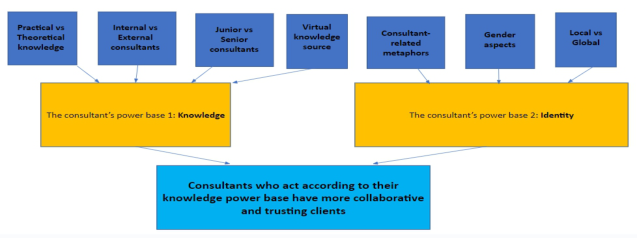
Participants Research participants, all with a minimum of two years’ experience as con- sultants, were exclusively drawn from the management consulting field. The 40 participants (45% female) included 30 Israelis and 10 from various global locations. The majority of participants had extensive experience, and most had an MBA. From a total of 40 categories and metadata, seven main themes emerged from the participants’ interviews. These seven were divided into two main themes.
Figure 1: The qualitative theme: The consultant’s power bases.
Findings In personal interviews, consultants were specifically asked about the most crucial skill for a successful client process. Notably, 80% of participants faced difficulty, evident in expressions of contemplation, extended pauses, and moments of deep thought. Responses varied, with some stressing knowledge and professional expertise, while others highlighted relationship-building, effective communication, self-confidence, and charisma. Extensive research underscores the pivotal role of the consultant-client relationship in consult- ing success (Nikolova & Reihlen, 2008). Alongside knowledge, interviewees emphasized consultants’ wealth of experience in diverse organizational con- texts, enabling resource optimization (Appelbaum & Steed, 2005). The data revealed two main themes: The Knowledge power base and the Identity power base. These themes collectively form a meta-theme: Consultants rely- ing on their Knowledge power base exhibit greater confidence than those depending on their Identity power base.
Summary The qualitative research question was as follows: What are consultants’ most common sources of power, and how do they affect the consulting process and the consultant-client relationship? The research found that there are two common power bases that shape and influence the consultant-client relation- ships: Identity & Knowledge. The overarching theme that emerged was that emphasizing the Knowledge is the main power source in the consulting pro- cess, since it enhances clients’ sense of connection and trust in the consultant. This finding is revolutionary, since thus far the research literature has not focused on consultants’ power sources in general, or as regards knowledge in particular. Numerous past studies have actually emphasized the importance
Exploring Consultant Roles: Analyzing Power Dynamics Through Expert 183
of the consultant’s identity over their knowledge. Thus, this study’s findings are of significant value, offering fresh insights into the field of management consulting regarding the knowledge power base.
Theoretical Background – Phase 2 - Assessing the Value of Consulting: Overcoming Challenges Defining quality in institutions is typically straightforward, but it poses chal- lenges for services like management consulting due to the absence of common measurable features (Nachum, 1999). This difficulty is amplified for services lacking precise outcomes. In the management consulting industry, a key chal- lenge is achieving high NPS scores and ensuring customer satisfaction with the consulting process and results (Schmuck, 2017). Identifying challenges requires distinguishing between consultant and client perspectives on factors influencing consulting success. Limited theoretical research exists on how management consulting success factors are perceived from the client’s view- point (Bronnenmayer et al., 2016). The current research seeks to assess the genuine impact of a consultant on a client by closely examining the consul- tant’s dominant power bases and their effects. Additional factors influencing client success will be detailed in the following section.
Unidentified Factors Influencing Consulting Outcomes Assessing management consulting services presents challenges, given the difficulty in consistently quantifying results and isolating the consultant’s contribution amid various influencing factors (Steinburg, 1992). To tackle this, it is crucial to evaluate the management consulting process, consider- ing both qualitative and quantitative aspects that benefit both the consultant and the client (Antonchenko & Kalenskaya, 2014). Quantitative aspects, involving significant data, have a tangible impact on both organizations and managers, unlike the more subjective and unpredictable future qualitative aspects of management consulting results (Ibatova et al., 2018). This study focuses on key factors influencing the outcomes of the consultation process, examining the impact of the consultant’s dominant power bases on the client.
Defining the Consultant’s Main Power Bases Studies often categorize power bases into two main types: coercive and non- coercive, with expert power falling into the latter category. Expert power, rooted in perceived job experience and specialized knowledge, fosters trust and solidarity in relationships. In contrast, referent power has an emotional impact (Sahadev, 2005). Generally, knowledge and expertise power bases prove more effective than identity power bases in eliciting desired changes in customers (Busch & Wilson, 1976). However, consultants employing refer- ent power or identity power bases are more likely to share knowledge (Issac & Bednall, 2022; Bhatt, 2001). Expert power is determined based on mean scores from six responses corresponding to the dimension in the Rahim Lead- ership Power Inventory (RLPI) (Rahim, 1989). While the expert power base is recognized in organizational behavior and management studies, few have empirically analyzed it as a distinct and independent power base (Sahadev, 2005).
Referent power is rooted in the interpersonal attraction and identification that subordinates feel towards a superior, driven by admiration or personal liking for that superior (French & Raven, 1959). A study by Issac and Bed- nall (2022) revealed that individuals with a strong sense of referent power perceive themselves as having significant influence among their colleagues. However, those with referent power are more likely to engage in knowledge hiding (Issac & Bednall, 2022). Therefore, this phase aims to focus on both referent and expert power bases, conducting a correlations check to under- stand whether managerial stress and self-efficacy impact success from the client’s perspective. Client’s challenges regarding management consulting Clients face diverse challenges in the consulting process, beginning with the administrative pressures on managers and the demand for multitasking, limit- ing their cognitive space for dedicated focus on change processes. Additional challenges include self-efficacy issues and the dynamics of their relationship with the consultant. There are also “unknown factors” described as mysteri- ous elements often discussed in research literature concerning the outcomes of consulting processes.
Management Stress (PMI3) Stress is the psychological and physical state arising when an individual’s resources are insufficient to handle the demands and pressures of a situation (Kohler & Kamp, 1992). Work-related stress, particularly among managers and executives, is increasing in modern society. Williams and Cooper (1998) developed a scale (PMI) measuring workplace stress among managers. Con- sultants aim to achieve various goals, including providing effective tools for managing work tasks and reducing managerial stress.
Clients’ Self-Efficacy (NGSE4) Studies on clients’ self-efficacy emphasize its role as a primary driver of management success, task performance, and motivation for change (Stajkovic & Luthans, 2003). Additionally, self-efficacy plays a crucial role in both acquiring and sharing complex knowledge (Endres et al., 2007). Defined as “beliefs in one’s capabilities to mobilize the motivation, cognitive resources, and courses of action needed to meet given situational demands” (Wood & Bandura, 1989, p. 408), self-efficacy is a pivotal factor. In the upcoming study, the focus is on exploring the impact of the consultant’s power bases on client success, considering both managerial stress (PMI) and self-efficacy (NGSE). This quantitative investigation aims to establish a sig- nificant relationship between the initial variables identified in the first study and those specified in the current research.
The Quantitative Research - The Power Bases Model as a Centralframework The selection of the PMI as a moderating variable stems from its rec- ognized influence on a manager’s overall success (Anderson et al., 1977) and, more specifically, on relationships within the consulting process (Nikolova et al., 2009). The NGSE4 was chosen as the dependent variable
Exploring Consultant Roles: Analyzing Power Dynamics Through Expert 185
due to the contemporary organizational framework’s emphasis on employ- ees and managers perceiving their self-efficacy positively (Wood & Bandura, 1989). Grounded in the Self-efficacy theory (SET), this study is based on the empirically supported notion that an individual’s perceived ability plays a piv- otal role in generating or facilitating action and change (Bandura et al., 2001). This research delves into the influence of the consultant’s power base (Expert vs Referent) on the dependent variable of self-efficacy. Combining insights from various management consulting literature and qualitative research, two independent variables, namely “Expert power” and “Referent power,” were extracted from the Rahim Leader Power Inventory (RLPI).
Prior research, such as Rahim (1989), establishes a notable correlation between Expert and Referent power bases, aligning with the Theoretical Model of Power, Conflict Styles, and Job Performance. This model under- scores significant positive correlations between these power bases. In our study, we explore how clients respond to Expert and Referent power bases in management consulting, recognizing the influence of multiple factors. Our primary focus is to enhance understanding of the consequences and corre- lations of a client’s self-efficacy—a key factor in successful consulting—by categorizing the consultant’s main power base as Referent or Expert. This leads to the research question: Does the consultant’s main power base (Ref- erent or Expert) correlate with the client’s managerial stress and self-efficacy? We assume that the managerial pressure index (PMI) moderates the relation- ship between the consultant’s main power base and the client’s self-efficacy, leading to the following hypotheses: Hypothesis 1a: The client’s PMI (pressure index) will moderate the corre- lation between the consultant’s main power base and the client’s self-efficacy. (Higher PMI will lead to a less significant correlation between the consul- tant’s main power base and the client’s self-efficacy). / Hypothesis 1b: Expert power will befound to have a positive significant correlation with client self- efficacy. / Hypothesis 1c: Referent power will be found to have a positive significant correlation with client self-efficacy.
To assess the three hypotheses, we administered validated research ques- tionnaires to a sample of 100 clients who had undergone a consulting process within the past two years. The objective of this research is to corroborate the client’s viewpoint in alignment with the insights derived from the qualitative research on the consultant’s perspective.
METHOD
Participants and Procedure The study involved participants who had undergone a consulting process in the past two years, resulting in a final sample of 100 participants after data cleaning. The participants included 50% women, with an average age of 42. Around 25% held a BA degree. The majority, 84%, held manage- ment positions with an average seniority of Mseniority = 7.7 years. Over half (53%) had experience with managerial consulting processes.Participants self- reported on their PMI and self-efficacy (NGSE), while third parties reported on their consultants’ power base (Expert or Referent).
Measures Managerial stress - Pressure ManagerialIndex (PMI)./ Power Bases – Expert or Referent power of the consultant (3rd party reporting), based on Rahim’s (1988) RLPI- Rahim Leader Power Inventory/ Client Self-efficacy (NGSE), based on a validated questionnaire that with 8 items (Chen et al., 2009). / Client seniority, duration of consultation process and consultant’s seniority were all measured separately using a single-item open text question. /Type of consultation process the client has been through, using one item question with 5 options emerged: organizational consulting, managerial consulting, coaching, business consulting, and others.
RESULTS
The research model was tested using Hayes’s (2017) procedure to test the regression, mediation, and moderated mediation. Hypothesis a—was not confirmed as no significant correlation was found; therefore, the significance of PMI was deemed irrelevant. Hypothesis b—was supported (R2 = 0.37, F = 19.4, p <0.000) and confirmed.The comparison between the two inde- pendent variables - Expert Power & Referent Power. The second phase, the quantitative study, had some significant results regarding Expert Power, compared to insignificant results regarding Referent Power. A significant pos- itive correlation was found between the consultant’s Expert Power and the client’s self-efficacy, while the client’s PMI moderated this connection. In con- trast, Referent Power had no significant correlations.When examining the moderated mediation hypothesis for PMI, we find the effect on the correla- tion between the independent variable - consultant’s Expert Power- on the dependent variable –the client’s self-efficacy (NGSE).
GENERAL DISCUSSION AND FINAL CONCLUSION The study reveals insights into power bases in management consulting, emphasizing Expert and Referent Power. Notably, it challenges past lit- erature, integrating knowledge, identity, and power. Aligning with earlier research, it diverges from Issac and Bednall (2022), emphasizing Expert Power over Referent Power. Both study phases highlight the positive impact of consultants’ Expert Power on the consultant-client relationship. Phase 1 shows consultants’ need for knowledge and expertise, with differences noted among consultants. Phase 2 quantifies the importance of Expert Power, while Referent Power proves insignificant. Results confirm Expert Power posi- tively correlates with client self-efficacy, moderated by managerial stress. The research contributes theoretically to management consulting, emphasizing the centrality of Expert Power and knowledge. Client self-efficacy is under- scored as crucial, offering insights into managerial stress as a moderating factor. This challenges existing literature, recognizing the profound influence of Expert Power on clients and their organizational transformation.
Exploring Consultant Roles: Analyzing Power Dynamics Through Expert 187
REFERENCES
Alvesson, M. & Robertson, M. (2006). The best and the brightest: The construction, significance, and effects of elite identities in consulting firms. Organization. 13(2), 195–224. Anderson, C. R., Hellriegel, D., and Slocum Jr, J. W. (1977). “Managerial response
to environmentally induced stress”. Academy of Management Journal, Vol. 20(2), pp. 260–272. Antonchenko, N. G., &Kalenskaya, N. V. (2014). Developing a methodology for assessing the efficacy of managerial decisions in entrepreneurial establishments. Life Science Journal, 11(7s). Appelbaum, S, H. & Steed, J, A. (2005). The critical success factors in the client-
consulting relationship. Journal of Management Development. 24 (1), 68–93. Bandura, A., Barbaranelli, C., Caprara, G. V., and Pastorelli, C. (2001). “Selfefficacy beliefs as shapers of children’s aspirations and career trajectories”. Child Development, Vol 72, pp. 187–206. Bhatt, G. (2001). Knowledge management in organizations. Knowledge Manage-
ment, 5(1), 68–75. Brown, L. (Ed.). (2014). Theaetetus. Oxford University Press, USA. Bronnenmayer, M., Wirtz, B. W., &Göttel, V. (2016). Success factors of management consulting. Review of Managerial Science, 10, 1–34. Busch, P., & Wilson, D. T. (1976). An empirical analysis of a salesman’s expert
and referent bases of social power in the buyer–seller dyad. Journal of Marketing Research, 13(1), 3 – 11. Chen, G., Stanley M. Gully, &Dov, E. (2009). Validation of a New General Self- Efficacy Scale. Organizational Research Methods. 4(1), 62. Corbin, J., & Strauss, A. (2017). Basics of qualitative research: Techniques and
procedures for developing grounded theory. Sage. 7(1), 5–72. Denzin, N. K., & Lincoln, Y. S. (2008). Introduction: The discipline and practice of qualitative research. Strategies of qualitative inquiry. 2(1), 1–43. Erkens, D., Hung, M., & Matos, P. (2012). Corporate governance in the 2007–
2008 financial crisis: Evidence from financial institutions worldwide. Journal of Corporate Finance. 18(1), 389–411. Fincham, R., & Clark, T. (2002). Preface: Management consultancy: Issues, perspectives, and agendas. International Studies of Management & Organization, 3–18. Fleming, P. & Spicer, A. (2014). Power in management and organization science.
Academy of Management Annals. 8(1), 237–298. French, J. and Raven, B. (1959). The Bases of Social Power. In Studies in Social Power, D. Cartwright, Ed., pp. 150–167. Hayes, A. F., & Rockwood, N. J. (2017). Regression-based statistical mediation and
moderation analysis in clinical research. Behaviour Research and Therapy, 98, 39– 57. Ibatova, A., Kuzmenko, V., &Klychova, G. (2018). Key performance indicators of management consulting. Management Science Letters, 8(5), 475–482. Issac, A. C., &Bednall, T. C. (2022). The effects of expert power and referent power
on. Journal of Knowledge Management. Jang, Y., & Lee, J. (1998). Factors influencing the success of management consulting projects. International Journal of Project Management, 16(2), 67–72. Kipping, M., & Clark, T. (Eds.). (2012). The Oxford handbook of management
consulting. OUP Oxford.
Kohler, S. & Kamp, J. (1992). American workers under pressure. Paul Fire and Marine Insurance Company. 1(2), 11. Kykyri, V.-L., &Puutio, R. (2018). Conflict as it happens: Affective elements in a con-
flicted conversation between a consultant and clients. Journal of Organizational Change Management, 34 (1), 28–45. Lahti, R. K., &Beyerlein, M. M. (2000). Knowledge transfer and management consulting: A look at “the firm”. Vezetéstudomány-Management and Business Journal, 31(7-8), 91–99. Lee Endres, M., Endres, S. P., Chowdhury, S. K., &Alam, I. (2007). Tacit knowl-
edge sharing, self-efficacy theory, and application to the open source community. Journal of knowledge management, 11(3), 92–103 McConnellogue, S. F. (2013). Culture and professional identity in global management consulting. 1–120. McKenna, C. D. (2006). The world’s newest profession: Management consulting in
the twentieth century. Cambridge University Press. Mosonyi, S., Empson, L., and Gond, J. P. (2020). “Management consulting: Towards an integrative framework of knowledge, identity, and power”. International Journal of Management Reviews, Vol 22(2), pp. 120–149. Nachum, L. (1999). Measurement of productivity of professional services: Anil-
lustration on Swedish management consulting firms. International Journal of Operations & Production Management, 19(9), 922–950. Neuman, W. L. (1991). Social research methods: qualitative and quantitative approaches. Boston: Allyn and Bacon. 1(2), 1–9. Nikolova, N &Reihlen, M. (2008). Client and consultant interaction: capturing
social practices of professional service production. Academy of Management Annual Meeting Proceedings. 1(6), 290–297. Nikolova, N., &Devinney, T. M. (2009). Influence and power dynamics in clientconsultant teams. Journal of Strategy and Management, 2(1), 31–55. Oncioiu, I., Kandzija, V., Petrescu, A. G. Panagore¸t, I., Petrescu, M., &Petrescu, M.
(2021). Managing and measuring performance in organizational development. Economic Research-EkonomskaIstraživanja. Routledge. 2–14. Rahim, M. A., &Buntzman, G. F. (1989). Supervisory power bases, styles of handling conflict with subordinates, and subordinate compliance and satisfaction. The Journal of Psychology, 123(2), 195–210. Raymond, C., & Dyer, C. (2020). The performative practices of consultants in a
change network: an actor–network practice perspective on organizational change. Journal of Organizational. 1–12. Sahadev, S. (2005). Exploring the role of expert power in channel management: An empirical study. Industrial Marketing Management, 34(5), 487-494. Schmuck, R. (2017). Managing Quality in Management Consulting. Selected Papers
from Responsibility. Komárno: International Research Institute. 15–21. Sharif, M., Zakaria, N., Chinge, N. and Fung, L. (2005) ‘Facilitating knowledge sharing through lessons learned system’, Journal of Knowledge Management Practice, Vol. 12, No. 117, pp. 1–7. Stajkovic, A. D., &Luthans, F. (2003). Behavioral management and task performance
in organizations: conceptual background, meta-analysis, and test of alternative models. Personnel psychology, 56(1), 155–194. Steinburg, C. (1992). The art of choosing a consultant. Training & Development, 46(1), 21–26.
Exploring Consultant Roles: Analyzing Power Dynamics Through Expert 189
Szeiner, Z., Kovács, Á., Zsigmond, T., Mura, L., Sanders, E., &Poór, J. (2022).
An empirical study of consulting in a transitional economy in the Central Euro- pean region during COVID-19. Journal of Eastern European and Central Asian Research. 9(3), 471–485. Szulanski, G., Ringov, D. & Jensen, R. J. (2016) ‘Overcoming stickiness: how the timing of knowledge transfer methods affects transfer difficulty’, Organization Science, Vol. 27, No. 2, pp. 304–322. Williams, S., & Cooper, C. L. (1998). Measuring occupational stress: development
of the pressure management indicator. Journal of occupational health psychology, 3(4), 306. Wood, R & Bandura, A. (1989). Social cognitive theory of organizational management. Academy of Management Review, 14(3), 361–384.
LISTED IN THE AHFE DIGITAL BOOKSTORE CATALOGUE
Explore the complete digital volume
Human Factors, Business Management and Society
Read this individual research paper free through the original publisher, or explore the full digital proceedings book.
ISBN 978-1-964867-11-3
Explore this ISBN in the AHFE Bookstore ↗Listed in the July 2026 bookstore catalogue; search by ISBN to confirm current availability · Digital book purchase optional