Asta Savanevičienė, Živilė Stankevičiūtė, Lina Girdauskiene, Vilma Pluščiauskaitė, Daivaras Sokas, Audrys Kukulskis, Andrius Rapalis, Lina Jankauskaitė, Rimvydas Eitminavičius (2024). Experimental research design for investigation of the impact of managerial behavior on employee stress. In: Human Factors, Business Management and Society. AHFE Open Access, vol. 135, pp. 323–329. https://doi.org/10.54941/ahfe1004959
The paper outlines the experimental research design for investigation of the impact of managerial behavior on employee stress. The proposed experimental research design integrates management, bioengineering, and medical sciences. From a management science perspective, real work situations and scenarios were created to investigate the impact of different managerial behaviors (transformational and transactional leadership styles) on employee stress in different work situations. The implications for bioengineering and medical sciences are revealed through the research of physiological parameters and biomarkers (cortisol, alpha amylase, and immunoglobulin A) to determine objective stress and its dynamics. Experimental research design based on the simulation of real situations face-to-face and the use of physiological parameters and biomarkers in determining the objective level of stress enables obtaining strong evidence of causal relationships by manipulating managerial behavior and different work situations that influence employee stress. The paper argues for the value of experimental research design in leadership and human resource management field and provides the elaborated protocol for deeper understanding of the influence of manager's behavior on employee stress in different work situations.
According to the European Agency for Safety and Health at Work, 28% of employees have health problems due to work-related stress. Research has revealed that the manager’s behavior is one of the key factors that determines the stress of employees at work. Moreover, managers can enhance or reduce
both the positive and negative effects of work environment factors. However, most of these studies follow a survey-based research approach, looking for the link between the manager’s behavior and employee stress at work. The scholars emphasize the shortcomings of these research methods, pointing out that it is often impossible to determine the specific work environment factor that caused the stress, i.e., identify the key stimulus in the set of factors of the work environment (Carton, 2022; Lukan et al., 2022; Podsakoff et al., 2023); in other cases, stress can be the result of work environment factors such as poor workplace relationships or low work performance (Chen et al., 2022; Da Costa et al., 2023); and finally, the perception of stress and its causes is subjective (Diebig et al., 2016; Weckesser et al., 2019) and is determined by many external and internal factors affecting the respondent at the time of filling out the questionnaire.
Thus, emphasizing the significance of employees’ positive socio- psychological experiences at work, the paper highlights the increasing interest of experimental designs in human resource management studies due to a deeper comprehension of the way the managerial behavior influences the employee stress in a given work situation. Experimental research enables the elimination of the limitations of survey-based research and allows for the understanding of cause-and-effect relationship variables due to the possibil- ity of controlling the variables and isolating the effects of one variable on another (Eriksson et al., 2000, Cohen, 2007, Liu et al., 2023).
The paper aims to provide an experimental research design for assess- ing the impact of managerial behavior on employee stress in different work situations. Moreover, the proposed experimental research design seeks to eliminate the limitations of the methodological approach of previous studies. Diebig (2016) appealed that research was mostly based on subjective percep- tion and assessment of stress, while future management research should use objective biological indicators of stress. Dóci and Hofmans (2015) argued that future research should be conducted in an experimental setting that would allow measuring the direct effects of managerial behavior on employee stress. An experimental research design for assessing the impact of managerial behavior on employee stress in different work situations integrates simula- tion of real work situations, analysis of biomarkers and physiological signals for determining objective stress, and semi-structured interview method for understanding subjective stress and its causes.
THE VALUE OF INTERDISCIPLINARY RESEARCH IN STUDYING THE IMPACT OF MANAGERIAL BEHAVIOR ON EMPLOYEE STRESS Experimental research designs are still rarely used in leadership and manage- ment (Podsakoff and Podsakoff, 2019; Figureau et al., 2020; Fu et al., 2022). Moreover, according to Diebig and Borman (2020), in the context of leader- ship research, objective biological indicators of stress are lacking in current practice. Diebig (2016) was one of the first to apply the use of hair cortisol as a biological stress marker in the field of organizational research, empha- sizing that this method is debatable, and that attention should also be paid to physiological parameters such as heart rate or skin moisture. It should also
Experimental Research Design for Investigation of the Impact of Managerial Behavior 325
be noted that hair cortisol dynamics are inert and reflect the consequences of long-term stress, so determining the true causes of stress is difficult due to subjective assessment. A later study (Rowold et al., 2017) was also lim- ited to examining cortisol (saliva and hair), but the results were interesting: transformational leadership had no effect on cortisol levels, but instrumental leadership was associated with increases in both salivary and hair cortisol levels in the evening, which indicates an increase in stress. However, this study also used a questionnaire survey, which summarized the experiences of a certain period, rather than stating the events of that day, i.e. a specific stress stimulus could not be identified. The latest medical studies (Giacomello et al., 2020; Valentinaviˇcius et al., 2020) recommend simultaneous examination of three substances for the determination of stress: cortisol, alpha amylase, and immunoglobulin A. One of the most recent studies investigating the stress of night workers has already examined two parameters – cortisol and alpha amylase (Briguglio et al., 2021), but these are only the first steps in applying objectified indicators (biomarkers) for stress determination.
The problem of subjectivity can also be solved using modern physiologi- cal signal registration and parameter monitoring technologies, which allow to assess and monitor the individual’s physiological changes as a reaction to certain stimuli in the work environment. A detailed analysis of 134 scien- tific publications (Kreibig, 2010) showed that recording psychophysiological reactions determined by the state of the autonomic nervous system was a suc- cessful attempt to determine the level of stress. Stress markers can be reflected in parameters of the autonomic nervous system, which can be divided into three categories: cardiovascular, respiratory and electrodermal. In total, there are several tens of these evaluated potential parameters, but today there is a lack of knowledge, which ones of these parameters are the most informative and appropriate for stress assessment. Nevertheless, the existing knowl- edge of developing physiological signal monitoring tools and algorithms can be used to study the impact of managerial behavior on employee stress in different work situations. (Rapalis et al., 2017)
An Experimental Research Design for Assessing the Impact of Managerial Behavior on Employee Stress in Different Work Situations The proposed experimental research design integrates management, bioengi- neering, and medical sciences. From a management science perspective, a qualitative study based on subjective opinion identified critical factors of the work environment and manager’s behavior affecting employees’ socio- psychological experiences and stress. Based on previous research, real work situations and scenarios were created to investigate the impact of different managerial behavior (transformational and transactional leadership styles) on employee stress in different work situations. The implications for bioengi- neering and medical sciences are revealed through the research of physiologi- cal parameters and biomarkers (cortisol, alpha amylase, and immunoglobulin A) to determine objective stress and its dynamics. Physiological signals are recorded while wearing a multimodal bracelet and the data is synchronized
326 Savaneviˇcien˙e et al.
with the critical events of the scenarios. Biomarkers are collected through saliva tests that are conducted between scripted scenes. Experimental research design based on the simulation of real situations face-to-face and the use of physiological parameters and biomarkers in determining the objective level of stress enables obtaining strong evidence of causal relationships by manip- ulating managerial behavior and different work situations that influence employee stress.
Sample The experimental sample consists of employed individuals with at least one year of working experience. Individuals who use drugs that slow the heart rhythm or whose health condition at the time of the study is related to an active disease affecting the heart rhythm (fever, heart rhythm disorders), cannot participate in the experiment.
For the study of the same work environment factors it is recommended to carry out experiments with 50 subjects. The number of 50 subjects is based on the opinion of Cohen et al. (2007) that an experiment needs at least 15 participants, but the experiments conducted by Ledolter and Kardon (2020) with samples of 20, 30 and 50 subjects showed that the statistical parameters of the study’s validity improved as the sample increased.
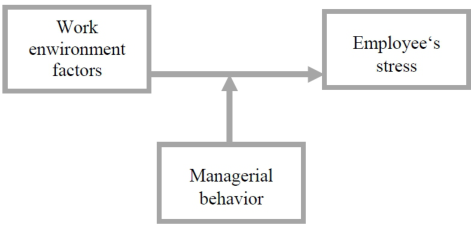
Scenario The main goal of the scenario is to model a situation that would allow to determine the causal relationships between independent and dependent vari- able(s). When investigating the impact of managerial behavior on employee stress in different work situations, the impact of work environment factors on employee stress is moderated by managerial behavior, i.e. managerial behav- ior can enhance or reduce both the positive and negative effects of work environment factors.
Figure 1: The relationship between work environment factors and employee stress, moderated by managerial behavior.
Pre-Experimental Stage Pre-experimental stage consists of two parts: introduction to the experiment and preparation for the experiment. The subject is explained the purpose of
Experimental Research Design for Investigation of the Impact of Managerial Behavior 327
the experiment and methods applied, and signs the consent to participate in the experiment. They ask the follow-up questions as needed.
In the preparatory stage, a demographic and physical data questionnaire is filled out (age, sex, height, and weight). These data are necessary for the interpretation of physiological signals, considering the unique characteristics of each subject. A multimodal bracelet is put on the subject, which registers physiological stress parameters, allowing to determine short-term stress. The bracelet is worn throughout the experiment. Finally, the subject is left to relax for 10 minutes to normalize the physiological parameters.
Experimental Stage The duration of the experiment is up to 60 min, and the respondent performs the tasks provided in 2 scenarios simulating stressful stimuli. The scenarios are composed of separate scenes in which the stimuli of the work environ- ment are clearly identified (for instance, task delegation, salary issue, etc.). The scenarios differ according to the manager’s behavior (transactional and transformational leadership).
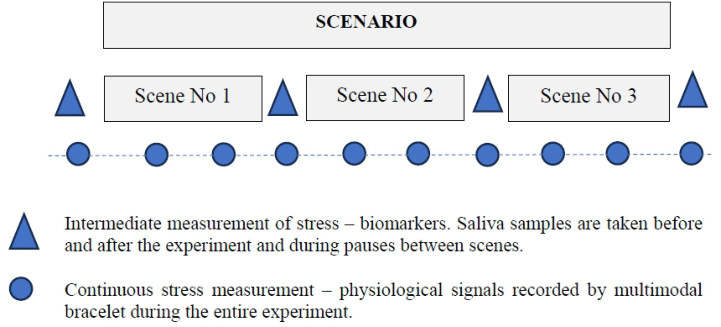
The number of scenes in different scenarios may vary depending on the stimuli studied. Physiological signals are continuously recorded during the performance of the tasks provided in the scenarios, and saliva samples are taken before and after the experiment and during pauses between scenes.
Figure 2: Measurement of physiological signals and biomarkers.
Post-Experimental Stage At the end of the task simulation, a semi-structured interview is conducted, where the subject is asked to share his experiences, how stressful these situa- tions were for them, what manager’s behaviors mitigated or, on the contrary, intensified the impact of the work environment stimulus.
328 Savaneviˇcien˙e et al.
CONCLUSION
The proposed experimental research design enables a study evaluating the impact of managerial behavior on employee stress in different work sit- uations. When simulating the manager’s behavior and work environment stimuli, real work situations are recreated in order to find out what manage- rial behaviors can enhance or reduce both the positive and negative effects of work environment factors. The human body responds to stimuli and physiological and biomarker changes can be recorded to indicate the stress levels. The research will help to understand how the dynamics of biomark- ers and physiological signals are related to different manager’s behaviors and to reveal the (non-)coincidences of subjective and objective stress. Based on the prepared empirical research design, it is possible to gain knowledge that enables preventively reducing the stress at work due to the manager’s behav- ior that promotes positive socio-psychological experiences and will ensure sustainable management of human resources.
ACKNOWLEDGMENT
This research project has received funding from the Research Council of Lithuania (LMTLT), agreement No [S-MIP-22-28].
REFERENCES
Allen, Andew P. Kennedy, Paul J. Dockray, Samantha. Cryan, John F. Dinan, Timothy G. and Clarke Gerard. (2016). The Trier Social Stress Test: Principles and practice. Neurobiol Stress. Volume 12, No. 6, 113–126. Briguglio, Giusi. Teodoro, Michele. Italia, Senastiano. Verduci Francesca. Pollicino,
Manuela. Coco, Manuela. De Vita, Annalisa. Micali, Elvira. Alibrandi, Angela. Lembo, Giuseppe. Costa, Chiara and Fenga, Concettina. (2021). Salivary Biomarkers and Work-Related Stress in Night Shift Workers. International Journal of Environmental Research and Public Health. Volume 18, No. 6, 3184. Carton, Andrew M. (2022). The science of leadership: A theoretical model and research agenda. Annual Review of Organizational Psychology and Organiza- tional Behavior, Volume 9, 61–93. Chen, Biao. Wang, Lu. Li, Biao. Liu Weixing. (2022). Work stress, mental health,
and employee performance. Front Psychol. Volume 8, 13. Cohen, Louis. Manion, Lawrence and Morrison, Keith. (2007). Research methods in education. Routledge. Da Costa, Jefferson, S. Leite, Djavan G, Sales, Weslley B. Lima Coutinho, Márcio D.
(2023). Influence of occupational stress on interpersonal and organizational relationships: an integrative review. Open J Pain Med. Volume 7, No. 1. Diebig, Mathias (2016). Leadership and Work Stress: A Three Study Investigation on Stress-Related Antecedents and Consequences of Full-Range Leadership Behaviors. Dissertation. Diebig, Mathias. Borman, Kai C. (2020). The dynamic relationship between laissez-
faire leadership and day-level stress: A role theory perspective. German Journal of Human Resource Management, Volume 34, No. 3, 324–344. Dóci, Edina. Hofmans, Joeri. (2015). Task complexity and transformational leadership: The mediating role of leaders’ state core self-evaluations. The Leadership Quarterly, Volume 26, No. 3, 436–447.
Experimental Research Design for Investigation of the Impact of Managerial Behavior 329
Fu, Xiaogai. Li, Chaoyang and Fu, Jialin. (2022). The experimental research on leaders and cooperative behavior. Front. Psychol. Volume 13, 944498. Eriksson, Lenart. Johansson, E. Kettaneh-Wold, Nouna. Wikström, Conny, and
Wold, S. (2000). Design of experiments. Principles and Applications, Learn ways AB, Stockholm. Figureau, Anne-Gaëlle. Hamelin, Anaïs, and Pfiffelmann, Marie. (2020). Experimentally validated surveys: Potential for studying cognitive and behavioral issues in management. M@n@gement, Volume 23, No. 4, 1–12. Giacomello, Ginevra. Scholten, Andreas and Parr, Maria Kristina. (2020). Cur-
rent methods for stress marker detection in saliva. Journal of pharmaceutical and biomedical analysis. Volume 191, 113604. Kreibig, Sylvia D. (2010). Autonomic nervous system activity in emotion: A review.
Biological Psychology. Volume 84, 394–421. Ledolter, Johannes. Kardon, Randy H. (2020). Focus on data: Statistical design of experiments and sample size selection using power analysis. Invest Ophthalmol Vis Sci. Volume 61, No. 8, 11. Liu, Lu. Jones, Benjamin F., Uzzi, Brian, and Wang, Dashun. (2023). Data, measure-
ment and empirical me. Datain the science of science. Nat Hum Behav Volume 7, 1046–1058. Lukan, Junoš. Bolliger, Lariss., Pauwels, Nele S. Luštrek, Mitja. De Bacquer, Dirk and Clays, Els. (2022). Work environment risk factors causing day-to-day stress in occupational settings: a systematic review. BMC Public Health. Volume 22, 240. Podsakoff, Nathan. Freiburger, Kristen J. Podsakoff, Philip M. and Rosen, Christopher C. (2023). Laying the Foundation for the Challenge–Hindrance Stres- sor Framework 2.0. Annual Review of Organizational Psychology & Organiza- tional Behavior, Volume 10, No. 1, 165–199. Podsakoff, Philip M.and Podsakoff, Nathan P. (2019). Experimental designs in man-
agement and leadership research: Strengths, limitations, and recommendations for improving publishability. In: Leadership Quarterly. Volume 30, No. 1, 11–33. Rapalis, Andrius. Janušauskas, Art¯uras. Marozas, Vaidotas and Lukoševiˇcius, Ar¯unas (2017). Estimation of blood pressure variability during orthostatic test using instantaneous photoplethysmogram frequency and pulse arrival time // Biomedical signal processing and control. Oxford: Elsevier. ISSN 1746–8094. eISSN 1746–8108., Volume 32, 82–89. Rowold, Jens. Diebig, Mathias and Heinitz, Kathrin (2017). The effects of trans-
formational and instrumental leadership on followers’ levels of cortisol. German Journal of Human Resource Management 2017, Volume 31, No. 3, 219–237. Valantukeviˇcius, Bernardas, Šeibokait˙e, Audron˙e ir Šepetien˙e, Ramun˙e. (2020).
Streso indikatoriai. Ju˛ reikšm˙e ir pritaikymas šiuolaikin˙eje ligu˛ diagnostikoje. Lietuvos bendrosios praktikos gydytojas, T. 24, No. 3, 172–178. Weckesser, Lisa J. Dietz, Friedericke. Schmidt Kornelius, Grass Juliane, Kirschbaum Clemens, Miller Robert. (2019). The psychometric properties and temporal dynamics of subjective stress, retrospectively assessed by different informants and questionnaires, and hair cortisol concentrations. Sci Rep. Volume 9, No. 1, 1098.
LISTED IN THE AHFE DIGITAL BOOKSTORE CATALOGUE
Explore the complete digital volume
Human Factors, Business Management and Society
Read this individual research paper free through the original publisher, or explore the full digital proceedings book.
ISBN 978-1-964867-11-3
Explore this ISBN in the AHFE Bookstore ↗Listed in the July 2026 bookstore catalogue; search by ISBN to confirm current availability · Digital book purchase optional