Xingyi Wen, Wei Cui, Huiyan Chen, Fan Liu, Yulin Shao, Fang You (2024). Cross-border Integration and Innovation of Traditional Chinese Exercises and Digital Media Technology: The Case of Baduanjin. In: Human Factors in Communication of Design. AHFE Open Access, vol. 136, pp. 159–165. https://doi.org/10.54941/ahfe1004978
Baduanjin is an independent and complete set of traditional Chinese fitness techniques originating in the Northern Song Dynasty, known for its holistic health benefits rooted in ancient Chinese customs, and is enjoying renewed popularity around the globe. In this study, through the use of body sensing camera, dynamic capture and limb movement recognition following the movement of Baduanjin martial artists in space, the body sensing camera data is combined with Touch designer to realise a new form of digital interaction design for real-time interaction of visual images. The transformative impact of digital media on the preservation, dissemination and promotion of Baduanjin is explored. The multidimensional aspects of this cross-border integration are revealed, providing insights into cultural adaptation, technological innovation, and the health implications of using digital media to disseminate traditional Chinese practices such as Baduanjin. The findings of this study contribute to an understanding of the evolving landscape of traditional calisthenics in a digitally connected world, highlighting the opportunities and challenges inherent in the fusion of ancient traditions with modern technological advances.
As a unique form of physical exercise, traditional Chinese Wushu contains profound and rich philosophical thoughts, carries rich cultural connotations and the importance of physical and mental health. It has a unique artistic charm and cultural value as it cultivates one’s physical quality, will quality and spiritual realm through internal and external training methods. The Bad- uanjin is an independent and complete set of traditional Chinese fitness gong methods that originated in the Northern Song Dynasty and is renowned for its holistic health benefits rooted in ancient Chinese customs, and is enjoying a renewed popularity around the globe.
Nathaniel Stern, in Interactive Art: Interventions in/to Process, argues that interactive art is a dynamic art form that responds to the viewer and the envi- ronment in terms of viewer participation and the interactivity of the work, and that they create situations that call attention to the various ways in which we relate to and care for structure and matter, enhancing and transforming experience and action. relationships and concerns as structure and matter in ways that enhance, disrupt and transform experience and action. The key lies in the ways in which our bodies, media, concepts and materials are performed.
This study uses a body camera to dynamically capture and follow the movements of Baduanjin martial artists in space with body movement recog- nition, and combines the body camera data with Touch designer to realize a new form of digital interaction design for real-time visual screen interaction. The transformative impact of digital media on the preservation, dissemina- tion and promotion of Baduanjin is explored. The multidimensional aspects of this cross-border integration are revealed, providing insights into cultural adaptation, technological innovation, and the health implications of using digital media to disseminate traditional Chinese practices such as Baduanjin.
Traditional Chinese Exercises and Baduanjin Traditional Chinese exercises, such as Wushu is a cultural reality, a traditional sporting activity developed in the context of agrarian civilization to improve technical skills and strengthen the body, and a traditional way of indoctri- nation that leads martial arts practitioners to understand man and nature, man and society. Because it is passed down through families and portals by “teaching by word and example,” in the process of spreading and practicing it over a long period of time, a variety of changes usually develop, weakening its original characteristics and effectiveness.
Characteristics of Traditional Chinese Exercises Wushu is one of the specific expressions of traditional Chinese fitness exer- cises. The practice of Wushu usually requires a combination of rigidity and flexibility without distraction. It requires the practitioner to perform pre- cise body movements based on a deep understanding of kinesiology as well as physiology to achieve a state of unity of knowledge and action. Chinese Wushu is a collection of traditional Chinese physical and cultural techniques, and is an art that emphasizes physical activity while pursuing a sense of writ- ing. In traditional Wushu, technique and meaning are originally connected, focusing on external technical appearances while paying more attention to internal realization and cultivation. Ancient martial arts boxing posture, pos- ture (boxing, sword, gun) and the physical appearance of the body is only floating on the surface of the “tip of the iceberg”, in the process of box- ing, through the human body’s external “hand, eye, body, law and step” and the internal In the process of boxing practice, through the coordination and cooperation between the external “hand-eye-body-fa-step” and the internal “essence, spirit, power and strength”of the human body (such as the external triad of form and body emphasized in Tai Chi, and the unity of the internal
Cross-Border Integration and Innovation 161
triad of spirit and intention, intention and gas, gas and power), the movement style and intention of the boxing set are reflected, forming the unique charm of traditional Chinese martial arts culture.
Characteristics of Baduanjin Baduanjin is one of the commonly used health and wellness techniques of the ancients, integrating traditional Chinese philosophical thinking and involving the basic theories of Traditional Chinese Medicine (TCM), with rich cultural connotations. According to the literature and history, the emergence of “Bad- uanjin” has a history of more than 800 years, first appeared in the Southern Song Dynasty Hong Mai’s book “Yijian Zhi”, there are “Wen eight-duan” (seated) and “martial arts eight-duan” (vertical), which is more convenient to practice vertical.
Baduanjin generally consists of eight movements, each of which is called a “Duan”. Each movement should be repeated several times and be accom- panied by breath conditioning (e.g. tongue against the palate, mindfulness of the dantian). The word “Jin” is used as a metaphor for something precious and beautiful; and “Eight-Duan Jin” is composed of eight movements, each of which has a good effect on unblocking the meridians of the human body and clearing the flow of qi and blood, and it is a fitness method that com- bines physical activities with breathing exercises, which is as precious to the body as “Jin”.
Traditional Chinese medicine believes that exercise methods such as the eight-duan brocade belong to the guiding method, through the practice of which can be achieved by regulating the spleen and stomach, the role of active blood, through the practice of the eight-duan brocade can improve the qi and blood circulation of the whole body, and the practice of the body’s internal organs will have a sense of warmth and heat, and will help to improve the peripheral circulation. Liu Hongfu and other (2008) scholars of the study has confirmed that the eight duanjin exercise can make positive emotions can be strengthened to relieve depression.
Because of its gentle movements, the practice of which requires no equip- ment, and is not subject to the limitations of space and time, the Badaanjin has a very wide range of adaptable people. Different people can adjust the practice intensity, rhythm and practice time according to their own situation, and can practice the whole set or a single movement. It can be seen that Bad- uanjin is an excellent fitness exercise with both traditional Chinese cultural connotations and kinesiology essentials.
Multimodal Digital Media Technology “Modality” is a biological concept put forward by the German physicist Helmholtz, that is, the channel through which organisms receive informa- tion by virtue of their sensory organs and experiences, such as humans have visual, auditory, tactile, gustatory and olfactory modalities. Multi-modality refers to the fusion of multiple senses, while multimodal interaction refers to the communication between human beings and computers through multiple channels such as voice, body language, information carriers (text, pictures,
audio, video), and the environment, which fully simulates the interaction between human beings.
An important advantage of multimodal design is to enhance the expressive- ness and comprehensibility of information. By combining different perceptual modalities, such as visual, auditory and tactile, multimodal design can present information in a richer and more diverse way. For example, in the field of edu- cation, by presenting text, images and sound at the same time, multimodal design can help students better understand and memorize knowledge and make educational content more vivid and concrete. The different modalities can also complement and reinforce each other to improve the clarity of infor- mation. Sometimes, the information conveyed through a single modality may not be clear or complete enough, while multimodal design can enhance the presentation of information through multiple perspectives and expressions. For example, in virtual reality (VR) applications, combining visual, auditory, and tactile modalities can provide a more realistic and immersive experi- ence, enabling users to better understand and feel the virtual environment. In addition, multimodal design can significantly improve user engagement and emotional experience. Through the combined use of multiple perceptual modalities, multimodal design can create a more vivid and interesting inter- action experience that stimulates users’ interest and emotions. For example, in the gaming field, multimodal design that combines visual, audio and tactile senses can create a more immersive gaming experience, which makes users more engaged and enhances the fun and emotional resonance of the game. By integrating the strengths of different perceptual modalities, multimodal design can present richer, clearer information and enhance user engagement and emotional experience, making multimodal design an important means of creating more engaging and impactful interactive experiences.
Fusion and Innovative Design of Baduanjin and Digital Media Technology The innovative design of the interactive art of Baduanjin with digital media technology is a way to create a unique and immersive art experience based on Baduanjin by utilizing advanced technological means. By combining dynamic capture, body movement recognition and real-time interaction tech- nologies, the movements of Badaodanjin are transformed into real-time responses of digitized images and sound effects, enabling users to interact with Badaodanjin in a completely new way. We can design from the following dimensions:
Firstly, perception layer aspect: real-time perception of the user’s move- ments and postures is realized by applying body-sensing cameras to dynami- cally capture and follow the movements of Baduanjin martial artists in space with limb movement recognition. The body camera can capture the user’s body movement data, such as the position, angle and speed of the limbs. Motion capture technology and rendering technology will be mainly used here: firstly, the details of the motion movement, including posture, speed, strength, etc., are captured using technology such as sensors or cameras, and converted into digital data.
Cross-Border Integration and Innovation 163
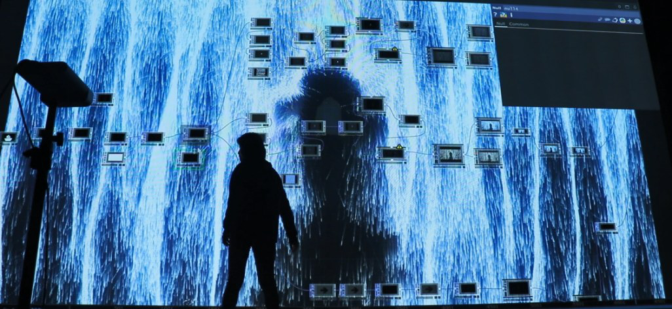
Secondly, Performance layer aspect: using software tools such as TouchDe- signer to combine user movement data acquired by body-sensing cameras with visual effects to realize real-time visual interaction design. By writing programs and designing visual effects, user actions can be mapped onto characters, graphics or other visual elements in the virtual environment. For example, user movement effects can be rendered in real-time so that the user’s body movements produce corresponding effects in the virtual environment, or the user’s experience can be enhanced by visual effects. In this case, the data captured by the body sensing camera is accessed into the system through Touch designer, and at the same time, the interface design tool of Touch designer is utilized to create an interactive screen to display the movement data and related information of the Baduanjin martial artist (Figure 1). By designing appropriate colors, images or other interactive elements, the real- time status and movement trajectory of the martial artist’s movements are displayed.
Figure 1: Using touchdesigner to create the movement data and related information of the Baduanjin martial artist.
Lastly, meaning layer aspect: centering on the expression of connotative symbols, the connotative symbols of traditional Chinese sports are integrated into the multimodal interactive art expression through images, words, sounds and other elements to convey the philosophical thoughts and values of the sports. 3D models, particle effects, special effects and other means can be utilized to combine the movements of Baduanjin martial artists with tradi- tional cultural elements to create images and scenes rich in symbolism. At the same time, matching the movements of Baduanjin with visual effects creates a unique and stunning artistic scene. Such a design enables the audience to understand and feel more deeply the values and philosophical thoughts repre- sented by Baduanjin. Such real-time rendering enables users to fully immerse themselves in the virtual environment full of artistic sense and interact with the Eight Duan Jin. On the other hand, through the innovative design of digital media technology, it is possible to create an artistic story with emo- tional resonance by combining the movements of the Eight Duan Jin with
the plot with the help of storytelling and emotional guidance. Through the unfolding of the storyline and the design of emotional guidance, the audience can be more deeply integrated into the story, and experience the emotional ups and downs and growth together with the eight-duanjin martial artists, so as to enhance the audience’s emotional identity and commitment to the art of eight-duanjin. Finally, through the emotional guidance and plot design, a fascinating story situation is created, so that the user can have emotional resonance in the interactive process. The audience can form a close emo- tional connection with the movements of Baduanjin through an immersive digital media experience, thus deeply participating in the art creation. In addi- tion, designing interactive elements and multi-user sharing features can also increase audience participation, enabling them to co-create and share their own artistic experience of Badaoduanjin with other audience members. By interacting with the virtual martial arts image, users can experience the emo- tional core of martial arts in depth, enhancing participation and the pleasure of interaction.
CONCLUSION
Through these design dimensions, the innovative digital media design of the Baduanjin will be able to convey its cultural connotation more com- prehensively, guide the audience’s emotional resonance, and enhance user engagement. The audience will be able to understand and experience the artistic charm of Baduanjin in a more in-depth way, thus deepening their knowledge and understanding of traditional culture. At the same time, the innovative design of digital media technology also brings broader expression space and creative possibilities for the art of Baduanjin.
ACKNOWLEDGMENT
This research was supported by the High-Level Foreign Expert Project (G2023133041L); the Digital Media Art, Key Laboratory of Sichuan Province, Sichuan Conservatory of Music (23DMAKL01, 23DMAKL12); Shanghai Pujiang Programme (23PJC103).
REFERENCES
Bekele, M. K., Champion, E., McMeekin, D. A., & Rahaman, H. (2021). The influence of collaborative and multi-modal mixed reality: Cultural learning in virtual heritage. Multimodal Technologies and Interaction, 5(12), 79. Chen, C., Zhang, K. Z., Chu, Z., & Lee, M. (2024). Augmented reality in the meta-
verse market: the role of multimodal sensory interaction. Internet Research, 34(1), 9–38. Huang, L., & Zheng, P. (2023). Human-Computer Collaborative Visual Design Creation Assisted by Artificial Intelligence. ACM Transactions on Asian and Low-Resource Language Information Processing, 22(9), 1–21. Kim-Boyle, D. (2014). Visual design of real-time screen scores. Organised Sound,
19(3), 286–294. Nathaniel Stern,”Interactive Art: Interventions in/to Process”, in Christiane Paul ed., A Companion to Digital Art, John Wiley & Sons, Inc. 2016, p. 310.
Cross-Border Integration and Innovation 165
Raptis, G. E., Kavvetsos, G., & Katsini, C. (2021). MuMIA: Multimodal interactions to better understand art contexts. Applied Sciences, 11(6), 2695. Reeves, L. M., Lai, J., Larson, J. A., Oviatt, S., Balaji, T. S., Buisine, S, & Wang, Q. Y.
(2004). Guidelines for multimodal user interface design. Communications of the ACM, 47(1), 57–59. Turk, M. (2014). Multimodal interaction: A review. Pattern recognition letters, 36, 189–195. Varela, F., Thompson, E., & Rosch, E. (1991). The embodied mind: cognitive science
and human experience.mit press. Cambridge, Massachusetts. Ware, C. (2019). Information visualization: perception for design. Morgan Kaufmann.
LISTED IN THE AHFE DIGITAL BOOKSTORE CATALOGUE
Explore the complete digital volume
Human Factors in Communication of Design
Read this individual research paper free through the original publisher, or explore the full digital proceedings book.
ISBN 978-1-964867-12-0
Explore this ISBN in the AHFE Bookstore ↗Listed in the July 2026 bookstore catalogue; search by ISBN to confirm current availability · Digital book purchase optional