I-jui Lee, Pan Xin - Ting (2024). Multisensory Virtual Reality Reminiscence Therapy: A Preliminary Study on the Initial Impact on Memory and Spatial Judgment Abilities in Older Adults. In: Human Factors in Virtual Environments and Game Design. AHFE Open Access, vol. 137, pp. 30–40. https://doi.org/10.54941/ahfe1004984
With advancing medical technology and the rise of an aging society, the global population of dementia patients is increasing. Dementia is an irreversible degenerative disease that leads to a gradual decline in cognitive abilities, including memory, spatial judgment, time perception, and language skills. Despite the availability of medication to alleviate symptoms, a complete cure is unattainable, and treatment can only delay disease progression with limited effectiveness. Recent literature explores non-pharmacological treatments for dementia, including reminiscence therapy, and investigates the use of Virtual Reality (VR) as a therapeutic approach. Unlike traditional methods, VR technology can create realistic virtual environments, enhancing sensory and cognitive experiences. Related studies have explored the combination of visual and auditory experiences in the VR environment, incorporating sensory stimuli such as touch and smell to enhance the sensory and cognitive abilities of older adults. Previous research indicates that combining multiple sensory stimuli can enhance memory and spatial judgment abilities. Therefore, the present study focuses on developing a VR game that integrates multiple sensory stimuli to investigate its impact on the memory, spatial judgment, and time perception of older adults. To achieve this goal, the research team invited experts to develop a VR game with multiple sensory stimuli, combining visual, auditory, tactile, and olfactory elements, with a theme centered around agricultural life. We conducted in-depth discussions on multi-sensory experiences, and preliminary feedback was obtained through interviews with elderly participants and observations by experts. Experts found that the nostalgic therapeutic farming game that combined VR technology and multiple sensory elements resulted in better performance of older adults in task judgment and memory retrieval. Despite the limited number of participants and this study's short training period, future comprehensive experiments and long-term observations are necessary to obtain more substantial evidence.
With advancing medical technology, the challenges of an aging society are becoming more pronounced, and dementia has emerged as a global focus of attention (Winblad et al., 2016; Prince et al., 2016; El-Hayek et al., 2019; World Health Organization, 2021). Dementia is an irreversible degenera- tive disease characterized by a gradual decline in cognitive abilities, including memory, spatial judgment, time perception, and language skills. These dete- riorations progressively impact patients’ daily lives as the disease advances (McKhann et al., 2011; Langa, 2018) An aging society presents challenges with an increased prevalence of degenerative diseases and a corresponding rise in the risk of dementia. Dementia is not a singular disease but a combina- tion of symptoms affecting the brain’s cognitive functions. The most evident characteristic is a significant memory decline, which may extend to long- term memory impairment as the disease progresses. Additionally, dementia may affect other cognitive functions, including language, perception, spatial awareness, motor coordination, reasoning, and calculation. Some patients may even exhibit symptoms of behavioural disorders (American Psychiatric Association, 2013; Prince et al., 2014).
Current treatments for dementia are primarily divided into pharmacologi- cal and non-pharmacological approaches. While pharmacological treatments can alleviate symptoms, a complete cure remains unattainable in the medical field. Therefore, non-pharmacological interventions are necessary to improve or maintain dementia patients’ functional status (Yasukawa, 2009).
Application of Reminiscence Therapy Reminiscence therapy for dementia patients has gained increasing attention in recent years. This therapeutic approach combines activities and experi- ences from past life segments while introducing multisensory stimulation to evoke memories through the process of memory retrieval, aiming to activate relevant memories (Woods et al., 2018). Memory refers to the psychologi- cal phenomenon of an individual receiving external stimuli through sensory organs and retaining this information. During everyday cognitive processes, memory is crucial in maintaining self-perception, integrating and understand- ing information, and solving problems. Numerous events and experiences are encountered throughout one’s life, and memories of past events or experi- ences are known as autobiographical memories. This type of memory allows individuals to seemingly travel back in time, recalling not only the content of events but also the surrounding environment, sounds, smells, and other sensory and emotional experiences (Bahk & Choi, 2018).
Reminiscence therapy is a nursing measure that uses memory as a ther- apeutic tool, guiding individuals through the process of re-collecting their memories. Despite a potential decline in cognitive abilities due to age or ill- ness in older adults, intervention through reminiscence therapy allows them to exercise their memory systems, enhance plasticity through recollection, strengthen cognitive abilities, and aid in the reintegration of life’s advantages and achievements (Cappeliez et al., 2007). The development of this therapeu- tic method positively influences the quality of life for dementia patients and introduces new possibilities and applications in the nursing field.
32 I-Jui and Xin-Ting
The Intervention of Virtual Reality Emphasizing enhanced sensory stimulation during reminiscence therapy is crucial for effectiveness. Therefore, researchers have recently introduced VR technology into the reminiscence therapy experiences of older adults. Compared to traditional reminiscence therapy, intervention with VR games significantly enhances sensory experiences and stimulation for older adult participants (Moreno et al., 2019).
VR intervention training and game therapy have been widely applied in dementia prevention. This technology creates immersive, interactive 3D envi- ronments that combine narrative visual and auditory effects while providing realistic virtual scenes that allow patients to experience situations as though they were there, generating entirely new visual experiences. Compared to traditional treatments, using VR therapy has shown better improvements in patients’ cognitive abilities (such as memory, dual-tasking, and visual atten- tion) and psychological functions (such as reduced anxiety and increased life satisfaction) (Moreno et al., 2019).
De Luca & Ugliotti (2020) developed an immersive VR application game for dementia patients to conduct daily training at home. This game strength- ens the everyday life skills and cognitive functions of older individuals through activities simulating daily scenarios. The game design comprises three activity levels, ranging from simple to complex, including walking in the park, searching for and purchasing products on supermarket shelves, and executing cooking tasks based on particular recipes. By using visual space and sound input, the game reinforces memory and cognitive abilities.
Most VR games focus primarily on visual and auditory experiences and sensory stimulation. However, research indicates that combining VR with other sensory stimuli can provide a more immersive experience by activating different cognitive functions (Woods et al., 2018). Yet, studies examining the application of multisensory stimulation in VR, especially reminiscence therapy for cognitive abilities such as memory, spatial judgment, and time perception for older adults, are still relatively scarce.
Therefore, the literature provided above offers significant motivation for the current study. If reminiscence therapy can be further combined with multisensory stimulation to develop VR games applied to older adults, it may impact their memory, spatial judgment, and time perception. Hence, this study invited experts in long-term care, clinical psychologists, elderly individuals, and designers to participate in discussions. The objective was to develop a multisensory stimulation VR game for reminiscence therapy intervention for older adults. In the development process, we guided brain- storming and AEIOU methods, collaborating with expert members to inspire creativity and design a corresponding multisensory stimulation VR game. Ultimately, the VR game we developed can be provided to older adults for operation. Through experimental and control groups, we observed the impact of multisensory stimulation on the cognitive abilities of older adults regarding memory, spatial judgment, and time perception during game interaction.
VR Game Design This study invited experts in long-term care, clinical psychologists, elderly individuals, and participants to join the discussion on game development. At the beginning of the workshop, we explained the workshop’s purpose and design plan to the participants, and through discussions, we shared our pro- fessional insight regarding the game’s content. The discussion topics included how to create a reminiscence therapy VR game with multisensory stimula- tion. The workshop focused on developing game content, using the context of farming life in Taiwan as a guide for game development. We brainstormed and defined the main processes of planting rice throughout the year’s four seasons, including transplanting seedlings, planting rice, harvesting, and stor- ing. Regarding discussion topics, we also brainstormed game scenarios to depict circumstances that might occur during these four stages. The design allows players to experience activities related to memory retrieval, spatial judgment, and time perception through game tasks. This design aims to enable researchers to better understand the impact of these elements on the sensory experiences and cognition of older adults in the later stages of game evaluation (see Table 1).
Table 1. Brainstorming and defining activities for the primary process of planting rice throughout the four seasons of agricultural life.
Table available in the original PDF paper.
Stage Visual Auditory Olfactory Tactile Transplanting seedlings Birdsong in spring Earthy smell Moisture of the soil Young green seedlings
Planting rice,
Cicada chirping in summer
Scent of rain, Fresh grass scent
Rice swaying in the wind
Touching rice seedlings, Gentle breeze Harvesting Golden rice field
Fragrance of rice, Burning straw smell
Touching plump rice ears, Gentle breeze
Rustling sound of wind through rice ears, Harvesting machine sound
Storage Bare rice field
Scent of drizzling rain
Cold wind, Drizzling rain
Sound of leaves falling in winter due to cold wind
ACTIVITY PROCESS Guided Reminiscence Therapy Game Scenario Brainstorming
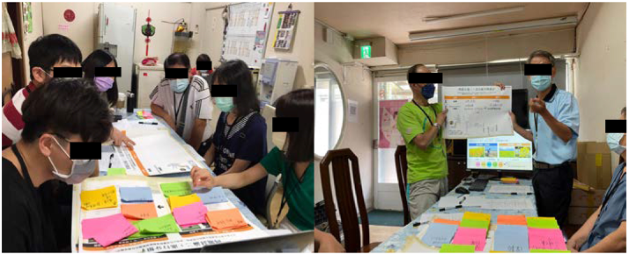
In the brainstorming stage of this game scenario development, we used the AEIOU method based on design thinking to guide the participating experts in imagining themselves as farmers engaged in activities during the four stages of rice cultivation. Through the five aspects of AEIOU: Activities (A), Envi- ronments (E), Interactions (I), Objects (O), and Users (U), we systematically considered scenarios, events, and sensory stimuli that might occur in the context of farming life (see Figure 1).
34 I-Jui and Xin-Ting
Next, we employed Osborn’s brainstorming method for unrestricted free association and discussion. Specifically, we described the expressions of sen- sory stimuli in terms of phenomena such as rural life, rice fields, and related activities. Participants’ ideas were concretely presented on sticky notes. Dur- ing this process, participants proposed various sensory ideas, such as the tactile sensation when stepping on the soil, the olfactory experience of fra- grant aromas carried by a gentle breeze, and the auditory sensation of the low, rough sound of water buffalo when ploughing fields.
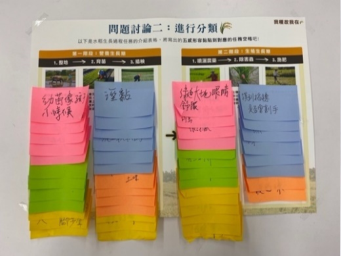
Descriptive adjectives were selected, focusing on activities that involve motor operations, tactile sensations, and olfactory stimuli. The researchers reorganized the generated information to facilitate the subsequent design of the game’s sensory stimulus-guiding elements (see Figure 2).
Figure 1: The discussion process of scenario ideation for a multi-sensory nostalgic therapeutic VR game.Figure 2: The categorized results of the sensory adjective associations.
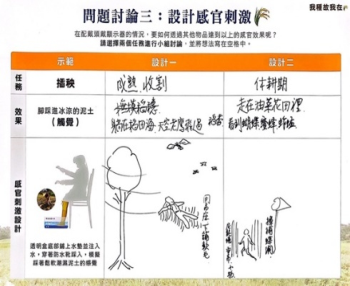
Guided Association for Multisensory Stimulus-Guiding Elements Subsequently, the research team guided participants using multisensory stimulus-guiding elements to realize the previously described sensory expe- riences. Taking the example of the harvesting task during the rice ripening period, we designed sensory stimulus-guiding elements, such as laying soft
fur on a hammock to simulate the feeling of lying in a sea of rice and being able to touch the rice spikes. Another scenario simulates a fallow period in a rapeseed flower field; participants suggested using nylon ropes to suspend rapeseed flowers from above, simulating the scene of strolling through a rapeseed flower field while allowing users to interact with butterflies using a butterfly net (see Figure 3).
The purpose of this association stage was to enhance the sensory experi- ences of touch and smell for VR players through physical and tactile objects. Through these multisensory stimuli, we can improve the participants’ grasp of memory, spatial awareness, and time.
Figure 3: The results of the discussion on the design of sensory stimuli-guided objects and their operational associations.
EXPERIMENTAL DESIGN The experimental design phase recruited six older adults and divided them into two groups: three in the experimental group and three in the control group. The older adults in the experimental group experienced the mul- tisensory VR gaming mechanisms, while the control group only operated the VR system (visual and auditory stimuli only). During interactive gaming tasks, the experimental group received additional sensory stimuli (incorpo- rating touch and smell) into different missions. For example, a water cushion was laid on the bottom of an acrylic box filled with water, and older adults were asked to wear waterproof boots and step in, simulating the sensation of stepping on mud. Furthermore, dry rice straw was burned in a container to mimic the smell of burning straw. Specific objects in the scene continu- ously played sound effects, providing auditory stimuli. The control group experienced traditional visual and auditory interactive VR games without additional multisensory stimuli.
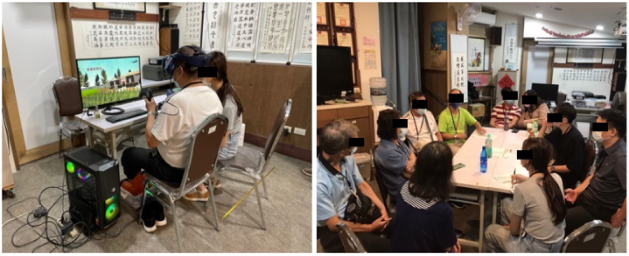
Subsequently, the researchers conducted interviews separately with the two groups of elderly participants. Based on the game content, they posed questions to confirm whether the participants could grasp the relevant infor- mation clearly. Finally, a comprehensive discussion occurred after the activity concluded (see Figure 4).
36 I-Jui and Xin-Ting
Figure 4: Comprehensive discussion after older adults engaged in a multi-sensory VR gaming experience.
EVALUATION TOOLS Regarding evaluation, three cognitive tasks were considered: memory, space, and time. After experiencing VR reminiscence therapy, both participant groups underwent competence verification using these three aspects for assessment. For example, for the memory-related cognitive task, participants were asked to recall how many types of organisms they saw in the scene. For the spatial task, they were asked about the orientation of the waterwheel in relation to the farmhouse. For the time-related task, we questioned par- ticipants about the rice harvesting season. These factors were enhanced for the experimental group through additional tactile and olfactory stimuli, aim- ing to improve their memory points and perceptual experiences. As such, the researchers examined whether there were differences in cognitive perfor- mance between the two groups of older adults or differences in experiential feedback.
RESULTS
The results of this study confirmed that compared to the experience of simply using VR games, adding multisensory stimuli in VR Reminiscence Ther- apy game systems helped improve the cognitive abilities of the experimental group participants in terms of memory, space, and time. When responding to cognitive questions related to memory, space, and time, older adults in the experimental group could respond more confidently to the corresponding information. Through their narratives, the participants in the experimental group mentioned that when this visual information appeared, accompanied by tactile or olfactory experiences, it helped enhance their memory retrieval because they could more easily recall recent events.
Due to the relative weakness of attention and cognitive abilities in older adults, providing only visual or auditory VR environments can easily lead to distraction while missing important information. Some older adults in the experimental group even mentioned that it was because of these exter- nal tactile and olfactory experiences that they could pay attention to what happened and what they experienced. Since the visual and auditory senses of
older adults typically decline with age, sometimes feeling dizzy when watch- ing VR environments and even being unable to fully grasp the information in the scene, most older adults in the experimental group had a more pro- found memory of sensory activities due to the tactile and olfactory sensations, deepening their experiential feedback of this information.
DISCUSSION
The cognitive feedback of the experimental group of older adults regarding memory, space, and time under multisensory stimulation in VR was supe- rior to the control group that used VR alone. The reasons for this may be attributed to the following factors.
Age-Related Visual and Auditory Degeneration, Increased Need for Multisensory Stimulation The visual and auditory functions of older adults gradually decline, reducing their perceptual abilities to external stimuli. As such, providing multisensory stimuli is beneficial to enhance the sensory experiences of older adults. Due to sensory degradation, multisensory stimulation can deepen their memory of events or other information. This heightened sensory experience can increase participation in various activities in daily life and contribute to maintaining memory and cognitive function. In a VR environment, specific tactile and olfactory designs can further enhance the attention and memory effects of older adults regarding game content. Through such technology, older adults can experience richer and more realistic stimuli in the virtual world, making the gaming experience more immersive and enjoyable.
Enhanced Memory Points Through Tactile and Visual Combined Operation Feedback In multisensory experiences, the combination of tactile and visual stimuli pro- vides a richer perceptual dimension and prompts action feedback, thereby deepening points of memory. Through tactile participation, users can feel the texture of objects in the virtual environment, making their actions more realistic and enjoyable. When users perform specific actions, tactile feedback provides the perception of real objects. This tangible interaction forms a stronger impression in the brain, subsequently enhancing the depth of mem- ory. This combined tactile and visual operational perception enriches users’ sensory experiences and provides a more diverse and vivid impression for memory access.
Enhanced Sensations Through Olfactory and Tactile Stimuli Strengthen Contextual Sensation for Memory Association Combining olfactory and tactile stimuli in multisensory experiences strength- ens users’ perception of the virtual environment and enhances contextual sensations in operations, promoting deeper memory associations. When olfactory and tactile stimuli are synchronously introduced into the virtual environment, users can perceive their surroundings more comprehensively,
38 I-Jui and Xin-Ting
thereby improving memory links to specific situations. For example, in a vir- tual farm, the soil scent perceived through olfaction and the tactile sensation of the soil through touch can allow users to experience the farming scenario more profoundly. Such sensory stimulation aids in connecting operations with context, subsequently enhancing the coherence and depth of memory.
Study Limitations Although this study has provided some beneficial findings regarding multi- sensory VR in Reminiscence Therapy, several limitations should be consid- ered. First, the relatively small sample size may limit the generalizability and statistical reliability of the results. Future research should consider expand- ing the sample size for a more comprehensive understanding of the effects of multisensory VR in Reminiscence Therapy. Second, this study’s valida- tion mechanism primarily relied on interview-style feedback, which, while capturing users’ subjective experiences, does not provide objective, quantifi- able data support. Future research could consider incorporating objective testing methods such as physiological measurements and behavioural obser- vations to ensure more objective and scientific results. Additionally, this study used HTC VIVE as the VR equipment, which presented some operational challenges, especially with hand operations. Future research could consider using more advanced VR technology or improving the operational interface to enhance the accuracy and interactivity of tactile perception. Researchers should address these limitations to ensure the rigor and reliability of future research on multisensory VR in Reminiscence Therapy.
CONCLUSION AND FUTURE RECOMMENDATIONS Future research should further examine the impact of multisensory stimula- tion VR in Reminiscence Therapy on the cognitive abilities of older adults. First, we recommend researchers broaden the research sample, increase the number and diversity of experimental and control groups, and conduct long- term observations to comprehensively assess changes in therapeutic effects at different time points. Second, personalized treatment plans should be explored, tailoring sensory stimulation content based on the symptoms and needs of each dementia patient to enhance therapeutic effectiveness. This requires more extensive research to understand individual responses and treatment needs. The key direction for the future is to closely integrate technology with medical expertise. We suggest further training medical and caregiving staff to ensure the practical application of multisensory VR ther- apy. Additionally, developing corresponding guidelines and standards will ensure the safety and effectiveness of treatment. Social acceptance and acces- sibility are issues that also require further attention. Future research should focus on the attitudes of older adults and healthcare institutions toward treat- ment methods, address technological and usability barriers, and enhance treatment accessibility. Finally, promoting multidisciplinary collaboration, including professionals from psychology, occupational therapy, computer sci- ence, etc., will ensure the comprehensiveness and effectiveness of treatment methods for patients with dementia. This multidisciplinary collaboration
contributes to a deeper understanding and application of multisensory stim- ulation VR therapy, driving innovation and progress in dementia treatment. These recommendations are expected to provide richer information and directions for future research in this field.
ACKNOWLEDGMENT
We extend our heartfelt appreciation to the National Science and Technology Council for their funding support under project Nos. NSTC 111-2221-E-027 -059 -MY2, and express gratitude to all the participants, including occupa- tional therapy experts and service personnel at the elderly care canters, for their valuable contributions to this study.
REFERENCES
American Psychiatric Association, & American Psychiatric Association, DSM-5 Task Force. (2013). Diagnostic and statistical manual of mental disorders: DSM-5 (5th ed.). Washington, D. C: American Psychiatric Publishing. Bahk, Y. C., & Choi, K. H. (2018). The relationship between autobiographical mem-
ory, cognition, and emotion in older adults: A review. Aging, Neuropsychology, and Cognition, 25(6), 874–892. Cappeliez, P., Rivard, V., & Guindon, S. (2007). Functions of reminiscence in later life: Proposition of a model and applications. European review of applied psychology, 57(3), 151–156. De Luca, D., & Ugliotti, F. M. (2020). Virtual Reality to Stimulate Cognitive
Behavior of Alzheimer’s and Dementia Patients. In Augmented Reality, Virtual Reality, and Computer Graphics: 7th International Conference, AVR 2020, Lecce, Italy, September 7–10, 2020, Proceedings, Part II 7 (pp. 101–113). Springer International Publishing. El-Hayek, Y. H., Wiley, R. E., Khoury, C. P., Daya, R. P., Ballard, C., Evans, A. R.,...
& Atri, A. (2019). Tip of the iceberg: Assessing the global socioeconomic costs of Alzheimer’s disease and related dementias and strategic implications for stakeholders. Journal of Alzheimer’s Disease, 70(2), 323–341. Langa, K. M. (2018,). Cognitive aging, dementia, and the future of an aging population. In Future directions for the demography of aging: Proceedings of a workshop (pp. 249–268). Washington, DC: National Academies Press. McKhann, G. M., Knopman, D. S., Chertkow, H., Hyman, B. T., Jack Jr, C. R.,
Kawas, C. H.,... & Phelps, C. H. (2011). The diagnosis of dementia due to Alzheimer’s disease: Recommendations from the National Institute on Aging- Alzheimer’s Association workgroups on diagnostic guidelines for Alzheimer’s disease. Alzheimer’s & dementia, 7(3), 263–269. Moreno, A., Wall, K. J., Thangavelu, K., Craven, L., Ward, E., & Dissanayaka, N. N. (2019). A systematic review of the use of virtual reality and its effects on cognition in individuals with neurocognitive disorders. Alzheimer’s & Dementia: Translational Research & Clinical Interventions, 5, 834–850. Prince, M., Albanese, E., Guerchet, M., & Prina, M. (2014). Alzheimer’s disease inter-
national world Alzheimer report 2014. Dementia and risk reduction. Alzheimer’s Disease International World Alzheimer, 104. Prince, M., Comas-Herrera, A., Knapp, M., Guerchet, M., & Karagiannidou, M.
(2016). World Alzheimer report 2016: improving healthcare for people living with dementia: coverage, quality and costs now and in the future.
& Zetterberg, H. (2016). Defeating Alzheimer’s disease and other dementias: a priority for European science and society. The Lancet Neurology, 15(5), 455–532. Woods, B., O’Philbin, L., Farrell, E. M., Spector, A. E., & Orrell, M. (2018).
Reminiscence therapy for dementia. Cochrane database of systematic reviews, (3). World Health Organization. (2021). Global status report on the public health response to dementia. Yasukawa, M. (2009). Horticultural therapy horticultural therapy for the cogni-
tive functioning of elderly people elderly people with dementia. International Handbook of Occupational Therapy Interventions, 431–444.
LISTED IN THE AHFE DIGITAL BOOKSTORE CATALOGUE
Explore the complete digital volume
Human Factors in Virtual Environments and Game Design
Read this individual research paper free through the original publisher, or explore the full digital proceedings book.
ISBN 978-1-964867-13-7
Explore this ISBN in the AHFE Bookstore ↗Listed in the July 2026 bookstore catalogue; search by ISBN to confirm current availability · Digital book purchase optional