Chia-hao Lin, I-jui Lee (2024). Exploration in the Design and Development of Emotive Teaching Aids. In: Human Factors and Systems Interaction. AHFE Open Access, vol. 154, pp. 342–351. https://doi.org/10.54941/ahfe1005382
Children with autism spectrum disorder often struggle with emotional communication due to innate emotional disorders. They find it difficult to express their own emotions and also struggle to understand the emotional states of others. These innate emotional barriers force them to rote memorize or mechanically learn specific emotional expressions, hindering effective emotional communication and expression.However, the abstract nature of emotional communication issues makes it challenging for autistic children to effectively express their feelings, leading to negative behaviors such as violence or self-harm due to emotional repression.To address this, we aimed to develop emotive toys, incorporating metacognitive game mechanics, to serve as tools for emotional communication and training for children with autism. For this purpose, we recruited several designers to collaboratively develop these emotive toys through workshops. Empathy mapping was used in these workshops to help the designers understand the emotional communication challenges faced by children with autism and inspire the design of emotive toys.After discussions, the designers proposed three different concepts for emotive toys, from which one was selected for further experimental validation. This selected toy was provided to eight pairs of players for an emotional communication game. The players used the toy's operations and sensory stimuli to communicate and express emotions.The results showed that through this game mechanism, all eight pairs of participants were indeed able to effectively communicate and express emotions, demonstrating that the toy effectively conveyed emotional information.
Innate Deficiencies in Children With Autism Spectrum Disorder Children with autism spectrum disorder (ASD) face challenges in emotional communication, expression, and understanding due to innate emotional disorders. They struggle to effectively understand others’ emotions and to express their own feelings, leading to difficulties in social interactions. These challenges negatively impact their ability to integrate into society and interact socially with others (Ip et al., 2018).
Against this backdrop, it becomes crucial to find effective ways to enhance emotional communication in children with ASD. Numerous studies have
Exploration in the Design and Development of Emotive Teaching Aids 343
shown that board games can significantly improve children’s conceptual understanding and skill acquisition (Chen & Xu., 2016; Waters et al., 2020).
Board games are seen as an effective method to engage learners in con- cept understanding or learning through play (Li et al., 2022). Therefore, we aimed to enhance the ability and interest of children with ASD in emotional communication through the design of emotive learning toys.
This study involved the design and development of emotive learning toys through workshops, employing metacognitive strategies for game strategy formulation and operation. This approach aimed to enhance the appeal of emotive learning toys, allowing players to master emotional communication skills and abilities through conjecture, reflection, and manipulation during the game Metacognitive Game Strategies
This study aimed to integrate metacognition strategy into the games to strengthen the players’ operation of emotive learning toys and enable them to engage in interaction, operation, conjecture, and reflection through the two-person interaction mechanism of the toys, thereby more effectively mas- tering emotional communication skills. To achieve this goal, we explored the application of metacognition in game design and its importance in enhancing emotional communication skills.
Metacognition is a capability that facilitates learners in mastering concepts through problem-solving and reflection (cognition about cognitive processes) (Jacobs & Paris., 1987). Through the processes of communication, conjec- ture, and manipulation, learners can understand concepts more deeply, shape skills and thinking, and construct specific cognitive schemas (Almås et al., 2023). Designing emotive learning toys with a focus on emotional communication issues, and pairing them with two-person communication formats, provides opportunities to create new ways and rules of playing. This helps players to communicate and express emotions more effectively.
In this study, based on the above concepts, we designed and developed emotive learning toys and provided them to players for practical use. Through real-world application, we assessed whether this game strategy could effec- tively help players to grasp emotional traits and thereby communicate and express themselves effectively.
DESIGN PROCESS AND METHODOLOGY This project aimed to facilitate the development of emotive toys for children with ASD through a series of workshops involving multiple designers. During these workshops, empathy mapping was employed to deepen the designers’ understanding of the emotional and communicative challenges faced by indi- viduals with ASD. Additionally, the concept of metacognitive game strategies was introduced to the designers, encouraging them to integrate deeper levels of thought into their designs.
In the latter stages of the activity, clay was used as a medium to assist the designers in the practical design of the toys. After going through suggestions
344 Lin and Lee
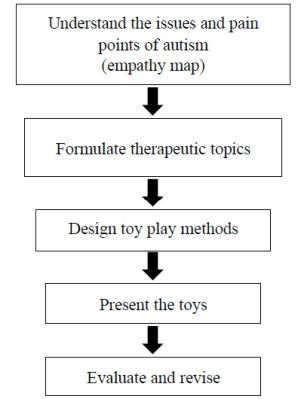
and revisions, the final versions of the toys were completed. These toys were then provided to eight pairs of players for use, to assess their practicality and effectiveness in real-world applications (Figure 1).
Figure 1: Design method flowchart.
Workshop Planning During the design phase of the emotive toys, we divided the designers into three groups and provided them with relevant video materials to deepen their understanding of the challenges faced by individuals with ASD in emotional communication. At the same time, we encouraged them to refer to creative concept cases of metacognitive games, so as to spark their discussions and creative ideation.
Subsequently, we provided clay as a medium, enabling the designers to collaboratively engage in the hands-on creation of the toys. After group discussions, the designers and researchers drew from their unique ideas to successfully develop three distinct concepts for emotive toys.
Playground Equipment Design Steps Step One: Inspiring Empathetic Understanding At the outset of the emotive toy design process, we first guided the designers to delve into the challenges faced by children with ASD in emotional com- munication and expression, using the concept of empathy mapping. The goal of this step was to help the designers comprehensively understand the needs of individuals with ASD, thereby enabling them to develop emotive toys that would be truly responsive to the specific needs of autistic children.
Step Two: Developing Multiplayer Gameplay With Metacognitive Concepts Subsequently, the designers formulated different gameplay methodologies tai- lored to the emotional needs of children with ASD. These methodologies were designed to involve multiple players and incorporated metacognitive concepts to ensure the games would have a substantial impact on the players’ emo- tional communication. The aim of this step was to ensure that the toys could not only meet the emotional needs of children with ASD but also guide them in better understanding their own and others’ emotions through gameplay.
Final Step: Presentation, Operation, and Validation Following the initial steps, we proceeded to the presentation of the toy designs. Each of the three groups of designers showcased their unique
Exploration in the Design and Development of Emotive Teaching Aids 345
concepts, emphasizing the innovation and practicality of their designs. Sub- sequently, we selected the most distinctive game for actual operation and validation. This step was crucial for confirming the effectiveness of the toy in real-world applications and its ability to meet the emotional needs of children with ASD. Through systematic procedures, we ensured the comprehensiveness and feasibility of the toy design (Figure 2).
Figure 2: Toy development process flowchart.
Design of Three Emotive Toys Here, we detail the designs of the three different emotive toys and describe their primary functions (Table 1).
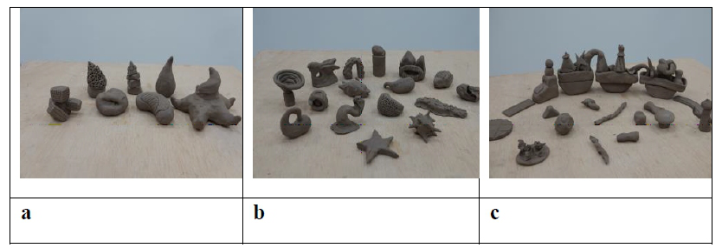
Emotion Transmission Battle (Group 1): This toy was based on six basic emotional expressions. It required at least three players, who transmitted emotions through giving, throwing, or dropping actions. Players could also apply pressure to the emotive objects to indicate the intensity of the emotion (Figure 3-a).
Nature’s Wonders (Group 2): Utilizing symbolic design, this toy featured various animals and creatures with different textures and patterns on their surfaces, each symbolizing different emotions. The gameplay involved one player presenting a scenario or phrase, while other players chose an ani- mal figure and shared their reasons for choosing it, describing the surface features of the figure, and sharing their feelings (Figure 3-b).
Emotional Train (Group 3): This toy was based on a toy train. The partic- ipants selected figures representing recent experiences and placed them as cargo on the train. Through arranging and combining the train and tracks, different scenarios could be created each time (Figure 3-c).
The gameplay methods for the emotive toys could be categorized into four primary types: transmitting, arranging, pressing, and combining (Table 1).
346 Lin and Lee
Table 1. Gameplay methods and functional features of the three emotive toys.
Table available in the original PDF paper.
Transmitting Arranging Pressing Combining Emotion Transmission Battle ( Group 1): V V Nature’s Wonders ( Group 2): V V Emotional Train ( Group 3): V V V
Figure 3: The three emotive toys: (a) Group 1; (b) Group 2; (c) Group 3.
EXPERIMENTAL VALIDATION For the final phase, we selected and further refined the design of Group 1. The researchers optimized and redesigned the shape, form, surface texture, and sensory experience of the toy, remaking the original models and strengthening the concept of metacognition in the design.
We then provided this emotive toy to eight pairs of players (16 individuals in total) to participate in an emotional communication experiment. During the experiment, one person in each pair was responsible for describing emo- tions (the describer), while the other was responsible for interpreting these emotions (the interpreter).
The design of Group 1 offered various emotional shape objects but initially lacked a metacognitive gameplay approach. To address this, we combined the emotional shape objects with a metacognitive gameplay method and provided it to the players for communicative use.
In the game, the two players took on the roles of describer and inter- preter. First, the describer assembled the emotional shape objects according to a given emotional scenario and then described the physical form of the assembled result. The interpreter, based on the describer’s explanation of the emotional shape assembly, then created their own interpretation. Finally, the interpreter was asked to articulate what emotional scenario the combination of shapes might represent.
The key observation was whether the interpreter could accurately grasp the emotional state conveyed through the combination of shapes presented by the describer, and whether they could deduce the emotional scenario as seen by the describer from this physical and emotional interpretation.
Throughout this process, we used a metacognitive gameplay approach to facilitate a two-player game where one described and the other inter- preted. The focus of interpretation was on charged situational descriptions, emphasizing the use of metacognition to enhance the understanding and communication of emotions.
Exploration in the Design and Development of Emotive Teaching Aids 347
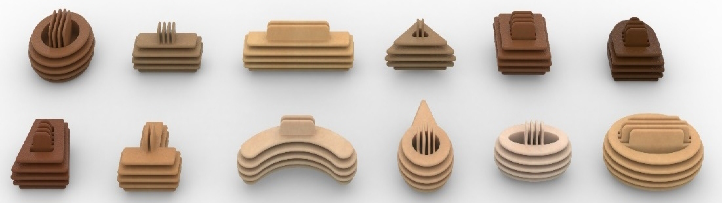
Gameplay Method Step 1: We provided 12 different emotive shape objects. These objects were distinct and had unique shape characteristics. They could be combined, stacked, or connected in any form.
Step 2: Next, one player (the describer) was shown ten sets of emo- tional scenario sentences. These sentences contained various emotional adjec- tives and contexts. The describer selected one sentence and then created a representation using the 12 different emotive shape objects (Figure 4).
Step 3: The describer then described their combination to the inter- preter. However, the interpreter could not actually see the creation made by the describer. The interpreter used clay to sculpt their interpretation, also referencing the 12 different emotive shape objects for their creative expression.
Step 4: The researchers then asked the interpreter to identify which emo- tional scenario sentence was chosen and described by the describer. This analysis was used to determine if the interpreter could grasp the emotional state described by the describer through the manipulation, operation, and sensory experience of the shape objects.
Throughout the game, the interpreter did not know which sentence the describer had chosen. Therefore, the entire process was conducted through communication via shaped objects. The emotional information in these sen- tences was also transformed into physical forms for expression. This helped to understand whether such a game mechanism could effectively convey emotional communication.
The 12 Different Emotive Shape Objects The 12 different emotive shape objects were composed of various individ- ual objects, each distinct and independent, characterized by unique textures and patterns on their surfaces. These objects could be combined, stacked, or connected in various ways, providing a versatile range of physical represen- tations. This variety enabled both the describer and the interpreter to engage in physical creation, using these objects to embody and express the physi- cal manifestations of different emotional description sentences, as shown in Figure 4.
Figure 4: The 12 emotive shape objects.
348 Lin and Lee
The Ten Emotional Scenario Sentences These ten sentences are designed for describing emotional situations, guiding the describer to choose one and express its sentiment using 12 emotive shape objects.
1. Love is a wonderful feeling that can make one’s heart flutter with joy and unease. 2. Moods ebb and flow like the tide, sometimes surging, sometimes calm. 3. In solitude, one’s mood is like a still lake, undisturbed and ripple-free. 4. When one feel downhearted, it’s as if the whole world turns grey. 5. A smile is the most beautiful language, capable of instantly transforming one’s mood. 6. Disappointment is a profound emotion, leaving an imprint on the soul. 7. Happy moments make one feel light as air, as if walking on soft clouds. 8. Longing is a deep call of the heart, making one feel wrapped in soft feathers. 9. In rainy weather, the mood also becomes damp and heavy. 10. The barometer of mood records the little things in our lives.
Assessment Tools Emotional Communication Assessment In the evaluation process, we scored the outcomes of the communication between the describer and the interpreter. The aim was to confirm whether they could effectively communicate through the emotive shape objects in the toy and thus convey their understanding of the chosen emotional scenario sentences.
When the interpreter correctly identified the scenario sentence chosen by the describer, it indicated successful emotional communication through the emotive shape objects within the toy. This assessment demonstrated the toy’s effectiveness in conveying accurate emotional information between players.
Emotional Perception Questionnaire Additionally, we provided an emotional perception questionnaire to evaluate the participants’ performance in conveying and perceiving emotions using the emotive toy. The questionnaire was divided into four main domains: Communicativeness, Emotion Identification, Expressiveness, and Emotional Regulation (Table 2). The players were asked to rate their experience in these areas, providing valuable feedback on the effectiveness of the emotive toy in various aspects of emotional communication and understanding.
RESULTS AND DISCUSSION
Accuracy in Emotional Communication Comparison The experimental results demonstrated the effectiveness of this gameplay mechanism. Out of the eight participating pairs, seven interpreter players were able to correctly identify the emotional scenario sentence described by
Exploration in the Design and Development of Emotive Teaching Aids 349
the describer. This outcome indicated that the emotive shape objects effec- tively guided the players in understanding and recognizing different emotions. The physical representation of these objects not only made abstract emotional concepts more tangible but also facilitated the participants’ understanding and expression of various emotional states.
Additionally, while manipulating these emotive shape objects, the sensory stimuli and interactive process allowed the players to experience the char- acteristics of different emotions. This interactive emotional experience aided the players in comprehensively understanding emotions and enhanced their abilities in emotional communication. The gameplay mechanism not only provided the participants with an engaging learning platform but also actively stimulated their interest in emotional communication.
The Emotional Perception Questionnaire After the gameplay, we administered an emotional perception question- naire to ask the participants about their experiences with the emotive toy across different dimensions. The questionnaire covered the four aspects of communicativeness, emotion identification, expressiveness, and emotional regulation. To enhance the analytical quality of the data, we used a seven- point Likert scale, with scores ranging from 1 (strongly disagree) to 7 (strongly agree), to gauge the participants’ experiences in expressing and understanding emotions collaboratively using the emotive toy. The research data is presented in Table 2.
Communicativeness: The average score for communicativeness was 5.65, reflecting the participants’ positive perception of the emotive shape objects. The participants noted that the gameplay mechanism made emotions easier to convey, effectively expressing their own emotional abilities and making the process of understanding others’ emotions more natural and intuitive.
Emotion Identification: The average score for emotion identification was 5.63. The participants mentioned that the emotive shape objects helped them distinguish different emotional expressions more acutely. The tangible repre- sentation of these objects made it easier for the participants to understand various emotions and accurately identify different emotional states.
Expressiveness: The average score for expressiveness was 5.65. The par- ticipants highlighted that the gameplay mechanism allowed for richer and more diverse expressions of emotion. This not only improved their emotional expressiveness but also enhanced their understanding of emotional diversity.
350 Lin and Lee
Emotional Regulation: The average score for emotional regulation was 5.46, indicating that the participants found the gameplay mechanism helpful in effectively managing and regulating their emotional responses. Through interactive gameplay, they learned to handle different emotions more flexibly.
Overall, the participants provided strong and positive feedback regarding their experiences with the emotive toy across different dimensions. These sub- jective descriptions reflected the valuable experience provided by the emotive shape objects and their interactive mechanism in enhancing the participants’ emotional perception.
FUTURE RESEARCH AND STUDY LIMITATIONS Overall, while our study did not directly involve children with ASD in the gameplay experiments, the participants’ positive descriptions of their experiences with the emotive toy across different dimensions were note- worthy. These subjective accounts suggested that the emotive shape objects and their interactive mechanisms provided valuable experiences in enhanc- ing emotional perception. The emotive toy, integrating metacognitive game strategies, facilitated training in emotional communication and expression through manipulation and sensory stimulation. These metacognitive strate- gies, combined with the game objects of the emotive toy, strengthened the operational aspects during gameplay, promoting conceptual mastery through problem-solving and reflection.
The emotional communication comparison game and the emotional per- ception questionnaire provided insights into the participants’ experiences with the emotive toy, including aspects such as communicativeness, emotion identification, expressiveness, and emotional regulation. In future applica- tions, we plan to apply this game tool to children with ASD to further assess its effectiveness in enhancing their emotional communication abilities. Overall, this project, combining emotive toy design and metacognitive game strategies, offered a promising and engaging tool for emotional communica- tion training for children with ASD, and provided valuable insights for the development of emotive communication toys.
ACKNOWLEDGMENT
We would like to express our sincere gratitude to the National Science and Technology Council for their generous funding support under project Nos. NSTC 111-2221-E-027-059-MY2. Additionally, we extend our heartfelt appreciation to all the participants for their invaluable contributions to this study.
REFERENCES
Almås, H., Pinkow, F., & Giæver, F. (2023). Reimagining how to understand learning game experiences: A qualitative and exploratory case study. Smart Learning Environments, 10(1), 14.
Exploration in the Design and Development of Emotive Teaching Aids 351
Chen Rongwei, & Xu Yuguang. (2016). A preliminary study on the application of board game media in family play therapy. Counseling Quarterly, 52 (3), 36–46. Ip, H. H., Wong, S. W., Chan, D. F., Byrne, J., Li, C., Yuan, V. S., Lau, K. S., &
Wong, J. Y. (2018). Enhance emotional and social adaptation skills for children with autism spectrum disorder: A virtual reality enabled approach. Computers & Education, 117, 1–15. Jacobs, J. E., & Paris, S. G. (1987). Children’s metacognition about reading: Issues in definition, measurement, and instruction. Educational psychologist, 22(3–4), 255–278. Li, C. T., Hou, H. T., & Lin, W. S. (2022). Chemistry education board game based on
cognitive mechanism: multi-dimensional evaluation of learners’ knowledge acqui- sition, flow and playing experience of board game materials. Research in Science & Technological Education, 1–21. Waters, C. F., Amerine Dickens, M., Thurston, S. W., Lu, X., & Smith, T. (2020).
Sustainability of early intensive behavioral intervention for children with autism spectrum disorder in a community setting. Behavior modification, 44(1), 3–26.
LISTED IN THE AHFE DIGITAL BOOKSTORE CATALOGUE
Explore the complete digital volume
Human Factors and Systems Interaction
Read this individual research paper free through the original publisher, or explore the full digital proceedings book.
ISBN 978-1-964867-30-4
Explore this ISBN in the AHFE Bookstore ↗Listed in the July 2026 bookstore catalogue; search by ISBN to confirm current availability · Digital book purchase optional