André Barros De Sales, Eduardo Palmeira, Fabiana Mendes, Mateus Augusto Sousa Silva (2024). Designing User Persona Cards to Support the Development of Digital Human-Computer Interaction Learning Games. In: Human Factors in Software and Systems Engineering. AHFE Open Access, vol. 140, pp. 67–75. https://doi.org/10.54941/ahfe1005039
This paper introduces a set of user persona cards intended to support the design and validation of learning games in the field of Human-Computer Interaction (HCI). After conducting a survey to understand our target audience better, we used the data to create four personas: one primary, two secondary, and one anti-persona. They prioritize specific player profiles and key attributes identified in the survey. Our user persona cards can serve as a quick and convenient tool to acquire information about the target audience, thereby enabling HCI learning game developers to gain a deeper understanding and more effectively address their users’ needs.
Resources to support teaching and learning have been used in academic con- texts as innovative approaches. Accordingly, learning games have become increasingly popular in computer education, as they can increase the effec- tiveness and engagement of learning (Barros de Sales and Boscarioli, 2021). However, a key challenge for learning game developers is how to design them to address the target audience effectively. In this context, personas can be used as a resource to support the design and validation of learning games and the decision-making of their design team (Barbosa et al., 2021).
Personas are fictional characters and hypothetical archetypes of a group of real users (Cooper, Reimann and Cronin, 2007). Although a persona is fictional, it is rigorously defined to represent a real audience of users who will use the designed system (Barbosa et al., 2021). They can be used to determine player experience goals, thereby assisting in game design activities (Fullerton, 2008). Thus, one of the main advantages of using personas in a game design process is that it does not require the frequent presence of users.
This article presents part of the results of a research project on didactic digital resources for teaching Human-Computer Interaction (HCI) content.
In our previous work, we conducted a survey to understand the aspects of quality expected by potential users of HCI learning games (Sousa e Silva, Barros de Sales and Mendes, 2021); data were analyzed to rank the essential player experiences and quality requirements of this type of game. Alterna- tively, this article presents subsequent findings built upon our previous work, using the same extensive dataset. Our objective is to propose a cast of per- sonas to support the development of HCI learning games. To achieve this, we designed a set of persona cards that can be used as a quick and convenient tool to acquire information concerning the target audience.
METHOD
The methodological process of this work comprises two stages. First, using a survey research process, we examined respondents’ preferences regarding the characteristics and qualities of learning games (Sousa e Silva, Barros de Sales and Mendes, 2021; Sousa e Silva, 2021). Then, based on respondents’ profiles concerning HCI learning games, we performed a persona-building process to propose a cast of personas for this type of game.
Survey Research Process A survey is a type of research in which data is collected through a pre- developed survey instrument answered by participants (Kasunic, 2005). Figure 1 shows the seven steps of the survey research process:
Figure 1: Survey research process (adapted from Kasunic, 2005).
First, we defined the survey objective as “to analyze user preferences regarding some characteristics and aspects of quality in HCI learning games and then specify player profiles for this type of game.” As mentioned earlier, the first part of this objective was explored in our previous work.
Later, we identified the target audience as undergraduate and graduate students from computer science or other computing-related fields. In addition to being potential users of digital HCI learning games, this audience was chosen because of their technical viewpoint on software’s aspects of quality as well as their expertise in using digital tools.
Then, we designed a sampling plan to obtain data on the mentioned audi- ence. The sampling was non-probabilistic since our goal was not to generalize the results outside the sample (Kasunic, 2005). Instead, we planned to use the survey results to build personas to be used in developing learning games for the intended target audience.
Next, we wrote a questionnaire based on personas’ attributes (Courage and Baxter, 2005) and characteristics and aspects of quality of learning games
Designing User Persona Cards 69
(Petri and von Wangenheim, 2019; Barros de Sales and Sousa e Silva, 2020). The questions aimed to collect data that would reveal player profiles and preferences regarding the quality of this type of game.
After that, we performed a pilot study to test the questionnaire with a small sample of three subjects. The pilot study was conducted via video call and provided feedback on question design, comprehension, question- naire structure, flow, and completion time. Following this, adjustments were made to the questionnaire based on respondents’ suggestions and evaluator perceptions.
Finally, we shared the self-administered questionnaire via email and social networks with student communities of some Brazilian universities. Data was collected from October 10th to October 27th, 2020, resulting in a sam- ple size of 184 responses. Eighteen responses were excluded—eight subjects answered the questionnaire twice, and ten were not students from computing- related fields—leaving 166 valid responses. The collected data were recorded in spreadsheet software and analyzed later.
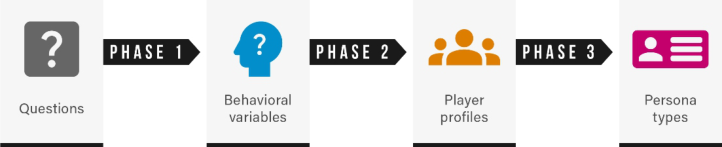
Persona-Building Process We designed our persona-building process based on the protocol developed by Cooper, Reimann and Cronin (2007). The process was performed in three major phases: (1) identify behavioral variables, (2) map interview subjects to behavioral variables, and (3) designate persona types. Figure 2 shows an overview of our persona-building process:
Figure 2: Persona-building process.
In the first phase, we identified the behavioral variables; each variable was derived from one or more questions in the questionnaire. They were intended to support the creation of player profiles. The behavioral variables are listed in Table 1:
Table 1. Behavioral variables.
Table available in the original PDF paper.
ID Variable V01 Age V02 Sex V03 Educational institution V04 Computing-related degree V05 Relation to the HCI course
(Continued)
Table 1. Continued ID Variable
Table available in the original PDF paper.
V06 Experience with interface design V07 Usual means to clarify doubts about certain content V08 Previous experience with learning games V09 Motivations for using learning games V10 Frequency of the use of learning games V11 Learning games played V12 Reasons to stop using learning games V13 Reasons for not having used learning games V14 Reasons for lack of interest in learning games V15 Importance of quality requirements in learning games V16 Importance of user experience in learning games
The second phase aimed to map the sample subjects according to the behavioral variables, identifying significant behavioral patterns and synthe- sizing relevant characteristics and goals. A spreadsheet software and its tools were used to filter and synthesize data. First, the behavior patterns were iden- tified based on their frequency in the sample. Then, these were synthesized into characteristics of relevance to composing player profiles.
Regarding the behavioral variables #V15 and #V16 listed in Table 1, we used aspects of quality rankings concerning learning games from our previ- ous work to categorize respondents into distinct profiles. This categorization enabled us to define the aspects of quality that are relevant for each player profile (Sousa e Silva, Barros de Sales and Mendes, 2021). Table 2 ranks quality requirements, and Table 3 ranks player experiences (expectations); both rankings were made according to the importance assigned by the survey respondents. Further findings concerning the analysis of the gathered sample results can be found in Sousa e Silva (2021).
Table 2. Ranking of quality requirements (adapted from Sousa e Silva, Barros de Sales and Mendes, 2021).
Table available in the original PDF paper.
ID Quality Requirements Ranking QR01 The game has an appealing design 01 QR02 The game provides feedback to the player 02 QR03 The game has rules that are easy and clear to understand 03 QR04 The game is easy to learn how to play 04 QR05 The game has a consistent design pattern 05 QR06 The game uses easy-to-read fonts 06 QR07 The game is easy to play 07 QR08 The game has accessibility 08 QR09 The game uses appropriate colors 09 QR10 The game offers points and rewards to the player 10 QR11 The game displays the ranking of players 11 QR12 The game features a narrative or story 12
Designing User Persona Cards 71
Table 3. Ranking of player experiences (adapted from Sousa e Silva, Barros de Sales and Mendes, 2021).
Table available in the original PDF paper.
ID Player Experiences Ranking
01
PE01 The player wants to feel satisfied while playing and learning
02
PE02 The player wants to feel confident that the content will be learned
03
PE03 The player wants to perceive the relevance of the content taught
06
PE04 The player wants to have fun 04 PE05 The player wants to feel challenged 05 PE06 The player wants to stay focused while playing the game
07
PE07 The player wants the game to be the primary medium for learning the content PE08 The player wants to interact with other players 08
In the last phase, we first ensured the completeness and minimized redun- dancy in the player profiles, enriching them with additional attributes and behaviors for greater realism. Subsequently, we designated the types of per- sonas for our proposed cast based on the representativeness of these player profiles. We used profile trends to design personas that either represent potential players of HCI learning games or do not.
THE PROPOSED CAST OF PERSONAS Following the persona modeling method developed by Cooper, Reimann and Cronin (2007), a cast with four personas was built. The proposed cast of personas consists of one primary, two secondary, and one anti-persona. A cast of four personas satisfies the intent of representing the roles of real users (Barbosa et al., 2021).
Based on Table 1, each persona presents the following attributes: (i) identity—demographic information and photo; (ii) general information— goals, skills, and tasks; and (iii) aspects of quality—requirements and expec- tations. This information is organized and presented through cards designed to support the development of HCI learning games. Each persona is described individually in each of the following subsections.
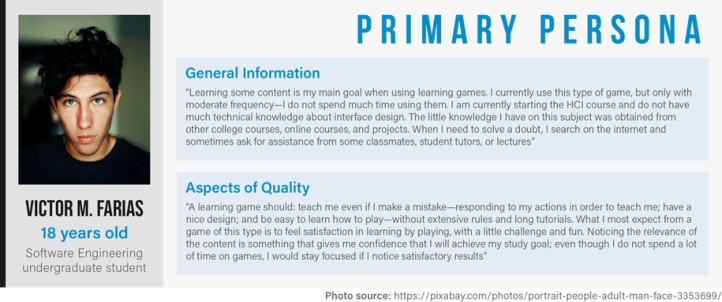
Primary Persona The name of the primary persona is Victor. He represents the target user, the most significant player profile from the sample—the one whom a game design should primarily address. Figure 3 presents the primary persona card containing his most relevant information:
Figure 3: Primary persona card.
The primary persona is primarily motivated to use games to learn—at least—new content concerning HCI. Victor is a Software Engineering under- graduate student currently enrolled in the HCI course who already has the habit of moderately using learning games for other subjects. He usually stud- ies and solves his doubts concerning HCI content using internet search tools. Nevertheless, he also considers the assistance of classmates and university lecturers as an alternative way to solve his doubts.
The primary persona satisfies the most relevant quality requirements and player experiences (Tables 2 and 3). Victor expects a learning game to have an appealing design (#QR01), provide feedback to the player (#QR02), have clear and easy-to-understand rules (#QR03), and be easy to learn how to play (#QR04). Moreover, he expects the game to make him feel satisfied (#PE01), challenged (#PE05), fun (#PE04), focused while playing (#PE06), and confident in the game’s effectiveness for learning (#PE02), as well as perceive the relevance of the content taught in the game (#PE03).
Since Victor is currently enrolled in the HCI course, he is starting to get a formal learning experience with this subject. Before this, his experience with interface design was limited to academic studies and other mediums. Therefore, learning games for this persona could involve fundamental and theoretical HCI concepts. In addition, recommending more detailed external materials on the subject (e.g., articles or digital books) could be a valuable game feature. Finally, it is worth noting that, given the learning games that this persona is familiar with, games involving questions and answers—with the possibility of learning from mistakes—would be perceived as a satisfying genre for him.
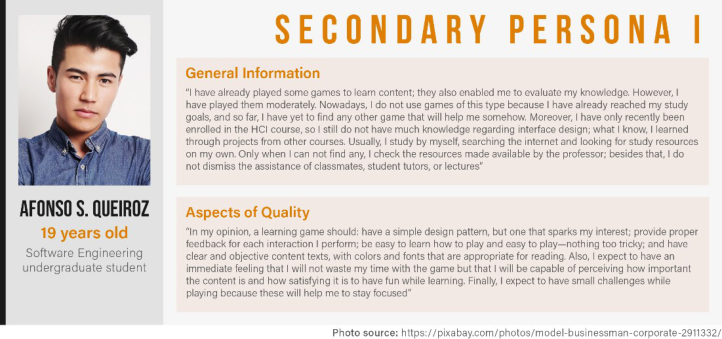
Secondary Persona I The name of the first secondary persona is Afonso (Figure 4). He represents survey respondents with a few differences compared to the primary persona. As a result, if addressed in a learning game design, he may add some features to the game that can attract more players.
Designing User Persona Cards 73
Figure 4: First secondary persona card.
The first secondary persona is very similar to the primary persona in some aspects. As such, Afonso is also a Software Engineering undergraduate stu- dent currently enrolled in the HCI course; nevertheless, he is motivated to use games not only to learn but also to assess his knowledge.
Afonso has already used games for learning other subjects before, but he no longer uses them because he has already achieved his study goals. Conse- quently, similar to the primary persona, he has a positive perception and little familiarity with learning games. The main distinction between these two per- sonas is that Afonso requires the game to evaluate his knowledge. In addition, he prefers to use internet search tools and books to solve his doubts instead of first asking classmates and university lecturers for help. For this reason, games intended for this persona do not necessarily have to include interactive features with other players (#PE08).
Afonso has almost the same expectations regarding the quality require- ments (#QR01-04) and player experiences (#PE01-06) as the primary per- sona. However, he also considers as relevant some secondary aspects of quality, such as accessibility (#QR08), appropriate use of fonts (#QR06) and colors (#QR09), consistent design pattern (#QR05), and ease of play (#QR07). Hence, if a learning game addresses him, the primary persona—the primary target player—would also be addressed to some extent.
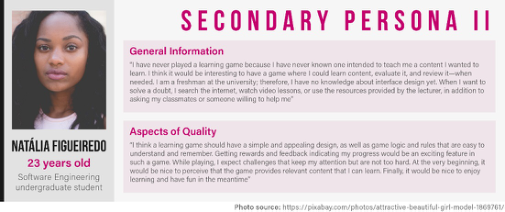
Secondary Persona II The name of the second secondary persona is Natália (Figure 5). She rep- resents more than one group of respondents and also has a few differences compared to the primary persona. Similar to the first secondary persona, if she is addressed in a learning game design, it may also bring some additional features to the game, attracting other players.
Figure 5: Second secondary persona card.
The second secondary persona has some aspects in common with the pri- mary and first secondary personas. That being so, Natália is also a Software Engineering undergraduate student; however, she is not enrolled in the HCI course yet. She expects to use learning games not only to learn new content and assess her knowledge but also to review some content.
Besides not being enrolled in the HCI course yet, she represents the part of the respondents’ sample with no interface design experience. Furthermore, this persona has never played learning games but is interested in doing so. For this reason, Natália represents users interested in playing an HCI learn- ing game before enrolling in the course, either out of curiosity or to learn some content in advance. Moreover, this persona uses any means to solve her doubts. As such, there is no specific requirement concerning how helpful resources should be featured in a game design.
Natália also has almost the same expectations concerning the quality requirements as the primary persona (#QR01-04). The difference is that she considers “offering points and rewards to the player” (#QR10) as an addi- tional relevant feature in a learning game. Regarding the player experiences, this persona has the same expectations as the primary and first secondary persona (#PE01-06).
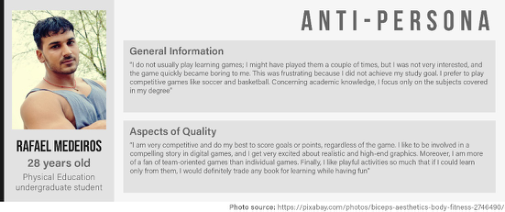
Anti-Persona The name of the anti-persona is Rafael (Figure 6). He represents a set of features that a design team of a learning game does not need to consider.
Figure 6: Anti-persona card.
Designing User Persona Cards 75
The anti-persona represents respondents who have already played learning games but no longer use them due to some negative experience. Consequently, there is no guarantee that these players will use a learning game again.
In short, Rafael does not represent potential players; instead, he empha- sizes features that should not be considered when designing an HCI learning game, such as ranking of players (#QR11), narrative or story (#QR12), and experiences of interaction and competition among players (#PE08). Moreover, following this reasoning, a learning game should be intended as something other than the primary learning medium for the student (#PE07).
FINAL REMARKS This article aimed to design and propose a cast of personas to support the development of HCI learning games. The cast was designed to prioritize spe- cific player profiles and the most significant attributes identified in a survey. Also, the user persona cards designed in this work are aimed to assist design teams in making decisions when developing this type of game by synthe- sizing the target audience and making it quick to acquire the most relevant information from the personas.
REFERENCES
Barbosa, S. D. J. et al. (2021). Interação Humano-Computador e Experiência do Usuário [Human-Computer Interaction and User Experience]. Self-publishing. Barros de Sales, A., Boscarioli, C. (2021). “Teaching and Learning of Interface
Design: An Experience Using Project-Based Learning Approach”, in: Proceedings of the 2021 16th Iberian Conference on Information Systems and Technologies. pp. 1–6. doi: 10.23919/CISTI52073.2021.9476547. Barros de Sales, A., Sousa e Silva, M. A. (2020). “Jogos Sérios no Processo de Ensino e Aprendizagem de Interação Humano-Computador” [Serious Games in the Teaching and Learning Process of Human-Computer Interaction], in: Proceed- ings of the 31st Brazilian Symposium on Computers in Education. pp. 552–561. doi: 10.5753/cbie.sbie.2020.552. Cooper, A., Reimann, R., Cronin, D. (2007). About Face 3: The Essentials of
Interaction Design. Indianapolis: Wiley Publishing, Inc. Courage, C., Baxter, K. (2005). Understanding Your Users: A Practical Guide to User Requirements Methods, Tools, and Techniques. San Francisco: Morgan Kaufmann Publishers Inc. Fullerton, T. (2008). Game Design Workshop: A Playcentric Approach to Creating
Innovative Games (2nd ed.). Boca Raton: CRC Press. Kasunic, M. (2005). Designing an Effective Survey. Carnegie Mellon University, Pittsburgh: Software Engineering Institute. Petri, G., von Wangenheim, C. G. (2019). “A Method for the Evaluation of the
Quality of Games for Computing Education”, in: Proceedings of the Work- shops of the 8th Brazilian Symposium on Computers in Education. pp. 951–960. doi: 10.5753/cbie.wcbie.2019.951. Sousa e Silva, M. A. (2021). Proposta de Personas para o Desenvolvimento de Jogos Digitais na Aprendizagem de IHC [Proposing Personas for the Development of Digital Games in HCI Learning]. Brasília: University of Brasília. Undergraduate Thesis. Sousa e Silva, M. A., Barros de Sales, A., Mendes, F. F. (2021). Aspectos de Qualidade
em Jogos Sérios Digitais [Quality Aspects in Serious Digital Games], RENOTE, 19(1), 207–216. doi: 10.22456/1679-1916.118428.
LISTED IN THE AHFE DIGITAL BOOKSTORE CATALOGUE
Explore the complete digital volume
Human Factors in Software and Systems Engineering
Read this individual research paper free through the original publisher, or explore the full digital proceedings book.
ISBN 978-1-964867-16-8
Explore this ISBN in the AHFE Bookstore ↗Listed in the July 2026 bookstore catalogue; search by ISBN to confirm current availability · Digital book purchase optional