Ying-Chia Huang (2024). Developing Smart Shorts for University Footballers for Self-training Purposes. In: Human Factors and Wearable Technologies. AHFE Open Access, vol. 141, pp. 20–27. https://doi.org/10.54941/ahfe1005051
This research evaluates the views of 15 female and 15 male footballers on a Taiwanese University team with regard to smart shorts for self-training use during the Covid-19 pandemic. All 30 athletes reported being able to adapt their play following visual self-training in the form of data received from the smart shorts. The study gathers feedback from the participants via two semi-structured interviews undertaken at the design preparation and garment fitting stages, and employs the Kawakita Jiro method to assess the findings.Firstly, the study investigates the footballer’s preferred smart wear design via interviews. Secondly, the smart shorts are developed. Thirdly, once the 30 participants have been fitted with, and have worn the shorts for self-training purposes, a second interview is conducted to collect the wearers’ feedback.The study identifies six elements of the participants’ smart short preferences: comfort, appearance, textile functionality, practicality, design, and electronic module and app functionality. In the pre-design interview, the majority of the users focus on the functionality of the textiles to be employed. Specifically, 16.7% express views regarding textile thickness. Meanwhile, in the garment evaluation step, all the participants highlight comfort as a requirement. In both interview stages, garment fit is the least important issue, and the functionality of the textile the most important. Additionally, the females are more concerned that the design is fashionable than the males. The participants highlighted the functionality of the electronic module and the app more in the pre-design stage than during the garment evaluation phase.
In their study, Fadlullah et al. (2022) reported that athletics was of significant importance for people’s lives during the Covid-19 pandemic, and Wich-50 Media (2021) highlighted the fact that the wearable garment market was a key market driver during the pandemic. However, during the pandemic, athletes faced major challenges, including the maintenance of their training regimens, and of good mental health and nutrition (Andreato et al., 2020). Many were required to maintain their level of physical activity and discipline independently via self-training, in order to retain their fitness for such time as they were able to return to competitive sporting events. Specifically, in their home setting, they were required to ensure the retention of their mobility,
Developing Smart Shorts for University Footballers for Self-Training Purposes 21
flexibility, body weight exercises, core stabilization, balance, and propriocep- tion for injury prevention (Leppänen et al., 2014; Meurer et al., 2018). While Silvers-Granelli et al. (2015) explained that the Fédération Internationale de Football Association (FIFA) recommended that footballers should engage in running, plyometric, strength, and balance exercises only if they had access to basic equipment and the necessary space, Tsai (2020) indicated that anyone who wished to exercise particular muscles, and to develop their skill level via self-training at home, either with or without tools, such as Switch or Nike Training Club, faced significant issues. Consequently, Hanuska et al. (2016) developed smart clothing as a tool for improving sporting performance and injury prevention for bodies such as the National Basketball Association (NBA) (Li et al., 2019), the Premier Soccer Leagues (Yu et al., 2018), and the Major League Baseball (MLB).
The AFC Asian Cup is to be held in Qatar in January 2024. In 2022, the national Taiwan football team gained the best ranking of this competition (Yen, 2022). Football teams around the world hope to obtain a sufficiently high ranking to play in the FIFA world cup. Among the members of the Tai- wan national football team, five players are part of the school team at Fu Jen Catholic University. During the Covid-19 pandemic, this study collected feed- back from the team’s footballers, in order to aid the development of smart shorts to assist the self-training of these athletes.
METHODS
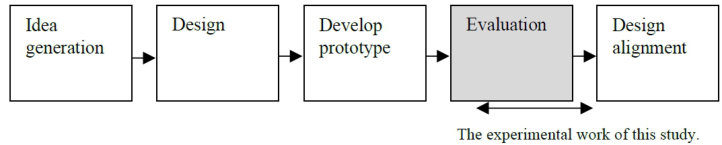
As shown in Figure 1, this study developed a smart garment, with a focus on the final two stages, namely the evaluation and the design alignment of the design prototype (Suh, et al., 2010).
Figure 1: The steps involved in developing the smart garment.
The first step with which this study was primarily concerned, the evalua- tion, followed the gathering of qualitative data via semi-structured interviews with 15 female and 15 male footballers, and qualitative data gathered via questionnaires distributed. Data was collected via Google Meet (see Figures 2–5) regarding the experience of wearing smart shorts when engaged in self- training. The questionnaire employed a seven-point Likert scale, and IBM Statistical Package for the Social Sciences (SPSS) Statistics 24 was employed to calculate the descriptive resulting statistics, average, and the standard devia- tion, and to conduct a crosstab analysis and a frequency distribution, in order to assess the findings of both the questionnaire and the interviews. A semi- structured interview format was employed; the interviews were recorded
22 Huang
and subsequently transcribed. The Kawakita Jiro method was employed to evaluate the results. In the design alignment step, a final smart trouser was determined, according to the users’ feedback.
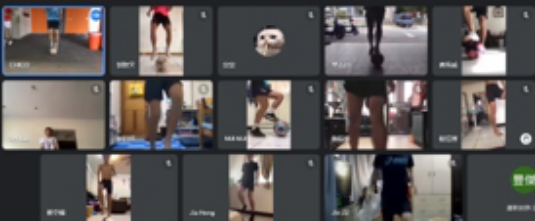
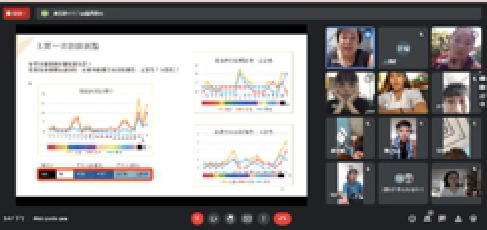
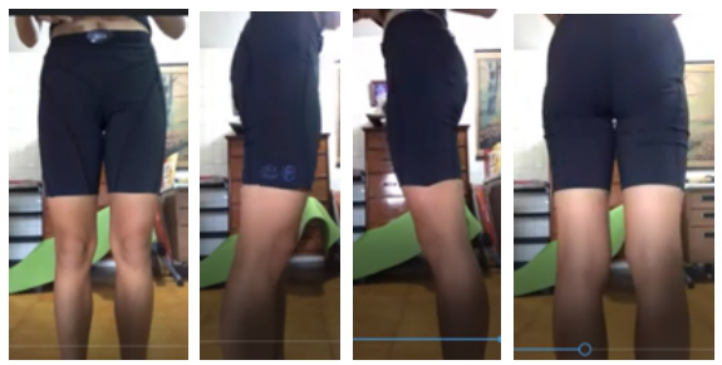
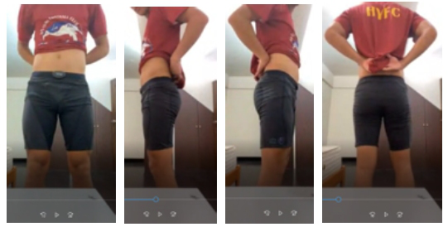
Figure 2: This study observed the footballers wearing the smart shorts while engaged in self-training during the summer of 2021, via Google Meet.Figure 3: In the online interviews, in which the participants were divided into small groups, the users’ feedback was sought regarding their experience of wearing the smart shorts for self-training.Figure 4: Female athlete No. 6 wearing the smart shorts (front, right side, left side and back views presented to the web camera).
Developing Smart Shorts for University Footballers for Self-Training Purposes 23
Figure 5: Male athlete No. 11 wearing the smart shorts (front, left side, right side and back views presented to the web camera).
Garment Fitting Evaluation: Questionnaire The questionnaire employed for this study included 12 questions, two of which concerned the user’s background, and five of which addressed their satisfaction with the fit of the smart shorts. Meanwhile, one question con- cerned the electronic device in the shorts, three addressed the users’ view of the garment, and one question addressed the anticipated selling price of the smart shorts. The data sets obtained were analysed using IBN SPSS Statistics 26 and Microsoft Excel, Version 16.46. The items included were as follows; included a seven-point Likert scale for the response (see Table 1):
1. Age; 2. Gender; 3. Smart shorts’ style; 4. Smart shorts’ appearance; 5. Functionality of textile; 6. Garment fit when engaged in static training; 7. Garment fit during sports training; 8. Satisfaction with the function of the electronic device; 9. Smart shorts’ suitability for self-training; 10. Overall satisfaction; 11. Likelihood of recommending the smart trouser to other athletes; 12. Price range of the smart shorts.
Table 1. Seven-point Likert scale employed for the questionnaire.
The study found that the respondents’ overall evaluation of the smart shorts, rated on a scale of one to seven, consistently reflected favorable impressions. Specifically, the style design achieved 5.13–6.07, appearance 4.93–5.73, fabric characteristics 4.87–6.00, wearability 5.20–6.13, and smart device integration 5.47–5.87. Significantly, the participants’ perceived suitability of the smart shorts for soccer-related athletic activities achieved an average 6.43, with the male respondents rating it 6.2, and the female respon- dents 6.67, indicating the garment’s suitability for soccer wear. Notably, 66.7% of the participants ranked the smart shorts a perfect score of 7, indi- cating their belief that the garment was exceptionally appropriate for this purpose. However, although they found them suitable for practice, 13.3% of the respondents expressed concerns about wearing the smart shorts during matches, fearing that they might be damaged.
The overall satisfaction scores evaluated, namely … achieved between 6.27 and 6.33 (6.30 overall, 6.33 for the male respondents, and 6.27 for the females), indicating a high level of satisfaction with the shorts. In all, 53.3% of the participants awarded a score of 6, while an impressive 40% scored the shorts a perfect 7. Furthermore, all 30 participants expressed a willingness to recommend the smart shorts designed for this study to their fellow ath- letes. The use of black as the primary color in the design garnered general approval, reportedly for being attractive and pleasing. However, an inde- pendent sample t-test revealed a significant difference between the male and female participants in their views of specific design aspects, with the male participants believing the smart shorts to be less distinctive than the females (significance at 0.020). The inclusion of the logos of Fu Jen Catholic Univer- sity’s Textile Department and the university’s soccer team was well-received. Concerning the fabric selection, only 10% of the respondents expressed a negative view, preferring thinner fabric, while the fabric’s wrinkle resistance received the highest score (5.80 overall; 5.60 for the males, and 6.00 for the females).
In terms of the shorts’ wearability, satisfaction was highest for ‘practi- cality’, ‘stretchability’, and ‘fit’. In terms of static conditions, the garment’s practicality achieved 5.80 overall (5.60 for the males, 6.00 for the females); stretchability achieved 5.67 overall (5.53 for the males, 5.87 for the females), and fit achieved 5.73 overall (5.60 for the males, 5.87 for the females), while in dynamic conditions, it achieved 5.93 overall (5.73 for the males, 6.13 for the females). Finally, the feedback regarding the functionality of the smart device was consistently positive, with the GPS and heart rate/stride data rank- ing the top two most satisfactory features (GPS: 5.87; heart rate/stride data: 5.83 overall; 5.80 for the males, and 5.87 for the females).
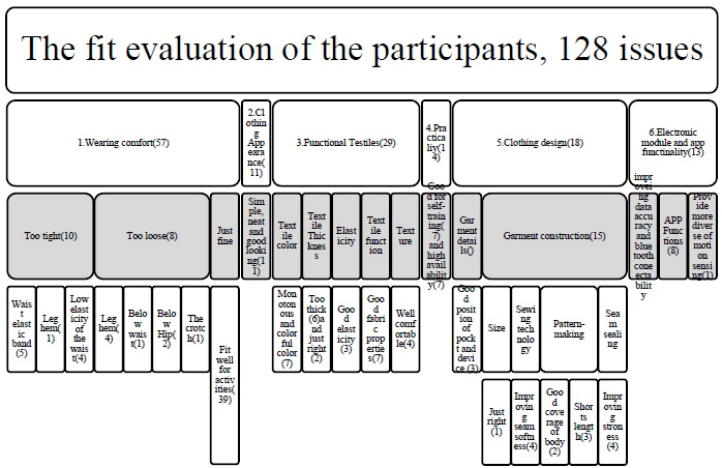
Garment Fit Evaluation: Interviews As shown in Figure 6, the interviewees noted 128 points in their evaluation of the smart shorts’ fit. The third iteration of the results of the Kawakita Jiro evaluation method classified these secondary categories into six overarching elements. Notably, those identified in the second round of interviews aligned with those from the first round, although there were certain differences in
Developing Smart Shorts for University Footballers for Self-Training Purposes 25
the subgroup categorizations. The six elements were as follows: ‘comfort’, ‘appearance’, ‘textile functionality’, ‘practicality’, ‘design’, and ‘electronic module and app functionality’. Among these, ‘comfort’ was mentioned most frequently (57 out of 143 entries), with 39 out of 57 entries noting the garment’s perfect fit.
Figure 6: The 128 points raised in the interviews regarding the smart shorts’ fit.
In terms of frequency of mention, the six items ranked as follows: comfort (39.8%); textile functionality (20.3%); design (12.6%); practicality (9.8%); electronic module and app functionality (9.8%), and appearance (7.7%). In terms of the gender-based rankings, the male athletes prioritized comfort (39.7%), followed by textile functionality (24.3%), electronic module and app functionality (0.3%), practicality (10.3%), appearance (10.3%), and design (5.1%). Meanwhile, the female athletes prioritized comfort (40%), followed by design (21.6%), textile functionality (15.4%), electronic module and app functionality (9.2%), practicality (9.2%), and appearance (4.6%). Notably, both the male and the female athletes ranked comfort their top priority, although their ranking differed for the other elements.
In terms of the overall frequency of mentions, the top three priorities were mobility, app functionality, and suitability of the garment for use by soccer players (each 26.7%), followed by appearance, colour, and fabric thickness (20%). For the male athletes, the elements that were ranked highest were mobility, simplicity, and app functionality (33.3%), followed by loose-fitting hem, which was noted as a problem, and fabric characteristics (26.7%). Meanwhile, the female athletes ranked comfort, colour, and suitability for use by soccer players (26.7% each) highest, followed by irritation at the seam, which was noted as a problem, and app functionality (20%). Notably, the
26 Huang
male participants mentioned the issue of a loose-fitting hem and the impor- tance of simplicity of design, while the females noted the irritation at the seams.
CONCLUSION
In all, two significant conclusions were drawn by this study regarding the physical fit of the smart shorts, and the feedback regarding their development, as follows:
In addition to gathering information via interviews, in order to understand athletes’ requirements, and utilizing measurements to assess athletes’ body types, trial fittings are vital. By employing the Kawakita Jiro method, this study found that there was a shift in emphasis among the participants’ views between the first and second rounds of interviews. In the initial interviews, the focus was on the functional attributes of textiles, while the second round of interviews highlighted the athletes’ wearing experi- ence. The expectations varied between these two scenarios. Fittings were deemed to be essential, in addition to obtaining initial measurements and surveying potential wearers’ requirements, which enables deeper insights into users’ needs, promoting the adjustments necessary to the design. Importantly, trial fittings should not be limited to a single occurrence;
It is essential to incorporate additional measurement points for the pant cuff circumference when measuring the human body. Due to the ongoing pandemic, the use of online tools for the trial fittings via interviews was initiated for the first time. While this approach enabled an understanding of the soccer players’ fitting conditions via screen-based interactions, it limited the ability to observe fitting issues and size and pattern discrep- ancies. Additionally, challenges such as an unstable internet connection caused disruptions during the interviews. During the trial fitting process, 26.7% of the male players reported loose pant cuffs. This issue was caused by overlooking the trouser cuff circumference during both the body mea- surements and the clothing simulations. As male players typically have broad waist and hip measurements but narrow lower limbs, the use of standard pant cuff dimensions by this study produced excessively wide cuffs. Therefore, additional measurement points, specifically for the shorts cuff circumference, should be included during the body measurements to mitigate the problem.
ACKNOWLEDGMENT
This research is founded by National Science and Technology Council (MOST 108-2221-E-030-001).
REFERENCES
Andreato, L. V., Coimbra, D. R. & Andrade, A. (2020). Challenges to Athletes During the Home Confinement Caused by the COVID-19 Pandemic. Strength and Conditioning Journal, Volume 42, pp. 1–5.
Developing Smart Shorts for University Footballers for Self-Training Purposes 27
Fadlullah, Z., Fouda, M. M., Pathan, A.-S. K., Nasser, N., Benslimane, A.
& Lin, Y.-D. (2020). Smart Iot SolutIonS for CombatIng the CoVID-19 Pan- DemIC. IEEE Internet of Things Magazine. Institute of Electrical and Electronics Engineers. Hanuska, A., Chandramohan, B., Bellamy, L., Burke, P., Ramanathan, R. & Balakrishnan, V. (2016). Smart Clothing Market Analysis. In: SIDHU, I. (ed.). California: University of California, Berkeley. Leppänen, M., Aaltonen, S., Parkkari, J., Heinonen, A. & Kujala, U. (2014). Inter-
ventions to prevent sports related injuries: A systematic review and meta-analysis of randomised controlled trials. Sports Med, Volume 44, No. 473–486. Li, Y., Cao, J. & Wang, Y. (2019). Implementation of Intelligent Question Answering System Based on Basketball Knowledge Graph. 2019 IEEE 4th Advanced Informa- tion Technology, Electronic and Automation Control Conference (IAEAC), 2019 Chengdu, China. IEEE 2601–2604. Silvers-Granelli, H., Mandelbaum, B., Insler, O. A., Bizzini, M., Pohlig, R.,
Junge, A., Snyder-Mackler, L. & Dvorak, J. (2015). Efficacy of the FIFA 11+ injury prevention program in the collegiate male soccer player. Am J Sports Med, Volume 43. Uh, M., Carroll, K. E. & Cassill, N. L. (2010). Critical Review on Smart Clothing Product Development. Wilson College of Textiles, Volume 6, No.1. Wich-50 Media. (January 19, 2024) Wearable Market Growing Strongly Says Gart-
ner. The Gartner website https://www.gartner.com/en/newsroom/press-releases /2018-11-29-gartner-says-worldwide-wearable-device-sales-to-grow- Yen, W. (January 19, 2024). Taiwan in position to advance at Women’s Asian Cup 2022 [Online]. The Central News Agency in Taiwan: CNA English News. The News website: https://focustaiwan.tw/sports/202201250005. Yu, F. T. S., Yu, E. H. & Yu, A. G. (2018). The Art of Learning: Neural Networks
and Education, Boca Raton, Florida, CRC Press.
LISTED IN THE AHFE DIGITAL BOOKSTORE CATALOGUE
Explore the complete digital volume
Human Factors and Wearable Technologies
Read this individual research paper free through the original publisher, or explore the full digital proceedings book.
ISBN 978-1-964867-17-5
Explore this ISBN in the AHFE Bookstore ↗Listed in the July 2026 bookstore catalogue; search by ISBN to confirm current availability · Digital book purchase optional