In the post-pandemic era, the apparel industry has undergone rapid digital transformation, with cross-dimensional technologies that integrate virtual and physical techniques emerging as a key trend. This study reviews 15 articles from the United States and Canada, exploring the application of physical and virtual simulation technologies to various types of apparel. It also analyzes the current challenges associated with the current transformations occurring within the garment evaluation process. Findings indicate that virtual technologies offer significant advantages in terms of enhancing design efficiency; notably reducing the number of revisions required when developing prototypes, and minimizing waste. These technologies are increasingly integrated with artificial intelligence, leveraging its potential to evaluate garment fit and comfort. However, despite their ability to substantially improve simulation accuracy and efficiency, ultimately validation through actual wearer assessments is required. This study recommends enhancing the interoperability of 2D to 3D tools, to establish evaluation frameworks that can provide new directions to support the digitalization of the apparel industry.
In line with the rapid changes that occurred during the pandemic, the global shift towards digitalization in both living and working environments has accelerated. This is driving an increasingly close integration of virtual and physical technologies within the fashion industry. Developments to date reflect a complementary relationship between both virtual and physical methods. Traditionally, apparel production has relied heavily on physical prototypes to assist with pattern drafting and modification. However, in the post-pandemic era, the adoption of 3D virtual fashion technologies has become the new norm. The integration of virtual and physical technologies offers significant efficiency gains, as well as increased potential for
168 Huang and Huang cross-border collaborations, enhancing real-time communication in design processes. By leveraging virtual garment creation and auxiliary tools, not only has prototype evaluation improved, but the time required for repeat modifications has also been reduced. By engaging with virtual technologies, users can vividly present garment designs and display effects within virtual spaces, eliminating the substantial time and cost investments required for physical prototype production (Geng, 2018). Undoubtedly, in the post-pandemic era, the integration of virtual and physical technologies is not only an inevitable trend informing the digital transformation of the fashion industry, it is also the crucial driving force behind its sustained development.
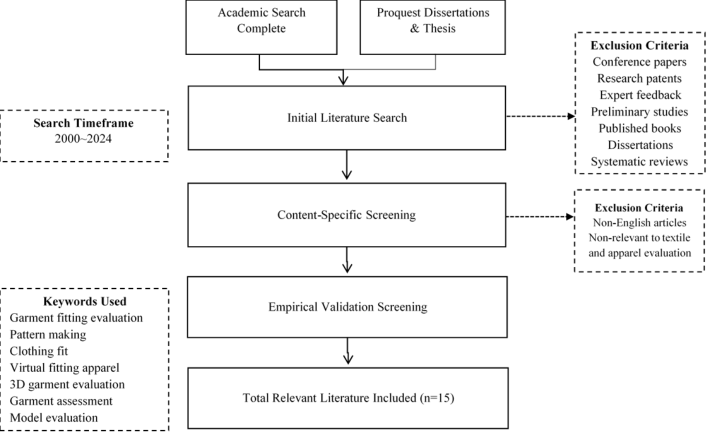
RESEARCH METHODS Literature Search and Keywords: With the continuous advancement of technology use in the fashion industry, the evaluation of physical and virtual garment prototypes has become increasingly integral to the design process. At present, there is a dearth of studies on physical and virtual garment evaluations within domestic contexts. Therefore, this study adopts a literature review approach, focusing on integrating previous research conducted in various foreign contexts, specifically within North America. The research scope encompasses studies published between 2000 and 2024, as identified from two major online databases: Academic Search Complete (EBSCOhost) and ProQuest Dissertations & Theses (PQDT). The literature search employs keywords, such as “Garment fitting evaluation,” “Pattern making,” “Clothing fit,” “Virtual fitting apparel,” “3D garment evaluation,” “Garment assessment,” and “Model evaluation,” ensuring the results encompass both evaluations designed to assess physical and virtual garments.
Literature Inclusion Criteria: This study describes a systematic review conducted examining research on the evaluation of physical and virtual sample garments, using data retrieved from Academic Search Complete (EBSCOhost) and ProQuest Dissertations & Theses (PQDT) databases, focusing on the United States and Canada. To ensure the accuracy and relevance of the search results, specific exclusion criteria were applied as part of the literature screening process: (1) Excluded document types included conference papers, research patents, expert feedback, preliminary experiments, published books, dissertations, and systematic review articles; and (2) Excluded content included studies unrelated to textiles and apparel evaluation and journal articles in languages other than English. Based on these criteria, a total of 15 relevant studies reviewing sample garment evaluation were included as reference materials.
Figure 1: Flowchart for the literature search and screening process.
RESEARCH RESULTS Research on Sample Garment Evaluation: The articles included in this study focus on evaluating physical and virtual garment prototypes, utilizing cross-dimensional analyses involving both physical model try- ons and virtual simulation techniques to assess garment fit and comfort (see Table 1). For example, when evaluating functional and comfort- oriented apparel, researchers frequently targeted specialized clothing, such as sportswear and protective gear. Such studies employ virtual models to analyze pressure distribution (Kim and Oh, 2023; Teyeme et al., 2023) and to conduct static and dynamic assessments of physical prototypes (Lin et al., 2016), with additional explorations of the impact of apparel on wearer experience. Studies comparing physical and virtual garments predominantly use physical clothing as a benchmark, leveraging virtual-physical verification as a mechanism to improve the accuracy and applicability of virtual try-on technologies, providing theoretical support for their practical implementation (Kim et al., 2017; Lin and Wang, 2016; Ancutione, 2014). Additionally, garment evaluation research incorporates artificial intelligence and machine learning techniques, employing data analysis methods to enhance precision of fit assessments, highlighting the potential for interdisciplinary technology integration in this field (Liu et al., 2017). Overall, the relevant literature indicates that garment evaluation methods are progressively integrating virtualization technologies and parametric design, thereby advancing the field by combining physical try-on testing and virtual evaluation techniques.
Table 1: Basic information of reviewed literature.
Table available in the original PDF paper.
Year Author(s) Research Topic
2024 Yang and Baytar
Fit models’ roles in identifying fit issues in the apparel technical design process and implications for improving 3D virtual fitting.
2023 Jin et al. Design and research into automatic garment-pattern-generation system based on parameterized design.
2023 Kim and Oh Cycling knee brace design analysis using 3D virtual clothing program to assess clothing pressure distribution and variance.
2023 Sayanjali et al. Assessment of the influence of weave structure, wind speed and garment size on the ventilation of simulated garment.
2023 Teyeme et al. Fit and pressure comfort evaluation on a virtual prototype of a tight-fit cycling shirt.
2021 Bao et al. 3D interactive garment parametric pattern-making and linkage editing based on constrained contour lines.
2019 Kim et al. Adaptivity of pattern making methods to garments for varying body dimensions.
2019(a) Zhu and Peng Fit Evaluation during repetition interaction in garment pattern design.
2019(b) Zhu and Peng Generation of realistic virtual garments on a recovery human model.
2017 Liu et al. Garment fit evaluation using machine learning technology.
2017 Kim et al. Development of similarity evaluation method between virtual and actual clothing.
2016 Lin and Wang The development of a clothing fit evaluation system under virtual environment.
2016 Lin et al. Ergonomic evaluation of protective clothing for earthquake disaster search and rescue team members.
2014 Ancutiene Comparative analysis of real and virtual garment fit.
2000 Taya An evaluation method determining clothing fitness relative to the body.
Evaluation Criteria and Tools for Sample Garments: This study explores the application scenarios and methodologies of virtual and physical garment evaluations, focusing on different evaluation criteria and tools. The evaluation criteria cover physical wearers, dimensional transformation systems, and 3D virtual models, thereby addressing diverse user needs.
In terms of selection of garment types, the studies in this review encompass a variety of clothing designs and applications, including daily wear, sportswear, personalized apparel, and protective gear. For instance, Yang and Baytar (2024) investigated business and casual wear, collecting feedback from subjects after trying on garments. Similarly, Kim and Oh (2023) and Teyeme et al. (2023) studied sportswear, including cycling knee pads and compression athletic apparel, to evaluate comfort and pressure distribution. Lin et al. (2016) conducted research into protective rescue gear for
Dimension Transformation and Garment Sample Evaluation via Bibliographic Database 171 earthquake responders, emphasizing wearability and performance. Studies addressing personalized clothing have also gained traction, as evidenced by Jin et al. (2023) and Bao et al. (2021), whose work highlighted the relevance of modern fashion technology as a tool for meeting consumer-specific needs. Elsewhere, Zhu and Peng (2019) investigated virtual try-on technologies for various fabrics and garments, demonstrating the potential for virtual simulation technologies to enhance design efficiency and limit resource waste. This research underscores the broad applicability of integrated virtual and physical evaluations across diverse garment types.
In terms of research tools, the evolution of apparel design tools has progressed from a traditional 2D flat pattern drafting to 2D-3D interactive modeling and 3D-3D virtualization, reflecting the transition from flat analysis to virtual simulation technologies. 2D-2D tools are typically used for garment performance analysis in specific scenarios (Sayanjali et al., 2023; Lin et al., 2016) as well as for collecting feedback on garments (Yang and Baytar, 2024; Kim et al., 2019), making them suitable for evaluating physical sample garments. 2D-3D technologies combine flat pattern drafting with virtual simulation (Jin et al., 2023; Bao et al., 2021; Zhu and Peng, 2019(a)(b); Kim et al., 2017; Lin and Wang, 2016; Ancutione, 2014), supporting more diversified pathways for garment evaluation, and enabling seamless digital integration from design to fitting. 3D-3D tools further utilize data for virtual simulations, and are applied widely when evaluating virtual garments, particularly when assessing fit and precision for sportswear and everyday clothing styles (Kim and Oh, 2023; Teyeme et al., 2023; Liu et al., 2017; Taya, 2000).
Table 2: Review of the literature on assessment items and tools.
Table available in the original PDF paper.
Author(s) Evaluation Project Garment Type Tool 2D-2D Yang and Baytar Fitting evaluation by test participants.
Businesswear, Casualwear Personalized Garments 2D-3D-2D Jin et al. Automated garment pattern- making system.
Kim and Oh Pressure analysis of knee pads. Cycling Knee Pads 3D-3D Cotton/Polyester Shirts 2D-2D Sayanjali et al. Impact of clothing ventilation performance.
Tight-Fit Cycling Wear 3D-3D
Teyeme et al. 3D virtual fitting and pressure analysis.
Bao et al. 2D-3D Interactive pattern-making. Personalized Garments 2D-3D Various Dresses 2D-2D Kim et al. Body shapes and pattern-making methods.
2D-3D-2D
Zhu and Peng Interactive pattern-making and fitting evaluation.
Basic Garments of Various Styles 2D-3D Zhu and Peng Virtual mannequins and fabrics. Virtual Fitting for Various Fabrics
Liu et al. Digital pressure data analysis. Straight-Leg Pants 3D-3D (Continued)
Table 2: Continued.
Table available in the original PDF paper.
Author(s) Evaluation Project Garment Type Tool Skirts 2D-3D Kim et al. Similarity between virtual and physical garments.
Lin and Wang Virtual vs. physical fitting. Shirts of Different Sizes 2D-3D Protective Rescue Wear 2D-2D Lin et al. Clothing for earthquake rescue teams.
Straight Dresses 2D-3D
Ancutione Comparison between test participants and virtual mannequins.
One-Piece Dresses 3D-3D
Taya Anthropometric data and garment sizing.
• Research process for sample evaluation: Research on prototype garment evaluation can employ a variety of methods and techniques, with the research process being loosely divided into four major categories: user needs and technical improvements, parametric and virtual technologies, fabric performance testing, and virtual-real comparative evaluations. An analysis and discussion of each category is set out below: User Needs and Technical Improvements: In the area of user needs and technical improvements, the studies examined typically focused on analyzing wearability requirements and enhancing design. Yang and Baytar (2024) conducted interviews with the participants to collect feedback and make suggestions about wear, investigating key areas and proposing directions for design improvements. Similarly, Kim et al. (2019) developed multiple prototype garments, gathering actual consumer feedback to validate the applicability of the designs. These studies aimed to develop criteria for prototype evaluation and technical advancements based on user requirements.
• Applications of Parametric and Virtual Technologies: Research on the utility of parametric and virtual technologies aims to enhance design efficiency and accuracy. Jin et al. (2023) addressed the limitations of traditional manual pattern-making by proposing a Python-based parametric design method, improving the pattern-making process and its precision. Kim and Oh (2023) employed CLO 3D to simulate the pressure distribution of cycling knee pads, assessing the impact of design changes on wearer comfort. Teyeme et al. (2023) input patterns into CLO 3D for virtual sewing and testing, refining pattern designs according to pressure distribution results that enhance fit and comfort. Similarly, Bao et al. (2021) established a parametric production model, iteratively conducting virtual fittings and parameter adjustments to improve on garment fit. Zhu and Peng (2019) integrated CNN technology with 3D body modeling to measure fabric elasticity, and deformation parameters, further enhancing the realism of virtual fittings. Liu et al. (2017) then utilized pressure data and machine learning models to optimize virtual
Dimension Transformation and Garment Sample Evaluation via Bibliographic Database 173 fitting evaluations, revealing the potential for integrating technology with design. Taya (2000), analyzed discrepancies between standard sizing and actual spacing using measurements from human bodies and garments, to provide data-driven improvements for prototype garment design.
• Fabric Performance Testing: In fabric performance testing, research focusing on the physical characteristics and functional properties of prototype garments. Sayanjali et al. (2023) investigated the breathability and air gap thickness of various fabric structures, testing wind speed and ventilation to establish the impact of weave patterns on garment performance. Lin et al. (2016) designed both static and dynamic wearability assessments, integrating motion capture technology to measure range of motion and simulate earthquake rescue scenarios when analyzing performance under specific conditions.
• Virtual-Real Comparative Evaluation: Research in this area explores the correlations between virtual technology and real-world fitting results. Lin and Wang (2016) quantified differences in dimensions between virtual and physical models, using void area calculations to identify discrepancies. Ancutione (2014) utilized CAD Lectra to construct garment samples, comparing real and virtual fitting outcomes, to validate the feasibility of virtual fitting technology. Zhu and Peng (2019) employed 2D and 3D grid technologies to enable flexible pattern modifications with real-time visualization, thereby showcasing applications of virtual technology in prototype evaluation. Kim et al. (2017) compared the shape parameters of virtual and physical garments, developing similarity assessment metrics for use in simulation evaluations during the design process. The studies reviewed represent a range of prototype garment evaluation methods, encompassing user need analyses, parametric technology applications, performance testing, and virtual-real comparisons. This comprehensive data highlights the integration of traditional and modern technologies, suggesting new directions for future developments in prototype garment evaluation.
Table 3: Review of the literature on assessment items and tool.
Table available in the original PDF paper.
Author(s) Research Process Yang and Baytar (2024)
1. Conducted observations and interviews with participants to collect their feedback and design suggestions. 2. Performed data coding and integrated analysis. 3. Explored potential improvements in 3D virtual fitting technology.
Jin et al. (2023) 1. Analyzed issues with traditional manual pattern-making. 2. Proposed a parametric design method using Python. 3. Validated the accuracy of curves and the effectiveness of 3D simulations.
(Continued)
Table 3: Continued.
Table available in the original PDF paper.
Author(s) Research Process Kim and Oh (2023) 1. Searched for and selected highly-rated bicycle knee pad products. 2. Conducted virtual wear pressure tests using CLO 3D. 3. Analyzed the impact of design elements on pressure distribution.
Sayanjali et al. (2023) 1. Produced fabrics with various structures. 2. Tested fabric breathability through gap and wind speed evaluations. 3. Assessed the impact of ventilation.
Teyeme et al. (2023) 1. Designed and exported patterns to CLO 3D. 2. Conducted virtual stitching and simulations on virtual models. 3. Adjusted pattern designs based on pressure analysis results Bao et al. (2021) 1. Developed a parametric production model. 2. Conducted virtual fitting and adjusted parameters. 3. Evaluated garment fit.
Kim et al. (2019) 1. Created prototypes using various pattern-making methods and garment styles. 2. Assessed garment appearance and collected consumer feedback. 3. Compared evaluations across different countries.
Zhu and Peng (2019a) 1. Conducted evaluations using 2D and 3D grids.
Zhu and Peng (2019b) 1. Measured fabric elastic deformation parameters.
2. Used CNN for 3D human body reconstruction. 3. Integrated 3D models for virtual fittings.
Liu et al. (2017) 1. Used pressure data to evaluate virtual fittings. 2. Trained machine learning models for evaluation accuracy. 3. Validated the predictive capability of the model.
Kim et al. (2017) 1. Built 3D virtual garments through physical scanning. 2. Conducted subjective and objective similarity evaluations. 3. Developed similarity assessment metrics.
Lin and Wang (2016) 1. Designed garments and created 3D models. 2. Quantified garment fit using void area measurement. 3. Assessed differences between virtual and real model sizes.
Lin et al. (2016) 1. Designed static and dynamic wear tests. 2. Measured range of motion using a motion capture system. 3. Simulated earthquake rescue scenarios to evaluate wear performance.
Ancutione (2014) 1. Constructed garments using CAD Lectra software. 2. Conducted virtual stretching and real wear evaluations. 3. Compared real and virtual evaluation results.
Taya (2000) 1. Digitized the body and clothing in 3D. 2. Tested using anthropometric data and garment dimensions. 3. Analyzed results against standard sizing.
RELIABILITY AND VALIDITY VERIFICATION OF THE SAMPLE CLOTHING EVALUATION This study focuses on reliability and validity verification of four items common to the sample garment evaluation research process.
User Needs and Technological Improvement Verification: Yang and Baytar (2024) utilized a qualitative feedback approach to evaluate satisfaction and clothing comfort levels. They validated feasibility through field observations and interviews. Kim et al. (2019) explored the impact of various clothing designs and pattern combinations on a garment’s appearance, conducting assessments based on participants’ subjective rankings.
Parametric and Virtual Technology Validation: Jin et al. (2023) applied a parametric design and Python programming for verification analyses, enhancing the accuracy and comfort of pattern drafting via physical and 3D simulations. Kim and Oh (2023) investigated the effects of virtual 3D simulations on pressure distribution and the comfort of knee braces, using pressure maps to refine design models. Similarly, Teyeme et al. (2023) employed virtual 3D simulation technology to analyze both garment pressure distribution and wear conditions, validating their findings through pressure maps and stress-strain tests. Bao et al. (2021) assessed garment fit and comfort using 2D-3D pattern models, before making adjustments through virtual simulations. Zhu and Peng (2019) compared 3D simulations with physical fabrics as a way to evaluate the realism of virtual simulations. Liu et al. (2017) used digital pressure technologies to quantify and evaluate pressure distribution in both virtual and physical contexts. Finally, Taya (2000) measured the spacing between the body and clothing to assess garment fit relative to body dimensions.
Fabric and Garment Performance Testing: Sayanjali et al. (2023) examined the effects of ventilation and fabric structure on breathability by monitoring airflow before conducting experimental tests for validation. Lin et al. (2016) combined motion capture with ergonomic analysis, thereby leveraging a fuzzy comprehensive evaluation method to improve garment comfort and flexibility.
Virtual and Physical Comparative Evaluation: Zhu and Peng (2019) investigated the application of 2D and 3D interactive comparisons as a means to improve model modification efficiency within the design process. Kim et al. (2017) utilized virtual 3D simulation technology to enhance the accuracy of virtual try-ons, by analyzing the similarities between virtual and physical garments. Lin and Wang (2016) studied the application of virtual 3D simulations to improve garment fit by comparing the results from virtual and physical try-on. Ancutione (2014) explored subjective evaluations and stretch-strain behavior in both physical and virtual try-ons, then compared the differences in performance between the two.
programming
comparisons.
physical testing.
garments.
physical try-ons.
breathability. Experimental testing in controlled environments.
appearance. Subjective ranking and evaluation by Participants.
the design process. Experimental validation through virtual and physical
participants Assessment of garment design and comfort. Field observation and interviews
physical and 3D simulations Pattern accuracy and comfort. Validation using parametric design and Python
pattern designs Effects of different patterns on garment
comparison Improving efficiency in model modification during
ergonomic analysis Comfort and flexibility of garments. Validation using fuzzy comprehensive evaluation methods.
tensile strain Garment fit. Validation through comparisons of virtual and real try-ons.
Table 4: Reliability and validity verification of sample clothing evaluation.
Table available in the original PDF paper.
Author(s) Evaluation Method Criterion Reliability and Validity Testing
Yang and Baytar Qualitative feedback from
Ji et al. Verification through
Kim and Oh Virtual 3D modeling Pressure distribution and comfort of knee braces. Adjustments using pressure maps and virtual simulations
Sayanjali et al. Monitoring airflow Impact of wind speed and fabric structure on
Teyeme et al. Virtual 3D modeling Pressure distribution and fit of garments. Testing using pressure maps, stress, and strain analysis.
Ba et al. 2D-3D pattern modeling Evaluation of garment tightness and comfort. Virtual simulation adjustments and Assessment.
Ki et al. Various garments and
Zhu and Peng (a) 2D and 3D interaction
Zhu and Peng (b) Fabric simulation Realism of 3D virtual try-ons. Comparison between actual and virtual fabrics.
Liu et al. Digital pressure sensing Quantifying real fit data. Pressure distribution comparison through simulation and
Kim et al. Virtual 3D modeling Accuracy of virtual try-ons. Assessment of similarity between virtual and physical
Lin and Wang Virtual 3D modeling Garment fit. Validation of fit through comparisons of virtual and
Lin et al. Motion capture for
Ancutione Subjective scoring and
Taya Virtual 3D simulation Fit between dimensions and body. Assessment of spacing between body and garment.
CONCLUSION
Enhancing the usability of 2D-to-3D conversion tools: Current research on 2D-to-3D conversion technology should strive to enhance the usability and applicability of these tools, and reduce the learning curve for users. This would facilitate smoother integration into the fashion design process, advancing digitalization within the industry.
Balancing technology applications and wearer needs: When applying virtual technologies, data serves as a critical basis for prototype evaluation, offering designers quantifiable parameters. However, these technologies are reliant on physical evaluations for validation. The study recommends establishing a unified evaluation standard to integrate virtual and physical assessments. This would ensure virtual technologies more accurately reflect the fit and comfort of physical prototypes, thereby achieving an optimal balance between the technological benefits and wearer requirements.
ACKNOWLEDGMENT
This research was funded by the National Science and Technology Council of Taiwan (NSTC-2221-E-030-012-). Fu Jan Catholic University Institutional Review Board agreed to this research. The certificate of Approval for amendment is FJU-IRB No:C113171.
REFERENCES
Ancutiene, Kristina. (2014). Comparative analysis of real and virtual garment fit.
INCOSE Industria Textila, Volume 65, No. 3. Bao, Chen, Miao, Yongwei, Gu, Bingfei, Liu, Kaixuan, and Liu, Zhen. (2021). 3D interactive garment parametric pattern-making and linkage editing based on constrained contour lines. INCOSE International Journal of Clothing Science and Technology, Volume 33, No. 5. Geng, Bin. (2018). 3D Clothing Design in Context of Virtual Reality Technology- A
Review of Virtual Reality and Implementation in Clothing. INCOSE, Volune 35, No. 8. Jin, Peng, Fan, Jintu, Zheng, Rong., Chen, Qing, Liu, Le, Jiang, Runtian, and Zhang, Hui. (2023). Design and research of automatic garment-pattern-generation system based on parameterized design. INCOSE Sustainability, Volume 15, No. 2. Kim, Hee, and Oh, Kyung (2023). Cycling knee brace design analysis using 3D
virtual clothing program to assess clothing pressure distribution and variance. INCOSE Fashion And Textiles, Volume 10, No. 1. Kim, KyoungOk, Fujii, Chinami, and Takatera, Masayuki. (2019). Adaptivity of pattern making methods to garments for varying body dimensions. INCOSE International Journal of Clothing Science and Technology, Volume 31, No. 4. Kim, Seo, Kim, Sungmin, and Park, Chang. (2017). Development of similarity
evaluation method between virtual and actual clothing. INCOSE International Journal of Clothing Science and Technology, Volume 29, No. 5. Lin, Xue, Zhai, Lina, Zhang, Mengying, Wang, Yunyi, and Li, Jun. (2016). Ergonomic evaluation of protective clothing for earthquake disaster search and rescue team members. INCOSE International Journal of Clothing Science and Technology, Volume 28, No. 6.
system under virtual environment. INCOSE Multimedia Tools and Applications, Volume 75. Liu, Kaixuan, Zeng, Xianyi, Bruniaux, Pascal, Wang, Jianping, Kamalha, Edwin, and Tao, Xuyuan. (2017). Fit evaluation of virtual garment try-on by learning from digital pressure data. Knowledge-Based Systems, 133, 174–182. Sayanjali, Fateme, Ezazshahabi, Nazanin, and Mousazadegan, Fatemeh. (2023).
Assessment of the influence of weave structure, wind speed and garment size on the ventilation of simulated garment. INCOSE International Journal of Clothing Science and Technology, Volume 35, No. 1. Taya, Yoshiko. (2000). An evaluation method of clothing fitness with body. INCOSE In Proceeding of the Human Factors and Ergonomics Society Annual Meeting, Volume 44, No. 38. Teyeme, Yetanawork, Malengier, Benny, Tesfaye, Tamrat, Vasile, Simona, and Van
Langenhove, Lieva. (2023). Fit and pressure comfort evaluation on a virtual prototype of a tight-fit cycling shirt. INCOSE Autex research journal, Volume 23, No. 2. Yang, Yoon, and Baytar, Fatma. (2024). Fit models’ roles in identifying fit issues in the apparel technical design process and implications for improving 3D virtual fitting. INCOSE Fashion and Textiles, Volume 11, No. 1. Zhu, Yuxiang, and Peng, Yanjun. (2019a). Fit evaluation during repetition interaction
in garment pattern design. INCOSE Mathematical Problems In Engineering, Volume 2019, No. 1. Zhu, Yuxiang, and Peng, Yanjun. (2019b). Generation of Realistic Virtual Garments on Recovery Human Model. Incose Mathematical Problems in Engineering, Volume 2019, No. 1.
Read this individual research paper free through the original publisher, or explore the full digital proceedings book.
ISBN 979-8-950676-09-3
Explore this ISBN in the AHFE Bookstore ↗Listed in the July 2026 bookstore catalogue; search by ISBN to confirm current availability · Digital book purchase optional