Elisabeth Broneder, Christoph Weiß, Stephanie Puck, Youssef Ibrahim (2024). Buddy4All – A Platform to Connect Generations. In: Interdisciplinary Practice in Industrial Design. AHFE Open Access, vol. 144, pp. 148–156. https://doi.org/10.54941/ahfe1005127
Seniors are frequently affected by a decline in cognitive and physical fitness. Apart from that they often feel lonely due to lack of social contacts or have the feeling of not being needed anymore since their children and grandchildren are already grown up. They often do not participate in social life as they used to but still would like to get in contact with the younger generation to pass on their life experience. On the other hand, younger adults – especially from non-stable or low-income families often struggle with school and a lack of role models. They still struggle with the negative effects Covid-19 had on their social life as well as on their mental health and still have to catch up with schoolwork. The number of younger adults suffering from depression rose drastically during the pandemic. On top of all that, tutoring is often expensive, and they do not trust adults to talk about their personal problems – especially related to their mental health. The Buddy4All platform targets these problems via an innovative Mixed Reality (MR) solution. Its intent is to build a bridge between the two generations. A social app provides helpful information for younger and older adults about their topics of interest. Further, it helps to overcome the first fears to get in contact with the other generation. Younger and older adults can help each other with everyday problems like homework or setting up a TV. Younger adults get the possibility to build trustful relationships to grownups and seniors can pass their life experience to younger adults and keep themselves socially included. An MR-application further provides games that can be played together as well as cognitive exercises for both target groups, to keep them cognitively fit but also to enhance skills like concentration. Based on a user-centered approach this platform has been tested in three workshops with end-users. This work details the results and comparisons of the second and third end-user workshop.
After retirement senior citizens face an increased risk of cognitive decline and depression due to reduced social contacts (Cardona et al., 2023). Engag- ing in social activities (Hikichi et al., 2016; Kim et al., 2016) and cognitive exercises or leisure activities, such as playing a musical instrument (Mansky et al., 2020), are significant methods for mitigating cognitive decline. Gami- fication of cognitive exercises and social activities can support in motivation and engagement (Mora et al., 2016; Khalegi et al., 2021; van de Weijer et al., 2019). Virtual Reality (VR) has proven to be a promising technology
for cognitive training and social inclusion of seniors (Rendever, 2022; Syed- Abdul et al., 2019; Gamito et al., 2019; Gamito et al., 2020) and had good acceptance rates among the users (Syed-Abdul et al., 2019). Apart from that, VR offers full immersion, which can improve cognitive ability (Wan, 2021) as well as create interest and motivation in cognitive exercises (Ferguson et al., 2020). These immersive environments are also used to encourage social interaction through apps such as Alcove, a family-oriented social VR-app (Alcove, 2022), and Rendever, a VR app that targets the improvement of social connections and familial ties in the geriatric setting (Rendever, 2022). Mixed Reality (MR) technology is also used in this field. TACTILE, for instance, offers a framework for mixed reality games, that include remote game partners via MR glasses (Broneder et al., 2022). Intergenerational inter- action stands out as a beneficial factor for the cognitive well-being of the elderly and young adults. This level of interaction is beneficial to both par- ties (Zhang et al., 2020; Zhang et al., 2018; Zeldin, 2005), with (Park et al., 2015) mentioning reduced depression specifically due to intergenerational interaction.
A common concern regarding VR / MR gamification for seniors is the high technological boundary. Despite the trend of increased technological acumen among seniors (Anderson and Perrin, 2017), they still lag significantly behind younger adults in terms of technological capability (Lee, 2019).
Buddy4All focuses on the benefits of intergenerational interaction between seniors and young adults (14–21 years old). The goal is to provide a techni- cal platform for intergenerational interaction (e.g., via location-based MR games), while simultaneously providing cognitive MR trainings. The project seeks to use the tech-savviness of young people to counteract any lower tech- nical ability of seniors (Anderson and Perrin, 2017). Since the solution focuses also on senior users, the usability has to be tailored to their needs. Therefore, a high user involvement is crucial to adapt the system accordingly. During the development phase, three user workshops have been conducted at end- user organizations in Austria and Switzerland, including seniors and younger adults to adapt the system to the needs of both target groups. At the end of the project, field trials are conducted in both countries to test the final prototype and collect feedback for a future product development. This paper focuses on the description of the final prototype and the results of the second and third workshop. The results of the first workshop are described in (Broneder et al., 2023).
THE BUDDY4ALL SYSTEM Buddy4All utilizes a buddy-concept, differentiating between three buddy roles – the virtual buddy, professional buddy, and real buddy. The “virtual buddy” represents the digital entity of the system and offers support content about topics relevant for younger adults and / or seniors (e.g., health articles, the first time, etc.). Further, the virtual buddy motivates end-users to use the system frequently. The “professional buddy” represents the relation between e.g., younger adults and social workers or seniors and their caregivers. Thus, users are connected with professionals, who are considered as secondary end- users of the system. The “real buddies” are the primary users of the system and represent a relation between seniors and younger adults. To implement
this concept, the Buddy4All system consists of three components: (a) a social app that offers digital support content (virtual buddy) and provides features to get in contact with real buddies and professional buddies; (b) an MR app that offers cognitive exercises and location-based games; and (c) a backend for user management, offering a frontend that allows professionals to con- figure digital support content, cognitive exercises and location-based games. The MR app uses the NReal Light MR glasses, which are connected to a smartphone via USB. In the following the social app and the MR app are described in more detail.
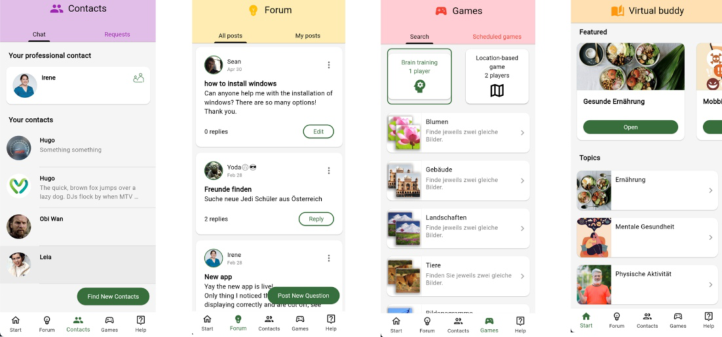
Social App The social app is a smartphone app that connects seniors with younger adults. Users can send friend requests to connect with a real buddy and commu- nicate via chats and video calls. Via offering various functionalities – like forum posts, chat and video calls seniors and younger adults can help each other – e.g., seniors can help with homework, younger adults with technical questions. They can interact and benefit from each other’s knowledge and life experience. Further, users can schedule location-based games that are played with each other. Apart from the intergenerational functionalities, the app offers virtual support via articles on specific topics relevant for the seniors and / or younger adults. Moreover, the app provides a direct connection to professional buddies like caregivers and social workers. This should lower the inhibition threshold to contact professionals especially for the younger target group. To avoid abuse of the system, users are not anonymous but reg- istered by professionals. If a user feels harassed or exploited, they can contact their professionals who will take further actions. To keep the users engaged in the Buddy4All system, notifications are sent to the smart phone to encourage them to use certain features, like playing a game, doing a cognitive exercise or making a friend. Figure 1 shows screenshots of the social app.
Figure 1: Screenshots of the social app. From left to right: contacts, forum, list of cognitive games, articles.
Buddy4All – A Platform to Connect Generations 151
MR Cognitive Exercises The mixed reality application offers cognitive exercises for both seniors and the younger generation. The benefit of using MR is to combine cognitive exercises with physical movement by distributing the elements of the exercise within the user’s home. Hand tracking allows the user to interact with the virtual elements intuitively. The Buddy4All system offers four different types of cognitive exercises: (a) two types of card matching games, (b) a game of finding anagrams and words, and (c) a “color game”. Interaction with all games is based on hand tracking and the need to physically touch the game elements to select them.
The first card matching game is an implementation of the game “Memory matching”. Players need to find pairs of images on cards that are shown face- down. The second card game, called Pairs, displays cards (with images or texts on them) face-up and players need to match these cards based on certain rules (e.g., matching names of painters to their painting). The content of both types of card games is retrieved from the backend. Thus, new matching rules or new images can easily be added to the system, allowing a vast variety of cognitive exercises.
The anagram game requires players to find either the anagram of a given word or to form new words with the letters of the given word. The color game is an implementation of the Stroop color-word test (Scarpina and Tagini, 2017). Figure 2 shows examples of cognitive exercises.
Figure 2: Examples of cognitive exercises. Left: pair game, middle: color game, right: anagrams.
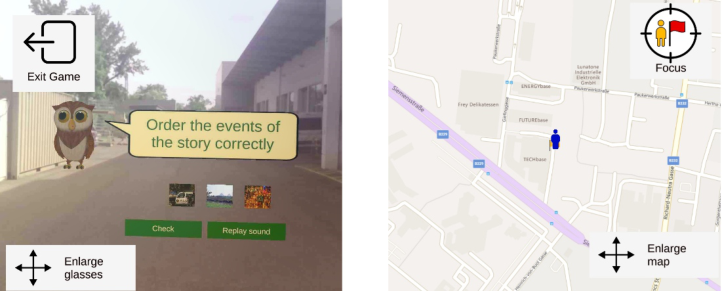
Location-Based MR Games The MR app provides location-based MR games that are played with a remote partner. In this game virtual puzzles are placed at a given physical location within the real world. One player (mainly the younger adult) is walk- ing outside with the MR glasses, searching for these puzzles while the senior stays indoors, observing on the smartphone a video stream of the younger adult’s field of view through the MR glasses while being connected via Voice over IP and thus able to talk to each other. The senior’s task is to guide the partner to the next puzzle location. To achieve this, the app tracks and shows the younger adult’s and the puzzle’s location on a map. Once the younger adult is in the vicinity of the puzzle, the players’ task is to solve it together. They can advise and find the right answer that is then manually selected by the younger adult. Puzzles consist of multiple-choice questions or sequential audio stories the players have to listen to and sort corresponding elements in the correct sequence. Figure 3 shows a screenshot of the location-based game.
Figure 3: Screenshot of the location-based game. Left: senior sees what the younger adult is seeing through his glasses. Right: map where the location of the younger adult and the location of the next puzzle is shown.
DESIGN AND DEVELOPMENT METHODOLOGY Within the course of the project, the system has been iteratively evaluated by end-users. Following a user-centered design approach feedback is gathered in three user-workshops and finally a series of field trials. The feedback collected from the user-workshops that took place during the development process, has been continuously incorporated into the system to create a final prototype for the field trials. During the field trials end-users take the system home and test it on their own. With the field trials currently ongoing, this paper will compare the results of the second (March 2023) and the third workshop (October, 2023).
Each workshop round 54 primary users and 20 secondary users have been invited to test the system. The end-user organizations invited primary users (seniors aged 60+ and adolescents aged between 14 and 21 years), secondary users (caregivers, social workers and experts in adult education) and tertiary users (e.g., social coordinators of communities, neighbourhood initiatives, social insurances) to give qualitative and quantitative feedback on the current state of the system.
The participants of the second workshop have been split into two groups. Every person answered initial questions before they were assigned to the groups. One group tested different aspects of the social app whereas the other half tested the anagram game and a location-based game on the MR glasses. After finishing the tasks, a final interview and standardized questionnaires were answered.
In the third workshop each participant tested the whole system. This included playing a location-based game together with a player of the other age group. The persons aged over 60 took the passive part and guided the adolescents to the puzzle locations. Further, test user needed to solve a cog- nitive exercise (either the memory or the pair game), and in the social app (a) create a forum post and edit it, (b) report the post of another person and (c) adapt the notification settings in terms of frequency and time. The partici- pants worked on these tasks on their own. Their impressions and statements
Buddy4All – A Platform to Connect Generations 153
during the process were collected by representatives of the end-user organi- zations. In addition, open interview questions were asked and standardized questionnaires including the system usability scale (SUS) (Rauer, 2011) and net promoter score (NPS) (Reichheld, 2003) were filled out.
The collected results of both workshops have been processed into a list of change requests that have been taken in account for the prototypes tested in the next workshops or field trials.
RESULTS
This paper highlights and compares the results of the second and third user workshop of the Buddy4All system. The second workshop was attended by 27 elderly users and 28 younger users in Austria and Switzerland. The senior users were aged between 60 and 89 years (21 between 60 and 79 years, 6 persons above 80). 19 younger participants were aged between 14 and 16 years and 8 were aged between 17 and 19 years and one person was aged between 20 and 21 years. The distribution between the number of male and female test persons was nearly equal (15 male and 12 female). Only with the younger adults the proportion of men was significantly higher (19 male and 9 female). The third workshop was attended by 26 elderly and 26 younger users from Austria and Switzerland. Half of the elderly users were aged between 70 and 79 years. Seven persons were aged between 60 and 69 years and 9 persons were aged over 80 years. For the younger group, the majority of participants was aged between 14 and 16 years (18 persons), only 8 persons were aged between 17 and 21 years. In terms of gender the distribution was equal in both participant groups (12 male, 14 female).
After the workshop was completed, the primary users filled in the Net Promoter Score, which evaluates if users would recommend the system, and the System Usability Scale (SUS) questionnaire. A Net Promoter score above 25 is seen as good.
Table 1. Net promoter score of 2nd and 3rd workshop per participant group.
Table 1 shows that the Net promoter score decreased between the second and the third workshop. We assume that the reason for the low rating is the fact that end-users evaluated the overall system in the third workshop, whereas only parts of the system were evaluated in the second workshop. Thus, technical problems had more influence on the overall result. It is also likely that the people who recommended the system in the second workshop did not recommend it in the third workshop due to a lack of progress in their opinion.
Table 2. System usability scores of 2nd and 3rd workshop divided by participant groups.
The SUS results (see Table 2) of workshop 3 are in between the results of the two system parts (social app, MR app) of workshop 2. The overall system in workshop 3 was rated worse than the social app in workshop 2 but better than the location-based game in workshop 2. This applies for both user groups. A SUS result above 68 is considered good.
Main findings of the qualitative data showed that 47 of the 52 primary users reported that the provided help section and tutorials in the social app are insufficient.
The evaluation of the MR application in the third workshop consisted of a location-based game and a cognitive exercise. The MR system was prone to technical problems being reported. Among these, mobile connection errors, visibility problems in bright areas and low audio volume when outside have been reported the most. For the location-based games, 7 persons had prob- lems with not being able to listen to the questions and stories again. 10 of the elderly persons had issues with deducing the view direction of the player with the MR headset on the map. Their proposal was adding an arrow to mark the field of sight. A further proposal was to use natural voice instead of a synthesized voice. This applies to all mixed reality activities implemented in the system.
The MR cognitive games have been received extremely well by the primary users. There were no main issues but two wishes for adaptions that were reported by the senior test-users. 11 persons had issues with the field of view of the headset as they could not see all cards of the game the same time. Also, 11 persons stated that it would be valuable if games could be played also while sitting.
For the social app, main findings showed that the forum section should be extended by search and filter functions. This was a main wish from the younger participants. The reporting function is perceived as necessary and valuable by all primary users. In the help section information should be added to explain what happens if a person is reported in the system.
For the virtual buddy, especially regarding the support content (e.g., health tips) 9 persons reported that search and filter functions are needed there as well. 6 younger persons reported that the articles should be shorter and written in simpler language.
SUMMARY AND OUTLOOK This work highlights the concept, the technical prototype, and the results of the second and third end-user workshop of the Buddy4All project. The paper presents the benefits of the social app as well as the MR solution and
Buddy4All – A Platform to Connect Generations 155
shows qualitative and quantitative results. The results show that the social app has been well received by both age groups, while the MR part’s usability suffered from technical problems. While the cognitive exercises worked well in indoor settings, the location-based games, which take place outdoors in variable environments, suffered from the effects of the surroundings (bad net- work coverage, bright environments, noise). Furthermore, the MR hardware did not provide the required ease of use and stability to pull users into recom- mending the MR part. However, the cognitive exercises have been received well, especially by the seniors. The full potential will be evaluated in the field trials.
The field trials have started in March 2024 and are still ongoing at the point of writing this paper. Field trials in Austria have concluded, with a second phase of field trials starting in Switzerland in the middle of May 2024. Moreover, an open trial of the social app will present Buddy4All to a broader audience. Adults of 18 years and older can sign up for a trial group and get to test the social app between May and July 2024.
ACKNOWLEDGMENT
The project Buddy4All is co-funded by the AAL Joint Programme (AAL- 2021-8-77-CP) and the following National Authorities and R&D programs in Austria, Switzerland, and Portugal: FFG, Schweizer Eidgenossenschaft, Fundação para a Ciência e a Tecnologia.
REFERENCES
ALCOVE (2022) Alcove – Your Family Corner in VR. Available at: https://alcovevr .com (Accessed 7 May 2024). Anderson, M. and Perrin, A., 2017. Tech adoption climbs among older adults. Broneder, E., Weiß, C., Thöndel, J., Sandner, E., Puck, S., Puck, M., Domínguez,
G. F. and Sili, M., 2022. TACTILE–a mixed reality-based system for cognitive and physical training. In Human Interaction, Emerging Technologies and Future Systems V: Proceedings of the 5th International Virtual Conference on Human Interaction and Emerging Technologies, IHIET 2021, August 27–29, 2021 and the 6th IHIET: Future Systems (IHIET-FS 2021), October 28–30, 2021, France (pp. 752–759). Springer International Publishing. Broneder, E., Weiß, C., Miu, V., Puck, M., Puck, S., Wolf, S. and Sili, M., 2023.
Buddy4All-A mixed reality-based solution for enabling intergenerational interac- tion. In Human Interaction & Emerging Technologies (IHIET 2023): Artificial Intelligence & Future Applications (pp. 297–304) Cardona, M. and Andrés, P., 2023. Are social isolation and loneliness associated with cognitive decline?. Frontiers In Aging Neuroscience, 2023, pp. 1–13. Ferguson, C., Van den Broek, E. L. and Van Oostendorp, H., 2020. On the role of
interaction mode and story structure in virtual reality serious games. Computers & Education, 143, p. 103671. Gamito, P., Oliveira, J., Alves, C., Santos, N., Coelho, C. and Brito, R., 2020. Virtual reality-based cognitive stimulation to improve cognitive functioning in community elderly: A controlled study. Cyberpsychology, Behavior, and Social Networking, 23(3), pp. 150–156.
Gamito, P., Oliveira, J., Morais, D., Coelho, C., Santos, N., Alves, C., Galamba, A., Soeiro, M. and Brito, R., 2019. Cognitive Stimulation of Elderly Individuals with Instrumental Virtual Reality-Based Activities of Daily Life. Hikichi, H., Kondo, K., Takeda, T. and Kawachi, I., 2017. Social interaction and
cognitive decline: Results of a 7-year community intervention. Alzheimer’s & Dementia: Translational Research & Clinical Interventions, 3(1), pp. 23–32. Kim, D., Arai, H. and Kim, S., 2017. Social activities are associated with cognitive decline in older Koreans. Geriatrics & Gerontology International, 17(8), pp. 1191–1196. Lee, L. N., Kim, M. J. and Hwang, W. J., 2019. Potential of augmented reality and
virtual reality technologies to promote wellbeing in older adults. Applied sciences, 9(17), p. 3556. Mansky, R., Marzel, A., Orav, E. J., Chocano-Bedoya, P. O., Grünheid, P., Mattle, M., Freystätter, G., Stähelin, H. B., Egli, A. and Bischoff-Ferrari, H. A., 2020. Playing a musical instrument is associated with slower cognitive decline in community-dwelling older adults. Aging Clinical and Experimental Research, 32, pp. 1577–1584. Mora, A., González, C., Arnedo-Moreno, J. and Álvarez, A., 2016, September.
Gamification of cognitive training: a crowdsourcing-inspired approach for older adults. In Proceedings of the XVII international conference on human computer interaction (pp. 1–8). Park, A. L., 2015. The effects of intergenerational programmes on children and young people. International Journal of school and cognitive psychology, 2(1), pp. 1–5. Rauer, M., 2011. Quantitative Usability-Analysen mit der System Usabil- ity Scale (SUS). Seibert Media Weblog: https://blog. seibert-media. net/blog/2011/04/11/usablility-analysen-system-usability-scale-sus. Reichheld, F. F., 2003. The one number you need to grow. Harvard business review,
81(12), pp. 46–55. Rendever (2022) Immersive technology for a longer, healthier, more connected life.
Available at: https://www.rendever.com/. (Accessed 7 May 2024). Scarpina, F. and Tagini, S., 2017. The stroop color and word test. Frontiers in psychology, 8, p. 241674. Syed-Abdul, S., Malwade, S., Nursetyo, A. A., Sood, M., Bhatia, M., Barsasella, D.,
Liu, M. F., Chang, C. C., Srinivasan, K. and Li, Y. C. J., 2019. Virtual reality among the elderly: A usefulness and acceptance study from Taiwan. BMC geriatrics, 19, pp. 1–10 van de Weijer, S. C., Kuijf, M. L., de Vries, N. M., Bloem, B. R. and Duits, A. A., 2019.
Do-it-yourself gamified cognitive training. JMIR Serious Games, 7(2), p. e12130. Wan, B., Wang, Q., Su, K., Dong, C., Song, W. and Pang, M., 2021. Measuring the impacts of virtual reality games on cognitive ability using EEG signals and game performance data. IEEE Access, 9, pp. 18326–18344. Zeldin, S., Larson, R., Camino, L. and O’Connor, C., 2005. Intergenerational
relationships and partnerships in community programs: Purpose, practice, and directions for research. Journal of Community Psychology, 33(1), pp. 1–10. Zhang, F., 2018. Intergenerational play between young people and old family members: Patterns, benefits, and challenges. In Human Aspects of IT for the Aged Population. Acceptance, Communication and Participation: 4th International Conference, ITAP 2018, Held as Part of HCI International 2018, Las Vegas, NV, USA, July 15–20, 2018, Proceedings, Part I 4 (pp. 581–593). Springer International Publishing.
LISTED IN THE AHFE DIGITAL BOOKSTORE CATALOGUE
Explore the complete digital volume
Interdisciplinary Practice in Industrial Design
Read this individual research paper free through the original publisher, or explore the full digital proceedings book.
ISBN 978-1-964867-20-5
Explore this ISBN in the AHFE Bookstore ↗Listed in the July 2026 bookstore catalogue; search by ISBN to confirm current availability · Digital book purchase optional