Jorge Camba, Joseph Anderson (2024). Change and Configuration Management as a Foundation for a new Digital Enterprise Education. In: Human Aspects of Advanced Manufacturing, Production Management and Process Control. AHFE Open Access, vol. 146, pp. 22–30. https://doi.org/10.54941/ahfe1005147
The principles of change and configuration management are foundational pillars for the operational excellence of any industrial enterprise, impacting every facet of its processes, technology, and personnel. They provide a method for identifying, analyzing, preparing, implementing, validating, and documenting engineering changes throughout a product’s lifecycle, ensuring everyone in the organization works from the same product record and changes are communicated in real-time. Change and configuration management are core enablers of the digital thread. However, the challenges and complexities of these subjects are generally not considered in current engineering or business curricula. In this paper, we report on the development and delivery of a graduate-level course dedicated to Change and Configuration Management and discuss a vision for a new digital enterprise curriculum. The course was developed in close partnership with industry and discusses the core elements, data structures, stakeholders, and workflows of change management and their role in the product lifecycle. The application of the industry standard CM2 methodology is emphasized as a strategy to provide control, maintain data integrity, and improve visibility and traceability of changes.
Computer information and communication technologies have been essential companions for engineering organizations for decades. Today, virtually any process, activity, and operation across an enterprise relies on or is driven by digital technology to the point that it would be extremely difficult to imagine any modern engineering discipline without this connection to the software world. And the connection is ever strengthening.
As more companies embark on digital transformation initiatives and revamp their current practices, operations, and ways of working, concepts such as digital twin and digital thread have become critical vehicles to har- ness the power of automation, data analytics, artificial intelligence, cloud computing, and other emerging digital technologies. In these environments, the digital representation of the product becomes a key information asset around which all development activities revolve (Aranburu et al., 2022).
Change and Configuration Management as a Foundation 23
The goal of a digital transformation is to enable smarter decision-making and effective real-time response to market disruptions while reducing costs and improving product quality (Jones et al., 2021). In this context, the Model- Based Enterprise (MBE) paradigm and enterprise software systems such as Product Lifecycle Management (PLM) and Enterprise Resource Planning (ERP) are considered major drivers of digital innovation and progress and provide the digital backbone for the Fourth Industrial Revolution (Philbeck and Davis, 2018; Gromova, 2020). A lack of knowledge of these powerful yet complex systems can certainly lead to significant challenges for engi- neering organizations. However, evidence shows that many of the problems attributed to technology often stem from inefficient business processes and workflows, especially those related to the management of changes (Nyemba et al., 2021; Eckert and Clarkson, 2023). In these environments, intervention resource expenditures – the resources expended to compensate for quality and schedule problems – are notoriously high, costly recalls are often fac- tored into warranty costs, and corrective action becomes the standard “way of working.” More and more firms realize that most change problems are related to complicated and congested administrative processes, and many organizations are exploring best practices to fit with their business scenarios (Jarratt et al., 2011).
From a higher education standpoint, traditional engineering curriculum has continuously adapted to the emergence of digital technology by incor- porating more time with computers, programming classes, and the use of various software systems and applications (Morris and Wagner, 2023). How- ever, the management and logistical aspects of engineering, in terms of the roles students will have to fulfill in modern industries and the way they are expected to operate and work as part of a team in a digital enter- prise ecosystem, as well as the consideration of lifecycle engineering as a fully integrated approach to product development are widely ignored. Enterprise systems such as PLM and topics such as business processes or change and configuration managements are usually left out of the cur- riculum. In some cases, they are covered indirectly (in a CAD course, for example) yet often insufficiently (due to time constraints) by instruc- tors with a genuine interest in the subject or as an extracurricular activity (Morris and Wagner, 2023). In general, engineering students finish their studies with suboptimal skills in PLM topics, change and configuration man- agement, lifecycle engineering, and the digital enterprise ecosystem as a whole (CIMdata, 2019).
In this paper, we describe a graduate-level change and configuration man- agement course developed at Purdue University in collaboration with the Institute for Process Excellence (IpX). IpX is the organization behind the CM2 model (IpX,2023), the industry standard for enterprise change and con- figuration management used by both governmental and private enterprises worldwide. We describe the motivation, objectives, structure, and assess- ment methods for the course, and discuss some student feedback and lessons learned.
24 Camba and Anderson
MOTIVATION Many authors have discussed the challenges that engineering schools face to teach the new technical skills and technologies – many of them disruptive - required to work and thrive in the emerging Industry 4.0 ecosystem (Frame, 2004; Boyd et al., 2023). Traditional engineering curriculum emphasizes mathematics, physics, and the engineering sciences, and combines them with practical and applied hands-on skills such as programming and Computer-Aided Design (CAD) (Agost et al., 2022). The breadth and depth of knowledge, both practical and theoretical, embedded in these curricula combined with extensive accredi- tation requirements naturally affect the flexibility of these programs and it is often difficult to make changes or add more courses or credits to the curriculum (Johnson et al., 2012). This can become problematic as new tech- nologies, tools, and especially, processes and methods, developed for Industry 4.0 are becoming increasingly prevalent and relevant to real-world industry. This challenge is critical given the growing demand for skilled engineers and technology professionals in support of the 4th industrial revolution.
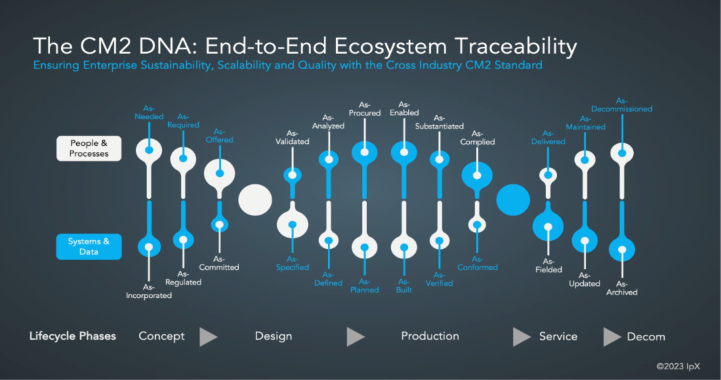
From an engineering management standpoint, change and configuration management is a particularly critical element of the industry 4.0 ecosystem. When we think of an organization’s processes and data, we traditionally consider these elements as simple tools or steps in the system that help an engineering organization accomplish a goal. However, a corporation’s data is a foundational building block that allows them to leverage institutional knowledge, optimize current product offerings and conceptualize products with complete end-to-end traceability. IpX’s CM2 model uses a DNA anal- ogy to illustrate this idea and the interplay between systems and data vs. people and process through the lifecycle (IpX, 2023), as shown in Figure 1.
Figure 1: The CM2 DNA as illustrated by the institute for process excellence (IpX, 2023).
Change and Configuration Management as a Foundation 25
Change and configuration management is at the core of an engineering and technology organization’s processes and data, and it affects every member of the enterprise. These disciplines provide strategies for ensuring the quality, reliability, and performance of complex systems in various industries. Change and configuration management involves identifying, documenting, control- ling, and tracking changes to the system’s components, requirements, and documentation throughout its lifecycle. It also helps to manage the integra- tion of these changes into the final product and verify that the system meets its intended specifications (Hamraz et al., 2013).
In this paper, we describe the development and the implementation of a graduate-level online course where students have the opportunity to explore, research, and discuss the challenges and practices associated to change and configuration management in the digital enterprise and how change impacts operations management and business processes. The course emphasizes the CM2 model, a robust comprehensive methodology supported by the Institute for Process Excellence (IpX) for managing the configuration of a product, system, and/or service throughout its life. CM2 teaches that communication and change affect all functions of an organization by preventing corrective action, quality escapes, and recalls.
COURSE OBJECTIVES AND STRUCTURE The goal of the course is to provide a solid foundation for enterprise change management based on the CM2 model. The specific learning objectives for the course include:
Summarize the challenges that engineering and manufacturing organiza- tions face when managing quality, options, and variants throughout a product lifecycle.
Construct and justify a product hierarchy and its associated datasets.
Estimate the magnitude of corrective action for a given change and compare it to the application of conformance measurements.
Assess the impact of an engineering change.
Evaluate and interpret the CM2 model, an industry standard closed-loop change management process.
Differentiate and prepare the main change objects for authorizing and managing work.
Summarize the challenges and complexities of lifecycle sustainment and assess how they differ from those in product development.
Prepare a detailed change implementation plan.
The course is designed as a 7-week online course. The delivery method is asynchronous where students can complete the modules in their own time. The course is structured into six modules. Each week, one full module is covered along with its respective activities and assessments. The last week is reserved for review. The six modules are described in Table 1.
The last week of the course is reserved for reviewing the content presented in previous modules and examining and reflecting on the CM2 model as a methodology for enterprise change.
26 Camba and Anderson
Table 1. Modules descriptions.
Table available in the original PDF paper.
Module Description
1. Foundations of Operational Excellence
The module lays the foundation for operational excellence through the CM2 industry standard by discussing the concept of business requirements and the business infrastructure that is built on this notion. The role and importance of communication is emphasized as well as the concept of corrective action and intervention resource expenditures. 2. Baselines and the Development Process
The module discusses the key building blocks for change process improvement, emphasizing baselines as the mechanisms to ensure that the information being changed is properly identified, structured, linked, and owned. It also examines the CM2 approach to product development and its foundational element, the V-model. 3. Items and Datasets
The module examines the role, significance, and proper management of items and datasets as information representation mechanisms, emphasizing the different relationships between these elements and how they should be structured and made visible to the organization. Common strategies for naming, numbering, and reuse are explored as well as the mechanisms to ensure data integrity and validation. 4. Change Management Foundations
The module studies the information elements and mechanisms that support the change management process. It discusses ways to ensure all issues of change, from a problem in innovation to a quote, are properly captured, documented, recorded, and incorporated throughout the organization. 5. The Change Management Process
Most organizations have subject matter experts identified for each key discipline, but rarely do organizations have a subject matter expert focused specifically on the management of change. This module introduces the CM2 change management process and discusses the roles, responsibilities, and workflows required for an organization to manage change efficiently and effectively. 6. The Complexities of Lifecycle Sustainment
The module studies how to manage the information of a product once it is in service or with a customer. It examines the gaps that occur between product development, factories, and service organizations. The module also introduces critical additions to the process flows and roles previously defined in the CM2 process, which are essential to the management of the digital thread in the Integrated Logistics Support lifecycle phase, which pertains to operation and maintenance
The content of each module relies on reading assignments from IpX’s official textbook for the CM2-Comprehensive Certification (Camba et al., 2023). After the successful completion of the course, students will be pre- pared to take the CM2-C certification exam. CM2 certifications have been provided worldwide since 1986 to companies of all sizes and industries mak- ing it known as the global standard for enterprise change and configuration management. The CM2-C certification is a six-course series that provides
Change and Configuration Management as a Foundation 27
a comprehensive methodology for managing the configuration of a prod- uct, system, and/or service throughout its life. The certification supports the various roles involved with change and configuration management in the enterprise such as project, product, and process managers/engineers, change specialists, PLM analysis, and solutions architects, among others. The CM2- C certification provides an expansive, enterprise-wide awareness and skillset in understanding an organization’s full change process from ideation through decommission while understanding how it affects the bottom-line.
Course assessment is comprised of three elements: short quizzes, discus- sions, and assignments. Each weekly module contains these elements. Weekly quizzes are intended to evaluate the student’s understanding of the read- ing material. All quizzes include ten multiple choice questions and are open book but cannot be taken multiple times. Class discussions are designed to promote student interactions and foster conversations related to various change management topics. Discussion prompts are posted weekly in the forum of the course delivery system. Discussions prompts serve as starting points for threads where students participate and engage with others by post- ing their responses, sharing comments and reflections, and comparing their own experiences to the topic. Discussion topics range from case studies of improper management of requirements and/or changes that have resulted in catastrophic failures to sharing personal experiences, anecdotes, recent news, and job announcements related to change and configuration manage- ment. Assignments are practical exercises related to each week’s topic. The assignments involve basic calculations and problems using data modeling and Excel in simulated engineering change scenarios. Students create the neces- sary change objects, calculate the recurring and nonrecurring costs, perform an impact analysis and assessment, determine a change propagates through- out a product hierarchy, and develop a detailed Change Implementation Plan in a “critical path” format, among others.
COURSE IMPLEMENTATION AND IMPACT The first iteration of the proposed course was delivered in the Fall semester of 2023. A total of 10 students, all working professionals with several years of experience in engineering and technology, enrolled in the course as part of their requirements for their master’s degree in engineering technology. Because the class is not traditional and all students work full time, a reason- able amount of flexibility was built into the course in terms of submission deadlines. The small class size allowed occasional virtual meetings and office hours with students (one on one) to answer questions, clarify certain aspects of an assignment, or provide additional feedback to students, despite some difficulties accommodating schedules and different time zones.
Because the new course covers topics that are typically not part of the tradi- tional engineering and technology curriculum, we were particularly interested in the students’ response and their perceptions in terms of the significance and relevance to the industrial world. Since all students had been in the workforce for some time, we consider their feedback particularly valuable. Student feed- back collected at the end of the semester was favorable, which highlights
28 Camba and Anderson
the need and demonstrates the value of this type of skills. Some of the most elaborated responses are included in the next paragraph.
As an example, one student wrote “I work in the service bill of mate- rials structure composition in my current position in service engineering. I focus on the technical aspects of the serviceability of a unit’s components. Ease of access, improvement opportunities, and sometimes reverse engineer- ing to provide feedback to downstream stakeholders (demand planning, field service, knowledge management, etc.). Recently, while working with these process partners, I have learned a lot about the CM2 process at a high level of communication. I will take the official CM2-C certification exam to add to my understanding and knowledge. Overall, this course was exciting because of your in-depth feedback on the assignments. I am a person of appreciation in abundance, so taking this course was an excellent investment in myself and my future!”
Similar thoughts were shared and echoed by other students: “This class offered a lot of valuable information that can be applied within my current field of work”and “this class was one of the more impact classes I have taken so far due to how closely it relates with my current line of work and the route our company is trying go down to improve our processes as an enterprise.” Finally, another student wrote: “This course was a true learning point for me as IT professional because of the focus on change management - highlighting its importance. Changes being made in the mass production of deliverables have an impact. This course has helped to detail, describe, and illustrate the types of upgrades, enhancements, and corrections, that can be made in those types of productions in the engineering subject matter. Showing purpose in the course readings and course homework/application.”
DISCUSSION
Throughout the implementation of the course, several concerns were iden- tified. The first one is related to the required amount of reading and work that was packed into seven weeks. This concern was voiced by some students who mentioned the fact that in some instances it was difficult for them to balance the required workload for the class while working full time. Since reducing the amount of content is not possible if we are interested in pro- viding students with the opportunity to become CM2 certified, it is possible that a new version of the course could be developed (either by extending the original course to 8-weeks or making it a regular 16-week course). This for- mat could also provide additional time to work on more examples, activities, and demonstrations, and distribute some of the workload across a longer semester.
Another concern is the delivery mechanism, which is based primarily on reading assignments, and the lack of examples to illustrate some of the assign- ments. In this regard, we are considering the creation of short video lectures to support the reading materials as well as posting solutions to sample prob- lems so students can anticipate the type of responses that are expected in the assignments.
Change and Configuration Management as a Foundation 29
The course described in this paper represents the foundation of a new curriculum focused on digital enterprise education. It covers the theoretical foundations of change and configuration management and the basic elements of the CM2 model. All assignments and activities are performed manually, however. Future work will include the creation of additional courses that will further prepare and equip students with the technical skills and tools necessary to succeed in a digital enterprise environment. For example, we are interested in exposing students to the professional enterprise software sys- tems such as PLM and MRP that they will encounter in their future careers and study how change and configuration management processes and work- flows are implemented in these environments, and how these tools meet the requirements of change management standards. Other additions will include guest lectures from industry professionals.
CONCLUSION
The course discussed in this paper is the result of a productive industry- academia partnership and collaboration. The Institute for Process Excellence (IpX) works with global academic institutions to support industrial educa- tion, research partnerships, and offer students holding CM2 certification job placement, awareness, and community.
Through this collaborative effort, university students gained access to the CM2 methodology, the most robust framework and quality management platform for creating and maintaining a digital enterprise with complete end-to-end ecosystem traceability. CM2 training teaches students practical and actionable hands-on methods preparing them for the workforce and providing credentials to their resumes to set themselves apart in the hiring process.
REFERENCES
Agost, M. J. Company, P. Contero, M. and Camba, J. D. (2022). CAD training for digital product quality: a formative approach with computer-based adapt- able resources for self-assessment. International Journal of Technology and Design Education Volume 32, No. 2. pp. 1393–411. Aranburu, A. Justel, D. Contero, M. and Camba, J. D. (2022). Geometric variabil-
ity in parametric 3D models: Implications for engineering design. Procedia CIRP, Volume 109. pp. 383–388. Boyd, L. Lu, Y. Souppez, J. B. (2023). Pedagogy 4.0: Employability skills and computer aided design (CAD) education for Industry 4.0. 28th International Conference on Automation and Computing (ICAC), pp. 01–06. IEEE. Camba, J. D. Fuerst, T., Ewing, D. and Anderson, J. (2023). The CM2 Approach
to Change and Configuration Management. eAcademicBooks. ISBN: 978-0- 9962452-9-6. CIMdata (2019). Need For a 21st Century Engineering Curriculum (Commentary).
https://www.cimdata.com/en/resources/complimentary-reports-research/commen taries/item/11528-need-for-a-21st-century-engineering-curriculum-commentary. Eckert, C. and Clarkson, J. (2023) “The Evolution of Complex Engineering Systems” in: Handbook of Engineering Systems Design, pp. 1–39. Cham: Springer International Publishing.
30 Camba and Anderson
Frame, R. (2004). Integrating PLM methods into the undergraduate curriculum.
2004 Annual Conference, pp. 9–764. Gromova, E. A. (2020). “PLM as a sequential round of the technological revolution”, in: IOP Conference Series: Materials Science and Engineering, vol. 968, no. 1, p. 012027. Hamraz, B. Caldwell, N. H. and Clarkson, P. J. (2013). A holistic categorization
framework for literature on engineering change management. Systems Engineer- ing, Volume 16, No. 4, pp. 473–505. Institute for Process Excellence (IpX). The CM2 Platform. https://ipxhq.com/traini ng/cm2-certification-courses/the-CM2-platform. Jarratt, T. A. Eckert, C. M. Caldwell, N. H. and Clarkson, P. J. (2011). Engineering
change: an overview and perspective on the literature. Research in engineering design, Volume 22, pp. 103–124. Johnson, N. Reidy, L. Droll, M. and LeMon, R. E. (2012). Program Requirements for Associate’s and Bachelor’s Degrees: A National Survey. Complete College America, Washington DC. Jones, M. D. Hutcheson, S. and Camba, J. D. (2021). Past, present, and future barriers
to digital transformation in manufacturing: A review. Journal of Manufacturing Systems, Volume 60, pp. 936–948. Morris, J. and Wagner, J. R. Application of Extracurricular Course Teaching Product Lifecycle Management Concepts to Undergraduates. 2023 ASEE Annual Conference & Exposition. Nyemba, W. R. Mbohwa, C. and Carter, K. F. (2021). “Systems Thinking Research:
Adapting for Engineering Change Management”, In: Bridging the Academia Industry Divide: Innovation and Industrialisation Perspective using Systems Thinking Research in Sub-Saharan Africa, pp. 41–56. Cham: Springer Interna- tional Publishing. Philbeck, T. and Davis, N. (2018). The Fourth Industrial Revolution: Shaping a New Era. Journal of International Affairs, Volume 72, No. 1, pp. 17–22.
LISTED IN THE AHFE DIGITAL BOOKSTORE CATALOGUE
Explore the complete digital volume
Human Aspects of Advanced Manufacturing, Production Management and Process Control
Read this individual research paper free through the original publisher, or explore the full digital proceedings book.
ISBN 978-1-964867-22-9
Explore this ISBN in the AHFE Bookstore ↗Listed in the July 2026 bookstore catalogue; search by ISBN to confirm current availability · Digital book purchase optional