Vaishnavi Sashidharan, Iveta Eimontaite, Sarah Fletcher, Alejandro Arpa, Alessandro Mazzon, John Stavridis, Scott Tucker, Igal Israeli, Samuel Zerbib (2024). Collaboration and Co-creation in Industry 5.0: User-engagement with industrial operators through co-creation workshops. In: Human Aspects of Advanced Manufacturing, Production Management and Process Control. AHFE Open Access, vol. 146, pp. 223–232. https://doi.org/10.54941/ahfe1005168
Industry 5.0 is characterized by human-centric designs and solutions. This implies that the creation and implementation of new technologies in industrial tasks should involve and engage the workforce at every stage of development. An effective method of workforce engagement are co-creation workshops - collaborative sessions designed to understand the needs and preferences of the end-users of new technology. Operator engagement through such workshops can provide valuable feedback for the design of new technology as well as boost operators’ acceptance of the new smart production systems. The following paper presents the methodology and findings from co-creation workshops conducted by the EU-funded project “CONVERGING”, in four use cases with factory operators. The workshops enforced a three-step protocol combining discussions and hands-on design tasks with the industrial operators. The workshops aimed to capture the operators’ experiences with the current task, expectations from smart assistive technologies, and their opinions on the CONVERGING solutions. The findings that emerged from the workshops are discussed for each use-case.
The aim of Industry 5.0 is to centralize the needs and interests of human workers and develop production systems by prioritizing workers’ wellbe- ing. While Industry 4.0 saw the creation of cyber-physical systems with the implementation of digital twins, machine learning, cloud technology, etc. (Maddikunta et al., 2022), the existence of the human operator in these production systems was left vastly unconsidered (Mitchell et al., 2021). In Industry 5.0, the human element is brought back to the center of these cyber- physical production systems, wherein the human operator is assisted by and
collaborates with smart technology and machinery. For these systems to cen- tralize the human operator, the development, design, and implementation of the smart technologies must involve the industrial operators at every stage.
This engagement of the of technology’s end-users in the design process is a key tenet of the user-centered design approach. In this design approach, the needs of the end-users of the technology are captured in an iterative process to serve as feedback to the technology developers. Research has shown that user- centered approaches in design increases user-acceptance (Pais et al., 2022). Involving the operators in the development of new smart production systems can boost the operators’ acceptance and openness towards the new technol- ogy alongside centralizing them in the design process. There are different approaches to capturing this feedback from the end users such as obser- vations, in-situ interviews, focus groups and workshops (Rodriguez et al., 2023). While interviews and focus groups are effective methods for achiev- ing user feedback, they are not very conducive for the generation of new ideas and insights outside pre-determined discussion points or questions (Benson et al., 2021). On the other hand, workshops have been found to be benefi- cial for not only capturing the needs and interests of end users, but also for enabling a collaborative and innovative environment with them. Specifically, co-creation workshops are effective means of fostering mutual learning and exchange of ideas between the developers and end-users.
Co-creation workshops are sessions designed to involve end-users of a pro- duct/service in its development. The aim of co-creation is twofold – firstly, to capture the needs, requirements, and expectations of the end-users, and sec- ondly, enable knowledge creation and innovation with the end-users thereby making them co-designers (Kristensson et al., 2008). Co-creation work- shops typically encourage the end-users to develop new ideas, discuss their current experiences with the product/service and their expectations for its future implementations. These steps are conducted through a combination of methods. The workshops often use brainstorming sessions, and semi- structured or unstructured group interviews, that are moderated or guided by the researcher. These discussions are oriented towards capturing various stakeholders’ experience with a product or service and their response to a pro- totype, ideas and solutions (Agarwal et al., 2022; Albitres-Flores et al., 2024; Jansma et al., 2022; Slomian et al., 2017). Very often, co-creation workshops include hands-on design tasks where the participants are given an opportu- nity to ideate and design their versions of the product or service. Previous studies have implemented this through drawing and sketching (Benson et al., 2021) and creating models with toys (de Saille et al., 2022). Research that has employed co-creation methods have found them to be effective for understanding consumer attitudes and perceptions (Benson et al., 2021), exploring consumer backgrounds that affect use of a product (Kristensson et al., 2008), determining key features expected from an appli- cation (van de Riet et al., 2024) and identifying barriers to accessing a service (Agarwal et al., 2022).
User-design approaches to study human-robot interaction in service robotics, have employed co-creation methods with design activities using Lego blocks. In these studies, participants build models with the Lego blocks
Collaboration and Co-Creation in Industry 5.0 225
to illustrate their visions of service robots and human-robot interactions, fol- lowed by discussions of their models (de Saille et al., 2022; Simon et al., 2020; Tuomi et al., 2020).
In the domain of industrial human-robot collaboration, co-creation work- shops have been previously used for the development of interfaces for human-robot interaction (Kohlgrüber et al., 2021). By introducing working prototypes of the robot to the operators, the robot designers gained valuable feedback about the robot’s design, function, and tasks, while the operators in turn learnt how to operate the robot.
Co-creation methods were also used for developing and refining graphical communication signage used for industrial co-working with robots (Gwilt et al., 2018). This study involved employing a mix of surveys, interviews and design prototyping tasks that helped understand the employees’ attitudes towards working with robots, and how graphical signage should be designed to facilitate acceptance of the robots.
Thus, co-creation workshops are effective opportunities to improve tech- nologies being developed for industrial tasks as they can help ensure user- friendly designs alongside familiarizing the industrial operators to the new technologies. However, the use of co-creation workshops to engage indus- trial operators in the development human-robot collaborative systems is still sparse.
The following paper presents the methodology and findings from co- creation workshops conducted in four industrial use cases that are part of the EU-funded CONVERGING project. CONVERGING is an Industry 5.0 project that aims to develop and deploy smart production systems by inte- grating big data, AI, and collaborative robots in the automotive, white-goods, aerospace, and additive manufacturing industries. The project aims to intro- duce smart production systems while establishing a human-centered social industrial environment that maximizes user-experience, trust and safety. (Home | CONVERGING | EU Funded Project, n.d.).
METHOD
Participants Participants in the workshops were factory operators working in the indus- trial tasks of manual sanding of dies (automotive industry – 4 male partici- pants), support removal and surface finishing of additive manufacturing parts (additive manufacturing industry – 4 male participants), fuel tank inspection and maintenance (aerospace industry – 5 male participants) and electric hob assembling (white goods manufacturing industry – 4 female participants). Each workshop had participants with varying experience (between 5 to 25 years) and roles (interns, operators, and line/ human resource managers).
Procedure Participants were invited by the use-case leader to join the workshops. Three workshops took place on-site in the factory, while one workshop took place virtually. The participants were introduced to the researchers, who began the
workshop by providing an overview of the aims and activities of the work- shop. They were informed about what they would be asked to do, their right to refrain from participation and withdraw, and the option to abstain from answering any questions that made them uncomfortable. The information and consent were translated by the use case leader. The workshop discus- sions were translated by the use case lead. Informed consent was recorded from participants on a separate recording. The workshops then commenced following the steps described in the following section.
Workshop Protocol The workshops enforced a three-step process. The first step was a discus- sion with the operators to capture the enjoyable and challenging aspects of their jobs. The second step began with a discussion about smart assistive technology operators are aware of (such as collaborative robots and aug- mented and virtual reality) that could be incorporated into their industrial tasks. The operators were then provided with a set of design materials (listed in the materials section) and were invited to a hands-on creative activity to design their vision of a potential workspace with smart assistive technology. The third step was a presentation of the CONVERGING smart technology solutions, followed by revisiting the hands-on design activity where the oper- ators redesigned their workspace in consideration of the CONVERGING solution. The new designs and feedback on the CONVERGING solutions were discussed further.
Materials
For the hands-on design activity, the participants were given a set of paper cutouts of graphics of a human, robotic and smart technology applications (single-arm robot, mobile robots AR headset, smart pen), industrial com- ponents (desk, cookers and cooker hoods, automotive parts, airplane parts, tool kits, raised platforms). They were also given A4 size papers, sketch pens, rulers, and glue sticks.
The CONVERGING solutions were presented to them through a power point presentation that contained slides of simulated graphics of the proposed future technologies.
The following questions were asked at various stages of the workshop (as explained in the workshop protocol) to guide discussion:
What do you like about the task? What are its enjoyable or pleasant aspects?
What do you dislike about the task? What are its challenging or unpleasant aspects?
What are some smart technologies you are aware of? How do you think it could help you in your job?
What do you think of the CONVERGING technological solutions? What are its strengths and weaknesses?
How can these solutions be improved?
What kind of training do you think you will need for working with the new technology?
Collaboration and Co-Creation in Industry 5.0 227
FINDINGS Automotive Industry
All operators agreed that the most enjoyable aspects of their work were chal- lenging tasks that required them to demonstrate their skills and knowledge. They emphasized on the “mental challenge” and non-repetitive elements of their work. They also valued creative work, expertise, continuous learn- ing, and the absence of monotony. This demonstrated that operators find satisfaction in showcasing their skills and using them to solve problems effectively.
On the other hand, operators explained that several aspects of the working environment were challenging. These challenges included noise, difficulty in concentrating, communication issues regarding the purpose of specific tasks, incomplete information, traceability problems during shift changes, and the physical demands of the job, such as numbness and pain of the hand, due to substantial pressure during sanding. Operators suggested that using more sophisticated tools, such as electric tools, could improve the physical aspects of the job.
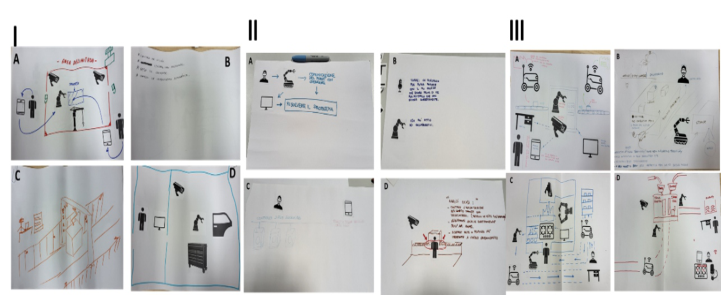
During the discussion and design of the future process, operators empha- sized concerns about safety working close to robots (Fig. 1(a)).
Operators labelled A, C, and D, in Figure 1(a), included barriers around the robot working area in their designs. Discussion revealed that initially, operators would consider light or conventional barriers, but with collabora- tive robots, the area surrounding the robot should be indicated by projection to prevent human entry. All four operators preferred engaging in complex task planning outside the main working area, leaving the repetitive aspects to the robot. Operator B suggested the need for automatic tool changes for the robot in addition to computer-controlled operations and camera vision.
White Goods Assembly In this workshop, participants expressed that they are familiar with collab- orative robots since they had either directly worked on processes involving
collaborative robots or had managed the production lines that used them. Regarding the pleasant aspects and challenges of the work, participants who worked directly with a collaborative robot before, indicated that “the enjoyable aspect is learning something [when being trained to work with collaborative robot] and the removal of physical strain on the wrists and elbows”. The other participants who managed the lines and operators, indi- cated that workstations with robotic technology require more work from the managing perspective: “robot can help with physical aspects, however, I still need to select the operators with the right characteristics and are more patient to learn”. Overall, participants indicated that the most enjoyable aspects are learning new processes, new technology, and assigning operators to manual tasks that match their skills and abilities. While asked to design the future process, operators indicated variety of smart technology provided in Fig. 1 (b).
The main concern the operators had with the CONVERGING solution was the close proximity in which the collaborative robot and operator were working. Their issue with this aspect was that it would not be allowed in their factory. Other participants concurred, stating that there is limited applica- tion of the solutions due to factory regulations. Another concern raised was the possibility of the operator obstructing the robot due to close proximity: “Operator might accidentally block the sensors while moving their arms, and then robot slows down due to thinking that the operator is in the red area and the whole workstation will decrease in efficiency”. Overall, participants agreed that collaborative robots and technology are useful but requires robust measures to ensure the distance sensors are not obstructed. In the discussion about the communication modes between operator and robot, participants indicated that having task instructions is a good way to help novice opera- tors to gain confidence, although the “precise task sequence is known to all the operators”. One of the participants indicated that even when operators know the steps of the process, “too much confidence can lead to errors”, so a reminder of the correct procedures that’s always visible to them would be helpful. Furthermore, participants preferred using voice interface where pos- sible and having their hands free for the assembly. This indicated that smart watch controls as proposed ‘in the CONVERGING solution, could interfere with the process. One of the participants suggested that having a touch screen instead of smart watch might be an option, as a screen is bigger and easier to view than a smartwatch.
Additive Manufacturing The discussion with the participants about challenging and enjoyable aspects of the additive manufacturing indicated that the enjoyable aspects come from designing new ways to produce different components and working with metals conventional manufacturing cannot work with. On the other hand, participants indicated that “machines need to be more user friendly” and “the removal of the supports” is complicated and could be simplified. Furthermore, the removal of powder and putting the safety equipment are found uncomfortable. One of the operators indicated that from his expe- rience “operators of additive manufacturing need to have more skills, and
Collaboration and Co-Creation in Industry 5.0 229
training is more difficult”. Although formal training can take one week, “the training carries on inside – tutoring, shadowing more experienced operators, learning by doing”.
When asked to design the process after discussing CONVERGING solu- tion, operators indicated that an additional collaborative robot might be needed to further assist with the powder loading/removing process to com- pletely remove the operator from this task. Operators also considered that interaction with the robot at their facility could take place with voice con- trols. However, they would prefer communication through gestures as that is similar to human-human interaction. While discussing with the participants how comfortable they would be working in a workstation which incorpo- rated proposed technology, one of the participants indicated that they would be “at the beginning, careful” and another participant indicated that people would lose jobs (“one operator per two or three machines”), which would make them weary. Furthermore, another participant indicated that training would be essential – “knowledge how to handle robotic assistance would be very important, and operator training should include not only taking care of the machine but being aware of all the automation”.
Aerospace Inspection The workshop began with asking the operators about the challenges they face in the current process of fuel tank inspection and maintenance. The three pri- mary issues raised were limited space and low visibility within the fuel tank, the time-consuming process of preparing the fuel tank prior to entering it, and the safety risks of the working in a fuel tank. These three points emerged as the main causes of multiple further problems faced by the operators while performing the current process.
The operators were encouraged to discuss their vision for using smart tech- nology to improve their occupational challenges. There was a consensus that a machine should enter the tank instead of the operator, and visually capture the tank’s internal environment. In this scenario, the operators suggested that they should be enabled to remotely view the images or visual feed of tank’s internal environment sent by the machine. The operators stressed on the importance of the images and video having high-resolution, to ensure that the images or video captured by the machine shows all defects or foreign object debris inside the tank.
However, when asked about their opinions on the machine being a smart machine that can identify and notify the operator of areas of concern in the tank, the operators were divided in opinion. Some operators stated that it would be useful to have a machine that pointed out areas that needed work, although, they would only trust the machine if they were absolutely certain of its accuracy. Other operators seemed less trustworthy and stated that regard- less of the machine, an operator would have to enter the tank to double check the inspection and carry out maintenance. The main concern that oper- ators pointed out with the CONVERGING solutions was that even with a smart machine carrying out inspection, a human operator would have to sign off on task-completion paperwork. Therefore, while the machine would be
acceptable for visual inspection, tasks such as sealant application, tightening components, and wiring can only be carried out by the operator.
DISCUSSION
The four workshops in different industries revealed that although the chal- lenges and needs are industry and process dependent, there are several common aspects from new technology introduction which needs to be con- sidered. These include trust in the technology, including its reliability and operator experience/knowledge; safety areas being clearly defined, separa- tion between robot and human until the operator is confident; and anxieties about changing job roles and the impact on employment.
The findings from the workshop have two functions. Firstly, the ideas and further needs for the future processes were communicated by the operators which will be communicated to the process and robot developers. Secondly, the operators could express their worries and anxieties about the project’s proposed solutions, which provides an understanding of future needs of operator engagement and how these anxieties can be reduced.
These main overlapping ideas are consistent with past research indicating that trust is related to the experience building and robot performance reliabil- ity (Hancock et al., 2011). Consistent performance, even though not 100% error proof encourages trust development and engagement with autonomous technology (Schaefer, 2016). Furthermore, changing employment sector and job roles are hot topics when discussing robotics, artificial intelligence, and smart tools. The unknown changes this technology will impact the job market causes anxiety (Erebak & Turgut, 2021) and might influence lack of accep- tance even with clear benefits to the working environment (de Graaf et al., 2017). Finally, safety and physical comfort are the underlying aspects of man- ufacturing processes. Operators who experienced conventional robots which were separated from them by gates and light barriers could experience a mas- sive change in work patterns and mental models (Adriaensen et al., 2022) if they have to directly interact with the robots.
By capturing these operators’ anxieties about the future changes in tech- nology and job roles, the project aims to use this feedback to ensure optimal trust, safety, and operator wellbeing in the implementation of the new smart productions system.
LIMITATIONS AND FUTURE DIRECTIONS The findings so far are consistent with the past literature indicating that workshops encourage the development and expression of new ideas (Kristensson et al., 2008). However, the limitation from these workshops points the researchers towards the need to deliver the workshops earlier in the project and technology development, to capture feedback at an earlier stage. Furthermore, greater considerations towards the online method and company IT security measures are needed prior to delivering the workshop online (the online workshop was supposed to deliver the design activity with
Collaboration and Co-Creation in Industry 5.0 231
Miro boards; however, it was not possible due to the company’s IT secu- rity protocols). Future directions for the project involve reiterations of the workshops with prototypes of the robots and new technology.
ACKNOWLEDGMENT
The work has been conducted on the CONVERGING project (101058521 (HORIZON-CL4-2021-TWIN-TRANSITION-01-01 – Innovation action) and the authors would like to thank all consortium members for their collaboration.
REFERENCES
Adriaensen, A., Costantino, F., Di Gravio, G., & Patriarca, R. (2022). Teaming with industrial cobots: A socio-technical perspective on safety analysis. Human Factors and Ergonomics in Manufacturing & Service Industries, 32(2), 173–198. https: //doi.org/10.1002/hfm.20939 Agarwal, S., Crespo-Ramos, G., Leung, S. L., Finnan, M., Park, T., McCurdy, K.,
Gonzalez, J. S., & Long, J. A. (2022). Solutions to Address Inequity in Diabetes Technology Use in Type 1 Diabetes: Results from Multidisciplinary Stakeholder Co-creation Workshops. Diabetes Technology & Therapeutics, 24(6), 381–389. https://doi.org/10.1089/dia.2021.0496 Albitres-Flores, L., Perez-Leon, S., Bernabe-Ortiz, A., Tenorio-Mucha, J., Cardenas, M. K., Vetter, B., Safary, E., Gamboa, R., Cordova, V., Gupta, R., Moran, A., Beran, D., & Lazo-Porras, M. (2024). Co-creation process of an inter- vention to implement a multiparameter point-of-care testing device in a primary healthcare setting for non-communicable diseases in Peru. BMC Health Services Research, 24(1), 401. https://doi.org/10.1186/s12913-024-10809-3 Benson, T., Pedersen, S., Tsalis, G., Futtrup, R., Dean, M., & Aschemann-Witzel, J.
(2021). Virtual Co-Creation: A Guide to Conducting Online Co-Creation Work- shops. International Journal of Qualitative Methods, 20, 16094069211053097. https://doi.org/10.1177/16094069211053097 de Graaf, M., Ben Allouch, S., & van Dijk, J. (2017). Why Do They Refuse to Use My Robot? Reasons for Non-Use Derived from a Long-Term Home Study. Proceedings of the 2017 ACM/IEEE International Conference on Human-Robot Interaction, 224–233. https://doi.org/10.1145/2909824.3020236 de Saille, S., Greenwood, A., Law, J., Ball, M., Levine, M., Vallejos, E. P., Ritchie, C.,
& Cameron, D. (2022). Using LEGO® SERIOUS® Play with stakeholders for RRI. Journal of Responsible Technology, 12, 100055. https://doi.org/10.1016/j.jr t.2022.100055 Erebak, S., & Turgut, T. (2021). Anxiety about the speed of technological development: Effects on job insecurity, time estimation, and automation level preference. The Journal of High Technology Management Research, 32(2), 100419. https: //doi.org/10.1016/j.hitech.2021.100419 Gwilt, I., Rolph, J., Eimontaite, I., Cameron, D., Aitken, J., Mokaram, S., & Law,
J. (2018, January 2). Cobotics: Developing a visual language for human-robotic collaborations. Hancock, P. A., Billings, D. R., Schaefer, K. E., Chen, J. Y. C., de Visser, E. J., & Parasuraman, R. (2011). A Meta-Analysis of Factors Affecting Trust in Human- Robot Interaction. Human Factors, 53(5), 517–527. https://doi.org/10.1177/ 0018720811417254
Home | CONVERGING | EU Funded Project. (n.d.). Retrieved 10 April 2024, from https://www.converging-project.eu/. Jansma, S. R., Dijkstra, A. M., & de Jong, M. D. T. (2022). Co-creation in support of
responsible research and innovation: An analysis of three stakeholder workshops on nanotechnology for health. Journal of Responsible Innovation, 9(1), 28–48. https://doi.org/10.1080/23299460.2021.1994195 Kohlgrüber, M., Maldonado-Mariscal, K., & Schröder, A. (2021). Mutual Learning in Innovation and Co-Creation Processes: Integrating Technological and Social Innovation. Frontiers in Education, 6. https://doi.org/10.3389/feduc.2021. 498661 Kristensson, P., Matthing, J., & Johansson, N. (2008). Key strategies for the suc-
cessful involvement of customers in the co-creation of new technology-based services. International Journal of Service Industry Management, 19(4), 474–491. https://doi.org/10.1108/09564230810891914 Maddikunta, P. K. R., Pham, Q.-V., B, P., Deepa, N., Dev, K., Gadekallu, T. R., Ruby, R., & Liyanage, M. (2022). Industry 5.0: A survey on enabling technologies and potential applications. Journal of Industrial Information Integration, 26, 100257. https://doi.org/10.1016/j.jii.2021.100257 Mitchell, J., Guile, D., Mitchell, J., & Guile, D. (2021). Fusion Skills and Industry
5.0: Conceptions and Challenges. In Insights Into Global Engineering Education After the Birth of Industry 5.0. IntechOpen. https://doi.org/10.5772/intechopen .100096 Pais, S., Petrova, K., & Parry, D. (2022). Enhancing System Acceptance through User-Centred Design: Integrating Patient Generated Wellness Data. Sensors, 22(1), Article 1. https://doi.org/10.3390/s22010045 Rodriguez, N. M., Burleson, G., Linnes, J. C., & Sienko, K. H. (2023). Thinking Beyond the Device: An Overview of Human- and Equity-Centered Approaches for Health Technology Design. Annual Review of Biomedical Engi- neering, 25(Volume 25, 2023), 257–280. https://doi.org/10.1146/annurev-bioeng -081922-024834 Schaefer, K. E. (2016). Measuring Trust in Human Robot Interactions: Develop-
ment of the “Trust Perception Scale-HRI”. In R. Mittu, D. Sofge, A. Wagner, & W. F. Lawless (Eds.), Robust Intelligence and Trust in Autonomous Systems (pp. 191–218). Springer US. https://doi.org/10.1007/978-1-4899-7668-0_10 Simon, O., Neuhofer, B., & Egger, R. (2020). Human-robot interaction: Conceptualising trust in frontline teams through LEGO® Serious Play®. Tourism Manage- ment Perspectives, 35, 100692. https://doi.org/10.1016/j.tmp.2020.100692 Slomian, J., Emonts, P., Vigneron, L., Acconcia, A., Reginster, J.-Y., Oumourgh,
M., & Bruyère, O. (2017). Meeting the Needs of Mothers During the Postpar- tum Period: Using Co-Creation Workshops to Find Technological Solutions. JMIR Research Protocols, 6(5), e6831. https://doi.org/10.2196/resprot.6831 Tuomi, A., Tussyadiah, I. P., & Stienmetz, J. (2020). Leveraging LEGO® Serious Play® to embrace AI and robots in tourism. Annals of Tourism Research, 81, 102736. https://doi.org/10.1016/j.annals.2019.06.003 van de Riet, L., Aris, A. M., Verouden, N. W., van Rooij, T., van Woensel, J. B. M.,
van Karnebeek, C. D., & Alsem, M. W. (2024). Designing eHealth interventions for children with complex care needs requires continuous stakeholder collabora- tion and co-creation. PEC Innovation, 4, 100280. https://doi.org/10.1016/j.peci nn.2024.100280
LISTED IN THE AHFE DIGITAL BOOKSTORE CATALOGUE
Explore the complete digital volume
Human Aspects of Advanced Manufacturing, Production Management and Process Control
Read this individual research paper free through the original publisher, or explore the full digital proceedings book.
ISBN 978-1-964867-22-9
Explore this ISBN in the AHFE Bookstore ↗Listed in the July 2026 bookstore catalogue; search by ISBN to confirm current availability · Digital book purchase optional