Ninja Vom Stein, Manuel Löwer (2024). Unveiling Trust: A Model-Based Approach to Understanding and Enhancing Perceived Safety in Autonomous Vehicles. In: Advances in Human Factors of Transportation. AHFE Open Access, vol. 148, pp. 181–190. https://doi.org/10.54941/ahfe1005208
Rapid technological development and shorter innovation cycles are driving significant changes in the field of autonomous vehicle systems. The trend towards autonomous driving has increased the importance of existing and new assistance systems in vehicles. The aim of developing such systems is to reduce the frequency and severity of accidents as traffic density increases. In addition, the presence of driver assistance systems should have a positive impact on the safety perception of vehicle occupants. At the same time, understanding human perception is becoming increasingly important as technology advances. For vehicle manufacturers, occupant safety perception is critical to improving their market position, as safety is an important decision criterion for users.The objective of this paper is to identify the factors that influence occupant and driver safety perception in Level 3 autonomous vehicles and to embed them in a comprehensive model. For this purpose, the current state of the art was reviewed and analyzed. The results were then used to identify a total of 17 factors in five categories of influence. The model shows the interrelations and dependencies between these factors. With the help of the developed model, it should be possible in the future to systematically evaluate vehicle interiors with regard to perceived safety.The developed model integrates objective factors that influence perceived safety and aims to be applicable across manufacturers and vehicle models. The model considers objective factors with measurable influences and defined optimal ranges, such as interior temperature. It is intended to serve as a basis for understanding the complex interactions that influence human perception of safety in autonomous driving scenarios.The development of a model that can be used as a basis for assessing perceived safety in autonomous vehicles proved to be complex, especially given the ongoing research in this area and the lack of fully autonomous vehicles on the market. Therefore, the model is designed to be extended in the future. Further studies are needed to improve the model, including experiments in real vehicles with different levels of autonomy and the development of appropriate measurement tools. In addition, it is important to investigate the composition of an ideal survey group, taking into account factors such as geographical origin and socio-economic background. The results of the experiments and surveys must be statistically analyzed in order to continuously improve the model. External influences, such as market trends, should be taken into account in the ongoing monitoring and improvement process.In conclusion, the developed model captures the influences on drivers and occupants of Level 3 autonomous vehicles and forms the basis for further research. Future research should focus on objective assessments using a catalog based on the model. In addition, ongoing research is essential to keep the model relevant in the face of technological advances and market dynamics.
Autonomous driving is one of the research trends in current automotive development. According to a study, the expected profit from autonomous driving technology is up to USD 400 billion by 2035 (McKinsey & Company, 2023). Considering human perception in a rapidly evolving technical field is an important component in increasing user acceptance. For vehicle manufac- turers, the perception of safety is an important topic in order to improve their market position, as safety is an important purchase criterion for customers (Statista, 2023). Accordingly, in addition to the high monetary interest, a (perceived) safe vehicle is a competitive advantage when opening up a new market, which can also be advertised accordingly. In order to implement this in a targeted manner, it is necessary to gain knowledge about when and how people perceive a vehicle as particularly safe.
Autonomous driving is supported by various driver assistance systems (Reif, 2010). Automation in cars has been divided in different levels. Some of level 2 driver assistance systems, such as Emergency Brake Assist or Speed Assist, have been mandatory equipment in newly built vehicles since mid- 2022. Other assistance systems, such as attention detection, have so far been optional features that can be ordered at will when purchasing a new vehicle (TÜV Rheinland, 2022).
Level 3 and above is referred to as conditional automation. From this level on, monitoring is also handed over to the system by the driver for the first time. The driver can request to take over the driving at any time.
As the series production of assistance systems for autonomous vehicles has only been completed in recent years, these vehicles have lately come into use in public transport and are hardly widespread. This as yet little-known tech- nology triggers the fundamental question of (perceived) safety in users. Safety is an individual feeling that is influenced by various factors. In the technical context of a vehicle, these are essentially the design of the interior (vehicle cockpit), the driving experience and external influences (such as traffic). For reasons of scope, this paper will focus primarily on the design of the vehicle cockpit.
A comprehensive model is necessary so that the perceived safety of the user can already be taken into account in the conceptual and design phase of the cockpit. In addition, the model can be used for the retrospective evaluation of existing designs. Due to the existence of many different requirements, some of which can be assessed objectively and some of which are purely subjective in nature, the creation of a model to evaluate the perceived safety of a vehicle interior is very complex.
A Model Describing Perceived Safety in Autonomous Cars In many cases, assistance systems in vehicles require interaction between the human driver and these systems. The fundamental aim in developing such systems is to reduce the frequency and severity of accidents in the long term as traffic density continues to increase (Reif, 2010). Furthermore, the per- ceived sense of safety of vehicle occupants should be positively influenced by the presence of driver assistance systems. The term “perceived” safety implies that this is an individual, subjective concept. Depending on personal perception and the underlying definition of safety, this results in different requirements for vehicle manufacturers when designing vehicle interiors. In addition to the systems for autonomous driving as such, this also includes the rest of the design of the driver’s cockpit.
To ensure that the influences on perceived safety can already be taken into account in the design of vehicle interiors and that a retrospective evaluation is possible, the factors influencing perceived safety are to be defined. For this purpose, a model will be created that identifies the influencing factors and shows the interactions between influencing factors. The following research questions should be answered:
1. What influences are vehicle drivers exposed to? 2. Can the influencing factors be described in a model? 3. Is it possible to assess the perceived safety in autonomous vehicles?
Unveiling Trust: A Model-Based Approach to Understanding 183
Autonomous Driving Systems With the help of driver assistance systems, the driver will be increasingly relieved and, step by step, tasks will be completely handed over to the sys- tems. The type of assistance is divided into three categories. The first category (category A) describes the information and warning functions. Examples of category A driver assistance systems are traffic sign recognition and lane departure warning. The second category, Category B, describes all continu- ously operating automated functions. These have a direct influence on vehicle control, which can run over short sections of the journey or longer periods of time. Examples of this category are adaptive cruise control and lane departure warning. Category C describes driver assistance systems that include inter- vening emergency functions, for example to avoid an accident. This category differs from the others, as these functions no longer respond to the driver’s reactions for a short period of time. The faster reaction time of the system is intended to avoid an accident and thus compensate for late intervention by the driver. (Winner et al., 2015).
Category B is also divided into different automation levels. The first level, Level 0, does not include any automation on the vehicle. Level 1 includes the first driver assistance systems. Here the driver can hand over lateral (steer- ing movement) or longitudinal control (speed, distance) to driver assistance systems. Level 2 is partially automated, where the system is able to take over both lateral and longitudinal control. However, the driver must constantly monitor what is happening and be able to intervene at any time and take over or correct the system’s actions. The first manufacturers are already at level 2+. This level differs from level 2 in that it can cope with far more driv- ing situations. In addition, Level 2+ allows the driver to take their hands off the steering wheel to some extent.
From level 3, it is conditional automation. The vehicle is controlled by the systems most of the time and is only handed over to the driver when the system prompts the driver to take over early on. In this case, the driver no longer has to constantly monitor the systems unless he is instructed to do so.
A high level of automation is achieved with level 4. Here, the system takes over monitoring and control. Even in more difficult driving situations, the systems retain control. The driver can intervene in the driving process at any time and take over if they wish but the driving process does not have to be permanently monitored.
Level 5 shows the full automation of a vehicle. As with high automation, the driver can permanently hand over driving to the systems and no longer has to take over control at level 5, even in difficult driving situations (On-Road Automated Driving (ORAD) committee).
Perceived Safety The concept of safety can be viewed from different angles. For example, safety is generally described as a state free of hazards (Raue et al., 2019). In engi- neering, safety is referred to when the existing risk is lower than the accepted risk (DIN EN ISO 12100:2011-03). Risk and safety are thus directly related.
184 Stein and Löwer
From a psychological point of view, safety is a feeling of whether a per- son feels safe or unsafe in an environment. In order to understand when a person develops a feeling of safety, it is necessary to explain what a person needs in order to feel safe. If these needs are not met, a person is not able to develop a sense of security. The concept of needs was described in a theory by Maslow in 1943. His theory thus forms the basis for understanding per- ceived safety, as there is an inseparable relationship between the fulfilment of needs and a person’s perceived safety. A distinction can be made between the needs physiological, safety, love, self-esteem and self-actualization (Raue et al., 2019).
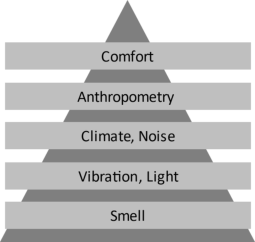
Physiological needs are mostly physical cravings, such as hunger or tired- ness. The safety needs consist of personal safety, health, integrity and financial security. Maslow’s theory emphasizes that basic human security is particu- larly important to people (Raue et al., 2019). The theory of comfort is used to understand physiological needs (Figure 1). In the model, various comfort needs are defined and categorised according to Maslow’s hierarchy of needs (Krist, 1994). Comfort can only be felt if there is almost no discomfort. The perception of comfort and discomfort is influenced by physical as well as physiological or psychological factors (Zhang et al., 1996). With regard to driver cockpits, this means that no discomfort, i.e. no perceived unpleasant sensations, may be present as a prerequisite for a possible positive perception of comfort. It is assumed that when perceiving comfort or discomfort, people unconsciously constantly compare current situations with previously expe- rienced ones. As long as there are no discrepancies between the experience and the expectations placed on the situation, this situation is not consciously perceived. Only when differences arise are they recognised. Comfort is there- fore dependent on the expectations of the person assessing comfort. As with Maslow’s pyramid of needs (Maslow, 1943), all basic needs must be fulfilled for the user to become aware of the next higher level and thus relevant to com- fort (Krist, 1994). Accordingly, factors such as ergonomics, thermal comfort and low noise levels are necessary for a sense of comfort, while subjective factors such as visual impression, smell, haptic quality and sound colour also play a decisive role (Pischinger and Seiffert, 2016). A high perception of com- fort thus satisfies the basic needs according to Maslow, which therefore also contribute directly to increased perceived safety.
Figure 1: Comfort hierarchy (Krist, 1994).
Unveiling Trust: A Model-Based Approach to Understanding 185
Influences on Perceived Safety in Vehicles Perceived safety changes depending on various influences. The idea behind the model is to show the influences that have an impact on the perceived safety of occupants of autonomous vehicles. The model depicts the influ- ences on Level 3 autonomous driving. According to Fischer et al. (Fischer et al., 2022), various categories of influences affect the safety of occupants. These also include individual influences, such as experience with autonomous driving or education. These are not taken into account in the modelling, as individual factors cannot be captured in the objective analysis.
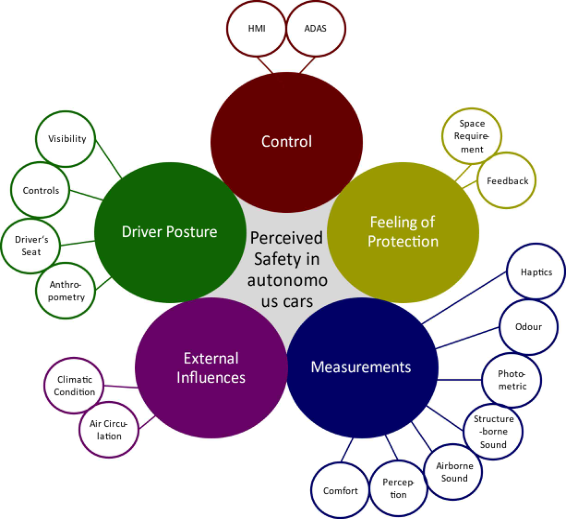
The individual influencing factors were developed in the first step of mod- elling. These can be found on the outer positions in the model (Figure 2). A total of 17 influencing factors could be determined for the current state of the art. These influencing factors were summarised into five categories based on their thematic affinity. The categories control, feeling of protection, mea- surements, external influences and driver posture were defined in the model. Within these categories, the influencing factors are mutually dependent or contribute jointly to the respective category.
In the following each influencing factor will be described in more detail. Moreover first ideas on how those factors can be measured will be explained. The model as such is not to be regarded as a finished evaluation system. It forms the basis for creating an evaluation scheme.
The Control category is made up of the influencing variables human- machine interface (HMI) and advanced driver assistance systems (ADAS). The displays inside the vehicle are part of the HMI and are crucial for com- munication between people and the vehicle. These displays can be acoustic, haptic or visual in nature (Lee et al., 2020). The displays to which the model must be applied are the instrument cluster, the central display and the head- up display (Macey and Wardle, 2009). The first step is to check whether the requirements of DIN EN ISO 15008 are met (DIN EN ISO 15008:2017-07). A catalogue of requirements can be created on the basis of this standard. The more requirements are met, the greater the feeling of perceived safety. In addition, the arrangement of the various displays must be analysed. This is a subjective factor that cannot be assessed on the basis of the current state of knowledge. In this case, it is necessary to conduct a representative study in order to obtain requirements for the alignment of the displays in the vehicle that is desirable for the representative majority and leads to a higher per- ceived level of safety. ADAS encompasses all driver assistance systems. Each of these individual driver assistance systems must fulfil defined requirements. For each requirement, there is a specific sensor that is responsible for fulfilling the requirement (Reif, 2010). The current state of the art must therefore be known in order to know which sensors must be present to fulfil the require- ments. The presence of the required sensors must be checked in the first step. A simple assessment of “is available” and “is not available” should be used here. In the second step, the sensors must be checked regularly to ensure that they are functioning correctly so that any necessary intervention can take place in appropriate driving situations.
186 Stein and Löwer
Figure 2: Influences on perceived safety in autonomous cars.
The driver’s posture is a combination of objective and subjective factors. It is determined by the influencing variables visibility, controls, driver’s seat and anthropometry. The design of the driver’s seat is objectively based on the dimensions of the persons and their extremities, the necessary freedom of movement, the accessibility limits of the controls and the visibility conditions. Furthermore, the angle of inclination of the seat, the seat length or the lateral guides of the seat contribute to a positive feeling of comfort (Bubb et al., 2015) It must be checked whether the driver’s seat in the tested interior can be adjusted in such a way that people of different sizes can adjust it comfort- ably and according to the objectively required conditions (Bubb et al., 2015). Laws, guidelines and standards that have been developed based on anthro- pometry and are related to the topic of vehicle dimensions can be used for this purpose. The requirements resulting from these must be checked. The more requirements the tested vehicle interior fulfils, the greater the feeling of com- fort, which has a positive influence on perceived safety (Akalin et al., 2022). There are various legal regulations and several standards (DIN, VDI, SAE) for evaluating visibility, which are intended to guarantee a minimum quality of visibility conditions (Remlinger). The resulting requirements for the vehicle interior must be checked for compliance. Here too, the more requirements are met, the higher the visibility and therefore the perceived safety. The controls include, for example, the instrument panel, the centre console, all controls on and around the steering wheel, the gear lever and the handbrake, the controls on the door, on the seat or on the vehicle headliner. The relevance of some
Unveiling Trust: A Model-Based Approach to Understanding 187
controls results in different priorities. For example, the gear lever should be easier to reach than the window opener (Bothe, 2010). SAE J287 forms the basic set of rules for the ergonomic design of controls. The requirements resulting from this must be checked in the same way as described in the pre- vious points. With regard to the driver’s posture as a whole, it must be taken into account that the individual influencing variables are closely interrelated and in some cases influence each other. For example, the adjustment of the driver’s seat has an influence on the accessibility of the controls. This can therefore lead to duplication.
The measurements category is made up of the influencing variables Hap- tics, Odour, Photometric, Structure-borne sound, Airborne sound, Percep- tion and Comfort. The haptics are determined both by the surface, i.e. the material quality and the shape, but also by the path-force curve during actu- ation. The visual impression must match the surface feel, as disappointing expectations can increase the perceived discomfort. Furthermore, the haptics also have an influence on the perceived quality of the vehicle. It promotes the aspect of liking and thus the perceived comfort and with that the perceived safety (Zhang et al., 1996). Odour experts for automotive companies can be consulted to assess the effects of odours in the interior of the vehicle being tested on people. The evaluation of odours is particularly important, as a feel- ing of comfort and the associated increase in perceived safety is only perceived when the factors causing discomfort, such as unpleasant odours, have been reduced or eliminated (Krist, 1994). Odours can be assessed on the basis of DIN ISO 12219-7. The photometric measurements can be used to assess the lighting. In many cases, there are no specific optimum values for these mea- surements, as external light influences, such as the daytime and the associated brightness, have an impact on the visibility of the displays. It should therefore mainly be checked whether the displays have been designed to be dimmable so that they can be manually adjusted to the external lighting conditions or auto- matically adjusted. Frequencies between 0 Hz and 500 Hz are perceptible as structure-borne sound (Knauer, 2010) and can therefore influence a person’s feeling of comfort or discomfort. Periodic excitations between 3 Hz and 7 Hz should be avoided at all in order to prevent resonance effects with human organs (Knauer, 2010). Good chassis design (springs and shock absorbers) avoids already transmitted vibrations in certain frequency ranges as far as possible (Braess and Seiffert, 2012). VDI standard 2057 and ISO 2631–1 are the currently valid assessment methods for mechanical vibration. However, they are controversial, as the limit value specified there (0.5 m/s2 for damage to health with all-day exposure) is never reached during driving. Airborne sound (noise) is partly a subjective influence, as a person’s ability to hear changes with age. Frequencies from 20 Hz to 20 kHz can be heard (Kuchling and Kuchling, 2022). The aforementioned comfort hierarchy pyramid shows that noise plays a fundamental role in the perception of comfort/discomfort. An optimum value cannot be defined. However, reaching the upper hearing threshold should be avoided in any case, as this is where pain is perceived instead of hearing (Hellbrück and Ellermeier, 2004). The influences comfort and perception are partly objective and partly subjective. As for noise, some people find a loud motor powerful, while others find it annoying.
188 Stein and Löwer
The external influences are based on the influence variables climatic con- ditions and air circulation. The temperature and humidity inside the vehicle are decisive for the climatic conditions. In terms of temperature, it is impor- tant that the vehicle can reach and maintain the temperature desired by the occupants. Although there is an optimum range for seated activities, which is between 19
C and 23
C, the personal preferences of individual occupants may deviate from this range. In addition, the relative humidity also has an influence on the climatic conditions and can be measured using a hygrom- eter (Bubb et al., 2015). It should therefore be checked whether there is an automatic climate control system that can reach and maintain the desired temperature. This can be done using a thermostat. The air circulation is already planned during development using CFD simulations (Pischinger and Seiffert, 2016). Despite the great effort involved in development, it is neces- sary to use test persons to assess the air circulation in a vehicle, as in addition to the objective assessment, the subjective assessment also has a significant influence on perception (Becker, 2010). Climate dummies can be used for objective assessment. ISO 1405–3 describes an evaluation scale based on questionnaires.
If the feeling of protection is assessed, space requirement and feedback must be considered. The movements of the driver during the journey create a space requirement, the restriction of which leads to a feeling of discomfort. This space requirement is described in the SAE J941c guideline. The evalu- ation can be carried out by means of a survey of test persons, but can also be considered using CAD programmes during the development phase of the vehicle. Feedback on the vehicle’s controls and displays is one of the most important factors in creating a feeling of safety. It is particularly positive if this feedback is provided via various redundant sensory organs. The time span for the feedback must not exceed 200 milliseconds (duration of human information absorption), as this can lead to confusion as the reference to one’s own actions is lost. The change in position of an actuator provides important feedback on the current status of the system and the effects of the control/operation performed.
DISCUSSION AND CONCLUSION In order to create an objective model to analyse the perceived safety of drivers in autonomous cars, all influences that are solely dependent on the individual driver were not considered in this work. The influencing variables were anal- ysed in more detailed. For many of the influencing variables, it was possible to define an evaluation standard that would enable an objective evaluation of these influencing variables from a scientific perspective. However, this was only possible for those parameters for which no subjective assessments were added to the objective assessments. Subjective influences must be taken into account for the influencing variables MMS, anthropometry, structure-borne sound, airborne sound, perception, comfort, haptics, air circulation and feel- ing of protection. In many cases, scientifically representative surveys can be used to enable an evaluation.
Unveiling Trust: A Model-Based Approach to Understanding 189
The first and second research questions posed 11What influences are drivers of autonomous vehicles exposed to?” and “Can the influencing fac- tors and interactions be described by a model?” can be answered positively as all influences were named and put into a model. With the information on the identified influencing factors, this developed model basically offers the pos- sibility of creating an evaluation scheme for perceived safety in autonomous vehicles. This also provides a positive answer to the third research question regarding the feasibility of an assessment of perceived safety in autonomous vehicles. As such, the model is to be interpreted as a source of information on which influencing variables can affect perceived safety and what this influ- ence looks like in detail. It also contains references to the currently valid legal bases, which serve as a basis for the objective evaluation of the various influ- encing factors. In order to carry out the evaluation of vehicle interiors on the basis of the model, it must be said that, according to the current state of knowledge, there are various influencing variables that can be objectively assessed, or at least partially objectively assessed.
The evaluation of the presented model poses some challenges. In order to evaluate the model objectively, it is necessary to test it on vehicles that enable autonomous driving. It is necessary to survey a statistically representative test group. Subsequently, the acquired knowledge about the model would have to be applied to differently equipped vehicles. A question and assessment sheet should be drawn up in advance, with the help of which the applicability of the model can be assessed.
So far the model summarises all objective influencing factors on the drivers perceived safety in autonomous cars. Future research should focus on objec- tive assessments using a catalogue based on the model and weighting factors. In addition, ongoing research is essential to keep the model relevant in the face of technological advances and market dynamics.
REFERENCES
Akalin, N., Kristoffersson, A. and Loutfi, A. (2022) ‘Do you feel safe with your robot? Factors influencing perceived safety in human-robot interaction based on subjective and objective measures’, International Journal of Human-Computer Studies, vol. 158, p. 102744. Becker, K. (ed) (2010) Korrelation zwischen objektiver Messung und subjektiver
Beurteilung in der Fahrzeugentwicklung, Renningen, Expert-Verl. Bothe, A. (2010) Entwicklung eines parameterbasierten CAD-Modells zur Ergonomieabsicherung einer Mittelklasselimousine, Diplomarbeit, Stuttgart, Uni- versität Stuttgart. Braess, H.-H. and Seiffert, U. (2012) Vieweg Handbuch Kraftfahrzeugtechnik, Wiesbaden, Vieweg+Teubner Verlag. Bubb, H., Bengler, K., Grünen, R. E. and Vollrath, M. (2015) Automobilergonomie,
Wiesbaden, Springer Fachmedien Wiesbaden. DIN EN ISO 12100:2011-03, Berlin: Beuth Verlag GmbH. DIN EN ISO 15008:2017-07, Berlin: Beuth Verlag GmbH. Fischer, L., Holder, D., Weiss, B., Kiessling, J., Reichelt, F. and Maier, T. (2022) ‘Factors influencing the perception of safety in automated vehicles interiors’, Proceedings of the 5th International Conference on Intelligent Human Systems Integration (IHSI 2022) Integrating People and Intelligent Systems, February 22–24, 2022, Venice, Italy, 2022, AHFE International.
190 Stein and Löwer
Hellbrück, J. and Ellermeier, W. (2004) Hören: Physiologie, Psychologie und Pathologie [Online], 2nd edn, Göttingen, Hogrefe Verlag für Psychologie. Available at https://elibrary.hogrefe.de/book/99.110005/9783840914751. Knauer, P. (2010) Objektivierung des Schwingungskomforts bei instationärer Fahrbahnanregung [Online], Göttingen, Cuvillier Verlag. Available at https://ebookcentral.proquest.com/lib/kxp/detail.action?docID=5020422. Krist, R. (1994) Modellierung des Sitzkomforts: Eine experimentelle Studie (Zugl.:
Eichstätt, Kath. Univ., Diss., 1993), Weiden, Schuch. Kuchling, H. and Kuchling, T. (2022) Taschenbuch der Physik, 22nd edn, München, Hanser. Lee, J. M., Park, S. W. and Ju, D. Y. (2020) ‘Drivers’ User-interface Information
Prioritization in Manual and Autonomous Vehicles’, International Journal of Automotive Technology, vol. 21, no. 6, pp. 1355–1367. Macey, S. and Wardle, G. (2009) H-Point: The fundamentals of car design & packaging, Culver City, Design Studio Press. Maslow, A. H. (1943) ‘A theory of human motivation’, Psychological Review, vol.
50, no. 4, pp. 370–396. McKinsey & Company (2023) The future of autonomous vehicles (AV): McKinsey.
Autonomous driving’s future: Convenient and connected [Online], McKinsey & Company. Available at https://www.mckinsey.com/industries/automotive- and-assembly/our-insights/autonomous-drivings-future-convenient-and- connected#/%20Dementsprechend (Accessed 26 January 2024). On-Road Automated Driving (ORAD) committee: Taxonomy and Definitions for Terms Related to Driving Automation Systems for On-Road Motor Vehicles, 400 Commonwealth Drive, Warrendale, PA, United States: SAE International. Pischinger, S. and Seiffert, U. (2016) Vieweg Handbuch Kraftfahrzeugtechnik, Wies-
baden, Springer Fachmedien Wiesbaden. Raue, M., Streicher, B. and Lermer, E. (2019) Perceived Safety, Cham, Springer International Publishing. Reif, K. (2010) Fahrstabilisierungssysteme und Fahrerassistenzsysteme [Online],
Wiesbaden, Springer Vieweg. in Springer Fachmedien Wiesbaden GmbH. Avail- able at https://ebookcentral.proquest.com/lib/kxp/detail.action?docID=750890. Remlinger, W. Analyse von Sichteinschränkungen im Fahrzeug, Dissertation. Statista (2023) Kaufkriterien für Autos in Deutschland im Jahr 2023 [Online], Statista GmbH. Available at https://de.statista.com/prognosen/999760/deutschlan d-kaufkriterien-fuer-autos (Accessed 26 January 2024). TÜV Rheinland (2022) Fahrerassistenzsysteme – Was ist ab dem 6. Juli 2022 Pflicht?
[Online]. Available at https://www.tuv.com/germany/de/lp/mobilit%C3%A4t/lp- fahrerassistenzsysteme/ (Accessed 26 January 2024). Winner, H., Hakuli, S., Lotz, F. and Singer, C. (2015) Handbuch Fahrerassistenzsysteme, Wiesbaden, Springer Fachmedien Wiesbaden. Zhang, L., Helander, M. G. and Drury, C. G. (1996) ‘Identifying Factors of Comfort
and Discomfort in Sitting’, Human Factors: The Journal of the Human Factors and Ergonomics Society, vol. 38, no. 3, pp. 377–389.
LISTED IN THE AHFE DIGITAL BOOKSTORE CATALOGUE
Explore the complete digital volume
Advances in Human Factors of Transportation
Read this individual research paper free through the original publisher, or explore the full digital proceedings book.
ISBN 978-1-964867-24-3
Explore this ISBN in the AHFE Bookstore ↗Listed in the July 2026 bookstore catalogue; search by ISBN to confirm current availability · Digital book purchase optional