Mengtao Lyu, Fan Li (2024). Patterning Risk: An Innovative Task Design Method for Simulating Incidents in Transportation Studies. In: Advances in Human Factors of Transportation. AHFE Open Access, vol. 148, pp. 88–94. https://doi.org/10.54941/ahfe1005198
The development of alternative tasks is pivotal in transportation safety research, particularly when resource constraints hinder the execution of incident simulations. Traditionally, many studies have relied on expert knowledge and subjective judgments to design such alternative tasks. However, a systematic methodology is lacking. This work proposes a novel task design approach by constructing a Task Knowledge Graph (TKG). The proposed approach leverages the Knowledge Graph to delineate the hierarchical and logical relationships of necessary operations of human operators in the incident scenarios. Such TKG patterns the risks to provide a theoretical foundation for designing alternative tasks. A case study is provided in this work to illustrate the effectiveness of the proposed approach. In the case study, a modified Stroop game was designed to pattern the task demand of pilots during engine shutdown incidents. The results showed that the Stroop game could evoke similar eye movements in the participants as the engine shutdown scenario replicated on a simulator. Overall, the proposed approach offers a feasible tool for designing alternative tasks to obtain human behaviour data when direct replication of research scenarios is impractical.
Incident analysis is crucial in transportation safety research as it plays an important role in understanding accidents. Researchers often conduct simula- tion experiments to replicate the incident scenarios without actually exposing the participants to risks (Brookes et al., 2020; Rosa et al., 2021). The simula- tions facilitate data collection of human behaviour, such as eye movements, to offer insights into the operators’ psychophysiological responses during inci- dents (Lyu et al., 2023; Yusuf et al., 2019). Meanwhile, sometimes it can be challenging to conduct simulations, as the comprehensive simulations can be very complex and resource-demanding. Consequently, researchers may need to design alternative tasks for experiment (Vine et al., 2015). These alter- native tasks aim to simulate the psychophysiological demands of original incidents as closely as possible to elicit similar psychophysiological responses in participants during the incidents (Bruder & Hasse, 2019, 2020). Such tasks need to be relatively easy to help induce more individual events, thereby
Patterning Risk: An Innovative Task Design Method for Simulating Incidents 89
enabling a more extensive data collection (Young et al., 2016; Li et al., 2024). The quality of alternative task design is of great importance, as it must accu- rately reflect the similar demands on participants in the incident scenarios. Though many existing studies have designed effective alternative tasks to col- lect human behaviours, most of them were based on experts’ knowledge and experience. A systematic method for designing such alternative tasks is still lacking.
To address the gap, this study proposes an innovative task design method- ology based on Knowledge Graph (Lyu et al., 2022). This method patterns the risks of incident scenarios by constructing a Task Knowledge Graph (TKG) with hierarchical task analysis (HTA) and Information Gathering, Decision- Making, and Action (IDA) theory (Kang & Landry, 2015; Li et al., 2023). The TKG is constructed by investigating the hierarchical structure of the tasks involved in incidents to capture the psychophysiological demands faced by individuals in real scenarios. Then, the alternative tasks can be designed based on the structure of the constructed TKG to ensure they are able to simulate the demands of real scenarios. To verify the proposed method, a case study is conducted by simulating the engine shutdown incident with a modified Stroop game designed based on the TKG.
The rest of the paper is organised as follows: Section 2 depicts the construc- tion of TKG. Section 3 presents a case study and data analysis to validate the proposed approach. Section 4 concludes the study with contributions and limitations.
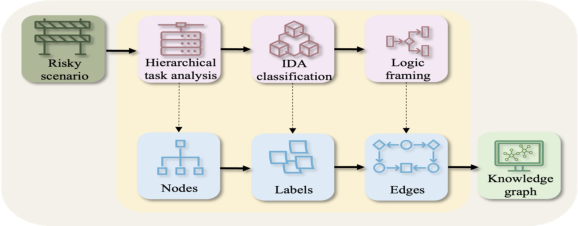
TASK KNOWLEDGE GRAPH To model the risk scenarios of incidents and guide the development of alterna- tive tasks, we propose to develop a Task Knowledge Graph (TKG) following a three-step process, as depicted in Figure 1.
Figure 1: Process of constructing task knowledge graph (TKG).
Initially, the tasks and their subtasks within the scenarios is analysed and identified, focusing on the operations that the human operators must perform. These tasks consist the nodes of the TKG. Next, these tasks are clas- sified according to the Information-Gathering, Decision-Making, and Action (IDA) theory. The schema of the TKG is hence created by using the classi- fication as node labels. The final step is to depict the connections between
90 Lyu and Li
tasks and subtasks based on their temporal sequence and logical relation- ships. These connections comprise the edges between nodes in the TKG. Eventually, a TKG that comprehensively simulates the operations required in the specific incident scenario can be constructed.
The constructed TKG serves as a systematic tool for representing the scenario in real-world situations and provides a theoretical foundation for designing alternative tasks. Following the structure of the TKG, the alterna- tive tasks can be designed to replicate the same psychophysiological demands to the human operators. Consequently, these tasks are expected to elicit behaviours from the operators that are identical to those in the actual scenar- ios. Meanwhile, the TKG can also provide insights into the safety research of the specific incident.
CASE STUDY Our research utilised the Task Knowledge Graph (TKG) methodology to devise alternative tasks for aircraft control following an engine shutdown. We constructed a TKG to represent the pilots’ necessary operations for main- taining aircraft attitude after such an incident. Based on this TKG, a modified Stroop game was designed to emulate the psychophysiological demands of these tasks.
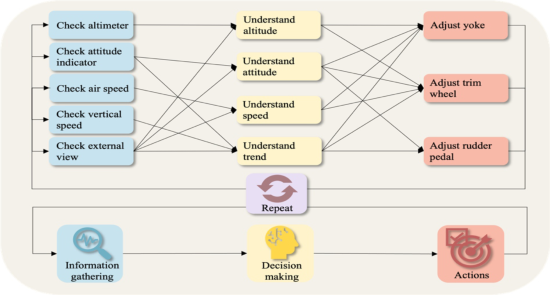
TKG Construction for Engine Shutdown Incident We selected the scenario of maintaining aircraft attitude post-engine shut- down for a case study. This scenario, simplified for research purposes, involves an aircraft losing power and pilots managing it under the com- bined effects of inertia and wind. The primary goal is to manually control the yoke, rudder pedal, and trim wheel, maintaining the aircraft’s pitch, roll, and yaw angles. This demands a thorough understanding of the aircraft’s status, both internally (via cockpit instruments) and externally (via visual observa- tion). The pilots continually gather information, make decisions, and take actions, adapting to the dynamic changes in aircraft attitude. This full process of information gathering, decision-making, and action was analyzed using hierarchical task analysis to construct a TKG, which is illustrated in Figure 2.
Figure 2: Task knowledge graph (TKG) for the engine-shutdown scenario.
Patterning Risk: An Innovative Task Design Method for Simulating Incidents 91
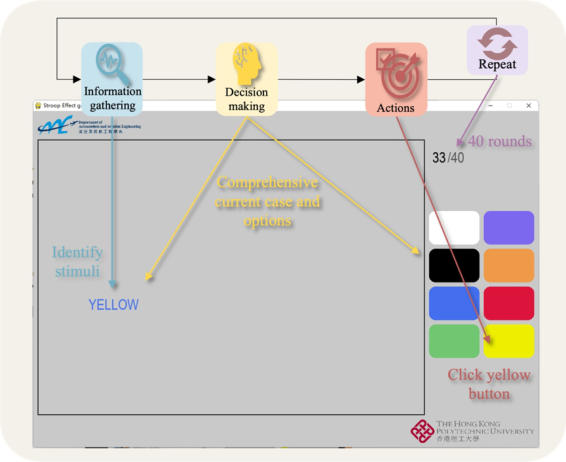
Alternative Task Design Based on TKG The alternative task, developed in accordance with the TKG, systemati- cally encapsulates the required operations. A modified Stroop game, detailed in Figure 3, was designed to simulate the psychophysiological demands faced by pilots. In this game, participants respond to colour-named hints appearing randomly on a screen every 2.5 seconds, simulating the criti- cal information presented on various aircraft instruments or external views. The challenge involves comprehending and deciding quickly, as the colour buttons also change randomly, mirroring the pilots’ need for accurate and timely responses. A complete game consists of 40 rounds, reflecting the continuous and visually intensive task of maintaining aircraft attitude dur- ing an engine shutdown. We expect this task to elicit psychophysiological responses similar to those in actual flight scenarios, aiding in the analysis of eye-tracking data.
Figure 3: Modified stroop game to simulate the risky scenario.
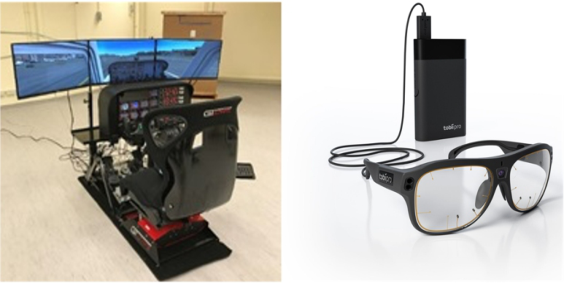
Experiment With Participants Twenty-six university students (17 males and 9 females) aged 22–32 years (SD = 2.01), all with normal or corrected-to-normal vision, partici- pated in this study. The research received approval from the Institutional Review Board of the Hong Kong Polytechnic University (Reference number: HSEARS20211117002). Informed consent was obtained from all subjects. The experiment used a Cessna 172 simulator integrated with Microsoft Flight Simulator for the flying environment and the Stroop game. Eye- tracking data were collected at 100Hz using Tobii Pro Glasses 3, as shown in Figure 4.
92 Lyu and Li
Figure 4: Experiment apparatus.
Participants underwent a practice session to familiarize themselves with the flight controls and complete a flight procedure. Following the calibra- tion of the eye tracker, each participant undertook two flight tasks, initially cruising with autopilot and then experiencing an unannounced engine shut- down, simulating the target scenario. The modified Stroop game was played before each simulated flight, with eye movements recorded.
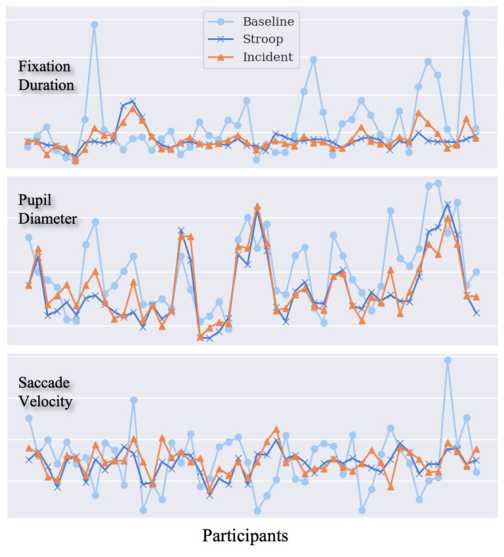
Data Analysis and Results After filtering out inadequate data, 48 records from 24 participants were analysed. We focused on three eye-tracking measurements: average fixation duration, pupil diameter, and saccade peak velocity. Data were compared between the Stroop game, a baseline state during autopilot cruising, and the manual operation task following engine shutdown, using paired t-tests. The results, detailed in Table 1 and visualized in Figure 5, show significant dif- ferences in fixation duration and pupil diameter between the baseline and both the task state and the Stroop game. However, no significant difference was observed between the task state and the Stroop game, suggesting the game successfully induced eye movements similar to those in the actual engine shutdown scenario.
Table 1. Paired t-test between different states.
Table available in the original PDF paper.
Phase & Fixation duration Pupil Diameter Saccade Velocity T-Test (two-tailed) M D M D M D
Baseline 610.8 435.5 4.03 0.69 251.4 72.2 Baseline – Task t = 0.001* t < 0.001* t = 0.814 Task 415.3 138.4 3.73 0.58 248.7 31.6 Task – Stroop t = 0.325 t = 0.056 t = 0.075 Stroop 401.3 128.7 3.67 0.61 242.3 29.2 Baseline - Stroop t = 0.002* t < 0.001* t = 0.389
Patterning Risk: An Innovative Task Design Method for Simulating Incidents 93
Figure 5: Eye-tracking metrics in different task states.
CONCLUSION
The development of alternative tasks is critical in transportation safety research, especially when simulations are constrained by limited resources. Traditional approaches often rely on subjective expert judgments, lacking sys- tematic methodologies. This study introduces an approach based on the Task Knowledge Graph (TKG), which employs a knowledge graph to outline the hierarchical and logical relationships in specific scenarios, aiding in the iden- tification of risk patterns for alternative task design. A case study testing this approach showed that the alternative tasks elicited similar psychophysiolog- ical responses in participants, confirming the method’s effectiveness. Though the study is limited by the proficiency level of student participants acting as pilots, the primary goal of verifying the tasks’ ability to induce comparable reactions was met, supporting the approach’s validity at a basic level.
However, this proposed approach should only be adopted as a tool to design alternative tasks when a comprehensive simulation is challenging. Though it can pattern the risks in a structural way, a distortion from the realistic scenario is inevitable. The obtained results can only serve as a pilot work to provide a reference for a more extensive study whenever it is possible.
In summary, our proposed TKG-based approach offers systematic and structured guidance for designing experimental tasks in transportation safety studies. This methodology enhances the investigation of human behaviors in such contexts, providing a valuable tool for researchers in this field.
94 Lyu and Li
ACKNOWLEDGMENT
This work was supported by the Hong Kong Polytechnic University under Grant P0038827 and Grant P0038933. The authors would like extend great gratitude to all participants who participated in this research.
REFERENCES
Brookes, J., Warburton, M., Alghadier, M., Mon-Williams, M., & Mushtaq, F.
(2020). Studying human behavior with virtual reality: The Unity Experiment Framework. Behavior Research Methods, 52(2), 455–463. https://doi.org/10. 3758/s13428-019-01242-0 Bruder, C., & Hasse, C. (2019). Differences between experts and novices in the monitoring of automated systems. International Journal of Industrial Ergonomics, 72, 1–11. https://doi.org/10.1016/j.ergon.2019.03.007 Bruder, C., & Hasse, C. (2020). What the eyes reveal: Investigating the detection of
automation failures. Applied Ergonomics, 82, 102967. https://doi.org/10.1016/j. apergo.2019.102967 Kang, Z., & Landry, S. J. (2015). An Eye Movement Analysis Algorithm for a Multielement Target Tracking Task: Maximum Transition-Based Agglomerative Hierarchical Clustering. IEEE Transactions on Human-Machine Systems, 45(1), 13–24. https://doi.org/10.1109/THMS.2014.2363121 Li, F., Chen, C., Sourina, O., Xu, G., & Han, S. (2023). A Hierarchical Task Network-
Based Approach to Generating Generic Tasks for Interface Usability Evaluation. In S. Long & B. S. Dhillon (Eds.), Man-Machine-Environment System Engineering (Vol. 1069, pp. 435–442). Springer Nature Singapore. https://doi.org/10.1007/ 978-981-99-4882-6_60 Li, Z., Li, R., Yuan, L., Cui, J., & Li, F. (2024). A benchmarking framework for eye-tracking-based vigilance prediction of vessel traffic controllers. Engineering Applications of Artificial Intelligence, 129, 107660. https://doi.org/10.1016/j.en gappai.2023.107660 Lyu, M., Li, F., & Lee, C.-H. (2023). The Effects of Adaptive Automation on Pilots’
Flight Control Performance and Visual Attention Distribution. In P. Koomsap, A. Cooper, & J. Stjepandi´c (Eds.), Advances in Transdisciplinary Engineering. IOS Press. https://doi.org/10.3233/ATDE230600 Lyu, M., Li, X., & Chen, C.-H. (2022). Achieving Knowledge-as-a-Service in IIoT-driven smart manufacturing: A crowdsourcing-based continuous enrichment method for Industrial Knowledge Graph. Advanced Engineering Informatics, 51, 101494. https://doi.org/10.1016/j.aei.2021.101494 Rosa, E., Dahlstrom, N., Knez, I., Ljung, R., Cameron, M., & Willander, J. (2021).
Dynamic decision-making of airline pilots in low-fidelity simulation. Theoretical Issues in Ergonomics Science, 22(1), 83–102. https://doi.org/10.1080/1463922X .2020.1758830 Vine, S. J., Uiga, L., Lavric, A., Moore, L. J., Tsaneva-Atanasova, K., & Wilson, M. R.
(2015). Individual reactions to stress predict performance during a critical avia- tion incident. Anxiety, Stress, & Coping, 28(4), 467–477. https://doi.org/10.1080/ 10615806.2014.986722 Young, S. D., Daniels, T., Evans, E., Dill, E., de Haag, M. U., & Etherington, T.
(2016). Flight simulation study of airplane state awareness and prediction tech- nologies. 2016 IEEE/AIAA 35th Digital Avionics Systems Conference (DASC), 1–11. https://doi.org/10.1109/DASC.2016.7777954 Yusuf, A. B., Kor, A.-L., & Tawfik, H. (2019). A Simulation Environment for investigating In-Flight Startle in General Aviation. Proceedings of the 2019 10th International Conference on Dependable Systems, Services and Technologies (Dessert), 180–185.
LISTED IN THE AHFE DIGITAL BOOKSTORE CATALOGUE
Explore the complete digital volume
Advances in Human Factors of Transportation
Read this individual research paper free through the original publisher, or explore the full digital proceedings book.
ISBN 978-1-964867-24-3
Explore this ISBN in the AHFE Bookstore ↗Listed in the July 2026 bookstore catalogue; search by ISBN to confirm current availability · Digital book purchase optional