Chunhao Yao, Lin Ma, Fei Wu, Yuanyuan Liu (2024). Aircraft Maintenance Training and Assessment: the Potential Applications of Mixed Reality. In: Training, Education, and Learning Sciences. AHFE Open Access, vol. 155, pp. 194–204. https://doi.org/10.54941/ahfe1005404
Navigating the complexities of aircraft maintenance and the development of skilled technicians present significant challenges. Traditional training for such tasks requires the use of large, infrequently employed and expensive equipment and aviation materials that are not easily accessible. At the same time, the use of paper documents, physically separated from technicians, leads to inefficient cognitive processing due to the need for constant focus shifting. Mixed Reality (MR) technology integrates real and virtual objects into a unified spatial scene through an environment generated by machine vision and computer graphics. This technology has the potential to provide more economical and safer training and assessment conditions without time and space constraints. This study delves into the potential application opportunities of MR in aircraft maintenance training and assessment utilizing a combination of literature research and expert interviews. It summarizes the advantages and challenges associated with the application of MR technology and offers insights for the development of future MR-based aircraft maintenance training and assessment systems.
Aircraft Maintenance Training and Assessment: The Potential Applications 195
and collaborative communication channels, significantly improving main- tenance efficiency and reducing guidance costs (Rambach, Schneider and Stricker, 2017; Utzig et al., 2019); MR environments facilitate the transfer of theoretical knowledge into practice and allow risk-free use of scarce, high- cost equipment (Moesl et al., 2022). Given these capabilities, MR also has enormous potential for application in aircraft maintenance and assessment scenarios. This study aims to answer the following research questions: i) What are the potential applications of MR in aircraft maintenance and assessment? ii) What advantages does MR offer compared to traditional training and assessment methods? iii) What are the current challenges in applying MR to aircraft maintenance and assessment?
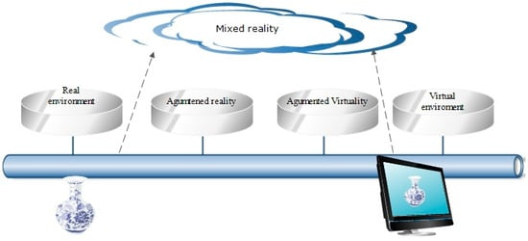
THE POTENTIAL APPLICATION OF MR IN AIRCRAFT MAINTENANCE TRAINING AND ASSESSMENT MR represents an intersection of the physical and digital worlds. Situated between the completely real physical environment and the entirely virtual digital environment, MR (see Figure 1) encompasses elements of both Vir- tual reality (VR) and augmented reality (AR) (Milgram and Kishino, 1994). While VR is predominantly provides a computer-generated virtual environ- ment, it often lacks interaction with the physical world. AR addresses this by integrating virtual objects into the physical environment using advanced visu- alization methods. However, AR still faces challenges in interaction between the real and virtual objects, affecting user immersion (Hönig et al., 2015; Rokhsaritalemi, Sadeghi-Niaraki and Choi, 2020). MR overcomes these lim- itations by employing technologies such as calibration, spatial modeling, object recognition and tracking, registration and mapping, and visualiza- tion, thus facilitating a highly interactive users experience with the real world (Rokhsaritalemi, Sadeghi-Niaraki and Choi, 2020; Campos et al., 2021). MR’s advantanges in immersion, information, interaction (Parveau and Adda, 2018) and cost make it highly promising for aircraft maintenance and assessment.
Figure 1: The first definition of mixed reality (adapted from Milgram and Kishino, 1994).
In exploring MR’s potential applications in this field, we synthesized find- ings from existing literature and presented a draft to experts across three workshops for their insights and to refine the applications. Ten participants (10 Males, Age 34 ± 8) from China Southern Airlines participated, including four MR researchers, four program developers, and two training and assess- ment instructors, contributed to this study. All participants had a minimum of three years of experience in their respective fields and were familiar with aircraft maintenance training and assessment and MR concepts. This study conducted three 60-minute workshops, wherein we stimulated expert insights by combining a training and assessment checklist with the draft. After each workshop, the draft was updated based on expert feedback and presented anew in the subsequent session.
The iterative process led to a convergence of our perspectives with those of the experts.Here we briefly present the main insights from the experts. Firstly, add missing applications. Participants meticulously reviewed the training and assessment process, identifying potential applications such as tool selection and component substitution in the production of training equipment. Sec- ondly, remove meaningless applications. Participants noted that some appli- cations were unnecessary, for instance, fastener inspection, which involves extremely low learning costs and high MR development costs. Thirdly, com- bine with Artificial Intelligence (AI). Participants suggested combining MR with AI for data processing to extract the value of data, reflecting the rapid development of recent technologies. Finally, expand the scope of MR appli- cations. Participants unanimously regarded MR as a disruptive technology, akin to mobile phones and computers, likely to creat a new ecosystem; and thus potential applications should emphasize the MR ecosystem.
The combination of literature research and expert interviews was instru- mental in identifying the following six potential applications of MR in aircraft maintenance training and assessment.
Aircraft Maintenance Theoretical Training The application of MR in aircraft maintenance theoretical training includes the following three aspects. Firstly, it can provide dynamic interactive learn- ing materials, including videos, 3D models and animations. Through real- time operation and interaction with the equipment in the learning materials, technicians can quickly understand obscure complex equipment structure and working principles that are difficult to grasp from traditional two- dimensional images (Münzer, 2012). Secondly, MR facilitates the creation a virtual classroom environment. This allows technicians to engage in class- room interactions without the constraints of time and space, significantly reducing the time and economic costs of off-site training. Lastly, MR can simulate teaching case scenarios with high fidelity, whether it involves fault diagnosis, strategy selection, or decision-making evaluation, the process becomes more vivid and immersive with MR technology.
Aircraft Maintenance Practical Training Tool Selection: MR technology can provide appropriate tools for technicians in training. Given that specific training tasks necessitate particular tools, the
Aircraft Maintenance Training and Assessment: The Potential Applications 197
traditional process of tool selection often involves consulting paper manu- als of specific aircraft models to identify the correct type and specifications. Although some technicians can substitute some tools to complete the same tasks based on their experience, this could lead to potential safety hazards. MR technology can offer real-time tool recognition and marking, assisting technicians in determining how to choose and use tools in specific tasks. For example, through the ARTSAM application (Satish and Kumar, 2023), tech- nicians can receive comprehensive guidance on tool management, selection, and utilization in an MR environment, such as during tasks like replacing engine oil filters. Utilizing MR can reduce the time spent and error rate in tool retrieval for maintenance training tasks, thereby enhancing overall safety in aircraft maintenance procedures.
Environmental Simulation: The application of MR in environmental simu- lation manifests in several key areas. First, it can restore the complex status of basic training tasks in real maintenance scenarios, tailored to the skill level of the technicians. This approach not only enhances the technicians’ awareness of real working conditions but also reduces the production costs of train- ing facilities for instructors. Second, MR can simulate various emergency situations to train technicians’ emergency response skills. This is partic- ularly effective in improving their decision-making and operational levels under pressure. Finally, MR facilitates team maintenance interactive simu- lations. By simulating specific team maintenance task scenarios, technicians can learn about task distribution, communication methods, and training tasks during maintenance. This assist technicians in better comprehending the requirements of team tasks and improves the efficiency of team task execution.
Operation Guidance: Traditional work manuals are often presented in paper form, require technicians in both real work scenarios and training sessions to constantly shift their focus between the manuals and the avia- tion objects being operated. This focus shifting increases the time required to complete tasks As technicians gain more training and operational expe- rience, they tend to form long-term memories of certain tasks based on the paper manuals, leading to operations based on memory recall. However, this practice can potentially increase the error rate among technicians (Safi and Chung, 2023). By conducting a layered task analysis of common manuals and redefining steps and sub-tasks, MR can provide enhanced information through virtual models and animations. This includes attention-guiding infor- mation, task descriptions and warnings, target location and surrounding environment information, and 3D models (Henderson and Feiner, 2011). MR transforms complex paper manuals into virtual instructions within MR devices, effectively addressing the issue of discontinuous attention caused by focus shifting.
Error Prevention: In traditional practical training, a common scenario is one instructor overseeing multiple technicians, which often results in techni- cians being unable to instantly recognize their operational errors during the training process. MR plays a crucial role in error prevention by monitoring the technicians’ operations in real time. It promptly identifies operational
mistakes, provides immediate operational feedback, and offers correct oper- ational guidance. Additionally, in complex maintenance training tasks, MR can preset execution steps according to the task list. This ensures the correct sequence of operations during technicians training and helps prevent omis- sions or errors, thereby enhancing the overall effectiveness and safety of the training.
Training Effectiveness Assessment Currently, post-training assessment are often constrained by time and space. Instructors are required to closely observe each technician’s operations indi- vidually and record their performance on paper assessment forms. This process not only challenge the instructors’ human resources but also demands intense mental concentration. MR devices can significantly enhance this pro- cess by providing real-time assessment of performance criteria and automat- ically recording assessment data in the background. This includes individual accuracy rates, sub-task completion times, and additional relevant data to a broader group of trained individuals. Moreover, MR provides segmented operation recordings based on sub-tasks, enabling instructors to manually assess the technicians’ operations. This approach is highly effective in liber- ating instructors from the traditional constraints of time and space, thereby optimizing the assessment process.
Aircraft Maintenance Training Mode The application of MR in innovating aircraft maintenance training models includes several aspects. Firstly, it addresses the issue of the conventional single-mode training format by creating multi-person collaborative training tasks. This approach allows technicians from different regions to engage in the same training task, thereby enhancing their collaborative and commu- nication skills within a team context. Additionally, MR platforms can be utilized to construct interactive online communities for knowledge sharing. These communities can leverage tutorial videos, 3D models, and other edu- cational resources, enabling technicians and instructors can share relevant experiences. Developers can categorize these experiences based on sub-tasks in training and incorporate them into practical training exercise, effectively bridging theory and practice. Finally, MR ensures the timely updates of train- ing content in line with the iteration of maintenance manuals, thus avoiding the delay and potential safety hazards associated with paper manuals.
MR Open Content Creative Center Content creation for MR training programs not only requires expertise in programming, 3D modeling, and a range of computer graphics skills but also a a profound understanding of business in two aspects: scene creation, such as scene layout, the relationship between 3D models, animations and the real environment; and scene experience, including how technicians interact with the scene, workflow enhancements, and the overall training experience (Bhattacharya and Winer, 2019; van Lopik et al., 2020). Involving techni- cians and instructors in content creation is an excellent strategy. For those
Aircraft Maintenance Training and Assessment: The Potential Applications 199
without computer skills, it is essential to provide content creation tools that support dynamic interaction and are based on GUI programming (Dengel et al., 2022). MR can establish an open content creation center, encouraging user participation in content creation. This not only boosts learners’ motiva- tion for active learning (Jesionkowska, Wild, and Deval, 2020), and makes the content creation of MR training programs more aligned with real-world scenarios but also reduces the development cost for programmers. At the same time, MR open content creation center can encourage more techni- cians and instructors to engage in content creation through a mechanism of creation incentives, facilitating the realization of human-centered design.
Training Data Centers The rapid development of AI plays a significant role in design, simulation, optimization, manufacturing, and maintenance in the aerospace industry.AI training requires extensive, high-quality, and personalized data (AXIS- CADES, 2019; Safi and Chung, 2023). Through MR devices, a vast amount of operational data essential for AR, which was previously overlooked, can now be collected during training, including gestures, eye movements, choices, and reaction times, etc. Furthermore, these operational data can be used to establish a training data center within airlines. The integration of MR and AI enables the assessment of learning progress and outcomes, and provides tailored training recommendations and plans. Additionally, data analysis can forecast long-term learning trends and training effectiveness, enabling leadership to provide technicians with sustainable and reasonable career development plans. Finally, it identifies weak links in the training process, offering targeted guidance for instructors to refine training materials and programs.
THE ADVANTAGES OF MR IN AIRCRAFT MAINTENANCE TRAINING AND ASSESSMENT The benefits of MR in aircraft maintenance and assessment can be demon- strated through its impact on various roles within this context, specifically focusing on technicians, instructors, and airlines.
For Technicians: MR provides an immersive training and assessment envi- ronment that mirrors actual maintenance site, offering instant feedback to help technicians identify and rectify mistakes promptly. This technology introduces significant openness and flexibility to training, enabling inno- vative training modes such as multi-person collaborative training tasks. In addition, it allows technicians to minimize their reliance on paper manu- als, thereby reducing head movement load (Henderson and Feiner, 2011) and focus shifts, which in turn enhances knowledge acquisition. The immer- sive and gamified experience offered by MR further encourage self-directed learning among technicians (Gómez-Cambronero et al., 2023).
For Instructors: Traditionally, instructors are tasked with creating work- stations using civilian materials as substitutes for unavailable aviation materi- als, a process that is both costly and time-consuming. MR facilitates training and assessment by providing access to aviation materials and consumables
at minimal costs, thereby easing the creation of training workstations and ensuring training scenarios closely resemble real maintenance situations. Additionally, the assessment judgment and replay functions of MR allow instructors to assess without the need to monitor them in real-time. These significantly alleviating constraints of the time and space on training and assessment, and optimizing their work experience.
For Airlines: Maintenance tasks constitute approximately 13% of an air- line’s operating costs (ICAO, 2017; Markou and Cros, 2021). Traditional maintenance training often involves the use of expensive equipment from retired aircraft, complicating the prediction of training costs. MR technology reduces the need for physical resources, offering considerable cost savings and enabling more effective training tasks. Moreover, MR provides a low- risk training environment, greatly reducing safety hazards for technicians. The vast and varied of data generated during MR training session facilitates the integration of MR with advanced AI technologies, offering great potential in airline employee management and training process optimization.
Overall, MR offers numerous advantages over traditional reality envi- ronments, VR, and AR in the context of aircraft maintenance training and assessment (see Table 1).
Table 1. The advantages of MR in immersion, information, interaction (Parveau and Adda, 2018) and cost.
Table available in the original PDF paper.
Virtual Reality Augmented Reality Mixed Reality
Dimensions Reality Environment
Real time spatial mapping
Immersion Fully realistic Fully digital Augmentation of the real world using virtual annotations Mediate interact with physical objects Interaction Immediate interact with physical objects
Mediate interact with virtual objects
Immediate interact with virtual and physical objects Information Paper manuals, not registered in space or time
Registered in 3D space, non-time- persistent, decorrelated from user space
Annotated in 3D space, non time-persistent, decorrelated from user space
Registered in 3D Space, time-persistent, correlated to user space Cost Realistic equipment production
Programming and VR devices maintenance
Realistic equipment production, p rogramming and AR devices maintenance
Realistic equipment production, programming and MR devices maintenance
THE CHALLENGES OF MR IN AIRCRAFT MAINTENANCE TRAINING AND ASSESSMENT Although MR offers many advantages in aircraft maintenance and assess- ment, it is not omnipotent, and there are still urgent challenges that need addressing in its application to in this scenario.
Technical requirements and Cognitive load: MR devices introduce addi- tional technical requirements beyond standard training needs. According to cognitive load theory, cognitive load is divided into intrinsic, extraneous and
Aircraft Maintenance Training and Assessment: The Potential Applications 201
germane categories (Sweller, van Merriënboer and Paas, 2019). The use of MR equipment introduces a new form of extraneous cognitive load for tech- nicians and instructors. The effectiveness of MR-based training is influenced by factors such as users’ age and their confidence in MR technology (Rios et al., 2013; Blattgerste et al., 2013; Blattgerste et al., 2013). al., 2017), which can bring uncertainty to the training outcomes.
Physical Discomfort from Prolonged Usage: The extended use of head- mounted MR devices, which have a smaller field of view (FOV) compared to natural human vision, can lead to adverse effects such as headaches, dizziness, and neck pain (Fiorentino et al., 2014; Yew, Ong and Nee, 2016; Hao and Helo, 2017; de Souza Cardoso, Mariano and Zorzal, 2020). These factors limit the duration for which MR devices can be effectively used in aircraft maintenance training and assessment.
Complexity and Scalability Limitations: The inherent complexity of air- craft maintenance training and assessment tasks can constrain the scalability and universality of MR technology. Each task often requires customized MR programs, necessitating the pre-setting and programming of relevant data, tools, and environments specific to aircraft models and locations. Addition- ally, many maintenance tasks involve intricate mechanical and electronic systems that demand high precision and reliability, which must be precisely simulated in MR environments. Furthermore, as aircraft equipment and training requirements evolve, MR systems must promptly adapt to these changes. These factors collectively restrict the scalability and versatility of MR technology in this context.
CONCLUSION
MR technology has been used in many industrial scenarios, including the aviation industry. Particularly in aircraft maintenance and assessment, MR shows great potential in adapting to technological developments in aviation maintenance tasks and meeting the increasingly complext training require- ments of technicians. Through literature analysis and expert interviews, this study summarizes six potential applications of MR in aircraft maintenance and assessment, including theoretical training, practical training, assessment, new training models, open content creation centers, and training data cen- ters. It highlights three technical advantages: for technicians, the ability to simulate on-site environments, provide instant feedback, eliminate reliance on paper manuals, and boost enthusiasm for self-learning; for instructors, it simplifies the production of training and assessment tools and alleviates time and space constraints; for airlines, MR facilicate more effective train- ing at lower cost and reduces safety risks for technicians. However, three application challenges have been identified: the additional technical demands of MR, the negative effects on technicians due to prolonged use, and the complexity of training and assessment tasks, which challenge the scalabil- ity and versatility of MR. In the future, with further improvement in MR software and hardware, MR is expected to create a new mobile device ecosystem and play a significant role in aircraft maintenance training and assessment.
ACKNOWLEDGMENT
This study was supported by China Southern Airlines Henan branch and Jingjinji National Center of Technology Innovation.
REFERENCES
AXISCADES. (2019) ‘Machine learning & artificial intelligence in aerospace industry’, Available at: https://www.axiscades.com/blog-resources/whitepaper/Aeros- pace-whitepaper.pdf. Baghdasarin, D. (2020) ‘Aviation Maintenance Instructional Design: How to Teach
the Millennial and Gen-Z Cohorts’, International Journal of Aviation, Aeronau- tics, and Aerospace, 7(1). doi: https://doi.org/10.15394/ijaaa.2020.1441 Bhattacharya, B. and Winer, E. H. (2019) ‘Augmented reality via expert demonstration authoring (AREDA)’, Computers in Industry, 105, pp. 61–79. Available at: https://doi.org/10.1016/j.compind.2018.04.021. Blattgerste, J. et al. (2017) ‘Comparing Conventional and Augmented Reality Instruc-
tions for Manual Assembly Tasks’, in Proceedings of the 10th International Conference on PErvasive Technologies Related to Assistive Environments. New York, NY, USA: Association for Computing Machinery (PETRA ‘17), pp. 75–82. Available at: https://doi.org/10.1145/3056540.3056547. Campos, C. et al. (2021) ‘ORB-SLAM3: An Accurate Open-Source Library for Visual, Visual-Inertial and Multi-Map SLAM’, IEEE Transactions on Robotics, 37(6), pp. 1874–1890. Available at: https://doi.org/10.1109/TRO.2021.3075644. de Souza Cardoso, L. F., Mariano, F. C. M. Q. and Zorzal, E. R. (2020) ‘A survey
of industrial augmented reality’, Computers & Industrial techniciansing, 139, p. 106159. Available at: https://doi.org/10.1016/j.cie.2019.106159. Dengel, A. et al. (2022) ‘A Review on Augmented Reality Authoring Toolkits for Education’, Frontiers in Virtual Reality, 3. Available at: https://www.frontiersin. org/articles/10.3389/frvir.2022.798032 (Accessed: 14 January 2024). Fiorentino, M. et al. (2014) ‘Augmented reality on large screen for interactive main-
tenance instructions’, Computers in Industry, 65(2), pp. 270–278. Available at: https://doi.org/10.1016/j.compind.2013.11.004. Gómez-Cambronero, Á. et al. (2023) ‘Immersive Virtual-Reality System for Aircraft Maintenance Education: A Case Study’, Applied Sciences, 13(8), p. 5043. Available at: https://doi.org/10.3390/app13085043. Guo, H. Y. (2023) ‘Feasibility Analysis of VR Technology in Civil Aircraft Main-
tenance Personnel License Training (TA Professional)’, Digital Technology and Applications, 41(1). DOI: 10.19695/j.cnki.cn12-1369.2023.01.14. Hönig, W. et al. (2015) ‘Mixed reality for robotics’, 2015 IEEE/RSJ International Conference on Intelligent Robots and Systems (IROS), pp. 5382–5387. Available at: https://doi.org/10.1109/IROS.2015.7354138. Hao, Y. and Helo, P. (2017) ‘The role of wearable devices in meeting the needs of
cloud manufacturing: A case study’, Robotics and Computer-Integrated Manu- facturing, 45, pp. 168–179. Available at: https://doi.org/10.1016/j.rcim.2015.10. 001. Henderson, S. and Feiner, S. (2011) ‘Exploring the Benefits of Augmented Reality Documentation for Maintenance and Repair’, IEEE Transactions on Visualization and Computer Graphics, 17(10), pp. 1355–1368. Available at: https://doi.org/10. 1109/TVCG.2010.245. International Civil Aviation Organization. (2017) ’Airline Operating Costs and
Productivity’, International Civil Aviation Organization.
Aircraft Maintenance Training and Assessment: The Potential Applications 203
Jesionkowska, J., Wild, F. and Deval, Y. (2020) ‘Active Learning Augmented Reality for STEAM Education—A Case Study’, Education Sciences, 10(8), p. 198. Available at: https://doi.org/10.3390/educsci10080198. Münzer, S. (2012) ‘Facilitating spatial perspective taking through animation: Evi-
dence from an aptitude–treatment-interaction’, Learning and Individual Differ- ences, 22(4), pp. 505–510. Available at: https://doi.org/10.1016/j.lindif.2012.03. 002. Markou, C. and Cros, G. (2021) ‘Airline Maintenance Cost Executive Commentary (FY2021 Data)’, IATA. Milgram, P. and Kishino, F. (1994) ‘Taxonomy of mixed reality visual displays’,
IEICE Transactions on Information and Systems, E77-D (12), pp. 1321–1329. Moesl, B. et al. (2022) ‘Towards a More Socially Sustainable Advanced Pilot Training by Integrating Wearable Augmented Reality Devices’, Sustainability, 14(4), p. 2220. Available at: https://doi.org/10.3390/su14042220. Parveau, M. and Adda, M. (2018) ‘3iVClass: a new classification method for Virtual,
Augmented and Mixed Realities’, Procedia Computer Science, 141, pp. 263–270. Available at: https://doi.org/10.1016/j.procs.2018.10.180. Rambach, J., Schneider, M. and Stricker, D. (2017) Augmented Reality based on Edge Computing using the example of Remote Live Support. Available at: https: //doi.org/10.1109/ICIT.2017.7915547. Rios, H. et al. (2013) ‘A Mobile Solution to Enhance Training and Execution of Trou-
bleshooting Techniques of the Engine Air Bleed System on Boeing 737’, Procedia Computer Science, 25, pp. 161–170. Available at: https://doi.org/10.1016/j.proc s.2013.11.020. Rokhsaritalemi, S., Sadeghi-Niaraki, A. and Choi, S.-M. (2020) ‘A Review on Mixed Reality: Current Trends, Challenges and Prospects’, Applied Sciences, 10(2), p. 636. Available at: https://doi.org/10.3390/app10020636. Safi, M. and Chung, J. (2023) ‘Augmented Reality Uses and Applications in
Aerospace and Aviation’, in A. Y. C. Nee and S. K. Ong (eds) Springer Handbook of Augmented Reality. Cham: Springer International Publishing (Springer Hand- books), pp. 473–494. Available at: https://doi.org/10.1007/978-3-030-67822-7_ 20. Satish, N. and Kumar, C. R. S. (2023) ‘ARTSAM: Augmented Reality App for Tool Selection in Aircraft Maintenance’, in N. Sharma et al. (eds) Data Management, Analytics and Innovation. Singapore: Springer Nature, pp. 569–581. Available at: https://doi.org/10.1007/978-981-99-1414-2_42. Schaffernak, H. et al. (2020) ‘Potential Augmented Reality Application Areas
for Pilot Education: An Exploratory Study’, Education Sciences, 10(4), p. 86. Available at: https://doi.org/10.3390/educsci10040086. Sweller, J., van Merriënboer, J. J. G. and Paas, F. (2019) ‘Cognitive Architecture and Instructional Design: 20 Years Later’, Educational Psychology Review, 31(2), pp. 261–292. Available at: https://doi.org/10.1007/s10648-019-09465-5. Utzig, S. et al. (2019) Augmented Reality for Remote Collaboration in Aircraft
Maintenance Tasks, p. 10. Available at: https://doi.org/10.1109/AERO.2019. 8742228. van Lopik, K. et al. (2020) ‘Developing augmented reality capabilities for industry 4.0 small enterprises: Lessons learnt from a content authoring case study’, Com- puters in Industry, 117, p. 103208. Available at: https://doi.org/10.1016/j.compin d.2020.103208.
Vincenzi, D. M., Jiahao Yu, Dahai Liu, Dennis A. (2023) ‘Augmented Reality as a Means of Job Task Training in Aviation’, in Human Factors in Simulation and Training. 2nd edn. CRC Press. Yew, A. W. W., Ong, S. K. and Nee, A. Y. C. (2016) ‘Towards a griddable dis-
tributed manufacturing system with augmented reality interfaces’, Robotics and Computer-Integrated Manufacturing, 39, pp. 43–55. Available at: https://doi.org/ 10.1016/j.rcim.2015.12.002.
LISTED IN THE AHFE DIGITAL BOOKSTORE CATALOGUE
Explore the complete digital volume
Training, Education, and Learning Sciences
Read this individual research paper free through the original publisher, or explore the full digital proceedings book.
ISBN 978-1-964867-31-1
Explore this ISBN in the AHFE Bookstore ↗Listed in the July 2026 bookstore catalogue; search by ISBN to confirm current availability · Digital book purchase optional