Xinwei Gao, Deng Kai Chen, Zhiming Gou, Lin Ma, Ruisi Liu, Di Zhao, Jaap Ham (2024). AI-Driven Music Generation and Emotion Conversion. In: Affective and Pleasurable Design. AHFE Open Access, vol. 123, pp. 82–93. https://doi.org/10.54941/ahfe1004679
1 Key Laboratory, Ministry of Industrial and Information Technology, Industrial Design Department, Northwestern Polytechnical University, Xi’an, 710072, China ↗
2 Research Group of Human Technology Interaction, Department of Industrial Engineering and Innovation Sciences, Eindhoven University of Technology, Eindhoven, 5600 MB, The Netherlands ↗
With the integration of Generalized Adversarial Networks (GANs), Artificial Intelligence Generated Content (AIGC) overcomes algorithmic limitations, significantly enhancing generation quality and diversifying generation types. This advancement profoundly impacts AI music generation, fostering emotionally warm compositions capable of forging empathetic connections with audiences. AI interprets input prompts to generate music imbued with semantic emotions. This study aims to assess the accuracy of AI music generation in conveying semantic emotions, and its impact on empathetic audience connections. ninety audios were generated across three music-generated software (Google musicLM, Stable Audio, and MusicGen), using four emotion prompts (Energetic, Distressed, Sluggish, and Peaceful) based on the Dimensional Emotion Model, and two generated forms (text-to-music and music-to-music). Emotional judgment experiment involving 26 subjects were conducted, comparing their valance and arousal judgments of the audios. Through Multi-way variance analysis, the AI-music-generated software had a significant main effect on the accuracy of conversion. Due to the diversity of generated forms of MusicGen, it has a lower accuracy of conversion compared to Google musicLM and Stable Audio. There was a significant interaction effect of generated forms and emotion prompts on the accuracy of conversion. The differences in accuracy between emotion prompts in the form of text-to-music were statistically significant, except for the differences between the accuracy of Distressed and Peaceful. Compared with the generated form of text-to-music, the form of music-to-music showed statistically significant emotional conversion ability for low arousal. The diversity of AI software input elements (i.e., text or music) may affect the effectiveness of emotional expression in music generation. The ability of different software to convey different emotions according to different prompts was unsteady in the form of text-to-music. This study advance computer music co-composition and improvisation abilities, facilitating AI music applications in fields such as medical rehabilitation, education, psychological healing, and virtual reality experiences.
AI-Driven Music Generation and Emotion Conversion 83
INTRODUCTION
With the iterative progress of artificial intelligence (AI) technology, AI- generated content (AIGC) has attracted much attention in the field of computer science. Generative Artificial Intelligence (GAI) models can be cate- gorized into five aspects: text generation, image generation, audio generation, video generation, and multimodal generation which accepts cross-modal instructions for random combinations. On November 30, 2022, ChatGPT, OpenAI’s natural language processing model based on the Transformer framework, was launched, symbolizing the shift in the role of AI from an assistant tool for human creative work to an independent creative entity (Wu et al., 2023). As a result of technological innovation, AI music gen- eration plays an increasingly important role in the future of the digital world.
Audio generation refers to the process of synthesizing corresponding sound wave forms based on input prompts (Dash and Agres, 2023). Broadly speaking, Artificial Intelligence Music (AI-Music) encompasses three cate- gories: speech, music, and environmental sound. As an advanced stage in the development of AI music, the focus of AI music research and application is often “strongly technocratic”, which tends to ignore the intrinsic con- nection between technological humanities and technological achievements themselves, such as aesthetic imagination, emotional cognition, and emotion generation (Xiao, 2022). In previous AI music research, scholars pay more attention to speech recognition, selection, and information algorithms. How- ever, for the premise of AI music technology, whether AI music can make the audience empathize has gradually become a research trend (Wu et al., 2023).
Music possesses the capability to convey intense emotions. In studies of typical emotional expression in music, it has been found that audiences can recognize emotions such as happiness, sadness, anger, threat, and tenderness with a very high degree of accuracy (Vieillard et al., 2008). In previous music and emotion studies, researchers have primarily used clips of well-known Western classical music, such as the Baroque and Romantic periods (Laurier et al., n.d.). These clips are usually selected by researchers randomly and par- ticipants are likely to be already familiar with the music clips, which may cause emotional responses to be influenced by musical external affiliations. As a result, research on the effects of the selection, quality, and quantity of music clips as stimuli in studies is more limited (Kreutz et al., 2008). Although previous research has attempted to avoid these problems by using some syn- thetic music stimuli, these stimuli have difficulty in provoking emotional empathy with audiences due to the lack of complex features like expres- siveness and tone that real music provides. However, with the breakthrough development of deep learning, big data, and cloud computing technologies, AI audio technology has entered a new stage of comprehensive development. AI music not only enhances expressive and tone effects as real music but also expresses emotions in a more comprehensive and in-depth way, thereby achieving a closer emotional connection with audiences.
Emotion is typically defined as a collection of psychological states that include subjective experiences, expressive behaviors, and surround- ing physiological reactions. To create music that matches human emotional expression, AI music generation technology needs to learn models of human emotional expression (Laurier et al., n.d.). In the study of emotional theory, psychologists have proposed two typical models of human emotion: the Dis- crete emotion theory model and the Dimensional emotion model. Among them, the Dimensional emotion model has found widespread application in existing research on emotional models.
The Discrete Emotion Model The Discrete emotion model is based on Tomkins’ theory, Izard’s model, and Ekman’s model as the main theoretical frameworks (see Table 1). The theory suggests that all emotions are derivatives of a limited number of innate basic emotions, such as fear, anger, disgust, sadness, and joy (Ekman, 1992; Rubin and Talarico, 2009). In music and emotion research, basic emotion models are often modified to better describe the emotions expressed in music (Eerola and Vuoskoski, 2011). For example, emotions that are rarely expressed in music, such as disgust, are often replaced with more suitable emotional vocabulary, like gentle or serene. It has been argued that some basic emotions in the Discrete emotion model may seem insufficient to capture the richness of emotional effects in music (Zentner et al., 2008).
Table 1. Modern basic emotion theory.
Table available in the original PDF paper.
Emotion Theory Researchers Emotional Categories Basic emotion theory Silvan Tomkins
Anger, disgust, fear, joy, sadness, surprise
Interest, enjoyment, surprise, fear, anger, pain, shame, contempt, disgust Modern basic emotion theory
Paul Ekman Carroll Izard
Robert Plutchik
joy vs sadness; anger vs fear; trust vs disgust; and surprise vs anticipation.
Sadness, happiness, anger, fear, disgust, surprise, interest, shyness, self-condemnation, contempt Psychoe- volutionary theory The Dimensional Emotion Model
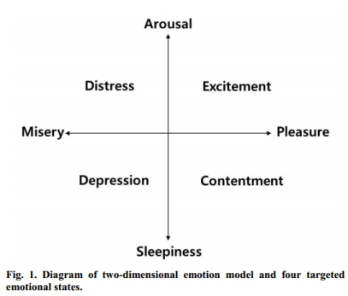
The Dimensional models of emotion attempt to conceptualize human emo- tions by defining the degree of human emotions in two or three dimensions. In recent years, Russell’s early Circumplex model - the Valence-Arousal (VA) two-dimensional emotion model, has been the most widely used nowa- days (Gomez and Danuser, 2004). The two-dimensional circumplex model (Russell, 1980) suggests that emotions are distributed in a two-dimensional circular space, where all emotions can be represented by various degrees of valence and arousal (see Figure 1). The circumplex model is the most com- monly used in testing stimuli related to emotion words, facial expressions, and emotional states. In 2021, Yik and Russell integrated a model of the core dimensions of mood and emotion based on the VA model and developed the
AI-Driven Music Generation and Emotion Conversion 85
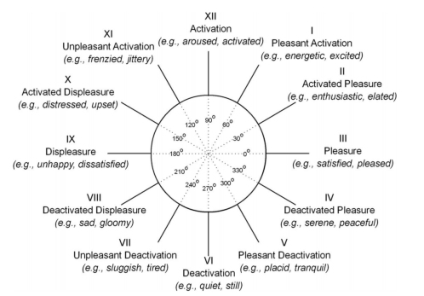
12-Point Affective Cycle (12-PAC) model of core emotions, which provided a clearer description of the core affective structure (Yik et al., 2011) (see Figure 2). In the field of music, Vieillard and others explored the emotional expression of music through similarity ratings, finding that these expressions could be mapped onto a two-dimensional model and well explained by two dimensions (Vieillard et al., 2008). In addition, the PAD three-dimensional model was developed by Albert Mehrabian and James A. Russell based on the two-dimensional emotion model, is one of the widely accepted three- dimensional psychological models for describing and measuring emotional states. As the current VA model aligns more with people’s basic cognition of the objective world in real life and the emotion prompts in the VA two- dimensional model are more compatible with music’s emotional expression, this research is based on the VA model for the analysis and exploration of AI music.
Figure 1: The Valence-Arousal (VA) two-dimensional emotion model (adapted from Russell, 1980).Figure 2: The 12-point affective cycle (12-PAC) model (adapted from Yik, 2011).
The research mentioned above indicates that music can be associated with and elicit emotional responses. AI music generation technology, as an
important branch of AIGC, its technology for speech synthesis and music cloning has been relatively mature, and the generated music presents effects and expressiveness that are extremely close to real music. With advances in artificial intelligence and machine learning, creating more emotional AI music will be a trend. To explore the emotional conveyance capacity of AI music generation, this paper will delve into the emotional aspects of AI music generation. Based on the Dimensional emotion model and experimen- tal methods, the research will leverage three types of AI music generation software (Google MusicLM, Stable Audio, MusicGen) to investigate the emo- tion conveyance and empathetic effect of text-to-music and music-to-music in AI music generation.
EXPERIMENTAL METHODS AND PROCEDURES Creators and Subjects
Twenty-six college students volunteered to participate in this experiment, including 6 females and 20 males (23.29±3.08). Four students were ran- domly selected as creators (two males and two females) in the experiment, with the remaining 22 students as subjects. All participants were not profes- sionally trained in music appreciation but possessed some aesthetic qualities.
Experimental Materials In this study, the Dimensional emotion model was chosen to explore the emotional delivery of AI music. Based on the 12-Point Affective Cycle (12- PAC) model, we categorized the four quadrants based on potency and arousal dimensions into three core emotion prompts according to different perspec- tives (see Table 2). Since the experimenters and participants were all Chinese graduate students, to consider the differences in cultural backgrounds, we conducted short interviews with all creators and subjects before the experi- ment to determine which emotion prompts elicited more intense emotional states. After interviews, the emotion prompts in the 12-PAC model with the angles of “60
, 150
, 240
, and 330
” were finally selected for further explo- ration, i.e., the four core emotion prompts of Energetic, Distressed, Sluggish, and Peaceful were used.
The creators chose the four core emotion prompts of Energetic (high valence-high arousal), Distressed (low valence-high arousal), Sluggish (low valence-low arousal), and Peaceful (high valence-low arousal) as the only emotion words in the prompts during the creation process and repeated them in the prompts to increase the weight of this keyword. The lexical category of the emotion prompts can be changed (e.g. energetic can be changed to energy). All creators were asked to limit their prompts to 20 words or less, with no adjectives other than the pre-defined emotion words. 15 prompts were generated by each emotion word, making a total of 60 prompts. For example: An energetic puppy running on the beach, the puppy is full of energy.
AI-Driven Music Generation and Emotion Conversion 87
Table 2. A collection of emotion prompts from three equal angles.
Due to the inconsistent duration among the three-generation software, we decided to splice or edit to standardize the audio length to 40s. Since Stable audio misinterpreted the prompts containing Distressed and output noise- dominant audio several times, we finally disregarded the effect of the music generation at low efficiency and high arousal in this software. In the form of text to music, 5 segments of corresponding AI music clips were generated by Google musicLM, Stable audio, and MusicGen, respectively, with a total of 55 segments of music. In addition, based on the generated audio, we ran- domly selected 10 pieces of each emotion type, making a total of 40 audios for secondary music creation. Since the MusicGen is the only software with the music-to-music function, we only use MusicGen to generate 10 segments of each of the corresponding emotion prompts, with a total of 40 audios, respectively. We chose 2–3 audios in each emotion category totaling 10 songs as pre-experimental material, and the remaining 85 pieces of music were used as formal experimental material (see Table 3).
Table 3. Statistics of experimental audio materials.
Table available in the original PDF paper.
Forms Text-to-Music Music-to Music Total MusicGen MusicGen Software Google musicLM
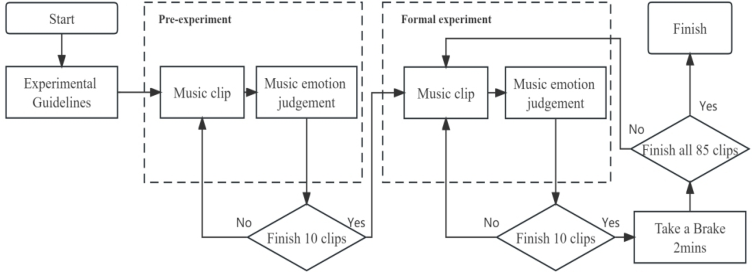
Experimental Procedure With the guidance of the four emotion types, the creators encoded their inten- tions and emotions into prompts and used AI music generation tools (Google musicLM, Stable audio, and MusicGen) to convey audio in both text-to- music and music-to-music forms. Finally, the subjects perceived their own emotions while listening (see Figure 3).
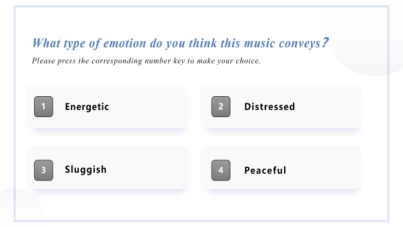
In the test, 85 mixed-emotion audios were played randomly and individ- ually. The screen interface appears as a black circle to improve the subjects’ experimental concentration. After completing the playing, the system will shift to the question interface automatically, and the subjects will use the dig- ital keys 1–4 to make judgments about the emotion choices of the current audio (see Figure 4). The pre-experiment had the same process as the formal experiment to ensure the subjects’ familiarity with and comprehension of the requirements and tempo of the test task. After listening, the audio will be evaluated by the subject at his/her speed and pace and there is no time limit. After evaluating the current audio, the program will present the next audio automatically. After evaluating every ten audios, subjects must take a two- minute break to avoid cognitive fatigue. At the end of all experiments, the subject will receive a small gift.
Figure 3: Experimental procedure.Figure 4: Interface of judgments about emotion choices.
The E-prime 3.0 program records subjects’ choices of emotions auto- matically. By matching the emotion types judged by the subjects with the corresponding emotion prompts, successful matching is recorded as correct and failed matching is recorded as incorrect. The rate of emotion matching accuracy was obtained by analyzing the number of correct ones for all sub- jects in each generation form, generation software, and emotion prompts, thereby showing the effect of emotion transmission.
AI-Driven Music Generation and Emotion Conversion 89
STATISTICS ANALYSIS We summarized the emotion judgments into IBM SPSS Statistics 26 soft- ware to analyze the data. Kolmogorov-Smirnov (Kolmogorov-Smirnov, K-S) test and Q-Q plots were used to check the normality of the data distri- bution. Emotion judgment data were analyzed using a multi-way ANOVA method, which included generation forms (text-to-music & music-to-music), generation software (Google musicLM, Stable audio, MusicGen), and emo- tion prompts (Energetic, Distressed, Sluggish, Peaceful) and their interaction, using a two-side alpha level of 0.05 to determine statistical significance. Post- hoc tests were used when differences between independent variables were statistically significant. Since Stable audio could not regress the emotion prompt of Distressed, the interaction effects of generative model with gener- ation forms and emotion prompts were not considered. Bonferroni method was used for a paried comparison of significant effects.
RESULT
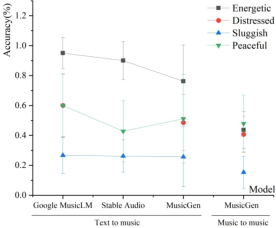
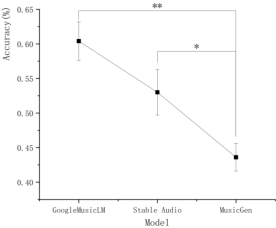
Figure 5: Descriptive statistics. Shows indicators of subjects’ accuracy in judging the emotion of AI music under each music generation method and generation software. Since MusicGen software is the only software with Music to music function, so we show the data for only one software. Depressed was not considered for stable audio software.Figure 6: The AI-music-generated software has a significant main effect on the accuracy of conversion.
Energetic has a far higher accuracy than the other emotion prompts, with Google musicLM having the highest accuracy for this emotion prompt (0.95 ± 0.103), followed by Stable audio (0.90 ± 0.127). The accu- racy of MusicGen in the form of text-to-music (0.762±0.242) was slightly higher than that in music-to-music (0.437±0.122), but the accuracy for this prompt in both forms was much lower than that of the other two types of software. Google musicLM was similar for Distressed (0.60±0.207) and Peaceful (0.60±0.213). MusicGen’s accuracy under text-to-music regard- ing Distressed (0.486±0.188) was similar to Peaceful (0.511±0.296), but the accuracy of Distressed (0.407±0.122) under music-to-music was lower than that of Peaceful (0.478±0.189). The processing of Stable audio (0.262±0.107) was the lowest for this word. Sluggish was significantly less accurate than the other emotion prompts, and the accuracy of this prompt under music-to-music(0.153±0.106) was significantly lower than that in text-to-music(0.261±0.120) (see Figure 5).
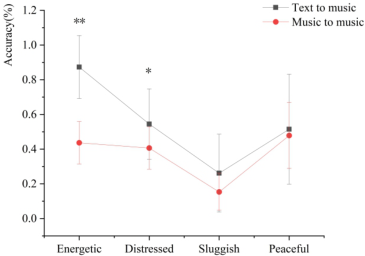
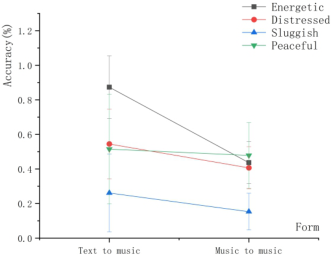
Figure 7: A Interaction effects between emotion prompts and generation forms.Figure 7: B Interaction effects between generation forms and emotion prompts.
The results of the analysis of variance (ANOVA) showed that the main effect of the factor “generating software” was significant (F = 12.579, P = 0.000, η2=0.109). The difference between Google musicLM and MusicGen (0.436±0.020) was statistically highly significant (P<0.001), and
AI-Driven Music Generation and Emotion Conversion 91
the difference between Stable audio and MusicGen was statistically signifi- cant (P<0.05). Google musicLM (0.604±0.028) generated significantly more than the other software generators, which was followed by Stable audio (0.530±0.033), and MusicGen (0.436±0.020) had the lowest generation effect(see Figure 6).
The interaction effect between emotion prompts and forms was signifi- cant (F = 2.666, P<0.05). The analysis of the simple effect of forms showed that the difference between the two generation forms was highly significant in the Energetic case (F = 45.366, P<0.001) and the effect of text-to-music (0.873±0.181) was significantly better than music to music (0.437±0.122). In the Distressed case, the difference in generation forms was significant (F = 3.950, P<0.05) and the effect of text-to-music(0.544±0.203) was bet- ter than music-to-music (0.407±0.122). As for Sluggish and Peaceful, all forms were not statistically significant (p>0.05), but the effect of text-to- music (0.545±0.203) was significantly better than that of music-to-music (0.407±0.122). The generative effect of Sluggish was the worst, and the gen- erative effect of text-to-music (0.262±0.224) was slightly better than that of music-to-music (0.153±0.105), but still significantly lower than the genera- tive effect of the other emotion prompts. The generative effect of Peaceful in text-to-music (0.515±0.307) was slightly better than that of music-to-music (0.479±0.189) (see Figure 7A).
The analysis of the simple effect of emotion prompts showed that the dif- ferences among emotion prompts were highly significant for text-to-music (F = 59.137, P< 0.001) and music-to-music (F = 6.960. P<0.001). The results of pairwise comparisons in the text-to-music showed that the differ- ences between all emotion prompts were highly significant (P<0.001), except the differences between Distressed and Peaceful, which were not significant (P>0.05). Furthermore, the conveyance ability of Energetic (0.873±0.181) was extremely high, and the conveyance ability of Distressed (0.544±0.202) and Peaceful (0.515±0.307) was close to and higher than 50%, respectively. Compared Energetic (0.437±0.122) and Distressed (0.407±0.122) with Sluggish (0.153±0.105) respectively, the differences of both were significant (P<0.05) (see Figure 8).
DISCUSSION
This study investigates the ability of AI music generation to convey semantic emotions provided by the creators. In this study, 22 participants judged the emotion of AI music regarding four categories of emotional words, Energetic, Distressed, Sluggish, and Peaceful. The experiment verified that AI music has the ability to convey emotions. In the next step, we evaluated the accuracy of emotion judgment comprehensively, to compare the generation forms (text- to-music & music-to-music), generation software (Google musicLM, Stable audio, and MusicGen), and emotion prompts (Energetic, Distressed, Sluggish, Peaceful) for emotion conveyance effects.
Compared to the input of music, the input of text provides a better ability for emotion conveyance. In text-to-music, AI music has an extremely high ability in conveying emotion prompts with high valence and high arousal, an
average and similar ability in conveying high valence low arousal and high arousal low valence emotion prompts, and the weakest ability in transferring low valence low arousal emotion prompts. In music-to-music, the ability to convey high valence or high arousal mood types was weak.
The conveying ability of the three generative software is different and sig- nificantly differentiated, with Google musicLM having a great advantage in AI music generation, and we believe that possibly due to the diversity of input sources, the database training set leads to a weaker emotion conveyance in MusicGen.
In conclusion, AI music generation provides a more accurate conveyance of high arousal emotions (positive), but its ability to convey low arousal emotions (negative) needs to be improved. AI music is more specialized in processing text prompts than music prompts.
This study has limitations, and we plan to address these shortcomings in future research. The subjects were not surveyed using subjective ques- tionnaires in this study, and the analysis of factors influencing emotions was solely based on the results of emotion judgments. In subsequent inves- tigations, we aim to mitigate these limitations by incorporating subjective questionnaires to gather more comprehensive insights into the emotional responses of participants. Additionally, future studies will involve the selec- tion of subjects from diverse age groups and academic backgrounds to further explore variations in the perception of AI music among individuals with different ages and disciplinary expertise.
ACKNOWLEDGMENT
Gratitude for the contributions of all the authors and the valuable insights from the reviewers.
REFERENCES
Dash, A., Agres, K. R., 2023. AI-Based Affective Music Generation Systems: A Review of Methods, and Challenges. https://doi.org/10.48550/ARXIV.2301. 06890 Eerola, T., Vuoskoski, J. K., 2011. A comparison of the discrete and dimensional
models of emotion in music. Psychology of Music 39, 18–49. https://doi.org/10. 1177/0305735610362821 Ekman, P., 1992. Are There Basic Emotions. Psychol. Rev. 99, 550–553. https://doi.
org/10.1037/0033-295X.99.3.550 Gomez, P., Danuser, B., 2004. Affective and physiological responses to environmental noises and music. Int J Psychophysiol 53, 91–103. https://doi.org/10.1016/j.ijpsyc ho.2004.02.002 Kreutz, G., Ott, U., Teichmann, D., Osawa, P., Vaitl, D., 2008. Using music to induce
emotions: Influences of musical preference and absorption. Psychology of Music 36, 101–126. https://doi.org/10.1177/0305735607082623 Laurier, C., Herrera, P., Fabra, U. P., n.d. Automatic Detection of Emotion in Music: Interaction with Emotionally Sensitive Machines. Rubin, D. C., Talarico, J. M., 2009. A comparison of dimensional models of emo-
tion: Evidence from emotions, prototypical events, autobiographical memories, and words. Memory 17, 802–808. https://doi.org/10.1080/09658210903130764
AI-Driven Music Generation and Emotion Conversion 93
Russell, J. A., 1980. A circumplex model of affect. Journal of Personality and Social Psychology 39, 1161–1178. https://doi.org/10.1037/h0077714 Vieillard, S., Peretz, I., Gosselin, N., Khalfa, S., Gagnon, L., Bouchard, B., 2008.
Happy, sad, scary and peaceful musical excerpts for research on emotions. Cog- nition and Emotion 22, 720–752. https://doi.org/10.1080/02699930701503567 Wu, J., Gan, W., Chen, Z., Wan, S., Lin, H., 2023. AI-Generated Content (AIGC): A Survey. Yik, M., Russell, J. A., Steiger, J. H., 2011. A 12-point circumplex structure of core
affect. Emotion 11, 705–731. https://doi.org/10.1037/a0023980 Zentner, M., Grandjean, D., Scherer, K. R., 2008. Emotions evoked by the sound of music: Characterization, classification, and measurement. Emotion 8, 494–521. https://doi.org/10.1037/1528-3542.8.4.494 Xiao P, 2022. Embodiment, Imagination and Empathy: A Technophenomenological
Study of Artificial Intelligence for Music Generation and Distribution. Modern Communication (Journal of Communication University of China) 44, 155–161. https://doi.org/10.19997/j.cnki.xdcb.2022.09.002
LISTED IN THE AHFE DIGITAL BOOKSTORE CATALOGUE
Explore the complete digital volume
Affective and Pleasurable Design
Read this individual research paper free through the original publisher, or explore the full digital proceedings book.
ISBN 978-1-958651-99-5
Explore this ISBN in the AHFE Bookstore ↗Listed in the July 2026 bookstore catalogue; search by ISBN to confirm current availability · Digital book purchase optional