Yidan Qiao, Deng Kai Chen, Wenyi Liao, Lin Ma, Haotian Li (2024). Dynamic Assessment Method for Group Decision-making Errors in Extreme Work Environment Driven by Team Cognitive Model. In: Human Error, Reliability, Resilience, and Performance. AHFE Open Access, vol. 132, pp. 51–60. https://doi.org/10.54941/ahfe1004880
Due to the task demands, team operating in extreme environments is socially isolated, subject to prolonged physical constraints, and exposed to significant risks. The cognitive functional structure of team was focused, and the submarine team was regarded as a social interaction unit. The cluster of Performance Shaping Factors (PSFs) was reconstructed, incorporating the Team-PSFs groups. In terms of member variability, the three-parameter Weibull distribution function was used to construct the human time performance distribution function. The quantitative models of different team cognitive failure modes were constructed that consider the communication information elements within the team, including individual independent transmission, communication shared transmission, and information transmission. The proposed methodology was validated through simulation in a typical task of manned submarine unpowered diving.
Advanced intelligent information technology has been developed and intro- duced into complex operating systems (Coyne, 2009). The vast amount of information clusters has increased the complexity of human cognition, mak- ing human errors more significant than ever before (Ilgen et al., 2005; Patrick et al., 2006). For groups operating in extreme environments, isolated from society, physically confined for extended periods of time, and exposed to sig- nificant hazardous environments due to mission demands (Vessey & Landon, 2017), they are organizations with high reliability requirements in complex systems. This study focuses on the group cognitive structure, which is the core that drives group reliability assessment. Shu et al. (2002) proposed a Team Behavior Network (TBN) model, which modeled the group cognitive processes such as information acquisition, situation awareness, decision- making, and action execution, and simulated and analyzed team responses to events under dynamic and context-sensitive conditions. Ekanem et al. (2016)
applied the Phoenix modeling method, using a team-centered cognitive model version of the information, decision, and action and a “macro-cognitive” abstraction of crew behavior to identify potential causes and influencing factors of failures in process-driven and knowledge-supported crew-factory interaction.
The state of communication between members within a team is ambigu- ous and dynamic. Researching comprehensive communication modes and their quantification methods in complex cooperative situations is key to analyzing the mapping mechanism between group cognition and team per- formance. Lee et al. (Lee et al., 2011) proposed a qualitative and quantitative method for analyzing communication errors, listing communication errors, error patterns, and types related to timing, channels, content, and sequences. Kottmann et al. (Kottmann et al., 2023) constructed a group operation situation under system and time-critical conditions, used the frequency of communication transmission as a benchmark for evaluating team perfor- mance, and constructed a Monte Carlo discrete event simulation model of human error. Petkov et al. (Petkov et al., 2004) proposed the Capability Evaluation Tool (PET) method for evaluating team cooperation performance, constructed a group communication model, analyzed the types of team errors.
This study attempts to address the problem of dynamic risk quantification analysis of decision-making errors by extreme groups in complex cooperative situations. The focus is on group cognitive processes, analyzing typical pat- terns of team communication and performance quantification mechanisms based on IDA. The characteristics of cognitive behaviors and performance of operators within the group under time variation are modeled to drive the cognitive transmission paths of group decision-making in hybrid event tree.
TEAM TASK OF THE SUBMARINE CREW The operational cabin of the manned submersible is a typical extreme envi- ronment characterized by long endurance, constraints, and narrowness. The extreme operational group consisting of three oceanauts forms needs to complete complex deep-sea research tasks in a complex, dynamic, and ambiguous context. The master navigator, executor, and technical advisor in the crew correspond to the three role characteristics of Decision Maker (ODM), Action Taker (OAT), and Consultant (OCT) respectively. The ODM is the leader of the crew, responsible for making decisions on critical tasks, executing important task procedures, supervising the OAT to perform them correctly, and consulting OCT for professional advice. The OAT is a profes- sional technician, responsible for receiving and executing orders from ODM. The OCT is an operator with expertise in the operating system, responsi- ble for providing knowledge and suggestions to ODM. For extreme teams, when the team is in a complex collaborative scenarios, operators of the team exhibit differences in cognitive performance.
During the entire manned submersible diving task, the three oceanauts remain in the operational cabin with a diameter of 2 meters, maintain- ing a fixed relative position. In this paper, the unpowered diving rejection
Dynamic Assessment Method for Group Decision-Making Errors 53
response test task is used as the validation objective of this study, and the main sequence in this task includes:
Make the submersible dive without power to a safe position off the seafloor and discard the dive ballast.
Record the attitude and time of the submersible during the diving.
Record the time, depth and attitude at which the submersible continues to dive due to inertia to a drifting state after the submerged ballast is rejected.
Adjust the attitude and equilibrium of the submersible after ballast rejection by longitudinal inclination adjustment or adjustable ballast.
In order to simulate the emergency response capability and error recovery of oceanauts, this case study added a tilt failure event during the diving as an emergency sequence.
Submersible tilt failure: adjust the attitude and equalization of the sub- mersible by tilt adjustment or ballast adjustment.
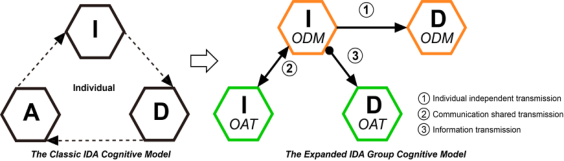
MODELING METHOD OF TEAM COGNITIVE BEHAVIOR The IDA model divides the cognitive activities of operators into three stages: Information Perception (IP), Problem Solving and Decision Making (PS/DM), and Action Execution (AE). This study focuses on the group cognitive func- tional structure (Hoegl & Gemuenden, 2001), and the proposed group behavior model is an update and extension of the individual operator model, IDA. In this study, the group structure is viewed as a social interaction unit. and the cognitive transmission paths within the social interaction unit are categorized into three types: individual independent transmission (IIT), com- munication shared transmission (CST), and information transmission (IT). The details are shown in Figure 1.
Figure 1: Expanded IDA group cognitive model.
The individual independent transmission (IIT) mode indicates that the path is independent within the same operator and is an one-way trans- mission. The quality of this path depends on the work performance level of operators.
The communication shared transmission (CST) mode indicates that the path is shared between two or more operators and is an interactive trans- mission. The quality of this path is determined by the state and relationship between operators and the work performance level of their own.
The information transmission (IT) mode indicates the handover of tasks between two operators, where the operator who executed the previous cognitive task transmissions information to the operator who executes the next task. This path is typically an interactive transmission. The quality of this path depends mainly on the quality of the information transmitted and the work performance level of the executing operator.
The main core of quantifying human error using the HRA method involves identifying internal and external factors that influence cognitive behavior, known as performance shaping factors (PSFs). The human error probability (HEP) is usually obtained based on the cumulative calculation of the PSFs multipliers. The multiplier value of each PSF represents its contribution to human error and risk. Based on the task scenarios of oceanauts and referring to numerous research studies on PSFs (Ham et al., 2021; Patrick et al., 2006), this study identified a directory of key factors that affect cognitive behavior performance, as shown in Table 1.
Table 1. PSF system.
Table available in the original PDF paper.
Category Situational Element Psychology Element Stress PSFs Experience and training Complexity Ergonomics Time constraint load
Procedure usability and quality
Information display usability and quality
To investigate the contribution of team tasks to system risk in com- plex collaborative scenarios, it is necessary to introduce a new Team-PSF framework that reflects team perspectives and incorporates information on interaction behaviors among members. In this study, the Team-PSF spectrum was constructed from four families: knowledge, power, responsibility, and communication quality, as shown in Table 2, which influence the cognitive mechanisms of group decision-making. The multiplier in Team-PSF repre- sents the extent to which team factors contribute to errors in the group decision-making process. This study suggests that Team-PSF with different family attributes has differential effects on group performance during the cognitive functional stages.
The Team-PSF family associated with knowledge primarily affects team performance in two cognitive stages: information perception, and problem-solving and decision-making.
The Team-PSF family associated with authority primarily affects team performance in the problem-solving and decision-making cognitive stages.
The Team-PSF family associated with responsibility primarily affects team performance in the cognitive stage of action execution.
The Team-PSF family associated with communication quality affects team performance during the handover of two cognitive tasks. Table 2 Team- PSF system and explanation
Dynamic Assessment Method for Group Decision-Making Errors 55
Table 2. Team-PSF system and explanation.
Table available in the original PDF paper.
Category Team-PSF Description and Guidance Knowledge Integrity of the structure of specialized knowledge Indicates the coverage and depth of knowledge of system and task acquired by team members. It is mainly reflected in the complementary nature of the members. Consistency in the quality of professionalism
Indicates similarities in professionalism, living environment, language, and personal habits among members. Authority Level of leadership Indicates centralized leadership authority. The leader has the final say in decision-making on issues. Decentralization of authority
Indicates the decentralization of the leader’s authority to the members, who can decide and perform some of the delegated tasks autonomously. Responsibility Role awareness Indicates that each operator has a correct perception of his tasks, responsibilities, and authority, and is responsible for assuming his role in the cooperative situation. Confidence Indicates the operator’s reasonable confidence in the perception, decision-making, and execution capabilities of other operators. Communication quality
3-way Indicates the number of communication paths between the two operators when making communications such as inquiries, orders, suggestions, confirmations, etc.
The cognitive behavior state is not only primarily influenced by contex- tual information but also significantly disrupted by temporal factors. The duration of human performance affects operators’ abilities in perception, decision-making, action, and communication. For most operational systems, human errors primarily come from two aspects: tasks and scenarios. The errors based on tasks are deterministically realized due to variations in con- textual environmental information (PSF and Team-PSF) generated by the discrete event tree. Whereas, the errors based on scenarios are randomly determined by the occurrence of emergency events. When a group in such a state suddenly enters an emergency state, transient behaviors occur due to disturbances from various factors. Therefore, in this study, a three-parameter Weibull distribution function is used to describe the human time performance of operators in task and scenarios, as shown in Equation (1).
Equations and mathematical formulas are available in the original paper PDF.
α )β (1)
α )β−1e−( t−µ
α (t −µ
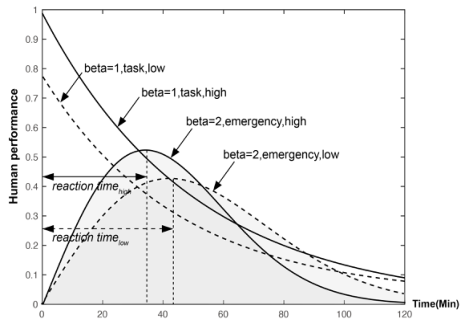
In this study, the shape parameter β of the distribution function of human time performance in error based task was determined to be 1, indicating that human∼performance gradually decreases over time. The shape parameter β of the distribution function of human time performance in error based scenario was determined to be 1.5, indicating that human performance is the lowest at the beginning of time critical conditions, which occurs at transient risk points. As time progresses, human performance gradually rebounded and then declined again. The
Figure 2 shows an example of the distribution function of human time performance. The three parameters of the distribution function are given by experts.
Figure 2: Distribution function figure of human time performance.
The temporal performance characteristics of operators are embedded in the cognitive model and exhibit global properties. The three-parameter Weibull function resembles a time multiplier and is uniformly applied to all cognitive activities including communication, perception, decision-making and action, giving the estimation of human errors a dynamic and nonlinear character.
METHOD FOR QUANTIFYING HUMAN RISK IN GROUP DECISION-MAKING Human Error Probability (HEP) is the main quantitative index for group deci- sion reliability analysis, which represents the probability of cognitive failure mode (CFM) caused by team behavior in complex collaborative scenarios. Each CFM has a specific decision tree that represents the most relevant PSFs or TPSFs. The detailed contextual information is the condition for estimating HEP, mainly representing the contribution of objective contextual environ- ment to human errors, without variability between operators, and it can be calculated through Equation (2).
Dynamic Assessment Method for Group Decision-Making Errors 57
[Equation or mathematical symbol available in the original paper PDF]
[Equation or mathematical symbol available in the original paper PDF]
[Equation or mathematical symbol available in the original paper PDF]
[Equation or mathematical symbol available in the original paper PDF]
!
N X
M X
wqPSFq
wiPSFi
[Equation or mathematical symbol available in the original paper PDF](1 −α)+0.2α
[Equation or mathematical symbol available in the original paper PDF]
[Equation or mathematical symbol available in the original paper PDF]
Where, Pex represents the contribution of the objective contextual envi- ronment to human errors, including three types of independent failure probabilities of cognitive function. The linear weighting coefficients for PSF, wi and wq, are determined through expert evaluation. In this equation, the contents of the two curly brackets represent two levels of influence. The con- tent in the first bracket indicates that PSFi has a significant impact on this type of human error. The content in the second bracket indicates that PSFq has a weaker influence on this type of human error and is used as a compen- satory or adjustment factor. Generally, 0 < a < 1, and in this paper, a is set to 0.5.
There exists intra-team variability distribution for HEP, and individual variability needs to be focused on. In this study, the function σ(t) for human temporal performance is introduced to correct the persistence and decay char- acteristics of different operators on the time scale. Therefore, the HEP of the CFM of IIT can be calculated by Equation (3).
HIIT
I_D_A = Pex × [1−σ(t)] (3) The HEP of the CFM of CST depends on the joint influence of the ability of the member performing the cognitive task and team performance. This study defines that member i makes an erroneous cognitive behavior after communicating with other operator j is modeled by an S-type function:
HCST
i
o (4)
hPJ
1 + exp n
TPSFex
i + fi + Pex (1 −σ(t))
Where, Sj is the state of the jth member, wij is the strength of the jth member’s influence on operator i. fi is the importance of the communicated information. Pex(1−σ v) denotes the probability that operator i makes failure behavior in the absence of group interactions in a particular stage of cognitive function. TPSFex denotes the team PSF mapped to cognitive function.
Similarly, this study defines the probability that member i performs an erroneous cognitive behavior by erroneous information provided by other operator j to be represented by an S-shaped function: HIT
TPSFex
fiφt−1 + Pex (1 −σ(t))
Where, fi is the importance of the communicated information. ϕt-1 is the error probability of operator in the previous cognitive task. TPSFex denotes the quality of the communication.
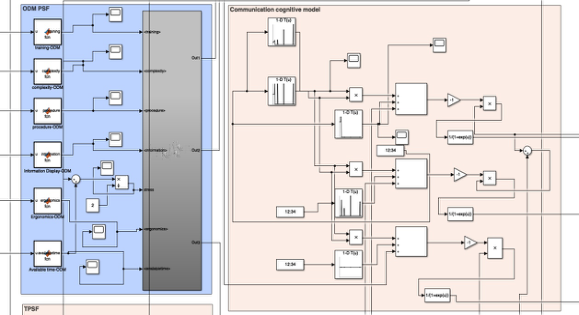
RESULTS AND ANALYSIS The HEP and its extended information for the manned submersible unpow- ered diving task are obtained by Simulink simulation based on the joint
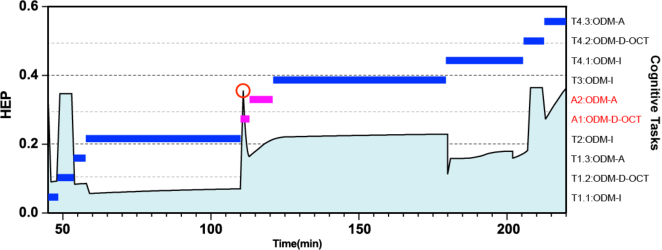
hybrid model of dynamic probabilistic risk assessment (as shown in Figure 3), the contextual information of the task, and characteristics of individual per- formance. The superimposed information of the time schedule and the HEP of the unpowered diving task is shown in Figure 4. According to the simu- lation results, the three transient performances of the HEP during the task are caused by one emergency scenario (t = 110s) and two team behaviors caused by decision-making information of communication shared transmis- sion (t = 48s, t = 207s). Therefore, we can conclude that the emergency decision-making ability of oceanaut and the communication efficiency are the key risk points of the task. The overall upward trend of the overlay information graph for human error can be explained by the gradual incre- mental trend in human performance risk as time advances during the task scenario, which may be caused by individual fatigue and has been confirmed by multiple studies (Chen et al., 2022; Qiao et al., 2024; Zhang et al., 2019).
Figure 3: The partial simulation model.Figure 4: Overlay information of time schedule and HEP for unpowered diving task.
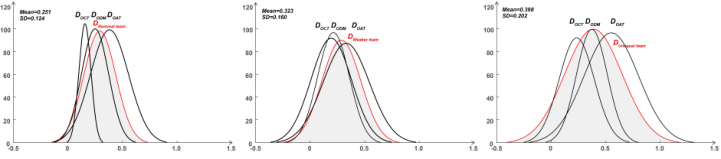
Variability is a significant characteristic of individual performance and can describe rich individual information, including basic level, persistence, and fluctuation. This study defines variability by referring to the individ- ual performance variability Dindividuality within the team as “intra-individual” variation, the performance variability Dteam of overall team as “intra-team”
Dynamic Assessment Method for Group Decision-Making Errors 59
variation. The variability of performance characteristics D is jointly activated by task characteristics, operational context, and individual time performance functions.
This study intends to simulate the performance effects of different team performance models. In this study, three typical team types are extracted, including nominal, weaker, and unequal. The variability of efficiency char- acteristics of three types of teams are shown in Figure 5. As can be observed from the figure, the overall performance of the nominal team is optimal (Mean = 0.251, SD = 0.124), mainly due to the low overall level of team risk and the narrowest range of variability. The overall performance of the weaker team is poor, mainly due to the higher overall level of team risk. The unequal team has the worst overall performance, mainly due to the highest overall level and the widest range of variability. Therefore, we can conclude that the individual performance level of operators is important in the group decision-making process, but the equality of performance levels among oper- ators within the team is also an important part of determining team efficiency. The variability parameter D of team structure can serve as an important reference for measuring team efficiency.
Figure 5: The variability of performance in three types of teams.
CONCLUSION
This study proposed an extended IDA cognitive behavior model that specifi- cally focuses on team cognitive processes. The risk of human error of group decision-making processes driven by different transmission mechanisms of team cognitive behavior was analyzed in detail. The performances of three types of team members, namely nominal, weaker, and unequal, in typical tasks of manned submersible were simulated and computed. The results indi- cate that there are distinct characteristics of cognitive performance among members or teams. The consistency of performance characteristics among members have significant impacts on group decision-making. Additionally, it is concluded that communication and interaction scenarios may be a risk event for group decision-making.
The novelty of this study lies in our attempt to research dynamic analysis techniques on HEP by differentially modeling team roles and investigating the coordination and communication mechanisms of teams in specific scenarios, in order to enhance the dynamic characteristics of group decision-making risk models. This research could analyse a wider range of scenarios and consider more broadly the impact on scenarios that may lead to failures of team mem- bers. Additionally, it should conduct a detailed, traceable, and documented
HRA quantitative analysis simulation procedure. This would contribute to overcoming some of the current challenges in the fields of HRA and DPRA.
ACKNOWLEDGMENT
The authors would like to acknowledge.
REFERENCES
Chen, D. K., Qiao, Y. D., Sun, Y. W., & Gao, X. W. (2022). Human reliability assessment and risk prediction for deep submergence operating system of manned submersible under the influence of cognitive performance. Ocean Engineering, 266, Article 112753. https://doi.org/10.1016/j.oceaneng.2022.112753 Coyne, K. A. (2009). A predictive model of nuclear power plant crew decision-
making and performance in a dynamic simulation environment University of Maryland, College Park. Ekanem, N. J., Mosleh, A., & Shen, S. H. (2016). Phoenix – A model-based Human Reliability Analysis methodology: Qualitative Analysis Procedure. Reliability Engineering & System Safety, 145(JAN.), 301–315. Ham, D.-H., Jung, W.-J., & Park, J. (2021). Identifying key factors affecting the per-
formance of team decision-making based on the analysis of investigation reports issued from diverse industries. Reliability Engineering & System Safety, 206, 107304. https://doi.org/10.1016/j.ress.2020.107304 Hoegl, M., & Gemuenden, H. G. (2001). Teamwork Quality and the Success of Innovative Projects: A Theoretical Concept and Empirical Evidence. Organization Science(4). Ilgen, D. R., Hollenbeck, J. R., Johnson, M., & Jundt, D. (2005). Teams in organiza-
tions: From input-process-output models to IMOI models. Annu. Rev. Psychol., 56, 517–543. Kottmann, F., Kyriakidis, M., Sansavini, G., & Dang, V. (2023). A human operator model for simulation-based resilience assessment of power grid restoration oper- ations. Reliability Engineering & System Safety, 238, 109450. https://doi.org/10. 1016/j.ress.2023.109450 Lee, S. M., Ha, J. S., & Seong, P. H. (2011). CREAM-based communication error
analysis method (CEAM) for nuclear power plant operators’ communication. Journal of Loss Prevention in the Process Industries, 24(1), 90–97. Patrick, J., James, N., Ahmed, A., & Halliday, P. (2006). Observational assessment of situation awareness, team differences and training implications. Ergonomics, 49(4), 393–417. Petkov, G., Todorov, V., Takov, T., Petrov, V., Stoychev, K., Vladimirov, V., &
Chukov, I. (2004). Safety investigation of team performance in accidents. Journal of Hazardous Materials, 111(1/3), 97–104. Qiao, Y., Zhang, X., Wang, H., & Chen, D. (2024). Dynamic assessment method for human factor risk of manned deep submergence operation system based on SPAR-H and SD. Reliability Engineering & System Safety, 243, 109865. https: //doi.org/10.1016/j.ress.2023.109865 Shu, Y., Furuta, K., & Kondo, S. (2002). Team performance modeling for HRA
in dynamic situations. Reliability Engineering & System Safety, 78(2), 111–121. https://doi.org/10.1016/S0951-8320(02)00111-4 Vessey, W. B., & Landon, L. B. (2017). Team Performance in Extreme Environments. The Wiley Blackwell Handbook of the Psychology of Team Working and Collaborative Processes. Zhang, S., He, W., Chen, D., Chu, J., Fan, H., & Duan, X. (2019). Thermal com-
fort analysis based on PMV/PPD in cabins of manned submersibles. Building and Environment, 148, 668–676. https://doi.org/10.1016/j.buildenv.2018.10.033
LISTED IN THE AHFE DIGITAL BOOKSTORE CATALOGUE
Explore the complete digital volume
Human Error, Reliability, Resilience, and Performance
Read this individual research paper free through the original publisher, or explore the full digital proceedings book.
ISBN 978-1-964867-08-3
Explore this ISBN in the AHFE Bookstore ↗Listed in the July 2026 bookstore catalogue; search by ISBN to confirm current availability · Digital book purchase optional